

The best composite pickleball paddles in 2026 are the Onix Z5 (best for power-hungry recreational players), the Selkirk Amped S2 (best premium composite), the Paddletek Phoenix Genesis (best for touch and finesse), the Engage Pursuit MX 6.0 (best for intermediate control), the HEAD Radical Pro (best all-court composite), the Diadem Riptide (best mid-range value), the GAMMA Sports 230 (best budget pick), and the Franklin Sports Pro Pickleball Paddle (best for beginners). Each one earns its place through a combination of fiberglass face durability, polymer core responsiveness, and consistent on-court performance that holds up across skill levels.
When choosing among these options, the three factors that actually move the needle are core type (polymer vs. Nomex), total weight, and grip size. Get those three right and the fiberglass face does the rest — delivering that characteristic blend of power and controlled dwell time that sets composite paddles apart from their graphite and carbon fiber counterparts.
The real question most buyers face is not whether composite is good (it is), but which composite paddle is right for their specific game. A heavy Nomex-core paddle that suits an aggressive baseliner will feel wrong in the hands of a 3.0 player working on kitchen dinks. Understanding that distinction upfront saves money and prevents the common mistake of upgrading to a paddle that actually slows your development.
Below, every paddle on this list gets a full standalone review covering specs, performance, and exactly who it is — and is not — built for.
What Is a Composite Pickleball Paddle?
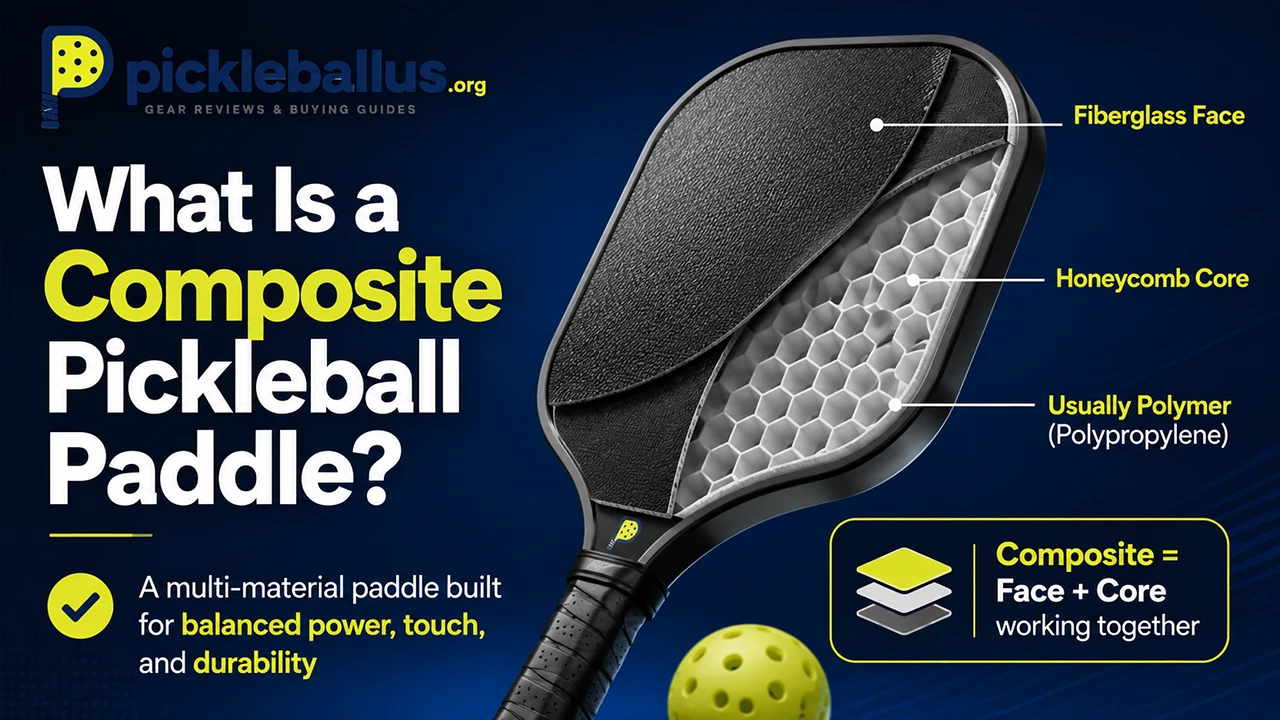
Composite pickleball paddles combine a fiberglass face surface with an internal honeycomb core — most often made from polypropylene (polymer) — to create a paddle that balances power, touch, and durability across a wide range of play styles. Unlike paddles named after a single material (graphite, carbon fiber), the “composite” label signals a multi-material construction where the face and core each contribute distinct performance properties.
The term sometimes confuses new players because it sounds like a specific material when it is, in fact, a design category. What defines composite paddles is not one ingredient but the way two or more materials are engineered together to complement each other’s strengths.
How the Fiberglass Face and Polymer Core Work Together
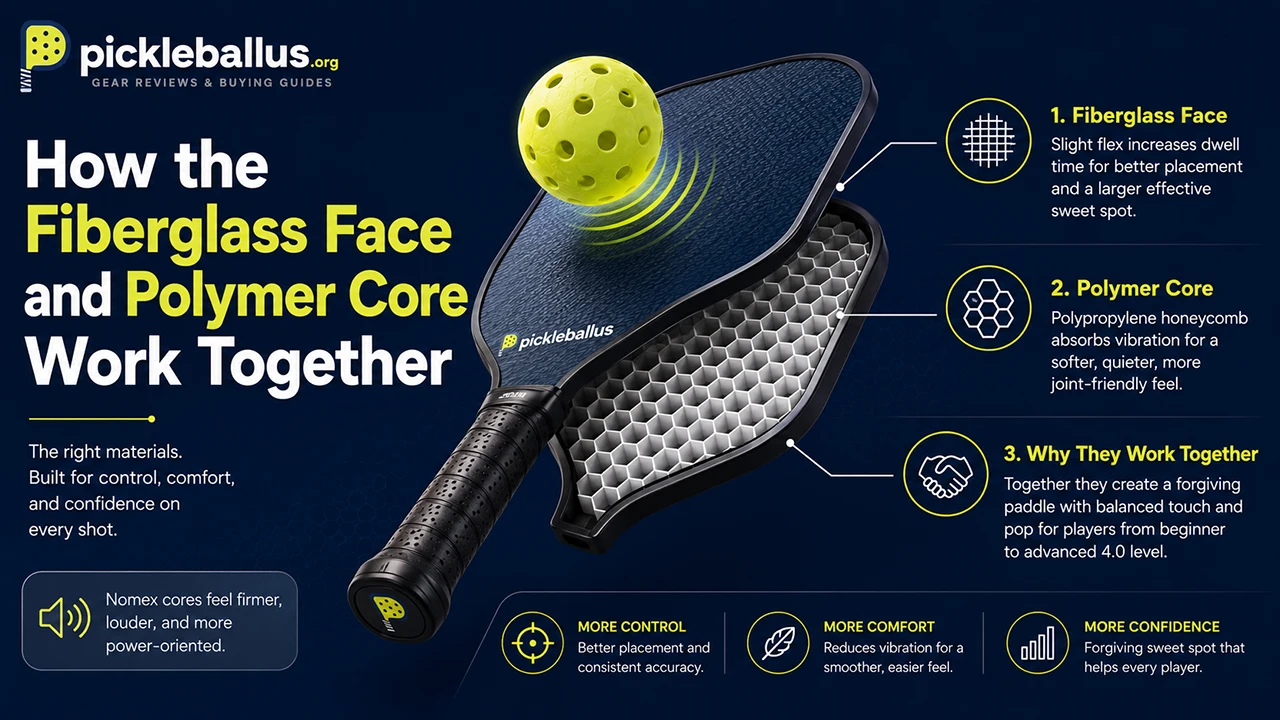
The fiberglass face is the defining feature of a composite paddle. Thin, woven strands of glass are bonded with resin to form a surface that is slightly flexible on impact — different from the rigid snap of a graphite or carbon fiber face. That flex creates a brief moment of “dwell time,” meaning the ball stays in contact with the paddle surface a fraction longer before leaving. The result is more placement accuracy on dinks and drops, and a larger effective sweet spot compared to stiffer alternatives.
Beneath the face, the polymer honeycomb core absorbs vibration and delivers a softer overall feel. Polypropylene is the most common core material in modern composite paddles because it is quieter, joint-friendly, and provides a balanced blend of touch and pop. Some older or more power-oriented composite paddles use a Nomex core instead — a rigid material that produces a louder, firmer hit and transfers more energy to the ball on fast exchanges.
Together, the fiberglass face and polymer core create a paddle with forgiving response across the full paddle face, which is why composite paddles consistently appear in recommendations for players from beginner through advanced 4.0 level.
Composite Paddles vs. Other Surface Materials
Understanding where composite sits in the broader material landscape helps you decide whether this is the right category to shop in or whether a different surface would serve you better.
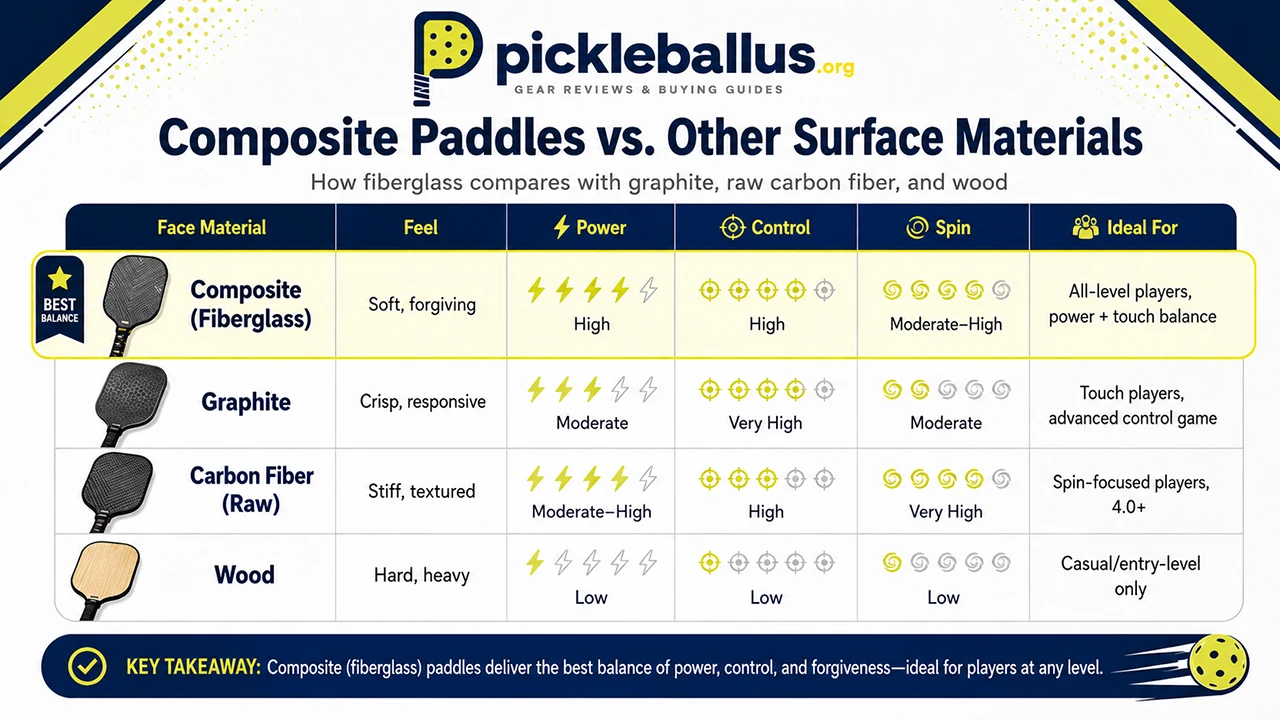
The table below summarizes the key differences across the four main paddle face materials:
| Face Material | Feel | Power | Control | Spin | Ideal For |
|---|---|---|---|---|---|
| Composite (Fiberglass) | Soft, forgiving | High | High | Moderate–High | All-level players, power + touch balance |
| Graphite | Crisp, responsive | Moderate | Very High | Moderate | Touch players, advanced control game |
| Carbon Fiber (Raw) | Stiff, textured | Moderate–High | High | Very High | Spin-focused players, 4.0+ |
| Wood | Hard, heavy | Low | Low | Low | Casual/entry-level only |
For players who want best fiberglass pickleball paddles in the traditional sense, composite is the primary category to explore. For a deeper side-by-side breakdown of composite versus graphite performance, see the graphite vs composite pickleball paddles guide.
8 Best Composite Pickleball Paddles in 2026
The eight paddles below were selected based on Amazon availability, customer review volume, and verified performance characteristics across their respective categories. Every paddle in this list receives a complete standalone review — no shortcuts, no grouped summaries.
Here is a quick reference comparison before diving into the full reviews:
| Paddle | Core | Weight Range | Best For |
|---|---|---|---|
| Onix Z5 | Nomex Honeycomb | 7.5–8.2 oz | Power, widebody shape |
| Selkirk Amped S2 | X5 Polymer | 7.6–8.4 oz | Premium all-court control |
| Paddletek Phoenix Genesis | ProPolyCore | 7.4–8.2 oz | Touch, finesse, dink game |
| Engage Pursuit MX 6.0 | Polymer 16mm | 7.9–8.5 oz | Intermediate control players |
| HEAD Radical Pro | Polymer Honeycomb | 7.8–8.4 oz | Balanced all-court play |
| Diadem Riptide | Polymer 16mm | 7.5–8.2 oz | Mid-range value seekers |
| GAMMA Sports 230 | Sensa Poly Core | 7.2–8.0 oz | Budget-conscious players |
| Franklin Sports Pro | Polymer Honeycomb | 7.2–8.0 oz | True beginners |
#1 Onix Z5 — Best for Power-Hungry Recreational Players
The Onix Z5 is one of the most recognizable composite paddles in the game, and for good reason: it has been consistently bestselling on Amazon for years and remains a benchmark in the widebody composite paddle category. If you want to hit harder with less effort, the Z5 delivers that more reliably than nearly anything else in its price tier.
Key Specs:
- Face: Composite (fiberglass/graphite blend)
- Core: Nomex honeycomb
- Weight: 7.5–8.2 oz
- Shape: Widebody
- Grip length: 5.25″
Performance Analysis
The Nomex core is where the Z5’s personality comes from. Nomex is a firmer, denser material than polymer, so the paddle produces a noticeably louder, crisper hit with faster ball departure off the face. For recreational players who enjoy an aggressive baseline game or who want to hit through the kitchen with authority, this translates directly to easier power generation. The widebody shape also extends the sweet spot horizontally, making mishits more forgiving — a feature that significantly benefits players in the 2.5 to 3.5 skill range.
The trade-off is at the net. The Nomex core’s stiffness means less dwell time, so precise dink placement requires a more deliberate soft touch than you need with a polymer-core paddle. Players who prioritize a finesse-first game will find the Z5 too firm at close range.
Pros
- Excellent power output for its weight class
- Widebody shape maximizes forgiving contact area
- Proven durability — fiberglass face holds up to extended play
- Strong value for the performance level offered
Cons
- Nomex core is louder (a factor on noise-restricted courts)
- Less touch/dwell time than polymer-core alternatives
- Heavier end of the composite spectrum
Best For: Recreational and club players (2.5–3.5 DUPR/skill level) who play an aggressive baseline or midcourt game and want easier power without sacrificing too much control.
My Verdict: The Z5 is the starting reference point for composite paddles because it does exactly what the category promises — accessible power through a proven fiberglass-face construction. It is not the most nuanced paddle on this list, but it may be the most dependable.
#2 Selkirk Amped S2 — Best Premium Composite Paddle
Selkirk’s Amped S2 represents what composite paddles look like when the engineering goes up a level. It uses Selkirk’s proprietary FiberFlex fiberglass face paired with their X5 polypropylene honeycomb core — a combination that produces a noticeably softer, more controlled response compared to traditional composite paddles at a lower price point.
Key Specs:
- Face: FiberFlex fiberglass (composite)
- Core: X5 polymer honeycomb
- Weight: 7.6–8.4 oz
- Shape: Standard (widebody option available)
- Grip: 4.25″ or 4.5″ circumference
Performance Analysis
The FiberFlex face gives the Amped S2 a longer dwell time than most fiberglass paddles — the ball feels like it sits on the face for a split second more, giving you a tangible sense of steering the ball rather than reacting to it. Combined with the X5 core’s vibration dampening, this paddle is unusually comfortable over long sessions, which matters as match lengths increase with skill.
At the kitchen line, the Amped S2 excels on reset volleys and third-shot drops. The soft response makes it easier to absorb pace and redirect softly rather than dumping the ball into the net. Power is still accessible on overheads and drives, but this paddle rewards patience over aggression.
Pros
- FiberFlex face delivers superior dwell time vs. standard fiberglass
- X5 core provides excellent vibration absorption
- Grip size options accommodate more hand sizes
- Strong tournament-level build quality
Cons
- Premium price tier
- Less raw power output compared to Nomex-core options
- May feel too soft for players accustomed to a harder, crisper paddle
Best For: Intermediate to advanced players (3.5–4.5) who want a premium composite experience and prioritize kitchen game, reset shots, and consistent all-court control.
My Verdict: The Selkirk Amped S2 is the composite paddle to buy when you are ready to invest in a paddle that grows with your game. The FiberFlex face technology genuinely separates it from budget-tier fiberglass options.
#3 Paddletek Phoenix Genesis — Best for Touch and Finesse
The Paddletek Phoenix Genesis has earned a loyal following among players who describe their game as “feel-first.” Built around Paddletek’s ProPolyCore polymer honeycomb, this paddle is oriented toward soft-game dominance — dinks, drops, resets — while still generating meaningful pop when the opportunity arises.
Key Specs:
- Face: Composite (fiberglass)
- Core: ProPolyCore polymer honeycomb
- Weight: 7.4–8.2 oz
- Shape: Standard
- Grip length: 5″
Performance Analysis
The Phoenix Genesis is quieter and more “muted” in feel than Nomex-core alternatives. The ProPolyCore technology specifically targets vibration dampening and shock absorption, which has two practical effects: it reduces arm fatigue over long sessions, and it gives the ball a softer, more predictable landing on touch shots.
At the net, this paddle is exceptional. Dinks feel controlled and consistent, and the paddle absorbs hard-driven balls without fighting back — a quality that improves your ability to reset and neutralize aggressive opponents. The fiberglass face provides enough texture to generate spin on serve and third-shot drops without demanding the premium price of raw carbon fiber.
Where the Genesis asks for patience is on power shots. Drives require a deliberate, full swing to generate pace, which can feel sluggish against fast-handed opponents who pressure you at the transition zone.
Pros
- Outstanding touch and feel at the kitchen line
- ProPolyCore significantly reduces vibration and arm fatigue
- Reliable, consistent fiberglass face with good spin texture
- Strong sweet spot for a standard-shape paddle
Cons
- Less explosive power generation than Nomex-core options
- Heavier end of its weight range can feel slow on quick exchanges
- May require adjustment period for players switching from stiffer paddles
Best For: 3.0–4.0 players who prioritize soft game, consistent dinks, and arm comfort over extended matches. Also a strong recommendation for players managing arm or elbow sensitivity.
My Verdict: If your coach keeps telling you to slow down and play more dinks, the Phoenix Genesis is the paddle that makes that advice easier to follow. It rewards patience and precision in a way that power-oriented composite paddles cannot match.
#4 Engage Pursuit MX 6.0 — Best for Intermediate Control
The Engage Pursuit MX 6.0 brings a 16mm thick polymer core into the composite category, and that extra thickness makes a real difference. More core depth means more cushioning between face and core, which produces a longer dwell time and a softer overall contact — characteristics that intermediate players trying to refine their control game will immediately notice.
Key Specs:
- Face: Composite (fiberglass)
- Core: Polymer honeycomb, 16mm
- Weight: 7.9–8.5 oz
- Shape: Elongated standard
- Grip: 5.25″ handle
Performance Analysis
The Pursuit MX 6.0 sits at the intersection of the best pickleball paddles for all-around control and the best composite paddles for intermediate players. The 16mm core thickness is the standout feature — thicker than the typical 13mm found on entry to mid-range paddles, it produces a noticeably controlled response on ball contact. Fast balls slow down when they hit this face; you feel like you are catching and placing rather than deflecting and hoping.
The elongated shape shifts weight toward the top of the paddle, providing additional leverage on drives and serves while keeping the sweet spot well-centered for volleys. The fiberglass face adds enough surface texture to generate consistent spin without requiring a complex swing technique.
Pros
- 16mm core delivers exceptional dwell time and control
- Elongated shape adds leverage without sacrificing volley feel
- Excellent vibration management for a mid-price paddle
- Durable fiberglass face holds up through heavy use
Cons
- Heavier weight range (7.9–8.5 oz) may fatigue lighter players
- Power generation requires more intentional swing mechanics
- Elongated shape has a smaller sweet spot than widebody alternatives
Best For: Intermediate players (3.0–4.0) who are actively working on control, placement, and kitchen-line consistency and want a paddle that rewards developing technique.
My Verdict: The Engage Pursuit MX 6.0 is a serious training paddle that accelerates control development. If you are moving from casual play to structured league competition, this paddle grows with you in the right direction.
#5 HEAD Radical Pro — Best All-Court Composite
The HEAD Radical Pro brings cross-sport credibility from HEAD’s racquet sports heritage into pickleball. It uses a composite (fiberglass) face with a polymer honeycomb core, tuned for an even blend of power and accuracy rather than specializing in either extreme. The result is a paddle that handles any situation on the court without a significant weakness.
Key Specs:
- Face: Composite (fiberglass)
- Core: Polymer honeycomb
- Weight: 7.8–8.4 oz
- Shape: Standard
- Grip: 4.25″ circumference
Performance Analysis
The Radical Pro performs best in transition zone exchanges where you need both pace and placement. Its balanced weight distribution keeps the paddle responsive on quick volleys while still generating clean drives from the baseline. The fiberglass face produces a medium-soft feel — not as plush as the Amped S2 or Phoenix Genesis, but noticeably more forgiving than a Nomex-core paddle.
HEAD’s construction quality is consistent, and the Radical Pro’s edge guard protects against the chips and cracks that often shorten the lifespan of composite paddles used on outdoor concrete courts. For players who split time between indoor and outdoor play, that durability is worth noting.
Pros
- Balanced performance across all court positions
- Solid construction and edge protection
- Good weight distribution for quick exchanges
- Widely available with consistent stock on Amazon
Cons
- Does not excel in any single performance area
- Less distinctive feel compared to specialist paddles (Selkirk, Paddletek)
- Grip circumference runs slightly small for large-handed players
Best For: Club players and recreational competitors (3.0–4.0) who want a single paddle that handles every situation competently without a significant learning curve.
My Verdict: The HEAD Radical Pro is the “no bad days” paddle — reliable, well-made, and capable enough across all court zones to be a sensible main paddle for players who are not yet ready to specialize.
#6 Diadem Riptide — Best Mid-Range Value Composite
The Diadem Riptide punches above its price tier with a 16mm polymer core and fiberglass composite face combination that rivals paddles sold at significantly higher prices. For players who want 16mm core performance without a premium price tag, the Riptide is the most straightforward recommendation on this list.
Key Specs:
- Face: Composite (fiberglass)
- Core: Polymer honeycomb, 16mm
- Weight: 7.5–8.2 oz
- Shape: Standard
- Grip: 4.25″ circumference
Performance Analysis
The 16mm core gives the Riptide the same core-depth advantage as the Engage Pursuit MX 6.0, but in a lighter weight window. That combination — thick core, moderate weight — produces a paddle that feels unusually soft and controlled for its price. Dinks register with a muted, cushioned sensation; drives have enough pop to stay dangerous; and the fiberglass face generates workable spin without demanding premium technique.
The Riptide does not have the premium finish or brand equity of Selkirk or Engage, but from a pure on-court performance perspective, the gap is smaller than the price difference suggests. For intermediate players who are not yet ready to invest in a top-tier paddle but want 16mm core quality, this is the paddle to buy.
Pros
- 16mm core performance at a mid-range price
- Lighter weight range than competing 16mm options
- Forgiving sweet spot for a standard-shape paddle
- Good spin generation off the fiberglass face
Cons
- Build quality and finish slightly below premium-tier paddles
- Less brand recognition may affect resale/trade-up value
- Grip could benefit from improved cushioning at the premium end
Best For: Intermediate players (3.0–3.5) on a budget who want 16mm core control without paying top-tier prices.
My Verdict: The Diadem Riptide is the value pick that experienced players respect and budget-conscious players love. If you are choosing between 13mm paddles at a premium price and this 16mm option, the Riptide wins on pure performance per dollar.
#7 GAMMA Sports 230 — Best Budget Composite Paddle
The GAMMA Sports 230 occupies a clear position: the best composite paddle for players who need to minimize spend without giving up the core characteristics that make composite paddles useful. It uses a Sensa Poly Core and composite face in a construction that delivers reliable performance at entry-level pricing.
Key Specs:
- Face: Composite (fiberglass/textured surface)
- Core: Sensa Poly Core
- Weight: 7.2–8.0 oz
- Shape: Standard
- Grip: 4″ handle
Performance Analysis
The GAMMA 230’s Sensa Poly Core is softer and more vibration-dampening than Nomex, giving this budget paddle a surprisingly refined feel for its price point. Ball contact registers cleanly, and the textured composite face generates enough spin to execute consistent serves and third-shot drops — a skill area where cheap paddles often disappoint.
At the net, the 230 performs adequately on dinks and volleys. It does not have the precision engineering of the Selkirk or Paddletek options, but for a player new to the sport or playing casually two to three times per week, the performance gap is minimal in practice. The lighter end of the weight range (7.2 oz) also makes it easier to swing consistently for players building court fitness.
Pros
- Accessible price without sacrificing basic composite performance
- Sensa Poly Core delivers better feel than most paddles at this price
- Lighter weight options benefit beginners and senior players
- Reputable brand with wide availability
Cons
- Build quality is noticeably below mid-range and premium options
- Sweet spot is smaller than widebody alternatives
- Durability decreases with heavy outdoor use
Best For: Beginners (2.0–2.5) getting their first quality paddle, casual recreational players, and senior players looking for a lightweight composite option at a budget price.
My Verdict: The GAMMA 230 is proof that you do not need to spend a lot to get a genuinely functional composite paddle. It is not the paddle you carry to a tournament, but it is the paddle that introduces you to what composite construction can do.
#8 Franklin Sports Pro Pickleball Paddle — Best for True Beginners
The Franklin Sports Pro Pickleball Paddle is the entry point for players who have never owned a proper composite paddle. Franklin’s consumer-facing composite line uses a polymer honeycomb core with a composite face in a construction tuned for accessibility — forgiving on mishits, easy to generate pace, and consistent enough to give beginners reliable feedback as they build technique.
Key Specs:
- Face: Composite (fiberglass)
- Core: Polymer honeycomb
- Weight: 7.2–8.0 oz
- Shape: Standard/widebody
- Grip: 4.25″ cushion grip
Performance Analysis
The Franklin Pro’s main strength is its large effective sweet spot. The standard shape with a slightly extended face area means mishits stay in play rather than skidding off toward the sideline — a critical feature for beginners who are still developing consistent contact. The composite face provides enough texture to hit spin-influenced shots as technique develops, and the polymer core keeps arm fatigue to a minimum during extended beginner sessions.
The paddle does not generate the refined feel of Selkirk or Paddletek options, and experienced players will notice the rougher construction quickly. For a player under 2.5 skill level, however, that difference is largely theoretical — the on-court experience at beginner level does not yet demand the precision engineering those paddles provide.
Pros
- Large sweet spot forgives beginners’ inconsistent contact
- Polymer core reduces arm fatigue during long learning sessions
- Accessible price suitable for first-time buyers
- Cushion grip is comfortable for players with smaller hands
Cons
- Build quality and durability below mid-range options
- Limited ceiling — outgrown relatively quickly as skill develops
- Less spin generation compared to textured 16mm alternatives
Best For: True beginners (2.0 skill level and below) buying their first composite paddle, players testing pickleball before committing to a bigger investment, and casual players who prioritize comfort over performance ceiling.
My Verdict: The Franklin Sports Pro is not trying to be a tournament paddle — it is trying to be the best first paddle. On that specific goal, it succeeds. Buy it, learn the game, then upgrade when you have clear reasons to do so.
How to Choose a Composite Pickleball Paddle
Choosing the right composite paddle means matching three core variables — core type, weight, and grip size — to your current playing style and skill level. Get these right first; face graphics, brand name, and secondary features follow.
Polymer Core vs. Nomex Core — Which Is Right for You?
Polymer honeycomb is the right starting point for most players. It is softer, quieter, and more vibration-dampening, which means more arm comfort and a better foundation for developing touch and placement skills. Players at 2.5 through 4.0 level will find polymer-core composite paddles more useful for developing a complete game.
Nomex core is firmer, louder, and produces faster ball departure. It suits players who already have a reliable soft game and want to add explosive power to their baseline and attack. The Onix Z5 is the clearest example of a Nomex-core composite done well. If you play on noise-restricted courts, Nomex paddles are worth avoiding regardless of performance preference.
A separate consideration: core thickness. A 16mm core (like the Diadem Riptide and Engage Pursuit MX 6.0) delivers more dwell time and control than a standard 13mm core. If control is your primary goal and budget allows, paying for 16mm thickness delivers a tangible on-court difference.
Weight: Light, Mid, or Heavy?
Composite paddles typically range from 7.2 to 8.5 ounces. This weight range has direct consequences for how the paddle performs and how your arm feels after a two-hour session.
- Under 7.5 oz (lightweight): Faster swing speed, quicker reaction at net, less arm stress. Suited to senior players, players with arm sensitivity, and beginners building fitness.
- 7.5–8.2 oz (midweight): The performance sweet spot for most players. Power and control are well-balanced. Handles the transition zone without favoring either net game or baseline game.
- Over 8.2 oz (heavyweight): More momentum on drives, more power generation on hard exchanges. Suited to strong, experienced players who prioritize power and can handle the extra arm load.
When in doubt, start in the midweight range and adjust based on how your arm feels after full sessions.
Grip Size and Handle Length
Grip circumference should allow a small gap between the tips of your fingers and your palm when you wrap your hand around the handle. The most common sizes are 4″ and 4.25″ — the 4.25″ fits a wide range of hand sizes and is the safer default choice.
Handle length matters more for players who use a two-handed backhand or who like a continental grip on serves. Longer handles (5.25″–5.5″) give you more room to choke up and adjust. Standard handles (4.5″–5″) suit most traditional grip styles. Refer to our full guide on pickleball paddle materials for a deeper breakdown of how construction choices interact with grip preference.
Do Composite Paddles Actually Improve Your Game?
Yes — for most players at most skill levels, a quality composite paddle produces measurable improvement compared to wood paddles and many beginner-tier alternatives. The fiberglass face’s texture, dwell time, and forgiving sweet spot all translate directly to on-court benefits: more spin on serves, easier placement on dinks, and less arm fatigue over long sessions.
There are three caveats worth knowing. First, composite paddles are not the ideal choice for players who have developed an advanced spin game. If you rely heavily on topspin drives and sidespin serves, raw carbon fiber faces generate significantly more spin than fiberglass — the surface texture difference is meaningful at 4.0+ level. Second, composite paddles do not add skill; they reduce the performance penalty for developing technique. A player who cannot maintain dink consistency will not solve that problem by switching paddles. Third, more expensive composite paddles are genuinely better — but only up to a point. The gap between a mid-range composite ($80–$130) and a premium composite ($150–$200) is real. The gap between premium composite and ultra-premium composite ($200+) is much smaller.
For a structured side-by-side look at how composite compares to the most common alternative, the composite vs carbon fiber pickleball paddles guide covers the decision in detail.
By now you have a clear picture of the top composite paddles across every budget, skill level, and play style, along with the core principles that help you narrow the field. Owning the right paddle, though, is only half the equation — how you care for that fiberglass surface and recognize when it is time to upgrade will determine whether your investment lasts one season or five. The next section covers the finer details that separate casual players from those who consistently get the most out of their gear.
Getting More from Your Composite Paddle
How to Care for a Composite (Fiberglass) Face
The fiberglass face is durable but not indestructible. The most common forms of preventable damage are surface delamination (bubbling caused by heat exposure) and edge chip damage (from paddle-ground contact on missed shots). Both are largely avoidable.
Store your composite paddle away from direct sunlight and avoid leaving it in a hot car — sustained heat above 100°F accelerates adhesive breakdown between the fiberglass layers and the core. Clean the face after each session using a damp cloth and mild soap; avoid abrasive cleaners or alcohol-based wipes that strip the surface texture. If the face develops minor scuffs, that is normal and does not affect performance. Visible bubbling or delamination means the paddle needs replacement.
Signs It’s Time to Replace Your Composite Paddle
Three signals tell you a composite paddle has reached the end of its useful life. First, dead spots — areas of the face that produce a hollow, inconsistent sound on contact instead of the normal responsive pop. Second, cracking or delamination on the face surface, which visibly alters ball contact. Third, grip wear so significant that even replacing the overgrip does not restore comfortable hold.
Performance degradation before these visible signs is subtle — most players notice the paddle “just feels different” before they can identify a specific cause. If you have been playing with the same composite paddle for over 18 months of regular use (3+ sessions per week), it is worth hitting with a new paddle to compare. Composite faces lose texture over time, and that texture loss has a direct impact on spin generation.
Composite vs. Carbon Fiber — Is the Upgrade Worth It?
The honest answer is: it depends entirely on your current skill level and playing goals. For players below 4.0 DUPR rating, the performance difference between a quality composite paddle and a carbon fiber paddle is detectable in testing but rarely decisive in matches. The fiberglass face’s forgiving dwell time often serves developing players better than the raw carbon fiber face’s spin ceiling.
For players above 4.0 who have a consistent spin game and rely on textured face interaction to generate precise ball flight, carbon fiber is worth the upgrade. The raw texture produces 15–20% more spin in controlled testing, and at advanced levels, that difference shows up in third-shot drop quality and serve effectiveness. The tradeoff is that carbon fiber paddles are less forgiving on mishits — the stiffer face punishes off-center contact more harshly. See the dedicated best graphite pickleball paddles comparison if you are considering that direction.
USAPA Approval and What It Means for Composite Paddles
All paddles used in sanctioned USA Pickleball Association (USAPA) tournaments must appear on the approved paddle list. Composite paddles are approved as a category, but individual models must be tested and cleared. The Onix Z5, Selkirk Amped S2, Paddletek Phoenix Genesis, and Engage Pursuit MX 6.0 are all USAPA approved — confirmed for league and tournament use without restriction.
When purchasing any composite paddle for competitive play, verify approval status on the USA Pickleball website before committing. Manufacturer claims about approval status can lag behind updated lists, and playing with an unapproved paddle in a sanctioned event results in disqualification. For recreational and club play, approval is irrelevant — but tournament players should make it a non-negotiable check.
For a comprehensive overview of all paddle surface materials and how to match them to your game, visit the pickleball paddle materials guide.
Write Your Review
No reviews yet. Be the first to share your experience!