

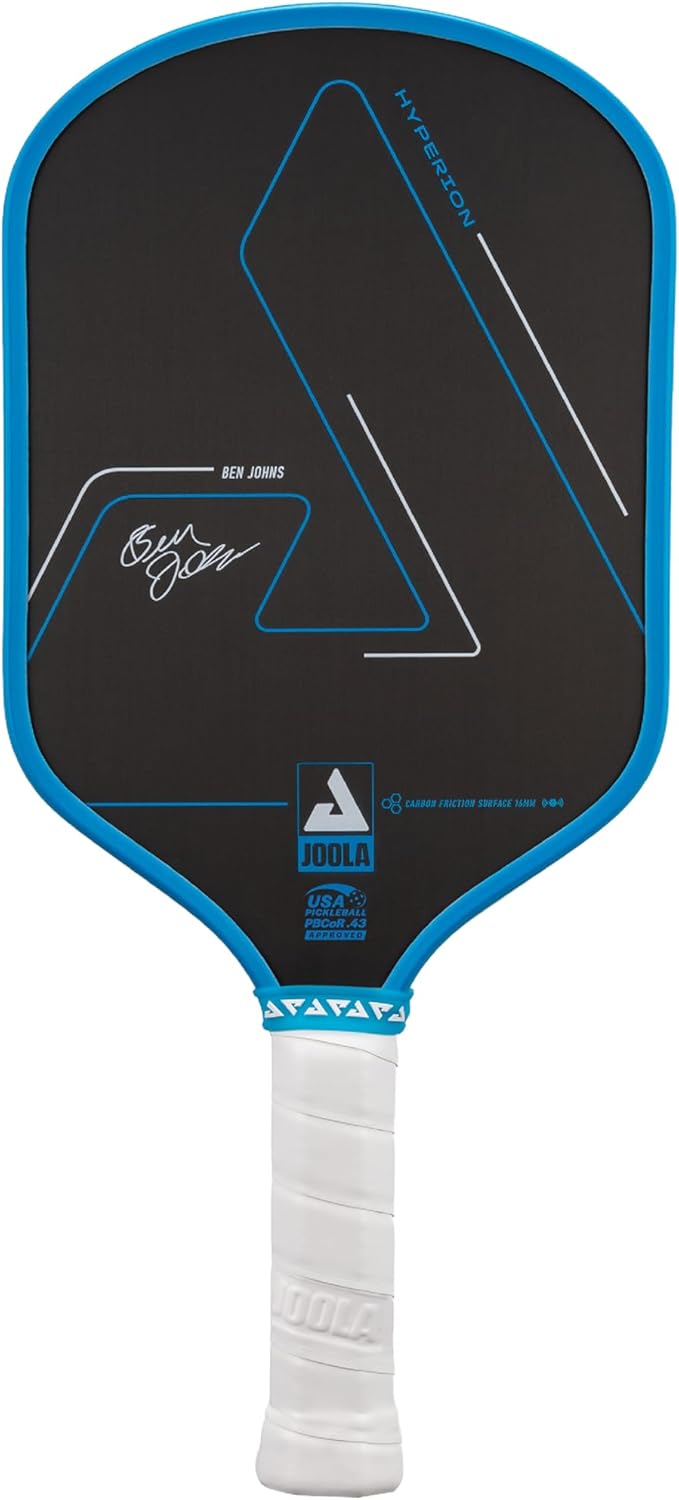
The best pickleball paddles for intermediate players in 2026 are the JOOLA Ben Johns Hyperion CFS 16mm (best overall), the Vatic Pro Prism Flash 16mm (best budget pick), the Six Zero Double Black Diamond Control 16mm (best for control), the JOOLA Ben Johns Perseus Pro IV 16mm (best for power), the Selkirk LUXX Control Air Invikta (best for touch and dinking), the Paddletek Bantam EX-L Pro (best for consistency), the Engage Pursuit MX 6.0 (best for spin), and the Franklin Ben Johns Signature Paddle (best entry-level upgrade).


Choosing the right paddle at the intermediate level is harder than it sounds. You’ve outgrown the wide-body beginner sticks that forgave every mis-hit, but you’re not yet ready to wield the twitchy, high-power gear that tour players use. What you need is something in between — a paddle that sharpens your third-shot drop and soft game while still rewarding you when you pull the trigger on an aggressive drive.
The market has exploded. There are dozens of paddles claiming to be “perfect for intermediate players,” but most of that language is marketing noise. The real differentiators come down to four things: core thickness, face material, swing weight, and how the paddle distributes feel across the hitting surface. Get those right for your playing style and you’ll improve faster. Get them wrong and you’ll fight your equipment every time you step on court.
Below is a breakdown of the eight best intermediate pickleball paddles in 2026 — each chosen for consistent on-court performance, strong availability on Amazon, and real-world feedback from the 3.0–4.0 skill-level community.
What Makes a Pickleball Paddle Intermediate-Ready?
An intermediate-ready pickleball paddle delivers a carbon fiber or composite face, a 14–16mm polymer core, and a weight between 7.8 and 8.3 oz — specs that support both the controlled soft game and the explosive attacks that define play at the 3.0–4.0 level. These numbers aren’t arbitrary; they reflect what the game demands once you move beyond just getting the ball back.
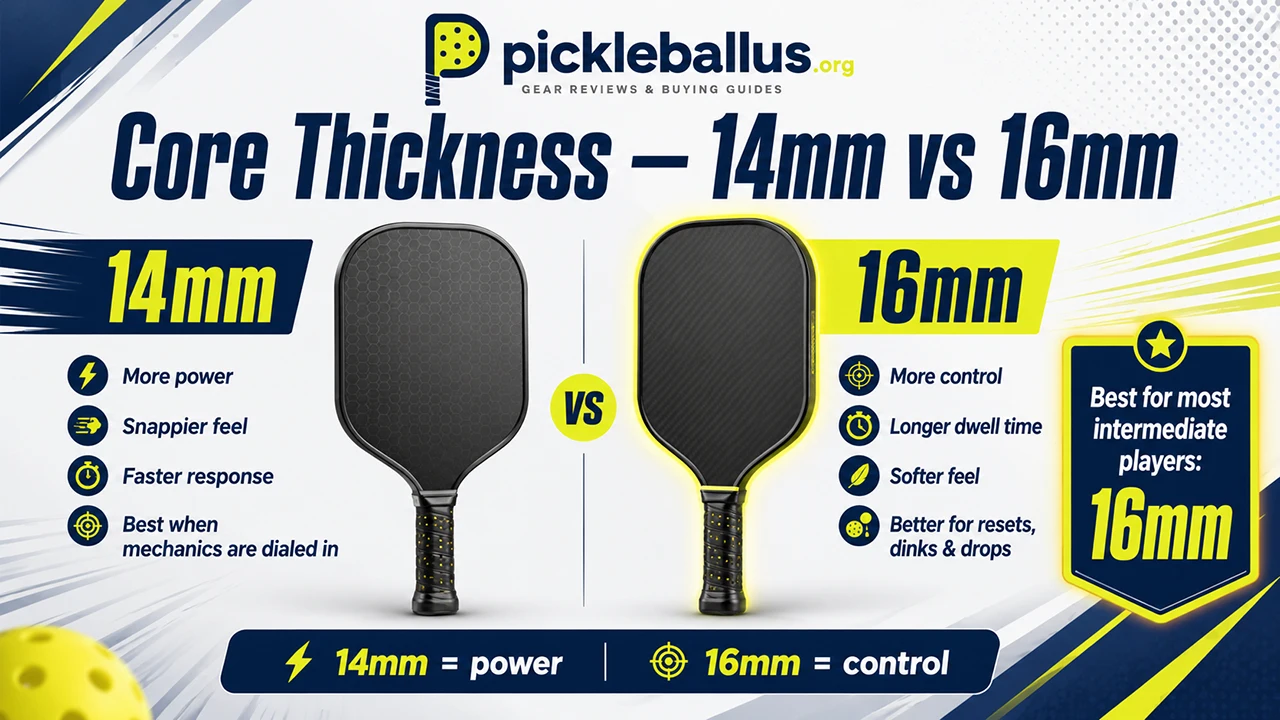
Core Thickness — 14mm vs 16mm
Core thickness is the single most impactful spec for intermediate players, and the choice between 14mm and 16mm defines whether your paddle favors power or control. A 14mm core compresses less on contact, generating a snappier, more explosive response — useful if you already have consistent placement and want to add pace. A 16mm core increases dwell time (how long the ball stays on the face), producing a softer, more controlled feel that helps with resets, dinks, and third-shot drops.
At the intermediate stage, most players benefit more from a 16mm core. You’re refining technique, not maximizing power output. The extra dwell time acts as a buffer, reducing pop-ups and keeping your soft game consistent. Once your mechanics are locked in — typically around the 4.0–4.5 level — that’s when a 14mm paddle starts earning its place. If you want to explore both options, best pickleball paddles for control and best pickleball paddles for spin break down those categories in detail.
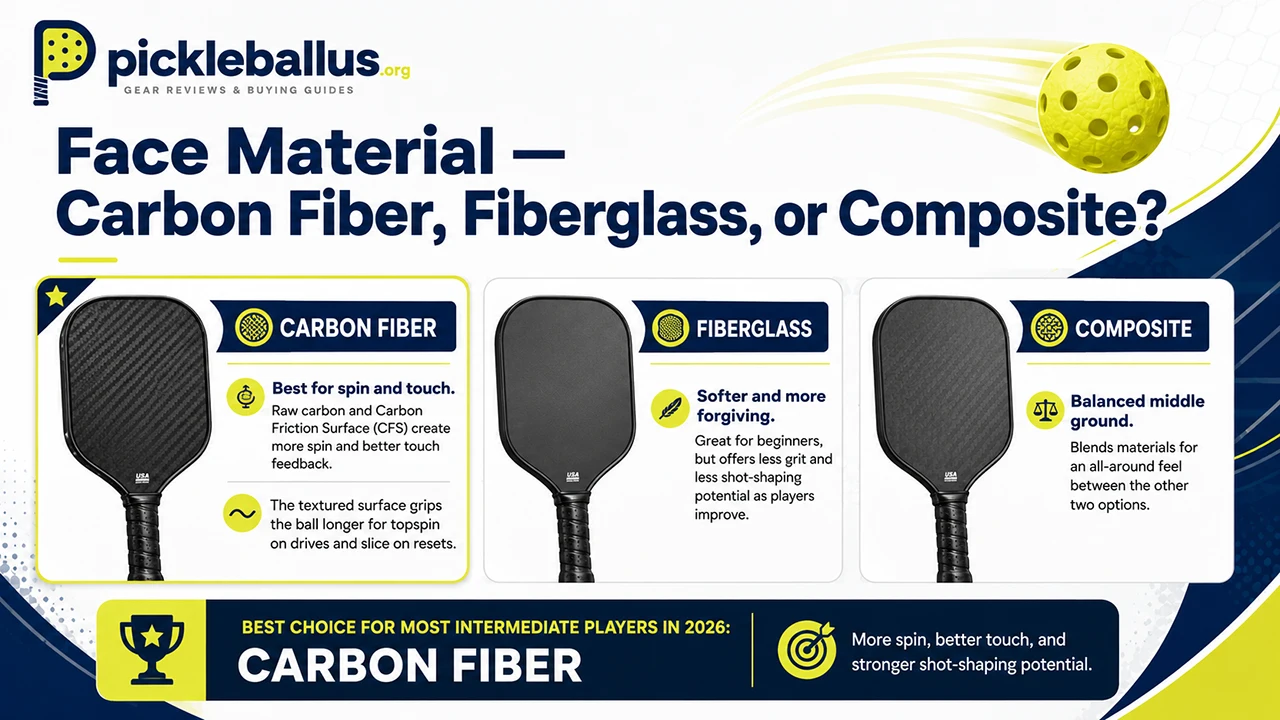
Face Material — Carbon Fiber, Fiberglass, or Composite?
Carbon fiber faces, specifically raw carbon and Carbon Friction Surface (CFS) variants, generate more spin and offer better touch feedback than fiberglass or composite alternatives. When the ball contacts a textured carbon fiber surface, the micro-grit grips the ball longer, allowing you to impart topspin on drives and slice on resets without extra arm speed.
Fiberglass faces are softer and more forgiving — great for beginners, but once you’re developing intentional shot shaping, their lack of grit becomes a ceiling. Composite faces sit in the middle, blending materials for a balanced feel. For most intermediate players upgrading in 2026, carbon fiber is the right call. The full breakdown of how each material performs is covered in pickleball paddle materials, which goes deeper into real-world differences across playing styles. The shortlist for those specifically interested in carbon: best carbon fiber pickleball paddle.
Weight Range That Fits the Intermediate Game
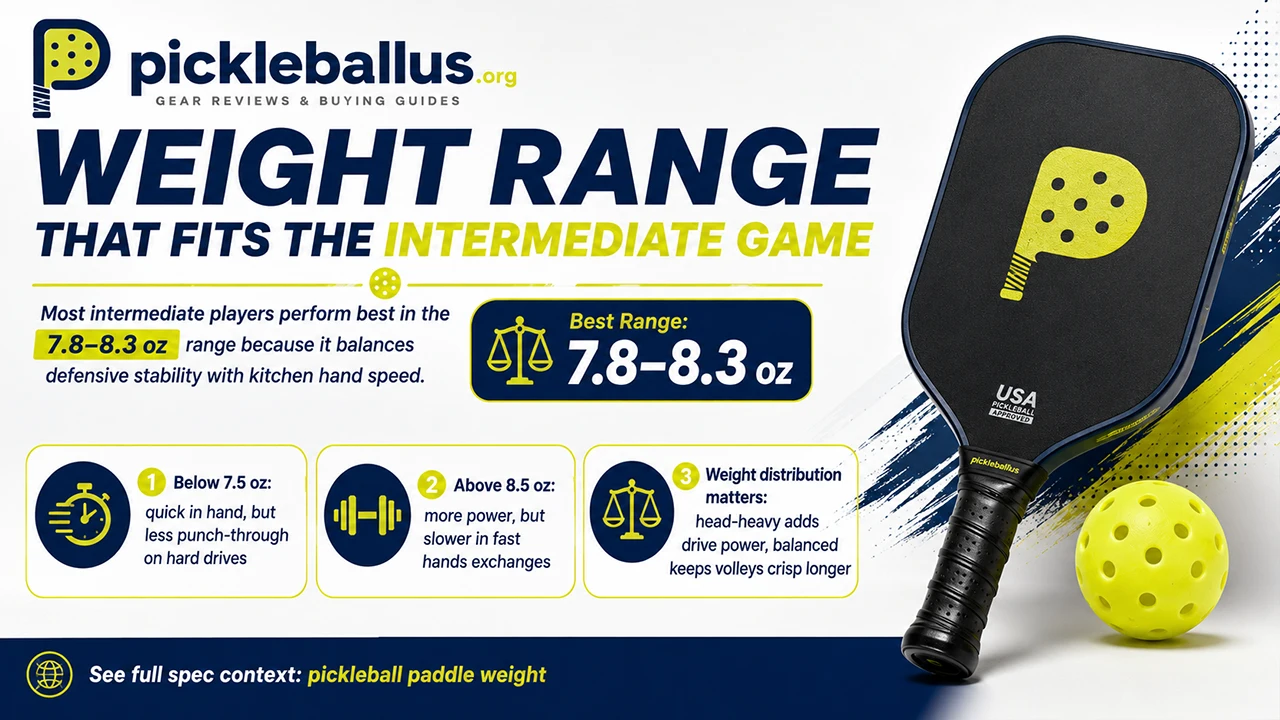
Most intermediate players perform best with a paddle in the 7.8–8.3 oz range, which offers enough mass to absorb pace on defense without sacrificing the hand speed needed at the kitchen. Paddles below 7.5 oz feel quick but lack punchthrough on hard drives. Anything above 8.5 oz adds power but slows your reaction time during fast hands exchanges. Weight distribution matters as much as total weight — a head-heavy paddle amplifies power drives but tires your arm during long sessions, while a balanced swing weight keeps volleys crisp for hours. The full spec context is available on pickleball paddle weight.
The 8 Best Pickleball Paddles for Intermediate Players in 2026
The paddles below were selected from actively-sold Amazon listings with strong review counts and verified performance histories. Every model appears in at least two independent testing platforms from early 2026.
#1 JOOLA Ben Johns Hyperion CFS 16mm — Best Overall
The JOOLA Ben Johns Hyperion CFS 16mm earns its place as the top intermediate paddle in 2026 by delivering the widest forgiveness window, the most consistent sweet spot, and the best all-court balance in its class. This is the paddle that Ben Johns — currently ranked world number one — uses in professional competition, and it’s built for the demands of elite play. That doesn’t mean it’s intimidating. The Hyperion’s design philosophy directly benefits intermediate players.
Key Specs:
- Core thickness: 16mm polymer honeycomb
- Face: Carbon Friction Surface (CFS)
- Weight: 7.9–8.1 oz
- Shape: Standard elongated
- Handle length: 5.5″
Performance Analysis: The defining feature is the Hyperfoam Edge Wall — foam injected into the perimeter of the paddle frame. Most paddles have a dead zone near the edges; the Hyperion’s foam injection extends the responsive hitting area all the way to the edge guard. Off-center hits that would cost you a point with a standard paddle stay playable with the Hyperion. For an intermediate player still building consistency, this is a significant margin for error.
The CFS face grips the ball long enough to put meaningful topspin on drives without requiring a technically perfect swing. Dinks feel soft and controllable. Hard drives produce a satisfying pop that rewards the follow-through but doesn’t punish early contact.
Pros:
- Largest and most forgiving sweet spot in its price tier
- CFS generates elite-level spin for a non-thermoformed paddle
- Excellent balance between touch at the kitchen and pace from the baseline
- Grows with your game — still competitive at 4.5+ level
Cons:
- Not the most powerful option if you’re already a confirmed banger
- Standard elongated shape requires a brief adjustment if coming from a widebody
Best For: All-court players at the 3.5–4.5 level who want one paddle that handles every situation without needing multiple sticks.
My Verdict: The Hyperion CFS 16mm is the safest, highest-quality upgrade path for intermediate players in 2026. If you’re unsure which paddle to buy, buy this one.
#2 Vatic Pro Prism Flash 16mm — Best Budget Pick
The Vatic Pro Prism Flash 16mm delivers T700 raw carbon fiber face technology at a price point that undercuts paddles from major brands by $50–$80, making it the strongest value play in intermediate pickleball gear right now. For players transitioning off their first paddle, this is the model that proves you don’t need to spend $200 to feel an immediate performance jump.
Key Specs:
- Core thickness: 16mm polymer honeycomb
- Face: Toray T700 raw carbon fiber
- Weight: 7.8–8.0 oz
- Shape: Standard elongated
- Handle length: 5.5″
Performance Analysis: T700 raw carbon fiber is the same face material used in paddles that retail for over $200. Vatic Pro sources it at scale and passes the savings through to the buyer. The raw texture generates strong spin — measurably better than fiberglass competitors in the same price range. The 16mm core gives you the controlled feel you’d expect from a premium paddle: dinks sit where you place them, and resets don’t pop up unexpectedly.
The neutral balance point makes the Prism Flash fast at the net, which matters as you start playing more transition zone exchanges at the 3.5 level. Some players note that the grip tape is thinner than what comes on JOOLA or Selkirk models — a quick overgrip wrap fixes that for a few dollars.
Pros:
- T700 carbon fiber face technology at a mid-range price
- 16mm soft core excellent for developing kitchen game
- Neutral balance for fast hand speed
- Reduces wrist and elbow strain during long sessions
Cons:
- Stock grip thinner than premium alternatives
- Less brand recognition than JOOLA or Selkirk for resale
- Not thermoformed — power ceiling lower than Gen 3 paddles
Best For: Intermediate players upgrading from beginner gear on a tighter budget, or players wanting to test carbon fiber feel before committing to a premium option.
My Verdict: The Prism Flash punches far above its price. If budget is a real constraint, this is the pick — you’ll be surprised how little you’re giving up compared to paddles costing twice as much.
#3 Six Zero Double Black Diamond Control 16mm — Best for Control
The Six Zero Double Black Diamond Control 16mm sets the standard for control-oriented play in the intermediate-to-advanced market, using a Japanese Toray 700K raw carbon face and a 16mm core to produce a paddle that makes resets, dinks, and cross-court placements feel almost effortless. If you’re a player who wins points through placement rather than pace, this is the paddle built for you.
Key Specs:
- Core thickness: 16mm
- Face: Japanese Toray 700K raw carbon fiber
- Weight: 8.0–8.2 oz
- Shape: Elongated (16.3″ length)
- Swing weight: 110 | Twist weight: 6.4
- Handle length: 5.5″
Performance Analysis: The Double Black Diamond’s low swing weight (110) and relatively high twist weight (6.4) create a specific feel: the paddle moves quickly through the air but stabilizes on off-center contact. At the kitchen, this translates to fast repositioning without shanking wide when you catch the ball near the edges. The raw carbon face adds grit for spin without making the surface feel scratchy or unpredictable.
The trade-off is power. This paddle is not built for hard drives from the baseline, and players who rely on aggressive attacks will feel limited. But at the 3.5–4.0 level, the game increasingly rewards precision over power, and the Double Black Diamond rewards that approach more than any other paddle in this roundup.
Pros:
- Best-in-class control and touch at the kitchen line
- Low swing weight enables fast, clean volleys
- Premium Japanese Toray carbon face with excellent spin
- Strong build quality and aerodynamic frame design
Cons:
- Not a power paddle — baseline drives are flat compared to thermoformed models
- Premium price tier
- Elongated shape with narrower face; smaller sweet spot than widebody alternatives
Best For: Control-style players at 3.5–4.5 who dominate from the kitchen and want a paddle that amplifies placement and touch.
My Verdict: If your game is built around soft, precise, tactical play and you want to fully commit to that style, the Double Black Diamond is the clearest pathway forward.
#4 JOOLA Ben Johns Perseus Pro IV 16mm — Best for Power
The JOOLA Ben Johns Perseus Pro IV 16mm is the most powerful option in this roundup, using full thermoformed construction and TechFlex Power foam technology to produce explosive pop on drives, counters, and speedups while retaining enough control for competitive soft play. This is the paddle for intermediate players who play aggressively and want to stop holding back on their attacks.
Key Specs:
- Core thickness: 16mm propulsion core
- Face: Charged Carbon Surface with TechFlex foam
- Weight: 8.1 oz
- Length: 16.5″ (elongated)
- Handle length: 5.5″
Performance Analysis: TechFlex construction adds foam to the outside of the frame under the edge guard, expanding the sweet spot and increasing pop on contact. The result is a paddle that generates noticeably more power than the Hyperion CFS at equivalent swing speeds. Drives come off the face with real pace, and speedups from the transition zone carry weight.
The Charged Carbon Surface delivers strong spin, giving topspin drives a sharper, dipping trajectory. The elongated shape aids two-handed backhand players by providing extra reach and a longer handle. The paddle is more demanding than the Hyperion — it rewards a cleaner, more consistent swing — but intermediate players who’ve developed solid mechanics will feel immediately rewarded.
One caveat: the Perseus Pro IV’s power makes the soft game require more deliberate deceleration. Players who struggle with pop-ups at the kitchen may find the Hyperion easier to manage.
Pros:
- Most powerful performance option in this roundup
- Full thermoformed construction for explosive pop
- TechFlex foam extends the sweet spot perimeter
- Excellent for two-handed backhand players
Cons:
- Power ceiling demands cleaner mechanics than forgiving all-court options
- Kitchen soft game requires conscious adjustment
- Premium price
Best For: Aggressive intermediate players at 3.5–4.0 who want to attack from the baseline and speed up balls at the transition zone.
My Verdict: If your playing style is built around pace and you feel like your current paddle is limiting your offense, the Perseus Pro IV removes that ceiling.
#5 Selkirk LUXX Control Air Invikta — Best for Touch Game & Dinking
The Selkirk LUXX Control Air Invikta delivers one of the most distinctive soft-game experiences available in 2026, using Selkirk’s Air Dynamic frame to reduce drag during fast exchanges while a premium carbon face produces reliable spin on every touch shot. For players investing in their dinking game and transition zone play, this is a compelling choice.
Key Specs:
- Core thickness: 16mm
- Face: Premium carbon fiber (Selkirk OPP Carbon)
- Weight: 7.6–7.9 oz
- Shape: Invikta (elongated widebody hybrid)
- Handle length: 5.25″
Performance Analysis: The Invikta shape is Selkirk’s answer to players who want the reach of an elongated paddle with the larger sweet spot of a widebody. It’s a smart middle ground that benefits intermediate players — enough face area to forgive off-center dinks, enough length to reach wide shots without over-extending.
The Air Dynamic holes reduce weight in the frame without compromising structural stability. On fast hands exchanges at the kitchen, the lighter feel reduces fatigue and keeps your reactions sharp. The trade-off is that some players find the lighter head requires extra intention on power shots. If you already have strong hands and want to sharpen your kitchen game without giving up pace, the LUXX Control Air Invikta earns its price.
Pros:
- Air Dynamic design reduces drag for faster net exchanges
- Invikta shape balances elongated reach with sweet spot size
- Excellent touch and feedback on dinks and drop shots
- Lighter weight reduces arm fatigue over longer sessions
Cons:
- Lighter feel requires more intentional swing to generate pace
- Shorter handle limits some two-handed backhand preferences
- Premium price tier from a premium brand
Best For: Touch-oriented intermediate players who spend most of their time at the kitchen and want a paddle that amplifies dinks, resets, and soft angle shots.
My Verdict: The LUXX Control Air Invikta is a specialist paddle for a specific style of play. If your game revolves around the kitchen, it’s one of the best investments available.
#6 Paddletek Bantam EX-L Pro — Best for Consistency
The Paddletek Bantam EX-L Pro is built around consistency above all else — a graphite face paired with a Bantam Smart Response Pro polymer core that keeps shot character predictable across the entire face, so intermediate players can trust the paddle rather than compensate for it. Paddletek’s paddle has been a staple recommendation for players who want reliable, no-drama performance.
Key Specs:
- Core thickness: Smart Response Pro polymer
- Face: Premium graphite
- Weight: 8.0 oz average
- Shape: Standard widebody
- Handle length: 4.5″
Performance Analysis: The Bantam EX-L Pro’s graphite face produces a slightly livelier feel than carbon fiber, with less spin generation but a more predictable, board-flat response. For players whose main frustration is inconsistency — balls that randomly fly long or sit up off the paddle — graphite’s reliability addresses that directly. The wide body shape gives you a larger sweet spot than elongated alternatives, making it forgiving on volleys and groundstrokes alike.
The Smart Response Pro core is one of the more durable polymer cores on the market. Where some thermoformed paddles show core degradation after heavy use, the Bantam EX-L Pro holds its feel longer. For intermediate players who play frequently and want their paddle to perform the same in month six as it did in month one, that durability matters.
Pros:
- Highly consistent feel across the entire paddle face
- Durable core that holds its character over time
- Wide body shape for maximum forgiveness
- Reliable on both hard drives and touch shots
Cons:
- Lower spin ceiling than carbon fiber alternatives
- Shorter handle limits two-handed backhand players
- Not optimized for aggressive power play
Best For: Intermediate players at the 3.0–3.5 level who want a dependable, versatile paddle that builds confidence through consistency rather than raw performance ceiling.
My Verdict: If you’re frustrated by unpredictable paddle behavior and want something you can trust every session, the Bantam EX-L Pro is the most consistent option in this roundup.
#7 Engage Pursuit MX 6.0 — Best for Spin
The Engage Pursuit MX 6.0 is purpose-built for players who generate points with heavy topspin, using Engage’s Polypropylene CX4 core technology and a textured composite face to produce measurably higher spin rates than standard paddles in this price tier. Players transitioning from tennis who rely on topspin mechanics will find this paddle immediately familiar.
Key Specs:
- Core thickness: 16mm CX4 Polypropylene
- Face: Textured composite (spin-optimized)
- Weight: 7.9–8.2 oz
- Shape: Standard mid-length
- Handle length: 5.25″
Performance Analysis: Engage’s CX4 core was designed specifically to work in concert with the textured face to amplify ball bite. The combination allows you to apply heavy topspin without needing elite swing technique — the paddle does more of the spin generation work for you. At the intermediate level, this matters because players are still developing the consistent mechanics that produce topspin naturally.
The mid-length shape and balanced weight distribution give the Pursuit MX 6.0 a versatile all-court feel. It’s not a one-trick spin machine — control and touch are solid, power is competitive — but spin is clearly where this paddle shines. For players who’ve identified heavy topspin as the weapon they want to develop, no intermediate paddle in this roundup amplifies that better.
Pros:
- Industry-leading spin generation for its price tier
- CX4 core specifically designed to amplify topspin
- Versatile all-court feel rather than a pure specialist
- Strong for players with tennis backgrounds
Cons:
- Face texture wears faster than carbon fiber alternatives under heavy spin use
- Less forgiving than the Hyperion CFS on off-center hits
- Spin focus means marginal power ceiling compared to thermoformed options
Best For: Intermediate players at 3.0–4.0 who want to develop heavy topspin as their primary weapon, especially those with tennis experience.
My Verdict: If spin is your game and you want a paddle that makes topspin production feel natural rather than forced, the Pursue MX 6.0 is the strongest dedicated spin option in this roundup.
#8 Franklin Ben Johns Signature Paddle — Best Entry-Level Upgrade
The Franklin Ben Johns Signature Paddle is the most accessible entry point in this roundup, using a carbon fiber face and a forgiving polymer core to give players who are just crossing into intermediate territory a genuine performance upgrade without the price of a premium option. This is the paddle for players who have outgrown their starter kit but aren’t yet ready to invest $150+.
Key Specs:
- Core thickness: 14mm polymer honeycomb
- Face: Carbon fiber texture
- Weight: 7.8 oz
- Shape: Standard elongated
- Handle length: 5.5″
Performance Analysis: The Franklin Signature delivers carbon fiber grit and a textured face at a price point that competes with mid-range paddles from less recognized brands. For players making the jump from a recreational beginner paddle, the difference in feel is immediate — more spin, more feedback, more shot-shaping potential. The 14mm core skews toward pop and power compared to the 16mm options above, making this a better fit for players who already have reasonable consistency and want to add offensive punch.
The lighter weight (7.8 oz) makes it fast and maneuverable at the kitchen. More experienced players moving to 4.0+ will likely outgrow the Franklin Signature within a year or two, but for someone transitioning from purely recreational play to competitive intermediate, it delivers exceptional value for the level.
Pros:
- Carbon fiber face technology at an accessible price
- 14mm core adds pop for offensive players
- Lightweight and fast for kitchen exchanges
- Strong name recognition and Amazon availability
Cons:
- 14mm core less forgiving than 16mm alternatives for players still developing consistency
- Power-focused build doesn’t suit control-first styles as well
- Most players will want an upgrade within 12–18 months as they improve
Best For: Players at the 2.5–3.0 level who have outgrown their first beginner paddle and want real intermediate performance before committing to a $150+ investment.
My Verdict: The Franklin Ben Johns Signature is the smartest first step into serious intermediate gear. Buy it, learn on it, and use what you discover about your playing style to choose your next paddle.
Head-to-Head: How Do These 8 Paddles Compare?
The table below summarizes the key differentiators across all eight paddles. Each is suited to a distinct style and budget, so the right choice depends on where your game is right now.
| Paddle | Core | Face | Weight | Best Strength | Best For |
|---|---|---|---|---|---|
| JOOLA Hyperion CFS 16mm | 16mm | Carbon Friction Surface | 7.9–8.1 oz | All-court balance | Most intermediate players |
| Vatic Pro Prism Flash 16mm | 16mm | T700 raw carbon | 7.8–8.0 oz | Budget value | Cost-conscious upgraders |
| Six Zero Double Black Diamond | 16mm | Toray 700K raw carbon | 8.0–8.2 oz | Control & touch | Kitchen-dominant players |
| JOOLA Perseus Pro IV 16mm | 16mm | Charged Carbon + TechFlex | 8.1 oz | Power & pop | Aggressive offensive players |
| Selkirk LUXX Control Air | 16mm | OPP Carbon | 7.6–7.9 oz | Soft game / dinking | Touch-oriented players |
| Paddletek Bantam EX-L Pro | Polymer (custom) | Graphite | 8.0 oz | Consistency | Players wanting reliability |
| Engage Pursuit MX 6.0 | 16mm CX4 | Composite texture | 7.9–8.2 oz | Spin generation | Topspin-focused players |
| Franklin Ben Johns Signature | 14mm | Carbon fiber | 7.8 oz | Accessible upgrade | Entry-level intermediate |
Which Intermediate Paddle Is Right for You?
The right intermediate pickleball paddle matches your current play style, not the style you aspire to have. Buying for a future version of your game usually means buying a paddle that frustrates you in the present.
Choose the Hyperion CFS 16mm if You Play All-Court
If you genuinely don’t know whether your game is more power-focused or control-focused — or if you play multiple positions and need a paddle that handles everything — the JOOLA Hyperion CFS 16mm is the clearest pick. Its Hyperfoam Edge Wall forgives technical inconsistencies, and the CFS face gives you elite spin without requiring elite mechanics. This paddle will not become obsolete as you improve; it’s used at the professional level for a reason.
If you’d prefer to compare it against the full range of best pickleball paddles across all skill levels before deciding, that guide covers options from beginner to professional tier.
Choose the Perseus Pro IV if You Play Aggressively
If drives, speedups, and aggressive counterattacks define your points, the JOOLA Perseus Pro IV is the paddle that removes the power ceiling. Its thermoformed construction and TechFlex foam deliver pop that the Hyperion can’t match. Understand that you’ll need to consciously slow down your soft game — but if you’re playing at the best pickleball paddles for 4.0 players level and beyond, the Perseus is built to grow with you.
Choose the Vatic Pro Prism Flash if Budget Matters
The Vatic Pro Prism Flash 16mm delivers T700 carbon fiber technology — the same face material as $200+ paddles — at a budget-friendly price. If financial constraints are real, don’t let anyone convince you that spending less means playing worse. This paddle genuinely competes with midrange options from major brands. It’s also an excellent secondary paddle to keep in your bag. For players still deciding between intermediate and beginner gear, the best pickleball paddles for beginners guide covers the entry-level options in the same detail.
When Should You Upgrade From a Beginner Paddle?
You should upgrade from a beginner paddle when your shots are consistently landing where you aim them, but the paddle is preventing you from adding spin, pace, or feel to those shots. That’s the clearest signal. If you’re still working on getting the ball over the net reliably, a better paddle won’t fix that — technique will. But the moment you start feeling the lid on your potential rather than the limits of your skill, intermediate gear is the right call.
Specific signals to watch for:
You can’t generate spin regardless of how hard you try. Beginner paddles have smooth or lightly textured faces that don’t grip the ball. Once you have the mechanics to apply spin, the paddle needs the surface grit to execute it.
You lose pace on resets and dinks. If your soft shots keep popping up even when your mechanics feel right, your core is likely too thin or too hard. A 16mm polymer core absorbs that energy instead of bouncing it back.
Off-center hits go everywhere. A small sweet spot on a beginner paddle amplifies positional errors. Intermediate paddles — especially those with extended sweet spot technology — reduce that variance.
You’ve plateaued around the 3.0 rating and your practice partners are pulling away. Equipment isn’t everything, but when you’ve maximized what your current paddle can do, upgrading is a legitimate performance lever. Players at the best pickleball paddles for 3.5 players level confirm this pattern consistently.
By now you have a clear picture of which paddles deliver the right balance of control, power, and spin across eight different options and multiple price tiers. Choosing the right paddle is only half the equation, though — how you care for it and when you recognize the right time to move up again will determine whether that investment serves your game for one season or several. The next section covers the practical details that separate players who get the most from their gear from those who replace it prematurely.
What Else Should Intermediate Players Know Before Buying?
How to Test a Paddle Before Committing
Testing before committing is the single most useful thing you can do, and most players skip it entirely. Manufacturer spec sheets don’t tell you how a paddle feels under your grip, how the vibration transfers up your arm, or whether the handle sits comfortably in your hand through a two-hour session.
Look for two options: demo programs and return policies. Many pickleball-specific retailers offer demo paddles for a small rental fee that applies toward purchase. Amazon’s 30-day return window on most sporting goods means you can test a paddle through several real sessions before deciding. Don’t buy based on a backyard rallying session — test the paddle during actual match play where your technical inconsistencies show up.
Pay attention to how the paddle feels on mishits specifically. A paddle that feels great on clean contact but punishes off-center hits will frustrate you more as your game improves and rallies get longer.
How to Extend Your Paddle’s Life
Pickleball paddle surfaces degrade faster than most players expect. The carbon fiber grit that generates spin is essentially a fine texture on the face, and it wears with contact. Once the texture flattens, spin generation drops noticeably. A few practices slow that down:
Clean the face with a damp cloth after every session — dirt and ball residue fills the texture gaps and reduces grip. Avoid scraping your paddle on the court when picking up balls. Store it in a protective cover rather than loose in your bag. Protect the edge guard; edge damage compromises the paddle’s internal structure and can accelerate core wear.
For thermoformed paddles specifically — the Perseus Pro IV and others using foam-injected frames — avoid extreme temperature storage. Leaving a paddle in a hot car repeatedly can soften the foam and alter the paddle’s feel over time.
Signs You’ve Already Outgrown Your Intermediate Paddle
Moving from intermediate to advanced gear is a real transition, and it happens faster than most players anticipate. You’ve likely outgrown your intermediate paddle if your swing speed has increased to the point where 16mm cores feel dead on hard contact — a sign that a 14mm or thermoformed paddle would amplify your aggression rather than absorb it.
You’ve also outgrown it if kitchen exchanges happen faster than your current paddle can keep up — when you’re losing hand battles at the 4.0–4.5 level not because of poor technique but because your paddle’s swing weight is slowing your reset response. At that point, the best pickleball paddles for advanced players are the natural next step — paddles built with higher twist weights, lower swing weights, and face materials tuned for tour-level hand speed.
Write Your Review
No reviews yet. Be the first to share your experience!