

The 8 best pickleball paddles for doubles in 2026 are the Selkirk LUXX Control Air Invikta (best for control-first doubles), the JOOLA Ben Johns Perseus Pro IV 16mm (best overall), the Six Zero Double Black Diamond Control 16mm (best for soft game and resets), the Franklin Sports C45 Dynasty 16mm (best for fast-hands kitchen exchanges), the Engage Alpha Pro (best control-power blend), the Paddletek Bantam EX-L Pro (best for intermediate doubles players), the Selkirk SLK Halo Power XL (best budget option), and the HEAD Radical Pro (best for aggressive power doubles play).
Doubles is not just singles with a partner added. The court fills up fast, exchanges happen in bursts, and the majority of points are settled within a few feet of the kitchen line. The paddle that wins long singles rallies — usually elongated, power-forward, stiff — is often the wrong tool for the tight geometry, reset battles, and dink exchanges that define competitive doubles. A great doubles paddle needs control, a forgiving sweet spot, and enough face texture to shape short shots under pressure.
Three things separate a genuine doubles paddle from a singles crossover: it absorbs pace on resets without going defensive, it moves quickly enough for hands battles at the NVZ, and it gives you enough feedback to know where every dink is going before it lands. Most players learn this through an expensive mistake with the wrong paddle. This guide skips that step.
Below you’ll find the eight paddles that consistently deliver in doubles, whether you’re a 3.0 player still learning the dink game or a 4.5 player competing on the weekends.
What Makes a Great Pickleball Paddle for Doubles?
Doubles rewards control, touch, and net-game consistency — not raw baseline power. Understanding the three physical features that support these qualities will make every paddle choice on this list easier to evaluate.
Soft Game and Kitchen Dominance Over Raw Power
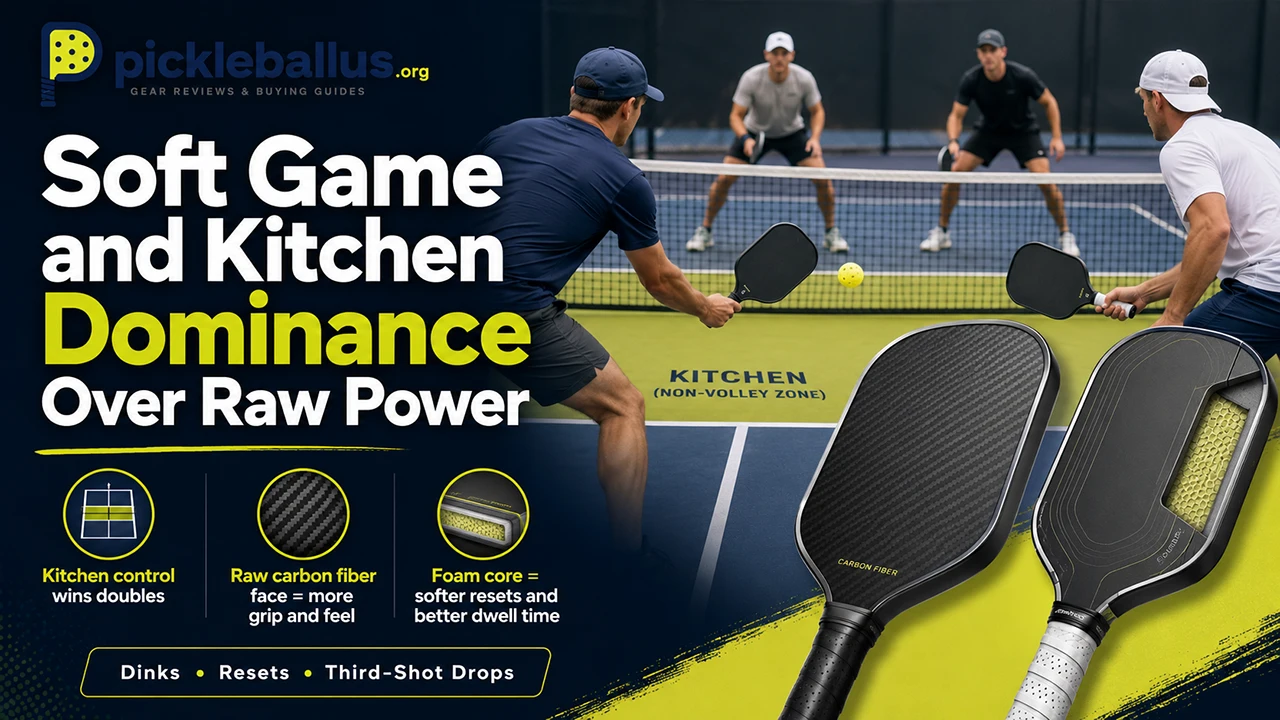
The non-volley zone (kitchen) is where doubles points are won and lost. Every reset, every dink, and every third-shot drop happens within a tight window where feel matters more than force. A paddle built for doubles needs a surface that grips the ball long enough to redirect pace — that’s dwell time — and a core that absorbs incoming drives without bouncing the ball out of the kitchen.
Raw carbon fiber faces consistently outperform smooth graphite in this area, because the textured surface creates friction that lets you roll, shape, and angle short shots. Foam-core paddles have gained ground for the same reason: the foam absorbs energy on contact, giving the ball a softer landing and better predictability on resets. For doubles, those two features — surface texture and dwell — rank above sheer power.
Core Thickness and Weight for Doubles Play
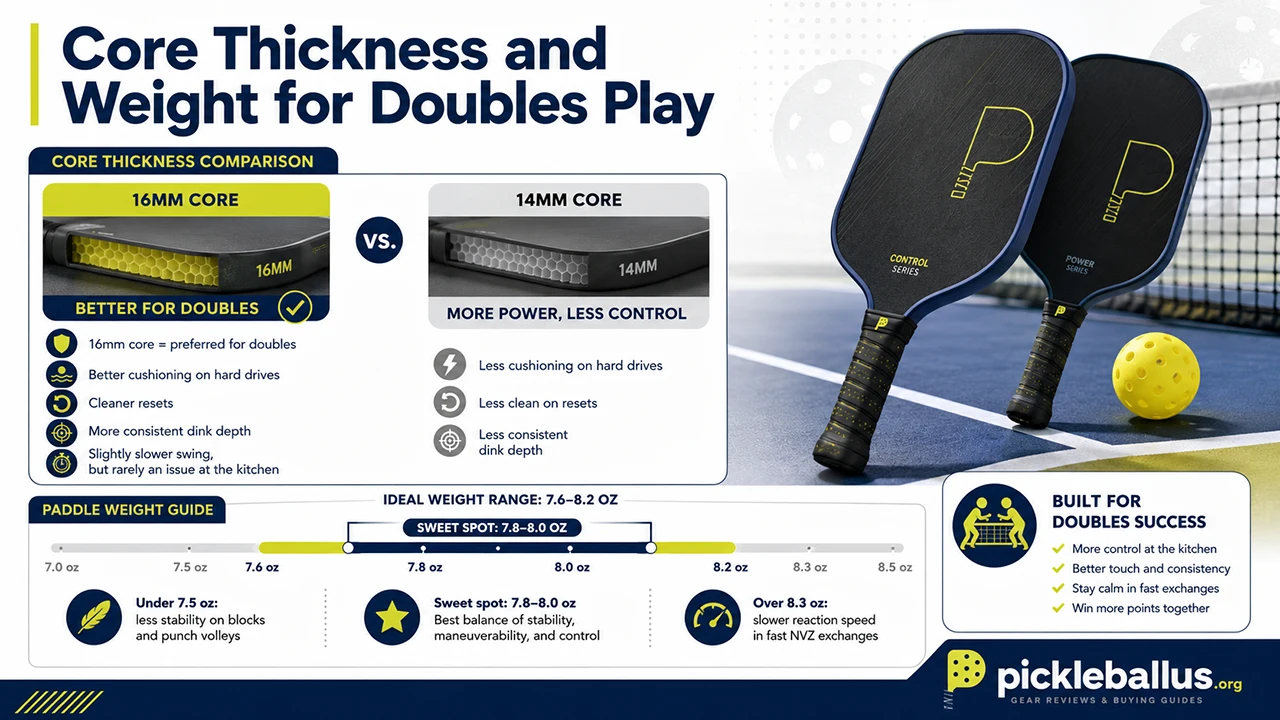
16mm cores are the clear preference for doubles, mainly because the thicker foam cushions hard drives better than a 14mm build, which translates directly to cleaner resets and more consistent dink depth. The tradeoff is a slightly slower swing, which is rarely a problem at the kitchen where compact strokes dominate anyway.
Weight matters too. The sweet range for doubles paddles sits between 7.6 and 8.2 oz. Paddles lighter than 7.5 oz sacrifice stability on block shots and hard punch volleys; paddles heavier than 8.3 oz slow down your reaction time during fast-hands exchanges at the NVZ. Most of the best doubles paddles cluster around 7.8–8.0 oz for this reason.
Paddle Shape and Reach at the NVZ
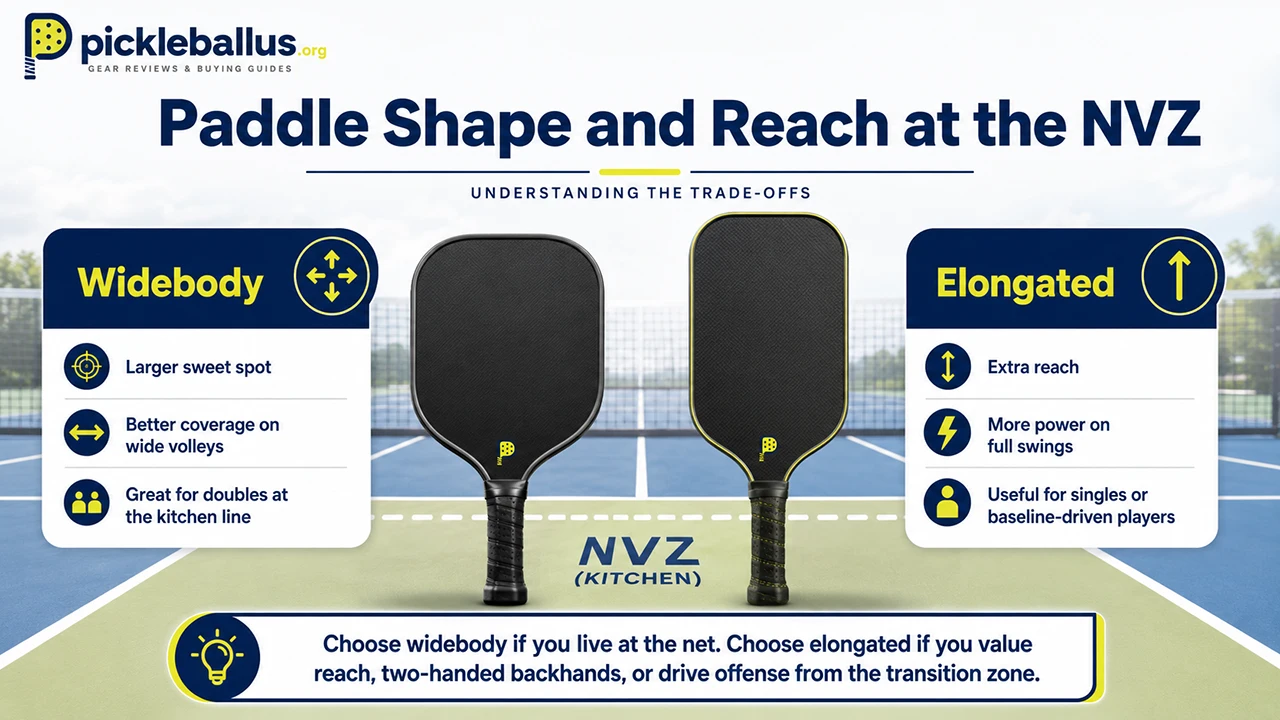
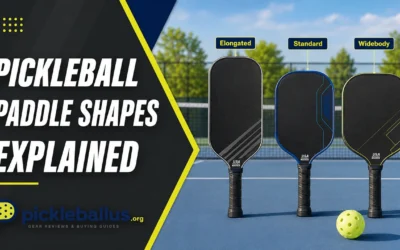
Widebody paddles (broader face, shorter handle) give you a larger sweet spot and better coverage on wide volleys — a real advantage when two players share the kitchen line. Elongated paddles trade that width for extra reach and power on full swings, which works better in singles where you need to cover more ground alone.
That said, elongated paddles still work in doubles for players who like two-handed backhands or generate a lot of drive offense from the baseline. The key is choosing based on where you spend most of your game — at the net or back on the transition zone.
8 Best Pickleball Paddles for Doubles in 2026
Eight paddles earn a spot on this list because they have each been tested extensively by the doubles community, carry strong Amazon availability and review history, and bring a specific strength to doubles play without a crippling weakness.
#1 Selkirk LUXX Control Air Invikta — Best for Control-First Doubles
The Selkirk LUXX Control Air Invikta is a dedicated control paddle built around a T700 raw carbon fiber face and a high-density polymer core designed to keep the ball on a predictable flight path even during low, tight dinks just above net level.
Key specs: T700 raw carbon face | Polymer honeycomb core | 7.4–7.7 oz | Elongated shape | 5.25″ handle
Performance: At the kitchen line, the LUXX Air delivers a soft, pliable contact that makes resets feel natural rather than forced. The T700 surface generates above-average spin without the harsh pop you get from some stiffer raw carbon faces — ideal for rolling topspin dinks cross-court or angling drop shots away from an opponent’s forehand. The elongated shape gives you a bit of extra reach for wide volleys without sacrificing too much face width. The trade-off is a smaller sweet spot than a true widebody, so mishits at the paddle edges go slightly softer than center-contact shots.
For doubles specifically, the “Air” design refers to the hollow channel system inside the paddle frame — it reduces vibration and keeps the feel consistent across the entire face, which becomes noticeable during sustained dink rallies when you’re making micro-adjustments on every shot.
Pros:
- Among the softest, most controllable contact in any raw carbon paddle
- Excellent spin generation for shaped dinks and angled drops
- Consistent feel across the face, even on off-center hits
- Lightweight (7.4–7.7 oz) for fast wrist-led resets
Cons:
- Limited pop on drives — not ideal for players who like to attack from the baseline
- Elongated shape offers less protection on wide body volleys compared to widebody options
Best For: Finesse-focused doubles players who win through placement, patient dinking, and controlling the kitchen line with precision rather than pace.
My Verdict: If your game lives and dies at the NVZ and your opponents often find your dinks unattackable, this is your paddle. It’s the pick for the player who understands that control in doubles is a weapon.
#2 JOOLA Ben Johns Perseus Pro IV 16mm — Best Overall for Doubles
The JOOLA Perseus Pro IV 16mm covers more ground than any other paddle on this list — it handles soft game well, generates real power on drives, and gives advanced doubles players the feedback to shape every type of shot confidently.
Key specs: Carbon Friction surface | 16mm foam-enhanced core | 7.9–8.2 oz | Elongated shape | 5.5″ handle
Performance: The Pro IV’s headline feature is the high-density foam inserted into the paddle’s lower corners and throat area. That foam increases paddle flex on contact, which does two things: it deepens dwell time for better ball feel, and it adds forgiveness on drive blocks and counters when the ball hits lower on the face. In a doubles context, that forgiveness is tangible — even when an opponent drives a ball hard at your feet, the Pro IV absorbs enough energy to keep the reset controlled.
The Carbon Friction surface generates strong spin, and the elongated shape gives you the reach to handle wide serves and poaching opportunities. At 7.9–8.2 oz, it sits on the heavier end for fast hands battles — some players add an overgrip to improve palm contact and stability — but the added weight pays off on punch volleys and third-shot drives.
Pros use this paddle in both doubles and singles, which speaks to its versatility. For the competitive recreational player aiming to improve at 4.0+, the Pro IV is a full-featured choice that doesn’t require you to sacrifice either side of your game.
Pros:
- Foam-enhanced core adds forgiving, consistent feel across different shot types
- Strong balance of power and control — works from baseline and kitchen
- High-spin surface for shaping drops and dinks with added margin
- Proven at the pro level in men’s doubles and mixed doubles (PPA Tour)
Cons:
- Heavier than some purely control-oriented doubles paddles
- Premium price point — mid-range players may find equal performance at lower cost
Best For: Competitive doubles players at 3.5–4.5 who want a single paddle that handles every phase of a doubles point without compromise.
My Verdict: This is the paddle to get if you play high-level doubles and want one tool that adapts to every situation. Worth every dollar for the competitive player.
#3 Six Zero Double Black Diamond Control 16mm — Best for Soft Game and Resets
The Six Zero Double Black Diamond Control 16mm is the soft-game specialist in this group — a low swing-weight, raw carbon paddle built specifically for players who win doubles points through resets, controlled drops, and defensive consistency.
Key specs: Toray 700K raw carbon face | 16mm polymer core | 8.0–8.2 oz | Elongated shape | 5.5″ handle | 110 swing weight
Performance: The Double Black Diamond’s low published swing weight (110) is the number that defines this paddle in doubles. A lower swing weight means the paddle feels faster and lighter through the air than its static weight suggests — critical for quickly adjusting to unexpected balls at the kitchen line. You don’t have to commit to a full swing; compact, last-second flicks feel natural because the paddle moves where you point it.
The Toray 700K raw carbon face sits among the grittiest surfaces available and gives you consistent spin even after hours of play. Dink depth and direction stay predictable because the soft core doesn’t amplify minor stroke inconsistencies the way a stiffer paddle would. Reset balls that would spray long from a power paddle stay low and safe from the Double Black Diamond.
The tradeoff is power — this paddle is not a driver. If your doubles game relies heavily on attacking drives or overhead putaways, you’ll feel the limit. But for a player whose strength is patience and court geometry, it delivers an advantage at the kitchen line few paddles can match.
Pros:
- Low swing weight (110) for exceptional hand speed at the NVZ
- Toray 700K raw carbon face provides long-lasting spin texture
- 16mm core absorbs pace cleanly — among the best reset paddles available
- Consistent performance from center to edge of the face
Cons:
- Limited power ceiling — not suited for drive-heavy doubles styles
- Advanced-level control; beginners may find it harder to generate pace intentionally
Best For: Advanced doubles players (4.0+) who rely on soft hands, patient resets, and placement-based point construction to beat power opponents.
My Verdict: The Double Black Diamond Control is the closest thing to a purpose-built doubles weapon on this list. If your opponents complain your dinks are unattackable, you’ve found your paddle.
#4 Franklin Sports C45 Dynasty 16mm — Best for Fast-Hands Kitchen Exchanges
The Franklin C45 Dynasty 16mm brings a lighter, faster profile to the doubles kitchen without giving up enough control to hurt. It’s the best option for players who win hands battles through quickness rather than weight.
Key specs: C45 Carbon Hybrid face | 16mm thermoformed unibody core | 7.6–7.9 oz | Elongated shape | 5.7″ handle
Performance: Franklin’s C45 construction uses a double thermoformed unibody frame — the face and frame are formed together as one piece rather than attached separately. That construction tightens up the paddle’s response so there’s no energy loss at the seams, and it makes the paddle feel slightly livelier than a standard 16mm build at the same weight.
At 7.6–7.9 oz, the Dynasty is among the lighter paddles on this list, and that weight pays dividends on quick exchanges at the net where you’re reacting faster than you’re thinking. The 5.7″ handle gives you enough room for a comfortable two-handed backhand grip if that’s part of your game. Top players including Hayden Patriquin have used C45 models in competitive doubles, which confirms the paddle’s capability beyond the recreational level.
The C45 face sits between raw carbon and smooth carbon in feel — it generates solid spin but has a slightly stiffer pop than the softest raw carbon options here. That means it’s a fraction less forgiving on resets than the Six Zero or LUXX Air, but more than compensates with added drive power for the player who likes to attack from both the kitchen and the transition zone.
Pros:
- Unibody thermoformed construction for consistent, tight response
- Light and fast (7.6–7.9 oz) for quick volley exchanges
- Longer 5.7″ handle suits players with two-handed backhands
- Proven at pro level in competitive doubles play
Cons:
- Slightly stiffer than the softest control options — requires cleaner stroke form on resets
- May lack top-end control for purely defensive doubles styles
Best For: Offensive-minded doubles players who mix kitchen play with aggressive third-shot drives and want a paddle that keeps up with both sides of their game.
My Verdict: A sharp, well-designed paddle that rewards active doubles play. Quicker at the kitchen than its specs suggest.
#5 Engage Alpha Pro — Best for Control-Power Blend in Doubles
The Engage Alpha Pro stands out as the most balanced control-power paddle Engage has produced — a foam-core widebody that delivers enough pop for offense without sacrificing the soft feel that doubles demands at the net.
Key specs: Carbon fiber face | Polymer foam core | 7.8–8.1 oz | Widebody shape | 5.0–5.1″ handle
Performance: The Alpha Pro’s widebody shape is the first thing doubles players will notice. A broader face means a bigger sweet spot, and a bigger sweet spot means more consistent resets and blocks across a wider area of the paddle face. You can react a fraction of a second late on a fast punch volley and still keep the ball in play — a significant advantage during multi-shot hands battles.
The foam core adds dwell time that most standard polymer cores can’t match, giving each contact point a slightly cushioned, pliable feel. On dinks, that feel translates to excellent depth control — you know where the ball is going because the paddle communicates the contact clearly. On drives, the same foam gives the ball enough trampoline effect to clear the net comfortably without overhitting.
The shorter 5.0–5.1″ handle is optimized for compact, wrist-led strokes that dominate net play. Players who rely on long, shoulder-driven swings may find the grip length limiting, but for kitchen specialists, the shorter handle naturally promotes the wrist action needed for sharp dink angles.
Pros:
- Widebody face provides a large, forgiving sweet spot for doubles net play
- Foam core adds dwell time and predictable ball feel
- Balanced weight range works across control and power moments
- Excellent for players defending against hard drives at the kitchen
Cons:
- Shorter handle reduces options for players with two-handed backhands or baseline-first games
- Foam core can feel less crisp for players accustomed to standard polymer
Best For: Doubles players who want maximum forgiveness at the net combined with real offensive capability when the moment arrives.
My Verdict: The Alpha Pro is the widebody pick for serious doubles players. Engage built it for exactly the hands battles that decide high-level doubles points.
#6 Paddletek Bantam EX-L Pro — Best for Intermediate Doubles Players
The Paddletek Bantam EX-L Pro gives intermediate doubles players (3.0–3.5) a reliable, well-rounded tool that reinforces the fundamentals of doubles play without punishing minor technical errors.
Key specs: Graphite carbon face | Polymer honeycomb core | 7.4–7.8 oz | Elongated shape | 5.0″ handle
Performance: The Bantam EX-L Pro has earned its reputation through consistency. Paddletek’s precision-injection-molded polymer core produces a uniform, predictable response across the entire face — something intermediate players depend on while building their dink game and kitchen consistency. The graphite face sits softer than raw carbon, which means slightly less spin but a more forgiving pop that keeps balls in the court when your stroke mechanics are still developing.
At 7.4–7.8 oz, the Bantam moves quickly enough for net exchanges without requiring the advanced hand speed that heavier paddles demand. The elongated shape adds reach for wide volleys, and the paddle’s price point makes it one of the most cost-effective genuine doubles paddles available on Amazon.
Where intermediate players gain the most from the Bantam EX-L Pro is in muscle memory development. The paddle’s consistent core response means your body receives accurate feedback on every shot — if your dink went long, it’s your stroke, not the paddle. That consistency accelerates improvement faster than a power paddle that masks or amplifies every error randomly.
Pros:
- Uniform, consistent response across the face — ideal for developing doubles fundamentals
- Lighter weight (7.4–7.8 oz) supports quick net reactions
- Accessible price without sacrificing quality or durability
- Good step-up from recreational paddles for players entering organized doubles
Cons:
- Graphite face provides less spin than raw carbon options at a similar price
- Less suited for advanced players who need more power ceiling or finer spin control
Best For: Recreational and intermediate doubles players (3.0–3.5) focused on improving dink consistency, reset fundamentals, and kitchen positioning.
My Verdict: A smart, honest choice for the player who hasn’t yet committed to a $150+ performance paddle but is serious about improving their doubles game.
#7 Selkirk SLK Halo Power XL — Best Budget Doubles Paddle
The Selkirk SLK Halo Power XL is the best budget-friendly doubles paddle you can buy without giving up the quality assurance that comes with one of the sport’s most respected brands.
Key specs: T700 Raw Carbon face | Polymer honeycomb core | 7.5–7.9 oz | Elongated XL shape | 5.5″ handle
Performance: The SLK line exists to give recreational players access to Selkirk’s raw carbon fiber technology at a more accessible price. The T700 face delivers real spin — not the watered-down version you get from graphite paddles at a similar cost — which opens up shaped dinks and angled drops that a smooth-face paddle simply can’t produce.
The Halo Power XL’s elongated shape sits between a standard elongated and a full widebody, giving you slightly more face coverage than a typical elongated without losing the reach advantage. For doubles players still developing their court positioning, that extra face width is a meaningful safety net on balls that arrive further from the paddle’s centerline.
The SLK Halo is not going to match the feel or precision of a $180+ performance paddle. The core dampening is less refined than the Pro IV or Double Black Diamond, and the spin texture wears slightly faster than premium raw carbon options. But for a player entering competitive doubles for the first time, or someone who breaks paddles regularly and needs a durable backup, the SLK Halo Power XL is an outstanding value.
Pros:
- T700 raw carbon face brings genuine spin capability at a mid-range price
- Elongated XL shape adds face coverage for net play
- Backed by Selkirk’s quality control and customer service
- Strong Amazon rating and review volume confirm consistent quality across batches
Cons:
- Core feel less refined than premium paddles — noticeable in sustained dink rallies
- Spin grit wears faster than top-tier raw carbon options under heavy play
Best For: Budget-conscious doubles players who want real raw carbon performance without paying premium pricing, and beginners moving up from recreational paddles.
My Verdict: Selkirk’s reputation and the T700 face make this the easy first-choice budget recommendation. It plays better than its price suggests.
#8 HEAD Radical Pro — Best for Aggressive Power Doubles Play
The HEAD Radical Pro brings unidirectional carbon and a performance-oriented build to doubles players who want to add aggressive drive offense to their kitchen game rather than play purely defensively.
Key specs: Unidirectional carbon face | Polymer core | 7.9–8.2 oz | Elongated shape | 5.5″ handle
Performance: Not every doubles player wins through soft game and patience. Some players prefer to shorten points with aggressive third-shot drives, fast punch volleys, and overhead putaways — and for those players, the HEAD Radical Pro delivers real offensive power alongside competitive control at the net.
The unidirectional carbon face creates a tighter, more directional contact than omnidirectional carbon weaves. Drives stay on line and carry through the court well, making the Radical Pro the right choice for the dominant “attacking” partner in a doubles pairing who wants to create offense from the baseline and the mid-court. The 7.9–8.2 oz weight adds stability on block volleys and counters at the kitchen without slowing the swing into an unusable range.
In the HEAD Radical Pro’s 2026 EX15 version, a TRIFLEX Versatility Core improves the paddle’s all-court adaptability — adding more touch around the kitchen without giving up the power ceiling that makes the Radical line stand out. The elongated shape assists with cross-court reach and overhead angles.
Pros:
- Strong offensive power for drive-heavy doubles styles
- 2026 TRIFLEX core adds all-court feel alongside traditional power
- Good stability at 7.9–8.2 oz for block volleys and counters
- Well-known brand with broad Amazon availability and established review history
Cons:
- Heavier feel makes quick adjustments slightly slower than lighter doubles paddles
- Not the first choice for purely defensive or soft-game-focused doubles players
Best For: The attacking doubles partner who wants to create offense through drives and overheads while maintaining enough kitchen game to stay competitive at net.
My Verdict: The Radical Pro is the doubles paddle for the player whose default answer is to speed up the point rather than reset it.
Doubles vs. Singles Paddle — What’s the Real Difference?
Doubles paddles and singles paddles solve different problems — and the gap between them is wider than most players realize until they try playing serious doubles with a singles-optimized stick.
Why Widebody Shapes Dominate at the Kitchen
Singles play rewards reach and baseline power, which makes elongated paddles the natural choice — more surface area at the paddle tip, longer handles for two-handed drives. In doubles, the court geometry is compressed: four players share the same 20×44 foot space, and the majority of exchanges happen within 7 feet of the net. Reach matters less. Coverage, forgiveness, and reaction time matter more.
A widebody paddle’s broader face means a larger sweet spot that covers more of the NVZ exchange zone. When your opponent attacks fast at your hip and you have a fraction of a second to block, a wider face keeps you in the point where a narrow tip might catch the edge. That’s not a minor advantage — it’s a structural one.
For a full comparison of how these formats differ, the best pickleball paddles for singles guide covers the specific features that change when the court geometry opens up and point patterns shift.
Core Thickness and Why 16mm Wins in Doubles Resets
The 16mm vs 14mm debate resolves cleanly in doubles. A thicker core cushions hard-driven balls better, making resets and re-dinks more consistent under pressure. In singles, players often choose 14mm for slightly more pop and responsiveness on long drives. In doubles, the extra pop comes at the cost of control on close-range exchanges — a trade most doubles players don’t want to make.
The best pickleball paddles for control guide goes deeper into how core thickness, face texture, and core material interact for players who prioritize consistency over power across all game formats.
How to Pick a Doubles Paddle by Skill Level
Your skill level determines which doubles paddle feature to prioritize, because the problems a 3.0 player faces at the kitchen line are genuinely different from the ones a 4.5 player faces.
3.0 and below — Focus on consistency and forgiveness. At this stage, building dink muscle memory matters more than spin nuance. Choose a paddle with a larger sweet spot (widebody or standard elongated) and a softer core that doesn’t amplify your errors. The Paddletek Bantam EX-L Pro and the Selkirk SLK Halo Power XL are the right picks here — they give you quality feedback without punishing every slight mis-hit.
3.0–3.5 — Transition to raw carbon. As your dink consistency improves, spin becomes the next lever. Raw carbon faces like the SLK Halo Power XL let you start shaping dinks cross-court and pulling drops shorter without completely changing your stroke mechanics. The transition here is about adding a new tool, not overhauling your game.
3.5–4.0 — Look for a balance of control and pop. At this level, you’re competing against players who can attack weak resets and slow dinks. You need a paddle that handles resets reliably but also gives you enough pop to put away setups. The Engage Alpha Pro, Paddletek Bantam EX-L Pro (advanced users), and Franklin C45 Dynasty all cover this range well.
4.0+ — Prioritize feel, spin, and dwell time. High-level doubles is decided by who controls the kitchen better, not who hits harder. The Selkirk LUXX Control Air Invikta, Six Zero Double Black Diamond, and JOOLA Perseus Pro IV are built for players at this level who understand exactly what they want from a paddle and have the technical skill to use it.
For players specifically developing within the 3.5–4.0 range, the best pickleball paddles for intermediate players guide provides a broader view of how paddle selection supports technical development across game formats.
By now you have a clear map of which paddles match each doubles role — from the soft-game finesse specialist to the power baseliner who needs pop on third-shot drives. Picking the right paddle is only half the equation, however; how you set it up, maintain it through a full season, and adapt it to your specific game determines whether that paddle stays at its peak or fades fast. The next section covers the finer details that regular doubles players eventually learn the hard way — lead tape placement, grip sizing, and the subtle sign that your paddle’s spin texture has expired.
Getting the Most Out of Your Doubles Paddle
Lead Tape Placement for Doubles Stability
Adding lead tape to a doubles paddle follows different logic than for a singles paddle. Singles players often tape at 12 o’clock to increase swing weight and add depth on drives. For doubles, the more useful placement is 3 and 9 o’clock (the sides of the face). Taping the sides raises twist weight — the paddle’s resistance to rotation on off-center hits. In a hands battle at the NVZ, off-center contacts happen constantly. A higher twist weight keeps those blocks and resets in control instead of twisting out of line.
Experiment with 1–2 grams on each side before committing to more. Even minor amounts of tape change the paddle’s balance noticeably, and adding too much too fast makes it harder to isolate what actually helped.
Grip Size and Wrist Control at the Kitchen Line
Grip size affects your wrist mobility more than any other physical paddle spec. A grip that’s too thick reduces the natural wrist rotation you need to dink cross-court and create angles at the kitchen line. A grip that’s too thin can cause grip tension that leads to arm fatigue during long matches.
A general rule: your grip size is correct when you can slide one finger between your fingertips and your palm while holding the paddle in your normal grip. For most adults, that’s a 4.0–4.25″ circumference. If your paddle runs slightly large or small, an overgrip adds roughly 1/16″ per layer and is an easy, inexpensive fix.
When to Replace Your Doubles Paddle
The most reliable signal that a doubles paddle has expired is loss of spin grit — the raw carbon surface becomes smooth enough that shaped dinks stop dropping and your soft game feels less reliable. This happens faster under heavy play (3–4 times per week) and slower for occasional players. Most raw carbon paddles maintain their top performance for 6–9 months under regular doubles play, though some premium textures are engineered for longer cycles.
Check regularly by dragging your thumbnail lightly across the face. A fresh surface feels rough and catches. A worn surface feels noticeably smoother. When that change becomes obvious, it’s time to replace the paddle — playing on dead grit means you’re fighting your paddle rather than your opponent.
Does Your Partner’s Paddle Affect Your Game?
Your partner’s paddle choice affects your team more than most players acknowledge. In doubles, you share court coverage and shot responsibility — if your partner uses a soft control paddle and you use a power-forward stick, the mismatch creates predictable gaps. Opponents learn to drive at the player with the power paddle (expecting harder blocks to go long) and drop to the control player (expecting resets to stay short). Over time that pattern becomes exploitable.
This doesn’t mean you need matching paddles — far from it. But it does mean coordinating on strengths: if your partner is the control player and you’re the attacker, positioning and calling responsibilities that align with those paddle characteristics gives your team a structural edge that good opponents won’t overlook.
For players also interested in best pickleball paddles for spin — particularly spin-focused doubles strategies — that guide covers which specific surfaces and core combinations generate the most spin on soft game shots and how to leverage those patterns in doubles play.
Write Your Review
No reviews yet. Be the first to share your experience!