

The best pickleball paddles under $75 in 2026 are the Doctor Pickleball Surgical Control (best overall), the Vatic Pro Prism Flash (best for intermediate players), the PBVMURTG Carbon Fiber Paddle (best under $50), the Selkirk Latitude Set (best value set), the Roore Coronado Titanium Carbon Fiber Weave (best premium feel), the JOOLA Essentials (best for true beginners), and the Head Radical Elite (best for tennis players switching to pickleball).
Choosing a paddle in this price tier has changed significantly. A few years ago, $75 bought you a fiberglass face, a shallow polymer core, and a grip that felt like it belonged on a badminton racket from a school gym. Today, it buys you T700 raw carbon fiber, 16–20mm honeycomb cores, and USAPA-approved construction that competes head-to-head with paddles priced two or three times higher. The gap between budget and premium has narrowed sharply — but not all paddles in this range deliver equally.
What most buyers at this price worry about is getting duped by impressive-sounding specs on the label that fall apart after a few weeks of real play. The face loses grit. The core starts to feel hollow and “dead.” The grip slides during longer sessions. These are real concerns, and they separate the paddles worth your money from the ones that belong back on the shelf.
Below you will find seven paddles tested and ranked by real performance data — control, spin, power, durability, and fit for skill level. Whether you want to use our how to choose a pickleball paddle guide first to understand the specs, or dive straight into the reviews, this list covers everything you need to make a confident call.

What Makes a Great Pickleball Paddle Under $75?
A great pickleball paddle under $75 delivers a carbon fiber face, a 14–20mm honeycomb core, and USAPA approval without compromising on grip comfort or structural integrity. Three specifications separate genuine value paddles from marketing fluff at this price point.
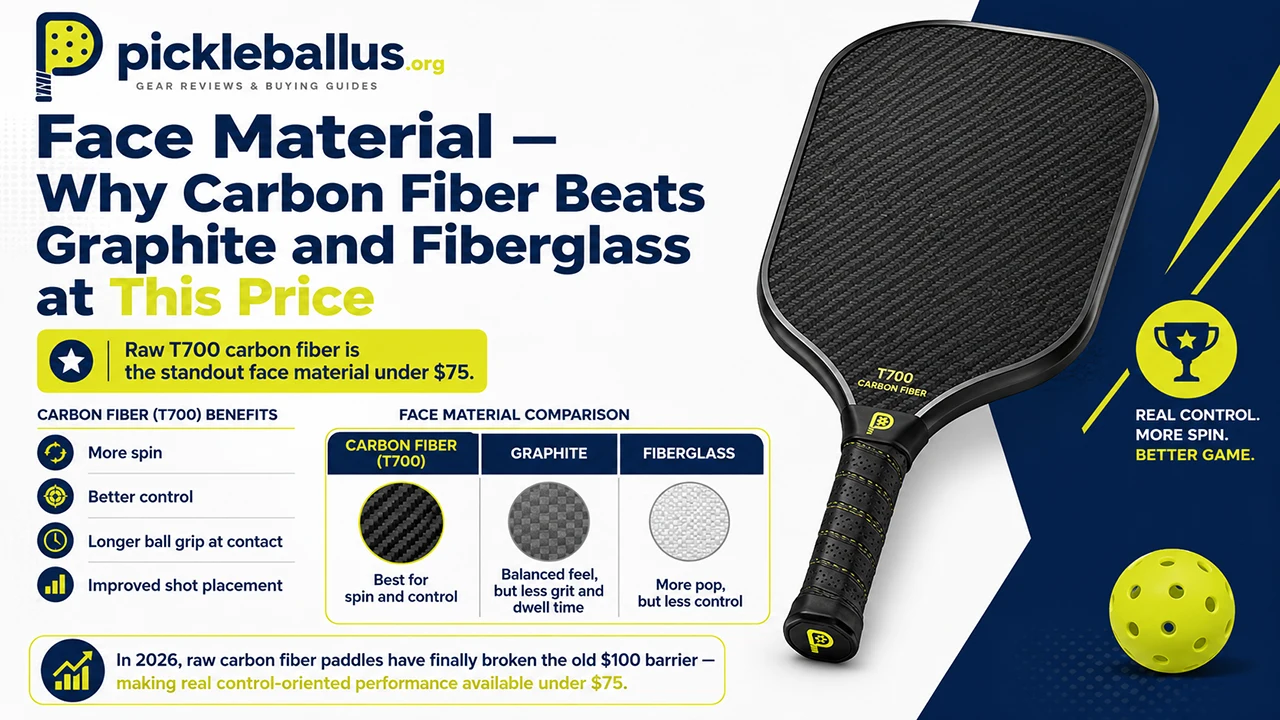
Face Material — Why Carbon Fiber Beats Graphite and Fiberglass at This Price
Carbon fiber — specifically raw T700 carbon fiber — is the standout face material at the under-$75 price point because it grips the ball longer at contact, generating more spin and better shot placement than graphite or fiberglass alternatives.
Fiberglass paddles feel livelier off the face and produce more pop, but that extra bounce comes at the cost of control. For players still developing consistent placement, a fiberglass paddle amplifies mistakes as much as it amplifies good shots. Graphite sits in between — lighter and more responsive than fiberglass, but without the grit and dwell time that raw carbon fiber provides.
The shift that makes 2026 different from previous years is that raw carbon fiber paddles have broken through the $100 price floor. Several paddles on this list carry T700 carbon fiber faces at prices that would have seemed impossible just two years ago. If you are already researching the best pickleball paddles for control, carbon fiber at this budget is where that search starts and often ends.
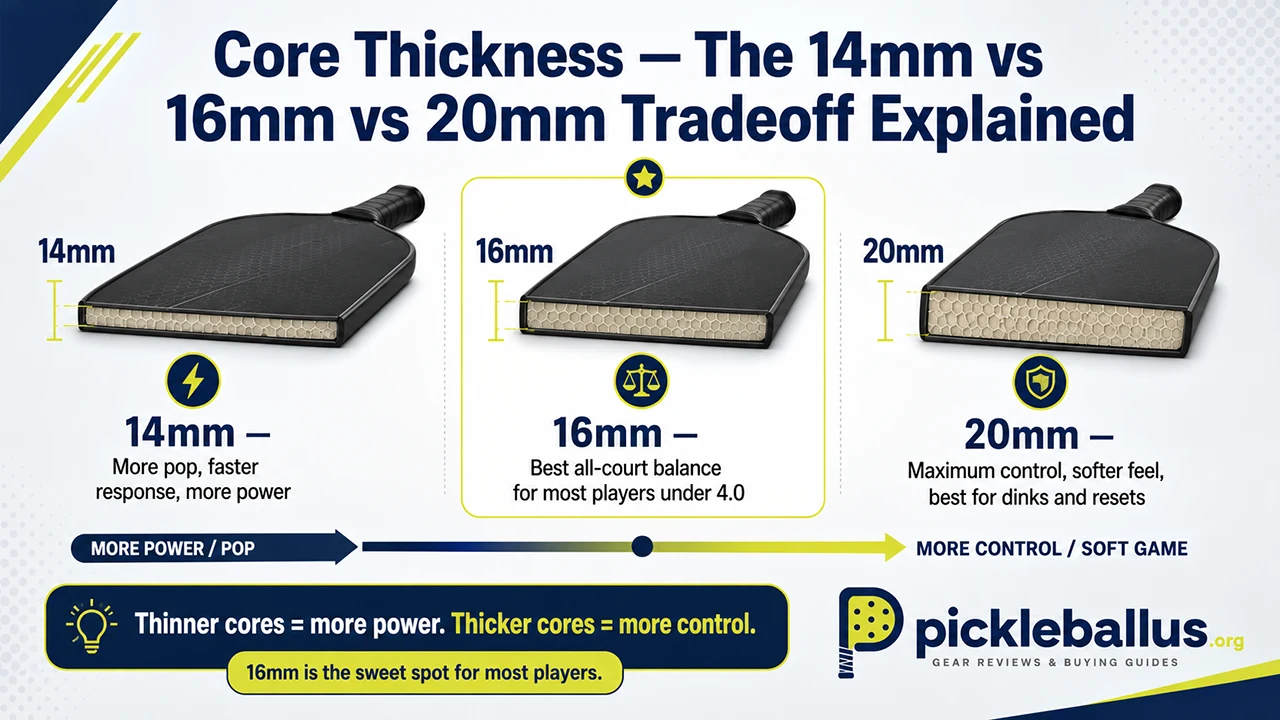
Core Thickness — The 14mm vs 16mm vs 20mm Tradeoff Explained
Core thickness directly controls the tradeoff between power and control — thinner cores (14mm) produce more pop and a faster response, while thicker cores (16–20mm) absorb more energy and return softer, more precise shots.
For most players under a 4.0 skill rating, a 16mm core offers the best all-court balance: enough power to drive from the baseline and enough cushion to execute drops and resets at the kitchen line. A 20mm core, like the one in the Doctor Pickleball Surgical Control, takes the control side of that tradeoff to an extreme — exceptional for dinking and soft-game specialists, but less suited to players who rely on power.
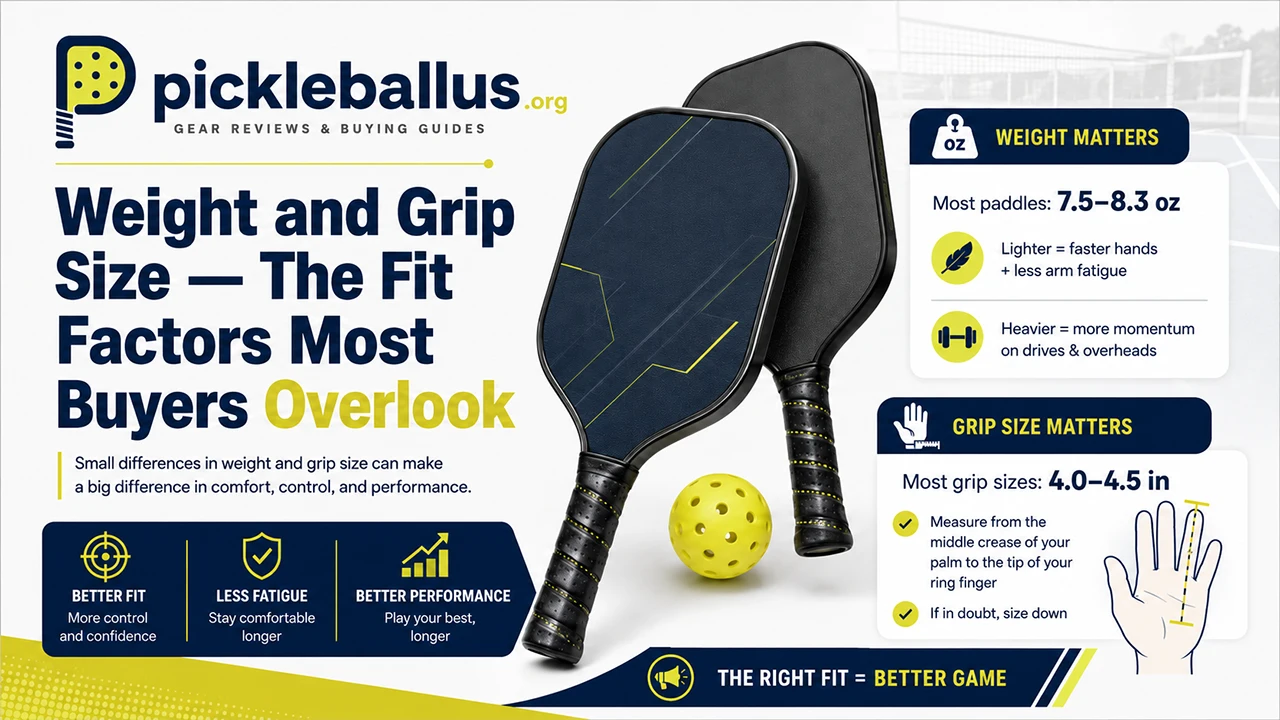
Weight and Grip Size — The Fit Factors Most Buyers Overlook
Most paddles in this category fall between 7.5 and 8.3 oz, and that window matters more than most buyers realize. A paddle on the lighter end moves faster and reduces arm fatigue — important for players managing tennis elbow or those with smaller frames. A paddle toward the heavier end generates more momentum on drives and overhead slams, which aggressive baseliners tend to prefer.
Grip size follows a simple rule of thumb: measure the distance from the middle crease of your palm to the tip of your ring finger in inches. Most players land between 4.0 and 4.5 inches — the standard small and medium grip sizes. An undersized grip lets you add an overgrip layer to build it up; an oversized grip cannot be shrunk, so when in doubt, size down.
7 Best Pickleball Paddles Under $75 — Full Reviews
Here are the seven best pickleball paddles under $75 play-tested and ranked for 2026. Every paddle below ships through Amazon and carries verified sales history with consistent customer ratings.
#1 Doctor Pickleball Surgical Control — Best Overall
The Doctor Pickleball Surgical Control earns the top spot in this roundup because it is the only paddle under $75 with a 20mm thick T700 carbon fiber face — a spec you typically find only on paddles priced well above this range.
Key Specs:
- Face: T700 raw carbon fiber
- Core thickness: 20mm honeycomb polymer
- Weight: 7.8 oz
- Handle length: 5.5 inches
- USAPA approved: Yes
Performance Analysis: The 20mm core changes how this paddle behaves at the kitchen line. Dinks land with soft, consistent placement. Drops that would sail out on a thinner paddle stay in the transition zone. That said, the thickness absorbs a noticeable amount of power — players who open up on drives will find the paddle measured compared to a 14mm or 16mm alternative. The carbon fiber face retains grit well through the first months of play, and the updated grip texture in the 2025 release removed the slippage complaints from earlier versions.
Pros:
- 20mm core delivers control that rivals paddles at twice the price
- T700 carbon fiber grabs the ball for consistent spin and placement
- USAPA approved for tournament play
- Comes with cover, grip tape, and a carbon fiber cleaning bar
Cons:
- Not ideal for power-first players who drive aggressively
- 20mm thickness takes adjustment if you are coming from a thinner paddle
Best For: Control-focused players, soft-game specialists, beginners who want to build accuracy from the start, and players dealing with tennis elbow who need a forgiving feel.
My Verdict: The Surgical Control is the easiest recommendation on this list. The 20mm carbon fiber spec at this price is genuinely unusual, and the performance backs it up. If your game centers on dinking, drops, and placement over power, no paddle in this price range touches it.
#2 Vatic Pro Prism Flash — Best for Intermediate Players
The Vatic Pro Prism Flash is the paddle intermediate players see recommended most frequently in 2026, and for good reason — it delivers T700 raw carbon fiber, a 16mm core, and excellent all-court performance at a price that undercuts most comparable paddles by $30 to $50.
Key Specs:
- Face: T700 raw carbon fiber (unidirectional)
- Core thickness: 16mm polypropylene honeycomb
- Weight: 7.6 oz
- Handle length: 5.5 inches
- USAPA approved: Yes
Performance Analysis: The Flash balances power and control better than any other paddle at this price. At the baseline, it generates solid drive pace without feeling like you are forcing every shot. At the kitchen, the 16mm core gives enough cushion to execute drops and resets. Spin generation is strong — the T700 face has enough surface texture to curl serves and shape dinks with intention. This paddle is one of a small group that earns its spot on the best pickleball paddles for intermediate players lists across multiple review sites.
Pros:
- Exceptional all-court balance at this price tier
- T700 carbon fiber provides consistent spin across all shot types
- Lightweight build suits players who want fast hand speed at the net
- Widely available and easy to replace if damaged
Cons:
- Not thermoformed (the Vatic Pro V7 and V-Sol Pro are, at a higher price)
- Grip can feel slightly thin for players with larger hands
Best For: Intermediate players (3.0–4.0 rating) who want a genuine upgrade from their starter paddle without crossing into the $100+ range. Doubles players who prioritize quick hands at the kitchen will find this paddle especially comfortable.
My Verdict: The Prism Flash is the most versatile paddle on this list. It handles everything adequately and handles dinking and spin exceptionally. For intermediate players shopping at this price, this is the default recommendation.
#3 PBVMURTG Carbon Fiber Paddle — Best Under $50
The PBVMURTG Carbon Fiber Paddle belongs on this list for one straightforward reason: it delivers a genuine carbon fiber face with a polymer honeycomb core at a price so low it should not be possible, making it the best entry point for players who are not yet ready to commit to a higher spend.
Key Specs:
- Face: Carbon fiber
- Core thickness: 16mm polymer honeycomb
- Weight: 7.8–8.0 oz
- Handle length: 5.25 inches
- USAPA approved: Yes
Performance Analysis: For the price, the PBVMURTG surprises on every front. Spin is better than you expect from a paddle in this range. Control is sufficient for consistent baseline play and soft game development. Power output is adequate — not exciting, but not limiting either. The paddle comes with a cover, grip tape, and a cleaning bar, which adds real value at this price tier. It does not match the Doctor Pickleball or the Vatic Pro Flash in performance, but it comes closer than it has any right to at this price.
Pros:
- Carbon fiber face at a price that undercuts most fiberglass paddles
- Includes accessories: cover, grip tape, cleaning bar
- Solid entry-level spin and control
- USAPA approved
Cons:
- Face grit may wear faster than paddles with higher-grade carbon
- Power output is limited compared to paddles with stiffer thermoformed construction
- Handle length may be short for two-handed backhand players
Best For: True beginners who want to start with carbon fiber rather than wood or fiberglass, casual players who want a backup paddle, or anyone unsure about long-term pickleball commitment. If you are exploring the full best pickleball paddles under $50 category, this is the standout at that lower threshold.
My Verdict: It is the most accessible quality paddle on this list. Buy it if budget is the overriding factor and you still want a carbon fiber face.
#4 Selkirk Latitude Pickleball Set — Best Value Set
The Selkirk Latitude Pickleball Set is the only pick on this list that gives you two paddles, outdoor balls, and a carry bag — all under $75 on Amazon — making it the best value for players who need gear for two people or want a ready-to-play complete kit.
Key Specs (per paddle):
- Face: Fiberglass composite
- Core: Polymer honeycomb
- Weight: 7.5–7.8 oz
- Handle length: 5.0 inches
- USAPA approved: Yes
Performance Analysis: Selkirk is a respected brand at the premium end of the market, and even at this price their quality control shows. The Latitude paddles feel balanced in the hand — neither too light nor too cumbersome. Spin and control are solid for recreational and beginner play. They are not carbon fiber, so spin generation and dwell time fall behind the other paddles on this list, but for two people playing casually or a family getting into the sport, the package value is unmatched. The grip runs slightly loose out of the box — an overgrip wrap fixes that easily.
Pros:
- Two paddles plus balls and bag under $75 — unbeatable kit value
- Selkirk brand quality at a budget-accessible price
- Lightweight build suits beginners and recreational players
- Widely available on Amazon
Cons:
- Fiberglass face lacks the control and spin of carbon fiber
- Grip feels loose compared to single-paddle offerings in this range
- Not suited for intermediate or advanced players looking for performance gains
Best For: Two friends, couples, or families picking up pickleball together. Also strong for players who want backup gear or need to equip a guest. Worth cross-referencing with the broader best pickleball paddles for beginners list if single-paddle options are also on your shortlist.
My Verdict: The best deal on this list if you are equipping two players. For solo buyers chasing performance, look at the Doctor Pickleball or Vatic Pro instead.
#5 Roore Coronado Titanium Carbon Fiber Weave — Best Premium Feel
The Roore Coronado Titanium Carbon Fiber Weave earns its place here because it is the only paddle in this price tier with a titanium-reinforced carbon fiber weave face — the construction you typically find on paddles in the $150–$200 range — making it the closest thing to a premium paddle experience that $75 buys.
Key Specs:
- Face: Titanium-reinforced carbon fiber weave
- Core: Polymer honeycomb
- Weight: 7.9 oz
- Handle length: 5.5 inches
- USAPA approved: Yes
Performance Analysis: The weave face construction changes the feel of ball contact in a way that is noticeable within the first few games. It grabs the ball better than standard unidirectional carbon fiber, producing more spin on serves and better shape on dinks. The visual design — a topographic map pattern — is a standout among budget paddles that usually offer little in the aesthetics department. All-court performance is strong. Spin, control, and power read closer to a $150 paddle than to what the price tag suggests.
Pros:
- Titanium carbon fiber weave face is the standout material spec in this price range
- Strong spin generation and precise shot placement
- Premium packaging: includes cover and grip tape
- Aesthetically distinctive — one of the best-looking budget paddles available
Cons:
- Availability can fluctuate on Amazon; pricing may vary without a discount code applied
- Limited brand recognition compared to Selkirk, JOOLA, or Vatic Pro
- Not thermoformed
Best For: Players who want the closest possible premium-paddle feel at this budget, and anyone who values a distinctive visual design. Also suited to 3.5–4.0 players looking for better spin generation than standard carbon fiber paddles provide.
My Verdict: The most surprising paddle on this list. The titanium weave face performs above its price point in every meaningful way. Worth the hunt if it is in stock at the right price.
#6 JOOLA Essentials Pickleball Paddle — Best for True Beginners
The JOOLA Essentials brings the credibility of one of the most recognized names in paddle sports — JOOLA makes equipment for competitive table tennis at the Olympic level — into a beginner-accessible pickleball package with a fiberglass face, large sweet spot, and comfortable grip.
Key Specs:
- Face: Fiberglass composite
- Core: Polymer honeycomb
- Weight: 8.0–8.3 oz
- Handle length: 5.0 inches
- USAPA approved: Yes
Performance Analysis: The JOOLA Essentials plays like it was designed for players who are learning to rally before they are learning to compete. The sweet spot is wide and forgiving — off-center hits stay in play more often than with narrower carbon fiber paddles. Power output is solid for the weight, and the fiberglass face provides a lively bounce that helps beginners generate pace without aggressive swing mechanics. The grip is comfortable and maintains tack well. Spin generation is limited compared to carbon fiber options, but for a player at 2.0–2.5 skill level, that is rarely the limiting factor.
Pros:
- Large, forgiving sweet spot suited for beginners developing consistency
- JOOLA brand reliability and quality control
- Comfortable grip that holds up through long sessions
- Good power output for a beginner paddle
Cons:
- Fiberglass face cannot match carbon fiber for spin or dwell time
- Heavier end of the weight range — may cause fatigue for smaller players
- Players will outgrow this paddle faster than they would a carbon fiber option
Best For: First-time pickleball players who want an approachable, forgiving paddle from a trusted brand. Strong pick for recreational players who will not be pushing toward competitive play in the near term.
My Verdict: The safest starting point for a true beginner. If you are buying for someone new to racket sports entirely, start here.
#7 Head Radical Elite — Best for Tennis Players Transitioning to Pickleball
The Head Radical Elite makes this list specifically for tennis players switching to pickleball who want a familiar brand name and a paddle that reflects the oversized, head-heavy feel many tennis players are already comfortable with. For other buyers, better options exist at this price.
Key Specs:
- Face: Graphite
- Core: OTC honeycomb composite
- Weight: 7.9 oz
- Handle length: 5.25 inches
- USAPA approved: Yes
Performance Analysis: Head’s positioning of the Radical Elite as a beginner paddle is accurate in one specific context: tennis players who already know how to generate pace and need a paddle that does not punish their existing swing mechanics. The large sweet spot and thick OTC core absorb aggressive shots well. Where it falls short for experienced pickleball players is spin and control precision — the graphite face does not generate comparable spin to carbon fiber options, and control at the kitchen line feels less intuitive than with a 16mm or 20mm carbon paddle.
Pros:
- Familiar brand for tennis players; Head’s construction quality is consistent
- Large sweet spot forgives aggressive tennis-style swings
- Widely available on Amazon with strong customer support
- Suitable for players who already have a tennis background
Cons:
- Graphite face underperforms carbon fiber at this price range
- Weaker control and spin generation than Doctor Pickleball or Vatic Pro Flash
- Tennis players will need to adjust technique significantly for the kitchen game
Best For: Tennis players in their first months of pickleball who want brand familiarity and a forgiving hitting surface while they adjust technique. Not recommended as a first choice for players coming from other sports or new to racket sports entirely.
My Verdict: A competent but not remarkable paddle. Choose it only if tennis-brand familiarity is a meaningful factor in your buying decision. Everyone else gets more value from the Vatic Pro Prism Flash or Doctor Pickleball Surgical Control at similar or lower prices.
Carbon Fiber vs. Fiberglass vs. Graphite — Which Budget Paddle Material Should You Choose?
Carbon fiber wins at this price point for spin, control, and long-term durability, fiberglass wins for power and lively feel, and graphite sits between the two without clearly excelling at either. Here is how the three materials break down practically for paddles in the under-$75 range.
The table below summarizes the key differences across the criteria that matter most for budget buyers:
| Criteria | Carbon Fiber | Fiberglass | Graphite |
|---|---|---|---|
| Spin Generation | High — surface grit grabs the ball | Moderate | Moderate |
| Control / Dwell Time | High — longer contact window | Low-moderate | Moderate |
| Power Output | Moderate | High — lively bounce | Moderate-high |
| Durability (grit retention) | Good | Excellent | Moderate |
| Best Skill Level | Beginner through advanced | Beginner | Beginner to intermediate |
| Common Price Floor | Now accessible under $75 | Under $40 | Under $60 |
The biggest shift in the market over the past two years is the carbon fiber price floor dropping below $75 — and in some cases below $50 — without a corresponding drop in quality. For players who plan to stay in the sport beyond a casual introduction, starting with carbon fiber saves money in the long run because the paddle remains relevant as your skill level climbs. You can find the full breakdown of how these materials compare on the pickleball paddle materials guide.
How to Choose the Right Pickleball Paddle Under $75 for Your Skill Level
Your skill rating determines which paddle specification matters most — beginners need forgiveness and consistency, intermediate players need a material and thickness that matches how they are learning to shape shots.
Beginner Players (Skill Rating 2.0–3.0)
For players in this range, the priority is consistency over performance. A beginner benefits more from a large sweet spot and a forgiving core than from a high-spin carbon fiber face that amplifies technical errors alongside intentional spin.
The Selkirk Latitude Set or the JOOLA Essentials serve this group well because their wider hitting surfaces and more elastic faces keep the ball in play during rallies — which is the primary skill beginner players are developing. The PBVMURTG Carbon Fiber Paddle is also a strong pick for beginners who want to start with carbon fiber and avoid re-buying when they improve. The broader best cheap pickleball paddles category includes additional beginner-focused options if none of these are the right fit.
Intermediate Players (Skill Rating 3.5–4.0)
Intermediate players should focus on face material and core thickness rather than brand name. A T700 raw carbon fiber face at 16mm gives the combination of spin-generation, dwell time, and shot control that intermediate players need to develop the soft game and third-shot drop that separates 3.5 from 4.0 play.
The Doctor Pickleball Surgical Control (20mm for soft-game specialists) and the Vatic Pro Prism Flash (16mm for all-court balance) are the two paddles that serve this group best. Both are the kind of paddles you will see consistently recommended across the best pickleball paddles roundups regardless of price category. If budget allows a small step up, the best pickleball paddles under $100 category opens additional thermoformed options worth considering.
Are Budget Pickleball Paddles Worth It — Or Should You Spend More?
Yes, budget pickleball paddles are worth it in 2026 — with two clear conditions: you choose a carbon fiber face, and you stay within the brands and models with verified Amazon sales history and consistent reviews. The performance gap between a $75 carbon fiber paddle and a $150 paddle has narrowed enough that most players below 4.5 skill rating will not notice the difference in match play.
The cases where spending more makes genuine sense are narrow. Thermoformed construction, which is the main differentiator in the $100–$150 range, adds pop, consistency, and durability that extends the paddle’s useful life. Players at 4.0+ who play three or more times per week will eventually feel that difference. Players who play recreationally once or twice a week at 3.5 or below will not get measurable improvement from spending twice as much.
The paddles on this list — particularly the Doctor Pickleball Surgical Control, Vatic Pro Prism Flash, and Roore Coronado — compete with paddles in the $100–$150 range in every category that matters for recreational and intermediate play. The budget paddle market in 2026 is genuinely competitive in a way that was not true three years ago.
By now you have a complete picture of the seven best paddles under $75, how the top materials compare, and which option fits your game based on skill level and playing style. Choosing the right paddle, however, is only half the equation — how you maintain it, when you recognize it is no longer performing at its original level, and how to protect a budget-tier surface from premature degradation will determine whether your investment lasts a full season or just a few months. The next section covers the practical details that most review guides skip.
Getting the Most Out of Your Budget Paddle — What Experienced Players Know
Players who get three years out of a $75 paddle and players who go through two in a single season are often making the same mistake — or avoiding it. The difference is almost entirely maintenance and timing.
How to Clean and Protect a Carbon Fiber Surface
Clean the carbon fiber face with a dedicated paddle eraser or a damp microfiber cloth after every session — never use abrasive materials, solvents, or rough towels, which strip the surface grit that generates spin.
Ball residue and court dust fill the micro-texture of a carbon fiber face over time, reducing the surface friction that makes spin possible. A light pass with a paddle eraser or damp cloth after play takes thirty seconds and preserves that texture for months longer than a paddle that never gets cleaned. Store your paddle away from direct heat — car dashboards in summer are a common delamination accelerator that budget paddles are especially vulnerable to.
Signs Your Paddle Is Dead — And When to Upgrade
A dead paddle produces a hollow, echoey sound on contact instead of a solid thud, feels noticeably less responsive on dinks and drops, and may show visible surface separation at the edges or face. These are signs of core compression or delamination — and no amount of cleaning reverses them.
If you are losing easy shots you used to make — drops going long, dinks losing depth — check the paddle before blaming technique. Tap the face in several spots and listen for inconsistency in the sound. A paddle that was solid and even at purchase and now sounds different in one corner has a compromised core and should be replaced.
Why Cheap Paddles Fail Fast — Delamination and Grit Loss Explained
Delamination occurs when the carbon fiber face separates from the core, usually triggered by heat exposure, a hard impact at the edge, or substandard adhesive at the manufacturing stage. Budget paddles are more vulnerable because the bond between face and core is less likely to be thermoformed — a production process that fuses layers under heat and pressure for permanent adhesion.
Grit loss follows a separate path: the micro-texture of a raw carbon fiber surface wears with use, particularly when players who generate heavy topspin drive the ball repeatedly against a hard court surface. Higher-grade paddles use denser fiber weaves that resist wear longer. At the budget tier, protecting grit through regular cleaning and avoiding abrasive surfaces extends the usable window meaningfully.
Budget Paddle vs. Premium Paddle: What You Actually Lose at $75
At the $75 threshold compared to $150+, you lose thermoformed construction, longer grit retention, and the consistency of a premium core — but you keep 80–90% of the on-court performance for recreational and intermediate play.
The practical performance difference between a $75 carbon fiber paddle and a $150 thermoformed carbon fiber paddle shows up at the edges of the performance envelope: harder drives, faster hands at the kitchen, more aggressive spin serves. For players still developing those skills, the gap is largely theoretical. The $75 paddle does not limit you until you are technically capable of exploiting what the premium paddle offers — and most players reach that level well after they have already justified a step-up investment.
Write Your Review
No reviews yet. Be the first to share your experience!