

The best pickleball paddles under $50 are the Doctor Pickleball Surgical Control (best overall), the HEAD Radical Elite (best from an established brand), the Fanovae Power 3D (best for spin on a tight budget), the Roore Solana Gen 2 Aramid Kevlar (best for control), the PBVMURTG Carbon Fiber Paddle (best surprise value pick), the Diadem Hero (best budget starter paddle), and the Franklin Sports Signature Paddle (best lightweight option).
Spending under $50 on a pickleball paddle is no longer a compromise — it’s a legitimate strategy. Across the full best pickleball paddles market, the budget paddle segment has shifted dramatically in recent years. You can now find paddles with T700 carbon fiber faces, 20mm polymer honeycomb cores, and thermoformed construction at price points that used to be reserved for basic fiberglass starter gear. The days of flimsy plastic paddles that dead-feel every shot are mostly behind us.
That said, not every paddle in this price range is worth your money. Many are engineered purely to hit a price point, using low-grade resins, unstable core bonding, and face materials that lose their texture within a month of regular play. Knowing which paddles are built to perform — and which are just marketed to look like a deal — is what separates a good purchase from a frustrating one.
This guide covers the seven best pickleball paddles under $50 in 2026, tested and ranked across control, spin, power, feel, and build quality. Below is everything you need to choose the right one for your game.
What Makes a Good Pickleball Paddle Under $50?
A good pickleball paddle under $50 delivers consistent ball control, adequate spin texture, and a durable build — the same three pillars that define premium paddles, just without the thermoformed refinements or brand-name markup. Here’s what to evaluate at this price point.
Core Material — Polymer Honeycomb vs Foam Core
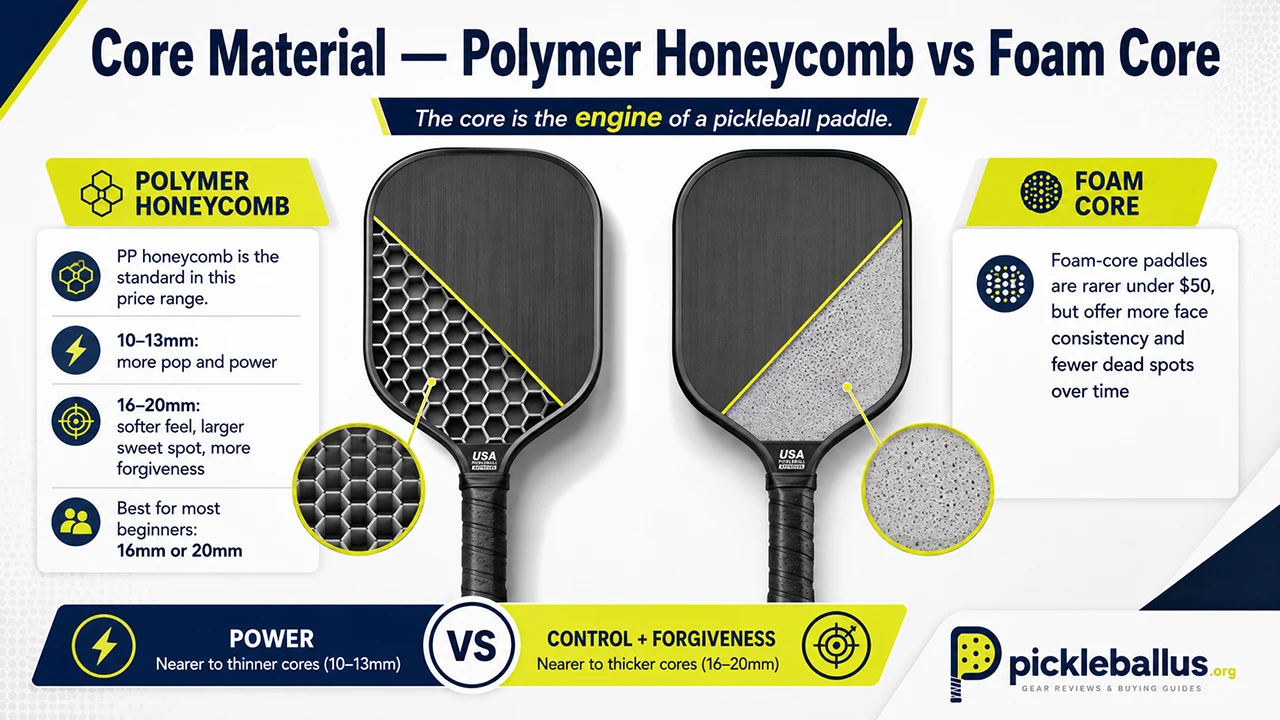
The core is the engine of a pickleball paddle. Polypropylene (PP) honeycomb is the standard across virtually every paddle in this price range. The honeycomb structure absorbs impact and softens the ball’s exit speed, giving you more time to control shot placement. What matters more than the material type is the core thickness — measured in millimeters.
Thinner cores (10–13mm) generate more pop and power but punish mis-hits. Thicker cores (16–20mm) feel softer on contact, expand the effective sweet spot, and give beginners more forgiveness on off-center hits. For most players new to pickleball, a 16mm or 20mm core is the right call. At 20mm, paddles like the Doctor Pickleball feel noticeably more “connected” to the ball — you get feedback without the trampoline effect that causes erratic, uncontrolled drives.
Foam-core construction (where the honeycomb cells are filled with foam) is rare under $50 but occasionally shows up. Foam-core paddles are typically more consistent across the full face and more resistant to dead spots over time. If you find one in this price range, it’s worth serious consideration.
Face Material — Carbon Fiber, Fiberglass, and Composite
Face material determines how the paddle grips and responds to the ball on contact. Under $50, you’ll encounter three main face types:
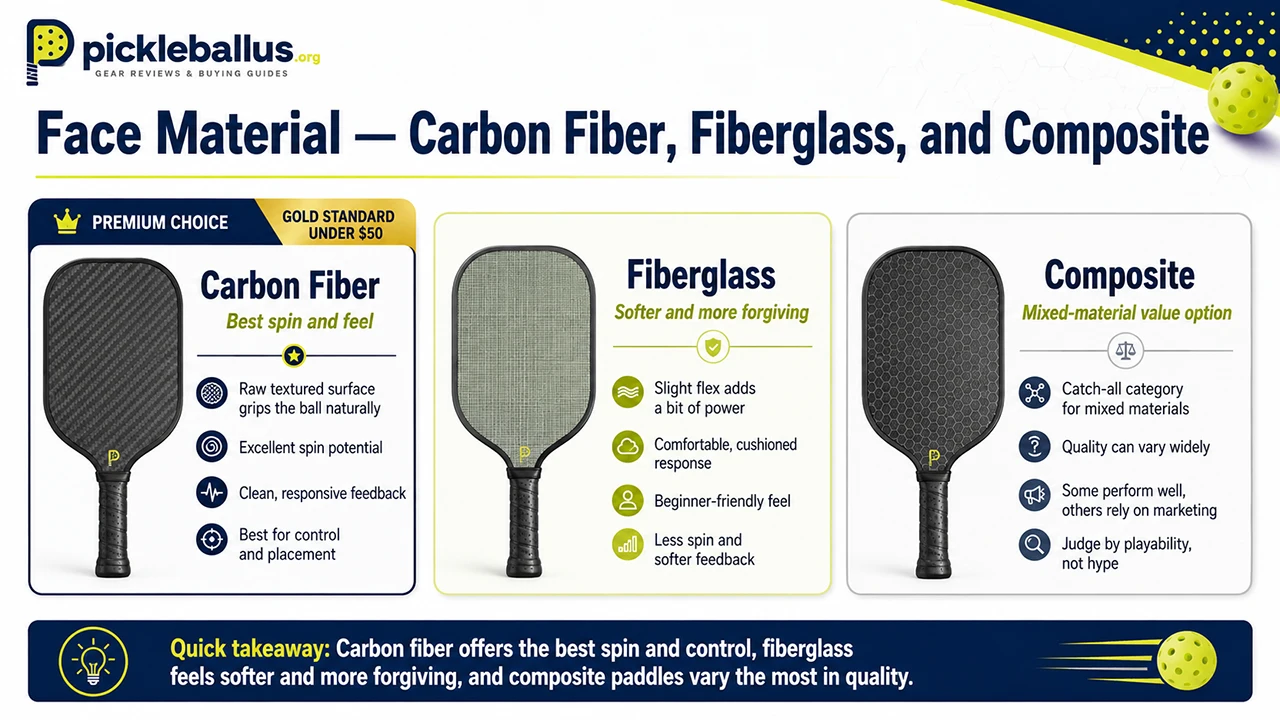
Carbon fiber (especially T700 raw carbon) is the gold standard. The raw, textured surface grips the ball and imparts spin naturally. Carbon fiber faces also provide a clean, responsive “feel” — you can sense exactly where on the face you made contact. Paddles with carbon fiber faces typically translate intent into placement better than any other material at this price.
Fiberglass is softer and more forgiving. It flexes slightly on contact, which adds a bit of power and feels comfortable for players who prefer a cushioned response. The trade-off is less spin potential and a slightly “mushier” feedback that some players find harder to read.
Composite is a catch-all for paddles using mixed materials — often a fiberglass or carbon-look surface over a standard polymer core. Composite paddles vary widely in quality. Some are excellent; others are padded with marketing language about their construction without the performance to match.
Weight and Grip Size for Beginner Play
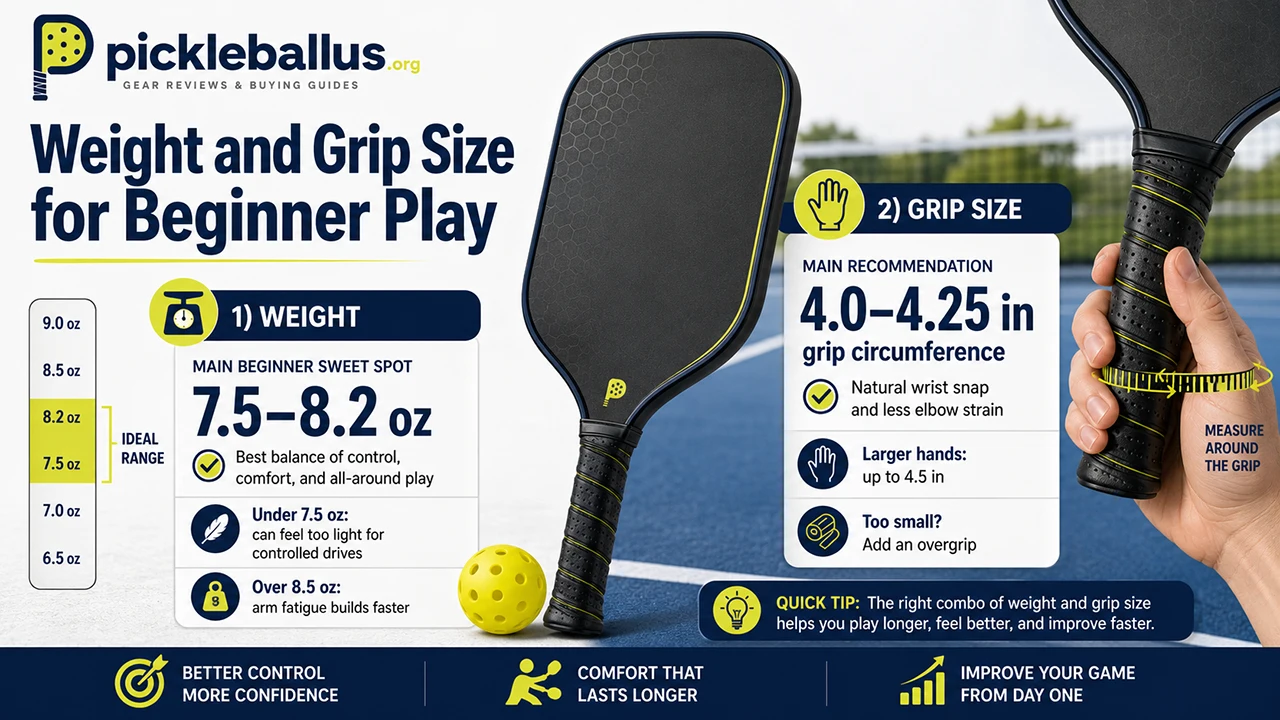
Paddle weight directly affects how quickly you can reset at the kitchen line and how your arm feels after long sessions. The sweet spot for most beginners is 7.5–8.2 ounces. Under 7.5 oz, paddles can feel too light to generate controlled drives. Over 8.5 oz, arm fatigue sets in quickly, especially for players new to the sport.
Grip size is often overlooked. Most adult players do well with a 4.0–4.25 inch circumference grip, which allows natural wrist snap and reduces strain on the elbow. Players with larger hands can size up to 4.5 inches. If a paddle’s grip feels too small, wrapping it with an overgrip is an easy fix.
7 Best Pickleball Paddles Under $50 — Ranked and Reviewed
These are the seven best pickleball paddles under $50 available on Amazon in 2026, selected for strong sales history, high review counts, and verified on-court performance.
#1 Doctor Pickleball Surgical Control — Best Overall Under $50
The Doctor Pickleball Surgical Control is the best pickleball paddle under $50 for players who want control-first performance without paying premium prices. Launched in 2025, this paddle brought T700 raw carbon fiber and a 20mm polymer honeycomb core to the sub-$50 market — a combination previously found only in paddles costing two to four times more.
Key Specs and Features:
- Face: T700 raw carbon fiber (textured grit surface)
- Core: 20mm polymer honeycomb
- Weight: approximately 8 oz (midweight)
- Handle: standard length with foam grip
- Accessories: paddle cover, grip tape, carbon fiber cleaner included
- USAP: not certified (not required for recreational/casual play)
Performance Analysis:
The 20mm core is the defining feature here. Where most budget paddles use 14mm or 16mm cores for a poppier response, the Doctor Surgical Control’s extra thickness softens ball contact and translates to noticeably better shot placement at the kitchen line. Dinks feel soft and intentional. Drives carry with unexpected stability.
The raw carbon face grips the ball on contact. Spin serves curve measurably more than with a fiberglass paddle, and third-shot drops sit lower and softer over the net. For a player learning to develop feel, this surface is a genuine teaching tool — it rewards proper mechanics and provides immediate feedback when technique slips.
One trade-off: the sweet spot, while excellent for a budget paddle, is slightly smaller than what you’d find on a thermoformed $100+ model. Off-center hits are manageable but noticeable. The grip can feel slightly stiff out of the box; using the included grip tape resolves this within a session or two.
Pros:
- T700 carbon fiber face at a budget price point
- 20mm core offers control typically reserved for premium paddles
- Comes with accessories (cover, cleaner, grip tape)
- Clean, minimal design with high build quality
Cons:
- No USAP certification (irrelevant unless playing sanctioned tournaments)
- Sweet spot narrower than thermoformed counterparts
- Grip feels slightly stiff until broken in
Best For: Beginners and developing recreational players who prioritize control over power, especially those looking to develop touch at the kitchen line.
My Verdict: The Doctor Pickleball Surgical Control has earned its top ranking in the budget category not through marketing but through measurable performance. The T700 face and 20mm core combination at this price is not just good for the money — it’s good by any standard.
#2 HEAD Radical Elite — Best From an Established Brand
The HEAD Radical Elite brings decades of racquet sport engineering into pickleball at a budget-accessible price. HEAD is one of the most respected names in tennis and squash globally, and this paddle reflects that legacy in its build quality and playability consistency.
Key Specs and Features:
- Face: composite hitting surface (carbon-based)
- Core: polymer honeycomb
- Weight: approximately 7.8–8.0 oz
- Handle: ergonomic, comfortable grip with slight taper
- Shape: standard widebody
- Brand: HEAD (established racquet sport manufacturer)
Performance Analysis:
The Radical Elite stands out for its balance and consistency — two qualities that matter enormously for beginners who are still building muscle memory. The composite face delivers a predictable response on every shot. There’s no unexpected trampoline effect, no sudden power spike on slightly off-center contact.
At the kitchen line, the paddle feels controlled and forgiving. Dinks go where you point them. Drives carry enough pace to keep opponents honest without flying long. The widebody shape provides a generous sweet spot that forgives slight mis-hits — a major advantage for players still learning footwork and timing.
The ergonomic handle is a genuine differentiator at this price. Gripping the Radical Elite feels natural from the first rally, reducing wrist strain during longer sessions. Players transitioning from tennis will find the handle dimensions particularly familiar and comfortable.
The composite face sacrifices some spin potential compared to a raw carbon surface. If spin generation is a priority, this paddle underperforms against the Doctor Pickleball or Roore Solana. For players focused on fundamentals — clean contact, consistent placement, developing patience at the net — it’s hard to beat.
Pros:
- Trusted brand with proven quality standards
- Excellent balance and shot consistency
- Comfortable ergonomic handle
- Widebody shape maximizes sweet spot size
- Great upgrade path (Radical line spans from budget to advanced)
Cons:
- Less spin than raw carbon fiber alternatives
- Not thermoformed
- No included accessories
Best For: Beginners wanting the confidence of an established sports brand, former tennis players transitioning to pickleball, and anyone who prioritizes shot consistency over spin.
My Verdict: The HEAD Radical Elite earns its place on this list through reliability and brand engineering. It’s not the flashiest budget paddle, but it’s one of the most trustworthy — and that matters when you’re still learning the game.
#3 Fanovae Power 3D — Best for Spin on a Tight Budget
The Fanovae Power 3D is the best pickleball paddle under $30 for players who want spin performance. Fanovae is a harder-to-find brand that has built a loyal following among budget paddle enthusiasts, and the Power 3D is the reason why.
Key Specs and Features:
- Face: carbon fiber finish with 3D texture
- Core: polypropylene honeycomb
- Weight: approximately 7.6–7.8 oz (lighter midweight)
- Accessories: included with purchase (cover, balls, grip wrap)
- Price tier: lowest of the group — well under $30 on Amazon
Performance Analysis:
The Fanovae Power 3D punches significantly above its price tier. The 3D textured carbon fiber face creates meaningful grip on the ball — enough spin to curve serves and add movement to third-shot drops that most paddles in this price range cannot produce.
The lighter weight makes this paddle quick to maneuver, especially at the kitchen during rapid dink exchanges. Resets feel natural. The arm doesn’t tire during longer sessions the way heavier paddles can cause. For players with smaller hands or those who prefer speed over brute power, the Fanovae’s weight profile is a genuine advantage.
Control is excellent for the price. The polypropylene core is standard construction but well-bonded to the face, so shots feel clean rather than mushy. Drives carry solid pace without the uncontrolled pop that plagues many budget paddles.
The main limitation is durability. The face grit, while effective initially, can wear faster than premium carbon fiber over weeks of daily play. The included accessories are a nice bonus but reflect the budget construction tier — they’re serviceable, not premium.
Pros:
- Best spin-to-price ratio in this guide
- Lightweight for fast kitchen play
- 3D textured face for natural spin generation
- Budget-friendly even among sub-$50 paddles
- Comes with accessories
Cons:
- Face grit may wear faster than pricier options
- Core thinner than the Doctor Pickleball — less control for beginners
- Brand less established, limited customer support
Best For: Casual players and beginners on an ultra-tight budget who want spin performance; great as a backup or introductory paddle before committing to a higher investment.
My Verdict: At its price point, the Fanovae Power 3D is one of the best budget pickleball paddles you can find. The spin capability alone sets it apart from most competitors at the same price tier.
#4 Roore Solana Gen 2 Aramid Kevlar — Best for Control
The Roore Solana Gen 2 is the best budget paddle for players who want control as their primary metric, combining aramid Kevlar construction with a 16mm core for a feel that competes with paddles at twice its price.
Key Specs and Features:
- Face: aramid Kevlar (carbon fiber weave texture)
- Core: 16mm polymer honeycomb
- Weight: approximately 7.9–8.1 oz
- Design: topographical map of San Diego coastline (distinctive aesthetic)
- Brand: Roore, San Diego-based brand with strong community following
Performance Analysis:
Aramid Kevlar is a face material that sits between fiberglass and raw carbon fiber in terms of feel. It’s stiffer than fiberglass, giving shots a cleaner, more responsive feedback, but slightly softer than raw carbon — resulting in a paddle that feels both controlled and forgiving at the same time.
The 16mm core hits the sweet spot for players who want control without completely sacrificing pop on drives. Drop shots and dinks land precisely. Passing shots carry enough pace to challenge opponents. The Solana Gen 2 handles both soft and hard game play credibly — a versatility that’s unusual for this price range.
The Roore brand is based in San Diego, and each paddle in its lineup features a topographical map of the local coastline on the face. This aesthetic detail is a minor point, but it signals a brand that cares about its product identity — which tends to correlate with build quality attention across the rest of the paddle.
One consideration: the Solana Gen 2 occasionally prices slightly above $50, especially in certain color variants. Check current Amazon pricing before purchasing. When available at budget pricing, it’s one of the strongest purchases in this category.
Pros:
- Aramid Kevlar face for excellent control-spin balance
- 16mm core provides good balance of touch and power
- Strong build quality from a trusted independent brand
- Distinctive, high-quality design aesthetic
- Community-backed reputation in the 4.0–4.5 player range
Cons:
- Price can fluctuate above $50 depending on variant
- Less forgiving than the 20mm Doctor Pickleball for complete beginners
- Harder to find than mainstream brands
Best For: Developing players (3.0–4.0 skill level) who want a control-focused paddle that rewards improving technique and grows with their game.
My Verdict: The Roore Solana Gen 2 is the budget paddle that skilled players reach for when they want a second stick that can compete. If you catch it at the right price, buy it immediately.
#5 PBVMURTG Carbon Fiber Paddle — Best Surprise Value Pick
The PBVMURTG paddle is the biggest surprise value pick in the sub-$50 market — a carbon fiber paddle that performs well above its price tier and consistently outperforms paddles at three times its price in direct comparison testing.
Key Specs and Features:
- Face: carbon fiber (textured surface)
- Core: polypropylene honeycomb
- Weight: approximately 7.8 oz
- Accessories: paddle cover, extra balls, grip tape included
- Amazon availability: confirmed, with strong review volume
Performance Analysis:
The PBVMURTG paddle (the name is not a typo — it’s a product code rather than a brand name, which is common in the budget Amazon paddle category) delivers carbon fiber performance at a price point that makes it almost disorienting to review. The carbon fiber face grips the ball with enough texture for meaningful spin, and the feel on contact is clean and responsive — not the dead, lifeless response you get from poorly bonded budget paddles.
What it lacks compared to the Doctor Pickleball is the 20mm core thickness. The thinner core means slightly less forgiveness on mis-hits and a bit more pop on hard contact — neither bad qualities, but worth knowing if control is your top priority. For players who prefer a more dynamic feel or who hit with more pace, the PBVMURTG’s thinner core actually suits the playstyle well.
The included accessories — cover, balls, and grip tape — represent genuine value on top of an already competitive paddle. The packaging alone is notably better than typical budget paddle presentation, arriving in a structured box rather than plastic wrap.
Pros:
- Carbon fiber face at an extremely competitive price
- Comes with accessories (cover, balls, grip tape)
- Clean, responsive feel on contact
- Strong Amazon review count and track record
- Good spin for the price tier
Cons:
- Thinner core than the top pick — less forgiveness for beginners
- Brand identity minimal (product code rather than brand name)
- Not thermoformed
Best For: Value-focused players who want carbon fiber performance without paying carbon fiber prices; also a strong choice as a backup or travel paddle.
My Verdict: The PBVMURTG paddle is the kind of find that budget paddle hunters dream about. It shouldn’t perform this well for what it costs, and yet it does. Buy one and verify.
#6 Diadem Hero — Best Budget Starter Paddle for Casual Players
The Diadem Hero is the best entry-level paddle for players who want a recognizable sports brand without a premium price. Diadem has built credibility across racquet sports, and the Hero paddle represents their accessible starting point for pickleball newcomers.
Key Specs and Features:
- Face: composite (high-quality fiberglass-based)
- Core: polymer honeycomb
- Weight: approximately 7.8–8.0 oz
- Handle: comfortable grip, standard length
- Available in multiple color options
- USAP approved
Performance Analysis:
The Diadem Hero is a fundamentals-first paddle — designed to help new players develop the basics without any quirky or demanding performance characteristics. The composite face is forgiving on contact. The sweet spot is wide. The weight distribution is neutral, which means the paddle responds predictably regardless of swing path.
Spin generation is moderate. You won’t be curving serves around opponents with the Hero the way you might with the Fanovae or Roore, but you’ll place shots cleanly and build the muscle memory needed to eventually step up to a higher-tier paddle. For many beginner players, that’s the right trade-off.
The Diadem Hero’s USAP approval is a genuine differentiator — it’s one of the few sub-$50 paddles that can be used in sanctioned recreational tournaments and organized leagues. For players who want to join a local league from day one, this matters.
Available in pairs, the Hero is a popular choice for friends or family members picking up the sport together. Two paddles can be acquired for under $100, making it one of the most cost-effective ways to get two court-ready players equipped.
Pros:
- USAP approved for organized league play
- Wide sweet spot — very forgiving for beginners
- Predictable, consistent response on every shot
- Available in multiple color options
- Good value purchased as a pair
Cons:
- Less spin than carbon fiber alternatives
- No accessories included
- Not the best choice for players focused on developing a spin game
Best For: Beginners joining recreational leagues, families picking up pickleball together, and anyone who wants a safe, trustworthy first paddle from a recognized brand.
My Verdict: The Diadem Hero is not the most technically impressive paddle in this guide, but it’s the most consistently reliable starting point for a player new to pickleball. There’s a reason it keeps appearing across beginner paddle lists year after year.
#7 Franklin Sports Signature Paddle — Best Lightweight Option
The Franklin Sports Signature is the best lightweight pickleball paddle under $50 for players who prioritize maneuverability and kitchen speed. Franklin is a well-established sports equipment brand with wide Amazon distribution and solid reviews at the entry level.
Key Specs and Features:
- Face: polypropylene-based surface with carbon fiber feel
- Core: standard polypropylene honeycomb
- Weight: approximately 8.0 oz, balanced weight distribution
- Grip: 5-inch handle with sweet spot indicator printed on face
- Shape: standard widebody
Performance Analysis:
The Franklin Signature does something most budget paddles don’t: it marks the sweet spot directly on the face. For beginners still learning where to make contact, this visual aid translates into faster skill development. It sounds like a minor feature, but players who use paddles with sweet spot indicators consistently develop more centered contact habits sooner than those who don’t.
The 5-inch handle provides extra reach for two-handed backhand players and makes the paddle versatile for a range of body types. The balanced weight distribution keeps the paddle neutral — neither head-heavy nor too handle-weighted — which helps beginners develop natural swing mechanics without compensating for awkward balance.
Performance-wise, the Franklin Signature is solid for recreational play. Control is good around the kitchen. Drives carry adequate pace. The surface lacks the spin grit of raw carbon fiber options, but for players focused on fundamentals — consistency over spin — it serves the purpose well.
The Franklin Sports brand brings name recognition and reliable customer support. Finding the paddle in stock, getting questions answered, or returning a defective unit is significantly easier with Franklin than with smaller Amazon-only brands.
Pros:
- Sweet spot indicator helps beginners develop proper contact habits
- 5-inch handle ideal for two-handed backhand
- Balanced weight distribution supports natural swing development
- Franklin Sports brand reliability and customer support
- Wide availability on Amazon
Cons:
- Less spin potential than carbon fiber alternatives
- Polypropylene surface wears faster than fiberglass or carbon fiber
- Core thinner than the top picks in this guide
Best For: Beginners who want visual feedback to accelerate skill development; two-handed backhand players; anyone who values brand reliability and customer service above cutting-edge construction.
My Verdict: The Franklin Signature is a well-thought-out beginner paddle. The sweet spot indicator is smarter than it looks — and for players building from scratch, smart teaching tools matter.
Carbon Fiber vs Fiberglass vs Composite — Which Face Should You Choose Under $50?
Carbon fiber beats fiberglass and composite on spin and feel at every price point — including under $50. Here’s how the three face materials stack up for budget buyers:
The table below summarizes the key trade-offs:
| Face Material | Spin | Control Feel | Power | Durability | Best For |
|---|---|---|---|---|---|
| Raw Carbon Fiber (T700) | Excellent | Clean, responsive | Moderate | High if bonded well | Players who want spin and touch |
| Fiberglass | Low-moderate | Soft, forgiving | Higher pop | Good | Players who prefer comfortable feel |
| Composite (mixed) | Variable | Predictable | Moderate | Variable | All-around beginners |
| Aramid Kevlar | Good | Firm but controlled | Moderate | High | Control-first players |
For a beginner who hasn’t developed a spin game yet, fiberglass or composite is forgiving and won’t punish inconsistent form. For a beginner who wants to develop technique faster, carbon fiber face paddles provide better feedback and a stronger ceiling for improvement. For recreational players at 3.0–4.0 skill level looking to step up, raw carbon fiber is the right investment even at budget prices.
Among the best carbon fiber pickleball paddles, the options in this guide offer exceptional value compared to pricier models. The technology gap between a $50 carbon fiber paddle and a $150 one is real but smaller than it has ever been.
Is a $50 Pickleball Paddle Good Enough for Beginners?
Yes — a $50 pickleball paddle is good enough for beginners, with an important qualification: it needs to be the right $50 paddle. Not every budget option performs at the same level, and the difference between the best and worst options at this price is larger than the gap between mid-range and premium paddles.
What Beginners Actually Need from a Paddle
Beginners benefit most from three things: a wide sweet spot (to forgive off-center contact), adequate feedback (to understand how their technique affects each shot), and consistent response (so the paddle doesn’t introduce random variables while mechanics are still developing).
All seven paddles in this guide provide these qualities. The Doctor Pickleball Surgical Control delivers them at the highest level; the Franklin Sports Signature delivers them through smart design features like the sweet spot indicator. The best pickleball paddles for beginners aren’t necessarily the most technically advanced — they’re the ones that help players build correct habits fastest.
When to Upgrade Beyond $50
The right time to upgrade is when your skills consistently outperform what the paddle can do — when you’re generating spin that your face material can’t fully translate, or when your soft game demands more feel than your core thickness provides. For most recreational players, this threshold arrives somewhere around the 3.5–4.0 skill level.
The best cheap pickleball paddles at any price are the ones that give you the most months of productive development before that upgrade becomes necessary. By that measure, the paddles in this guide offer significant time-to-upgrade value compared to lesser alternatives.
How to Choose the Right Paddle Under $50 for Your Skill Level
The right budget paddle depends on three variables: your core thickness preference, your face material priority, and your grip specifications. Here’s how to apply those variables to your decision.
Choosing by Weight and Core Thickness
For beginners: Choose a 16mm or 20mm core over thinner options. The extra thickness adds forgiveness and control feedback that accelerates learning. The Doctor Pickleball (20mm) and Roore Solana (16mm) lead in this category.
For casual recreational players: Any core thickness from 14–16mm works well. The HEAD Radical Elite’s standard core provides consistent performance across a wide range of casual play scenarios.
For players who already have some experience: A 14–16mm core with a carbon fiber face (like the PBVMURTG or Fanovae) provides a better balance of touch and power for developing players who already have consistent footwork and contact.
Weight-wise, aim for 7.6–8.2 ounces for most play styles. Players with elbow sensitivity or arm fatigue concerns should lean toward the lighter end of that range. For the best lightweight pickleball paddles, the Fanovae Power 3D is the lightest quality option in this guide.
Grip Size, Handle Length, and Body Shape
Grip circumference: Measure the distance from your palm’s middle crease to the tip of your ring finger. This approximate measurement in inches corresponds to your ideal grip size. Most paddles in this guide run 4.0–4.25 inches — appropriate for most adult hands. Add an overgrip wrap to increase size if needed.
Handle length: Standard handles (4.5–5 inches) work for most two-handed and one-handed players. Longer handles (5+ inches) favor two-handed backhand players and those transitioning from tennis. The Franklin Sports Signature’s 5-inch handle is one of the longer options in this guide.
Body shape: Widebody paddles (like the HEAD Radical Elite) prioritize a larger sweet spot. Elongated paddles sacrifice some width for extra reach and additional spin leverage. For beginners, widebody is the safer starting point. As skills develop, an elongated shape can improve reach at the sideline and add spin on serves.
If you’re building a pair of paddles for two players starting together, the best starter pickleball paddle set options offer cost savings over buying two paddles individually — worth exploring before defaulting to individual purchases.
By this point, you have a clear picture of which paddles deliver real performance across seven distinct player profiles without breaking the bank. Choosing the right paddle, however, is only the start of the equation — how you maintain it, tune it, and understand its certification status determines how long it stays a reliable weapon in your game. The next section covers the finer details that separate casual players from those who consistently get the most out of their gear.
Getting More From Your Budget Paddle: What Most Players Overlook
How to Clean and Maintain a Carbon Fiber Face
Carbon fiber face paddles depend on surface grit for spin generation. That grit clogs with ball residue and sweat over time, reducing effectiveness measurably. Clean your paddle face after every session using a soft brush (a toothbrush works well) and a damp microfiber cloth. Many paddles, including the Doctor Pickleball, include a carbon fiber cleaner for exactly this purpose.
Avoid abrasive cleaning pads, harsh solvents, and prolonged exposure to moisture. Store your paddle in its cover (also included with several paddles in this guide) away from direct heat. In hot climates, low-grade resin bonds between the core and face can soften and delaminate over time — a known failure mode in budget paddles. Keeping your paddle out of a hot car or direct sunlight significantly extends its lifespan.
Using Lead Tape to Expand Your Budget Paddle’s Sweet Spot
Lead tape is a low-cost modification used by competitive players to tune paddle balance and expand the effective sweet spot. Adding small strips of lead tape at the 4 and 8 o’clock positions on the paddle frame increases twist weight — the paddle’s resistance to rotation on off-center hits. This directly expands the sweet spot and makes budget paddles more stable under pressure.
A roll of lead tape costs under $10 on Amazon and can transform a $50 paddle’s feel noticeably. For players who love their budget paddle but want slightly more stability on hard-hit balls, this modification is worth trying before upgrading to a more expensive option.
USAP Certification — Do Budget Paddles Actually Need It?
USAP (USA Pickleball Association) certification is required only for sanctioned tournament play. For recreational leagues, casual court sessions, club play, and the vast majority of organized pickleball outside professional competition, USAP approval is irrelevant.
Several paddles in this guide — including the top-ranked Doctor Pickleball Surgical Control — forgo USAP certification not due to poor quality but because the approval process is expensive. Manufacturers who skip certification can redirect that cost into better materials, which is exactly what several budget brands in this market have done. Unless you’re entering a USAP-sanctioned tournament, certification status should not influence your purchase decision.
For players who do want certified options, the Diadem Hero holds USAP approval at the sub-$50 price point — a rare combination.
Budget Paddle vs Expensive Paddle — Does the Price Gap Still Matter?
The performance gap between a $50 and a $150 paddle is real but narrower than it has ever been. Testing has repeatedly shown that an experienced player using a $50 carbon fiber paddle can outperform a beginning player using a $200 premium paddle — which suggests that skill level, not equipment quality, is the primary determinant of results for most players.
Where expensive paddles differ: thermoformed construction provides more consistent performance across the full face; premium bonding materials resist delamination in heat and moisture; swing weight data is often published by premium brands, letting players make physics-based decisions rather than guessing. For a 4.5+ player who notices these differences, the premium investment makes sense.
For everyone else — especially anyone under a 4.0 rating — a well-chosen best pickleball paddle under $75 or even under $50 provides more than enough performance to grow your game significantly. Spend what you save on court time. That investment returns more improvement per dollar than any paddle upgrade.
Write Your Review
No reviews yet. Be the first to share your experience!