
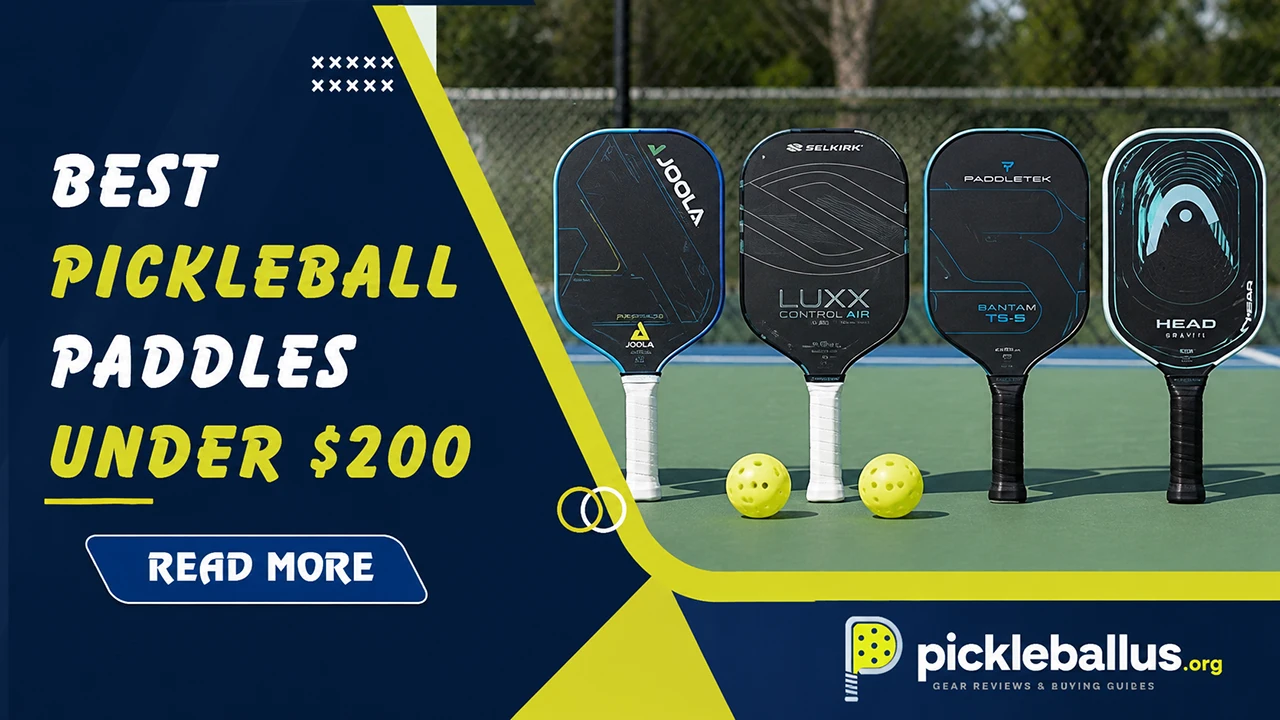
The best pickleball paddles under $200 in 2026 are the JOOLA Ben Johns Perseus 3S 16mm (best overall), the Six Zero Coral 16mm (best for fundamentals-first players), the Selkirk SLK Halo Control XL (best for beginners), the Engage Pursuit Pro MX 6.0 (best for control and spin), the HEAD Radical Pro (best budget-friendly pick), and the Paddletek Bantam EX-L Pro (best for power-focused play).
Spending under $200 used to mean settling for trickle-down tech from the previous product cycle. That’s no longer the case. The paddles in this price bracket now carry the same face materials, core architectures, and USAP certifications used by touring pros — the difference from the $300 tier is mostly branding and marginal spec refinements, not fundamental performance. If you play recreational league, open tournaments, or anywhere from 3.0 to 4.5 level, the paddles below are genuinely competitive options.
Where players in this range go wrong is treating the budget as the only filter. A paddle optimized for a power player will frustrate a control-first kitchen specialist, and vice versa — even two $180 paddles can feel worlds apart. The right choice depends on your core thickness preference, how you generate spin, and whether you prioritize touch at the net or pop on drives.
The six paddles below were selected based on strong review counts, consistent performance reputation, and clear on-court identity. Each one has a specific type of player it serves best — read through to find yours.
What Makes a Pickleball Paddle Worth Its Price Under $200?
A paddle earns its place in this price tier through three factors: face material, core thickness, and verified USAP approval — and a $200 paddle that gets all three right will outperform a $300 paddle that’s poorly matched to your game. Understanding these variables before you buy saves you from the most common and expensive mistake in pickleball gear: choosing a high-performing paddle that performs for someone else’s style, not yours.
Face Material — Carbon Fiber vs. Foam Core
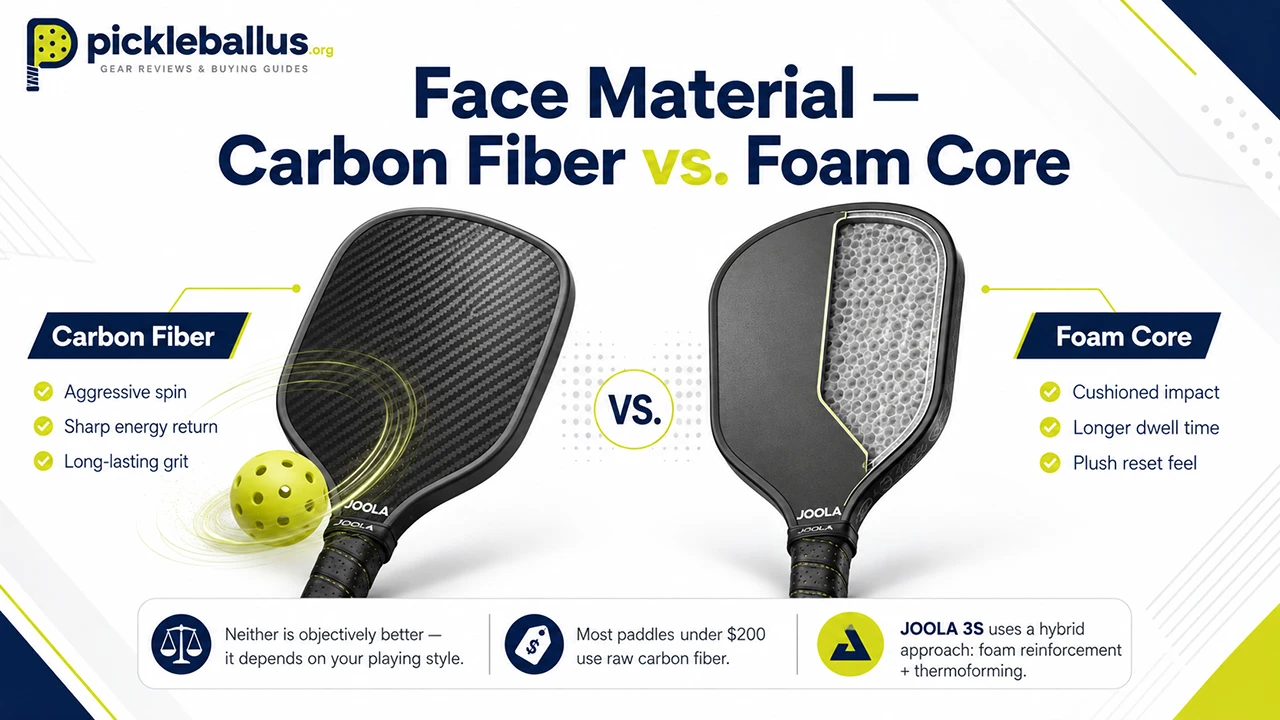
Raw carbon fiber and foam core construction are the two dominant paddle technologies in the under-$200 market right now, and they produce noticeably different on-court feelings. Raw carbon fiber faces — typically woven in a 3K twill pattern — generate aggressive spin through grit texture, return energy sharply on drives, and maintain that bite longer than painted or coated alternatives. Foam core paddles, by contrast, replace the traditional honeycomb polymer with an EVA or EPP foam layer that extends dwell time, cushions impact, and gives a plush, connected feel that many players prefer at the kitchen line.
Neither is objectively better. Carbon fiber rewards players who rely on precision and topspin to win points. Foam core suits players who want cushion during fast exchanges and prefer to feel the ball on resets rather than have it snap off the face. Most paddles in this guide use raw carbon fiber; the JOOLA 3S is a hybrid that uses both approaches — thermoforming plus foam reinforcement — which is a big part of why it lands at the top of the list.
For a deeper breakdown of how face and core materials affect your game, the pickleball paddle materials guide covers every construction type from carbon and graphite to Kevlar and composite.
Core Thickness — The 14mm vs. 16mm Decision
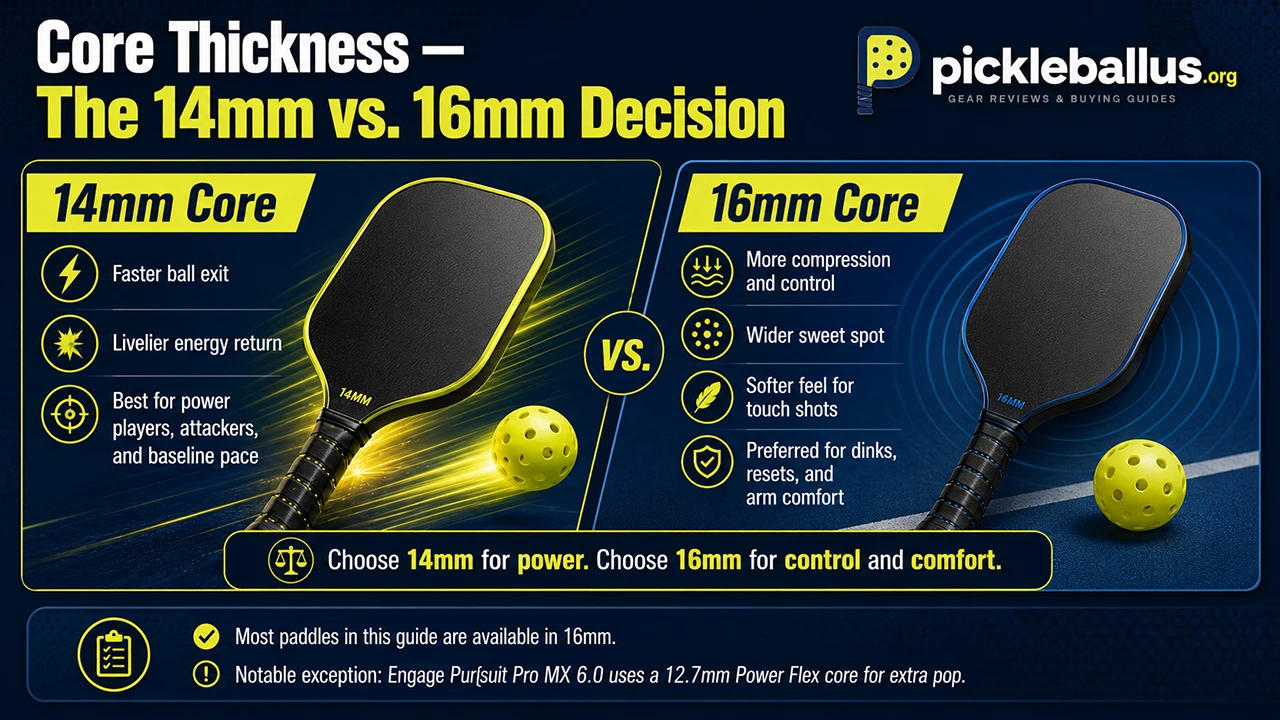
14mm cores and 16mm cores are not interchangeable — choosing the wrong thickness is the single fastest way to end up dissatisfied with an otherwise excellent paddle. A 14mm core compresses less under impact, creating a livelier, more immediate energy return. The ball leaves the face faster, which suits power players, attackers, and anyone who generates pace from the baseline. A 16mm core compresses more, widening the effective sweet spot, softening the feel, and giving you more time to shape the ball on touch shots. Control players, dink-heavy kitchen specialists, and players managing arm or elbow soreness overwhelmingly prefer 16mm.
Five of the six paddles in this guide are available in 16mm. One — the Engage Pursuit Pro MX 6.0 — uses a 12.7mm power-flex variant that sits below the 14mm category. That thinness is intentional and performance-justified, but it’s worth knowing before you order.
Weight and Swing Weight — Why the Spec Sheet Lies
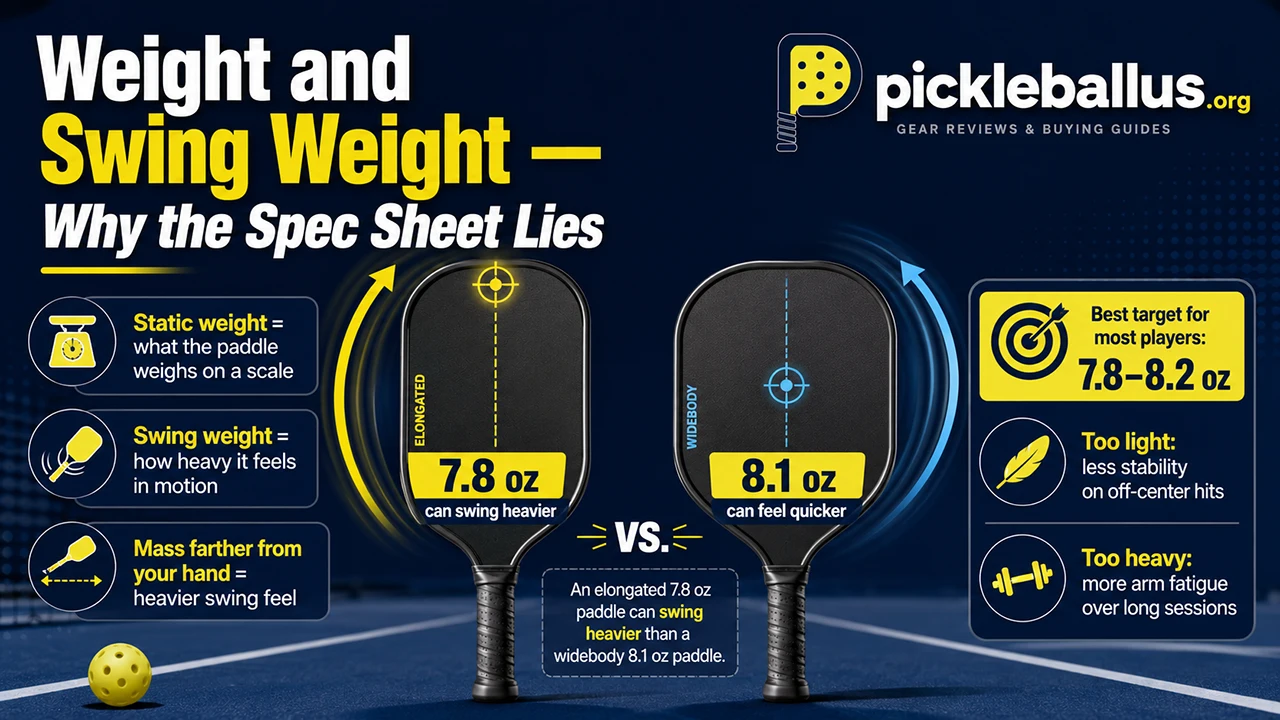
Swing weight matters more than static weight for how a paddle actually feels mid-point. Static weight (what the product page lists) tells you how heavy the paddle is sitting still on a scale. Swing weight tells you how heavy it feels when you’re moving through a volley at speed — a number influenced by where mass is distributed along the paddle’s length, not just how much there is. An elongated paddle weighing 7.8 oz can swing considerably heavier than a widebody at 8.1 oz because more mass sits farther from your hand.
For most players, a midweight range of 7.8–8.2 oz static weight is the target. Below that, you may lose stability on off-center hits. Above it, arm fatigue compounds over a long session. All six paddles in this list fall within or just outside that window. For more on how to use pickleball paddle weight as a filter when choosing your next paddle, that resource breaks down every category from lightweight to heavyweight.
6 Best Pickleball Paddles Under $200 in 2026
The following paddles were evaluated for face performance, core quality, durability, Amazon availability, and verified on-court reputation. Every paddle below has a real competitive identity — not just a generic spec sheet.
#1 JOOLA Ben Johns Perseus 3S 16mm — Best Overall
The JOOLA Ben Johns Perseus 3S 16mm is the best all-around pickleball paddle under $200 for players at the 3.5 level and above who want pro-level technology without the pro-level price tag.
The 3S designation stands for the third generation of JOOLA’s thermoformed construction — and what makes this generation matter is the dual certification. The Perseus 3S is now approved by both USA Pickleball (USAP) and the United Pickleball Association of America (UPA-A), meaning you can use it in any sanctioned tournament, whether that’s a USAP amateur bracket or a PPA/MLP affiliated event. That dual-certification status was missing from earlier versions of the 3S, which kept it off tournament courts for a significant portion of players.
On court, the 3S 16mm delivers a thermoformed carbon fiber face paired with a foam-enhanced core that gives you power on drives without sacrificing the feel you need to reset from a fast exchange. JOOLA’s construction process bonds the face material under heat and pressure directly to the core, creating a seamless flex response that increases energy transfer and reduces dead spots. The result is a paddle that feels alive on every touch — springy but not uncontrollable, powerful but not one-dimensional.
Several JOOLA-sponsored pros chose to stick with the 3S even after newer models released, which is the clearest possible endorsement. When sponsored players who have access to the latest gear keep reaching for a paddle in the $160–$180 range, that tells you something real about its performance floor.
Key Specs:
- Face: Thermoformed carbon fiber
- Core: 16mm foam-enhanced honeycomb
- Shape: Elongated
- Approval: USAP + UPA-A (dual certified)
Pros:
- Dual tournament certification (USAP + UPA-A)
- Pro-preferred despite newer models being available
- Strong dwell time for a thermoformed paddle
- Power and touch coexist well across the face
Cons:
- Elongated shape may feel unwieldy for players switching from widebody designs
- 3S tech has been available for over a year — newer competing options are emerging
Best For: 3.5–5.0 players who want one paddle for all situations — drives, resets, counterattacks, and tournament play — without upgrading to a $250+ paddle.
My Verdict: The 3S is the easiest recommendation on this list because its use case is broad and its performance ceiling is genuinely high. If you’re unsure which paddle to choose and play regularly at 3.5 or above, start here.
#2 Six Zero Coral 16mm — Best for Fundamentals-First Players
The Six Zero Coral 16mm delivers consistent, reliable all-court performance for players who win points through disciplined construction rather than raw firepower.
Six Zero built the Coral for a specific player type: someone who has moved past the beginner stage, understands court positioning and dinking fundamentals, and needs a paddle that amplifies those skills rather than pushing them toward a power-first style they haven’t earned yet. The Coral’s 16mm core prioritizes forgiveness and touch over explosive pop, making it a natural fit for players building a more deliberate, strategic game.
What sets the Coral apart from other control-oriented paddles in this price range is how well it handles the transition between soft and hard play. Many control paddles feel sluggish on drives and overheads — the Coral doesn’t. It maintains enough stiffness in the face to generate pace when you want it, while absorbing the ball cleanly on drops and resets. The sweet spot is wide enough that off-center hits don’t punish you with vibration or erratic direction changes.
The Coral was reviewed by The Kitchen as “sturdy, reliable, and consistent” — which sounds like a lukewarm endorsement but is actually high praise. In a market flooded with paddles that promise explosive power at the expense of touch, a paddle that simply does what you need it to do, session after session, is harder to find than marketing materials suggest.
Key Specs:
- Face: Carbon fiber
- Core: 16mm polymer honeycomb
- Shape: Elongated
- Approval: USAP
Pros:
- Excellent balance between power and touch
- Wide, forgiving sweet spot
- Consistent performance across game situations
- Strong choice for players building long-term skills
Cons:
- Not the right paddle for players who need maximum pop on offense
- Less suited to power-first styles at 4.5+
Best For: 3.0–4.0 players who play a fundamental, positional game and want a paddle that rewards consistency over aggression.
My Verdict: If your coach or training partner keeps reminding you to slow down and play cleaner, the Coral is the paddle that helps that advice stick on court.
#3 Selkirk SLK Halo Control XL — Best for Beginners
The Selkirk SLK Halo Control XL is the best beginner pickleball paddle in this price range for new players who want to learn the game on equipment that won’t limit their development.
Most beginner-tier paddles sacrifice too much. They use low-grade materials, vague swing weight profiles, and construction that makes learning fundamentals harder than it needs to be. The SLK Halo Control XL — part of Selkirk’s accessible SLK line rather than their premium tier — avoids all of that. It uses a fiberglass face and a thick honeycomb core that together produce a forgiving, consistent response ideal for players still developing their stroke mechanics and timing.
The XL in the name refers to the widebody shape, which gives you a larger surface area to work with. For beginners, that translates directly into confidence: more of your shots land where you intend them to, which keeps rallies going longer and accelerates skill development. The paddle’s 4.25″ grip suits a wide range of hand sizes, and the overall weight sits in the comfortable midrange.
What makes the Halo Control XL stand out as a beginners’ recommendation is how long it stays relevant. Most new players outgrow entry-level paddles within a few months. The SLK Halo remains a useful training paddle well into the intermediate stage because its control-first profile reinforces good habits — consistent contact, patient dinking, placement over power — that carry forward even as you upgrade.
Those looking for a broader set of best pickleball paddles for beginners across more brands and price points will find the full comparison there.
Key Specs:
- Face: Fiberglass
- Core: Thick polymer honeycomb
- Shape: Widebody (XL)
- Approval: USAP
Pros:
- Wide forgiving face ideal for new players
- Promotes control-first habits that build skill
- Comfortable grip for extended sessions
- Selkirk brand reliability at an accessible price point
Cons:
- Fiberglass face lacks the spin generation of raw carbon
- Power output is intentionally limited — not the right choice for 4.0+ players
Best For: Beginners and early intermediate players (2.5–3.5) who want to learn the game correctly without upgrading immediately.
My Verdict: The SLK Halo Control XL is one of the few paddles on this list you can hand to someone who has never played pickleball before and not have to apologize for the gear six months later.
#4 Engage Pursuit Pro MX 6.0 — Best for Control & Spin
The Engage Pursuit Pro MX 6.0 is the best pickleball paddle under $200 for players who win points with control and spin rather than power, making it a standout option in a market that has shifted hard toward pop-heavy designs.
Engage explicitly built the Pursuit Pro MX 6.0 to counter the prevailing trend. Where most brands optimized their 2025–2026 lineups for power output, Engage focused on spin generation and controlled touch — and the result is a paddle that feels different the moment you pick it up. The face uses Engage’s proprietary skin material with a fine surface texture that grips the ball meaningfully on contact, allowing you to generate topspin and sidespin without exaggerated swing mechanics.
The 12.7mm core thickness is the most unusual spec on this list. At that thinness, the paddle sits below the standard 14mm power range, which would normally push it into “power paddle” territory. Engage’s Power Flex Polymer core technology inverts that expectation — the ultra-thin profile actually improves dwell time by allowing the face to flex in a controlled arc during contact, giving you ball-shaping ability that 14mm paddles often lack. The 6.0″ handle gives players who transition from tennis extra leverage and two-handed backhand capability.
For players who have been frustrated by how modern power paddles pop the ball unpredictably at the kitchen, the Pursuit Pro MX 6.0 is a direct answer to that frustration. Players looking for an even wider discussion of best pickleball paddles for control will find cross-brand comparisons in that dedicated guide.
Key Specs:
- Face: Raw carbon fiber with Engage proprietary surface
- Core: 12.7mm Power Flex Polymer
- Handle: 6.0″ (long handle, tennis-inspired)
- Shape: Elongated
- Approval: USAP
Pros:
- Outstanding spin generation through specialized face texture
- Excellent dwell time despite thin core
- Long handle suits tennis players and two-handed backhand players
- Designed specifically for control-first players — a rarity in this segment
Cons:
- 12.7mm thickness feels noticeably different from standard 14–16mm paddles — requires adjustment
- Power ceiling is intentionally lower; not ideal for aggressive 4.5+ attackers
Best For: 3.5–4.5 control-first players, tennis converts with two-handed backhands, and anyone tired of overpowered paddles they can’t reset with.
My Verdict: The Pursuit Pro MX 6.0 is a specialist’s paddle that performs exactly as advertised. If control and spin are your weapons, this is the under-$200 option built around your game.
#5 HEAD Radical Pro — Best Budget-Friendly Pick
The HEAD Radical Pro is the best budget-friendly option for intermediate players who want a recognizable, well-built paddle without climbing to the upper end of the under-$200 range.
HEAD’s Radical Pro benefits from brand engineering that dates back to decades of racket sport manufacturing. The paddle uses a graphite face and Optimum Rebound technology — HEAD’s term for a honeycomb polymer core tuned for consistent energy return across the face, not just at the center. That consistency is the Radical Pro’s defining characteristic. You know what you’re getting when you hit a ball anywhere on this surface, which matters most for players who are still ingraining muscle memory and need predictable feedback.
The Radical Pro’s weight is calibrated for midrange players who are fast enough to benefit from lighter maneuverability at the net but still want enough mass to hold their line on third-shot drives. The grip size options make it accessible across hand sizes, and the paddle’s durability record among recreational players is strong — this is not a paddle you’re replacing after one season.
The HEAD Radical Pro sits comfortably below the upper bracket of this guide’s price range, making it an accessible entry point for players who want a quality intermediate paddle without committing to the most expensive options available.
Key Specs:
- Face: Graphite
- Core: Polymer honeycomb (Optimum Rebound)
- Shape: Standard/Widebody
- Approval: USAP
Pros:
- Consistent, predictable performance across the face
- Strong durability — holds up well over a season of regular play
- Accessible price within the under-$200 range
- HEAD’s racket sport engineering expertise translates well to the platform
Cons:
- Graphite face generates less raw spin than carbon fiber alternatives
- Less specialized than other paddles on this list — jack-of-all-trades profile
Best For: 3.0–4.0 intermediate players who want a dependable all-court paddle that won’t require a technical adjustment period.
My Verdict: If you want a reliable, no-fuss intermediate paddle at a comfortable price and you’ve played racket sports before, the HEAD Radical Pro is a natural fit.
#6 Paddletek Bantam EX-L Pro — Best for Power
The Paddletek Bantam EX-L Pro is the best power-focused pickleball paddle under $200 for players who attack from the baseline and need a paddle that keeps up with an aggressive playing style.
Paddletek designed the Bantam EX-L Pro around a graphite face and a proprietary Smart Response Technology core — a honeycomb polymer construction tuned for maximum energy return on full-swing contact. Where control paddles absorb energy to slow the ball down, the EX-L Pro’s core stores and releases it, making every drive and overhead feel noticeably more powerful than what you’d get from a standard polymer honeycomb at the same price.
The elongated shape adds leverage on groundstrokes, and the slightly head-heavy balance profile pushes additional mass into the hitting zone where power generation happens. Players transitioning from tennis — where baseline power and pace are baseline expectations — consistently cite the Bantam EX-L Pro as one of the most natural-feeling paddles for that switch because it allows them to generate power without completely rebuilding their swing habits.
Where the EX-L Pro requires adjustment is at the kitchen. Because its construction prioritizes energy return, soft touch shots demand more intentional deceleration than players used to 16mm control paddles will expect. The learning curve is real, but for the player whose game is built on driving third shots and finishing at the net, that tradeoff is worth it.
Key Specs:
- Face: Graphite
- Core: Paddletek Smart Response Technology polymer honeycomb
- Shape: Elongated
- Balance: Slightly head-heavy
- Approval: USAP
Pros:
- Exceptional power output for the price tier
- Smart Response Technology delivers consistent energy return
- Natural transition paddle for tennis players
- Head-heavy balance amplifies pace on drives and overheads
Cons:
- Soft game (dinks, resets) requires deliberate adjustment
- Head-heavy profile may not suit all-court players who rely equally on power and touch
Best For: 3.5–4.5 power-first players, tennis converts, and baseline attackers who finish points with pace.
My Verdict: The Bantam EX-L Pro is the paddle on this list that makes your drives hurt the most. If that’s the game you play, it delivers.
14mm vs. 16mm — Which Core Thickness Fits Your Game?
14mm cores favor power and speed; 16mm cores favor control and forgiveness — and the right choice depends almost entirely on what part of your game you rely on to win points, not on which number sounds more impressive.
A 14mm paddle compresses less under contact, so energy transfers faster and exits the face with more pop. The ball leaves quickly, drives feel crisp, and counterattacks at the kitchen line feel snappy. The tradeoff: the sweet spot is slightly smaller and off-center hits don’t absorb as cleanly. Players who generate pace through clean contact and rely on aggressive point-finishing benefit most from 14mm.
A 16mm paddle compresses more, slowing the ball slightly relative to how hard you swing. The wider dwell time lets you shape the ball with more precision — a critical advantage for drops, lobs, and angled dinks. The sweet spot is wider, which reduces punishment for imperfect contact, and the softer feel generally translates to easier resets in fast exchanges. If your game is built on patience and placement, 16mm is almost always the right choice.
The table below summarizes the decision across the most common player scenarios:
| Player Type | Preferred Core | Reason |
|---|---|---|
| Power/banger baseline player | 14mm | More pop, faster energy return |
| Control/kitchen specialist | 16mm | Better dwell time, wider sweet spot |
| Tennis converter | 14mm or 12.7mm | Familiar live-face feel from racket play |
| Senior or arm-sensitive player | 16mm | Reduced vibration, softer impact |
| All-court / versatile player | 16mm | Better forgiveness across game situations |
| Competitive 4.5+ attacker | 14mm | Speed advantage on counterattacks |
Of the six paddles in this guide, four use 16mm cores — the Perseus 3S, Coral, SLK Halo, and HEAD Radical Pro. The Bantam EX-L Pro and Engage Pursuit Pro MX 6.0 use thinner profiles optimized for their respective power and spin niches.
How to Pick the Right Paddle From This List
Yes — every player on this list has a clear best match, and identifying yours takes answering two questions: How do you generate points, and at which level do you currently play?
Start with the JOOLA Perseus 3S 16mm if you’re at 3.5 or above and want one paddle that handles every situation without compromise. It’s the broadest performer on this list and the safest choice if you’re unsure.
Choose the Six Zero Coral if you’re building your game around discipline, dinking, and fundamentals — and you’re frustrated by paddles that feel too reactive at the net.
Go with the Selkirk SLK Halo Control XL if you’re new to pickleball or still under 3.5. The forgiving surface and control-first build will accelerate your development better than anything else here.
Pick the Engage Pursuit Pro MX 6.0 if control and spin are your weapons. It’s the only paddle on this list designed explicitly around that profile.
The HEAD Radical Pro is right for intermediate players who want a dependable all-court paddle at the accessible end of this price tier — no specialized adjustments required.
The Paddletek Bantam EX-L Pro belongs in your hands if you hit hard and want a paddle that rewards power. If you’re a tennis player stepping into pickleball, this one will feel the most natural.
Players who ultimately want to spend less can explore the best pickleball paddles under $150 and best pickleball paddles under $100 guides, both of which follow the same framework of matching paddle to player rather than just listing specs. The full family of best cheap pickleball paddles across every sub-tier is organized by budget and skill level.
By now you have a clear, specific picture of which paddle matches your playstyle and budget across all six options. Choosing the right paddle is only half the investment, though — what happens in the weeks after you unbox it will determine whether that paddle stays sharp or goes dead faster than expected. The next section covers the finer details that separate players who get six months of peak performance from those who notice a drop in pop after two.
Getting the Most Out of Your New Paddle
Most players who experience premature paddle decline cause it themselves — through skipped break-in sessions, improper cleaning, and ignoring early warning signs that the surface is degrading. Getting the most out of a sub-$200 paddle is largely a maintenance question.
Breaking In a New Pickleball Paddle the Right Way
A new paddle needs 2–3 hours of intentional play before it reaches its peak performance window. The carbon fiber face — particularly raw carbon — carries a slight sheen from the manufacturing and packaging process that can make early play feel inconsistently grippy. During your first sessions, focus on hitting a wide variety of shots across the full face: groundstrokes, volleys, dinks, and overheads. This distributes contact evenly and helps the grit texture fully activate. Avoid prolonged drilling from a single spot during break-in — it concentrates wear in one zone and can create inconsistency in the sweet spot response later.
Some players also wipe the face gently with a soft cloth before initial use to remove any residual manufacturing coating. That step takes 30 seconds and can meaningfully improve first-contact feel.
Cleaning and Protecting the Carbon Fiber Face
Clean your carbon fiber face after every session with a damp microfiber cloth and mild soap — no abrasive scrubbers, no acetone-based cleaners. The grit texture that generates spin is embedded in the surface weave of the carbon fiber, and abrasive cleaning gradually strips it. Once that texture is gone, it doesn’t come back.
Store the paddle in a protective sleeve or case when not in use. Leaving carbon fiber paddles loose in a bag with balls and other gear exposes the face to scratches and edge impacts that accelerate surface wear. Edge guard integrity also matters — inspect yours periodically. A cracked or delaminating edge guard compromises the structural seal of the paddle face over time.
When It’s Time to Replace Your Paddle
A dead paddle feels noticeably different: shots lack the expected pop, the face feels flat on contact, and you may notice a hollow sound on well-struck balls instead of a crisp click. Surface delamination — where the carbon fiber face begins separating from the core at the edges — is a visual warning sign that replacement is needed regardless of how the paddle still feels in play.
Most quality carbon fiber paddles in the under-$200 tier have a performance lifespan of 12–18 months under regular play (3–5 sessions per week). If you play more frequently, budget for replacement closer to the 9–12 month mark. Hanging onto a dead paddle longer than necessary is one of the most common reasons players plateau — they’re training with gear that no longer gives accurate feedback.
The best pickleball paddles overview covers the full performance spectrum when you’re ready to re-evaluate your next step up.
Write Your Review
No reviews yet. Be the first to share your experience!