

The best pickleball paddles under $150 in 2026 are the JOOLA Ben Johns Perseus CFS 14mm (best overall), the Selkirk Labs 007 Invikta 14mm (best for control), the Engage Pursuit Pro MX 6.0 (best for spin), the Vatic Pro Saga Bloom 16mm (best value pick), the Franklin Sports Ben Johns Signature (best for beginners), the HEAD Radical Pro (best for intermediate players), and the Paddletek Bantam EX-L Pro (best for power). Every paddle on this list ships from Amazon, carries hundreds of verified reviews, and has been selected based on proven sales history and consistent performance feedback — not sponsorships.
The $100–$150 tier is where the value-performance equation makes the most sense for most players. You get raw carbon fiber faces, thick polymer honeycomb cores, and construction quality that matched the $200–$250 range just two years ago. The technology gap has closed enough that recreational and intermediate players have no practical reason to spend more unless they’re competing at a high DUPR level and chasing marginal gains.
That said, not every paddle in this range is worth your money. Some use outdated fiberglass construction disguised with modern branding. Others overweight the paddle to fake a “premium” feel. The seven picks in this guide avoided both traps during selection — each one delivers honest performance at an accessible price, covering every playstyle from spin-heavy baseliners to finesse-first kitchen players.
Here’s what you need to know before diving into the reviews: core thickness and face material matter more than brand name or paddle shape. The sections below explain both before the product reviews begin, so you can evaluate each paddle with context rather than relying on marketing copy.
What Makes a Pickleball Paddle Worth It Under $150?
A paddle earns its price in the sub-$150 tier through three factors: face material, core construction, and how the two interact at contact. Paddles that nail all three deliver performance that punches above their cost. Paddles that cut corners on any one of them will feel like entry-level gear regardless of their sticker price.
Core Construction — Polypropylene Honeycomb vs. Foam-Core Technology
The core is the single biggest driver of how a paddle feels and how long it performs. Two core types dominate the under-$150 market.
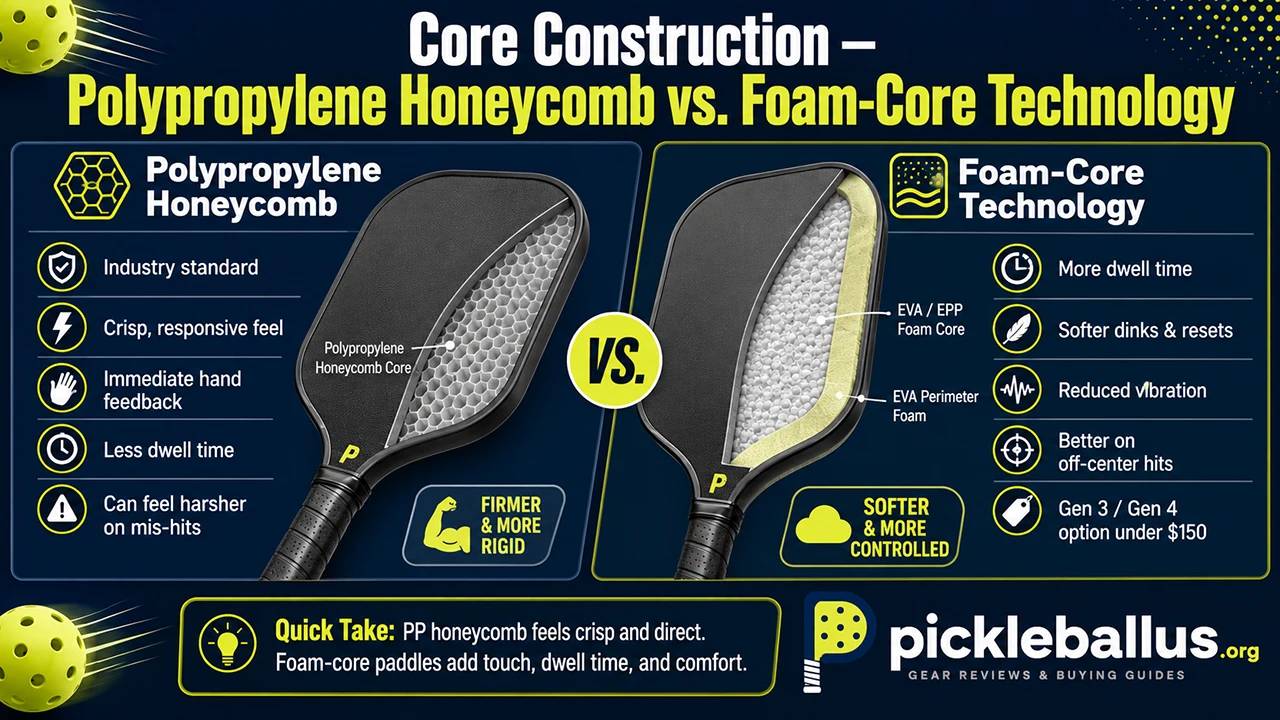
Polypropylene (PP) honeycomb cores have been the industry standard for years. A rigid honeycomb of plastic cells sits between the two face layers, absorbing impact and transmitting feedback to your hand. PP cores produce a crisp, responsive feel — ideal if you like to “hear” the ball and want immediate hand feedback during fast exchanges at the kitchen. The downside is that older PP cores can feel harsh on mis-hits and offer less dwell time compared to newer alternatives.
Foam-core technology — specifically EVA and EPP foam injected around or replacing the traditional PP honeycomb — adds dwell time: the brief window where the ball sits on the face and you can shape the shot. Gen 3 and Gen 4 foam constructions, now available at this price point, use a floating foam core with EVA perimeter foam to reduce vibration on off-center hits and give softer, more controlled dinks. If touch and reset ability matter to you, foam-core paddles at this price tier have become a serious option.
Face Material — Raw Carbon Fiber, Fiberglass, and Hybrid Surfaces
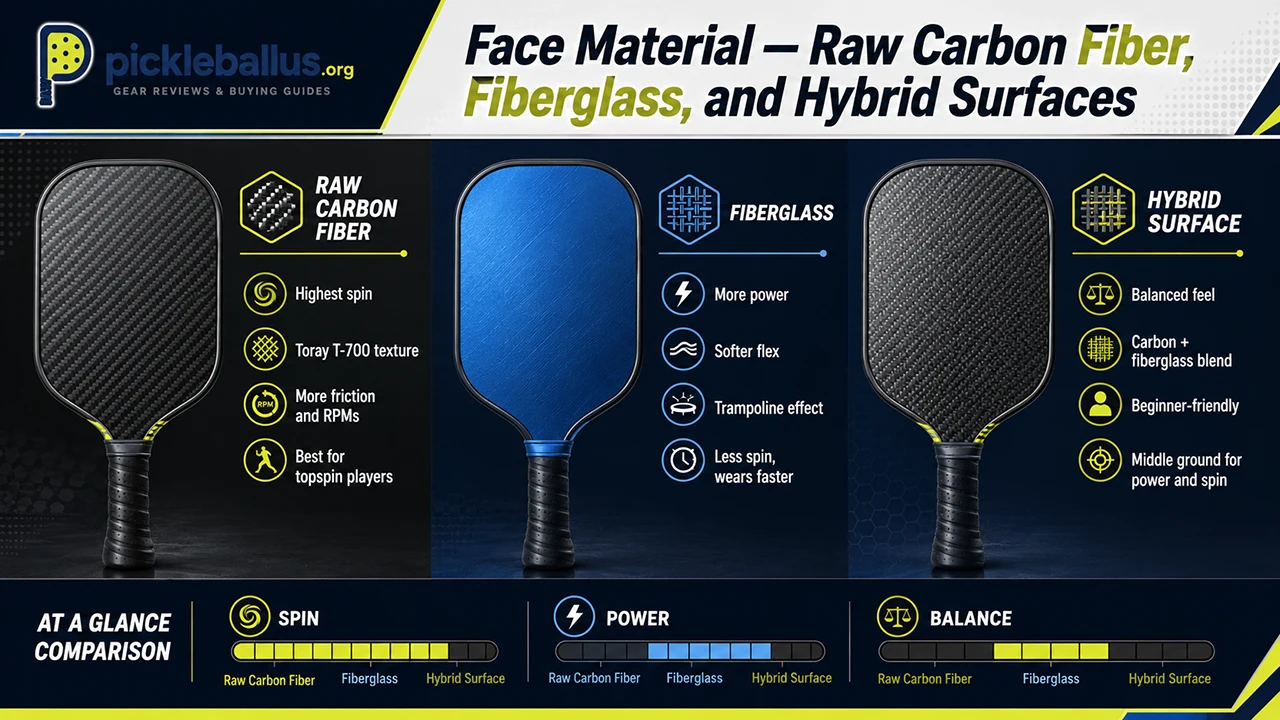
Face material determines spin generation and ball feel more than any other spec. Raw carbon fiber — specifically Toray T-700 — is the material to look for. The woven texture creates friction on contact, biting into the ball and transferring rotational energy. Raw carbon paddles generate consistently higher RPMs than fiberglass alternatives, which is why every top-performing paddle in this guide uses some form of carbon fiber face.
Fiberglass faces are softer, flex more on contact, and produce a “trampoline” effect that adds power — but they sacrifice spin and wear faster. Hybrid or composite surfaces layer carbon and fiberglass to split the difference. They’re a reasonable choice for beginners still learning shot mechanics, but players committed to developing topspin should prioritize raw carbon over any hybrid option.
Weight and Balance — Static Weight vs. Swing Weight Explained
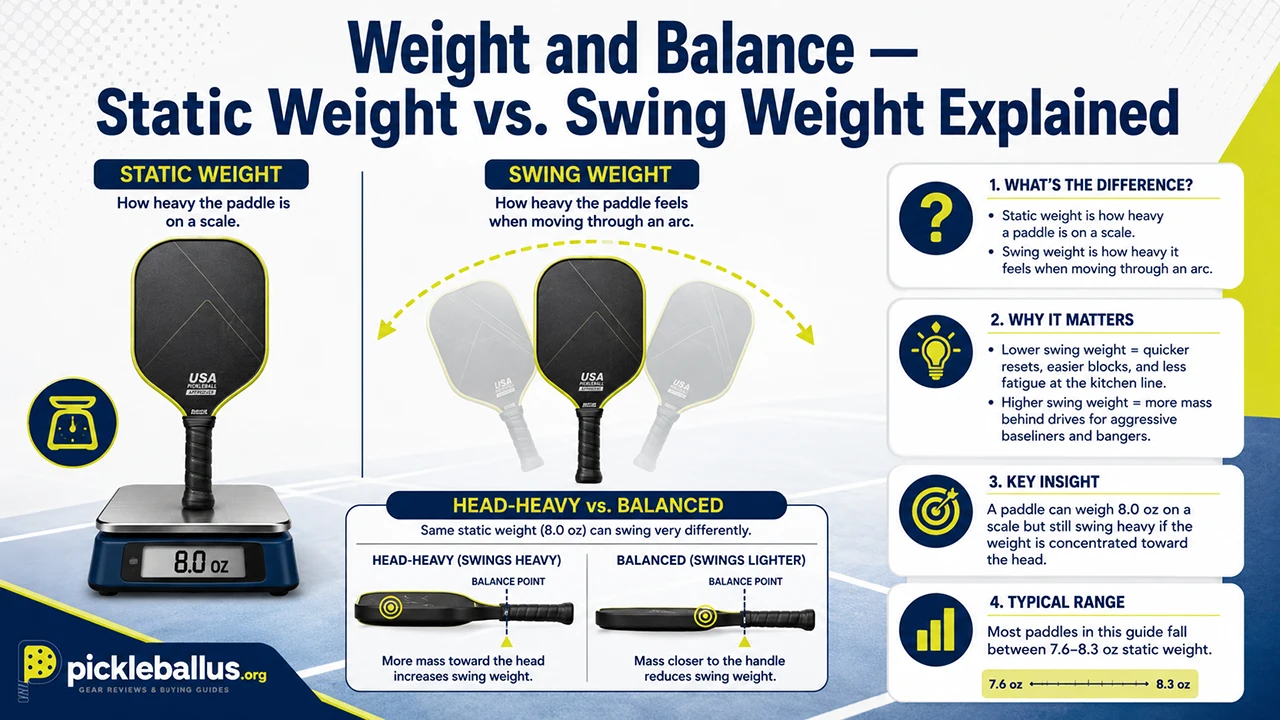
Paddle weight affects fatigue and maneuverability in ways most buyers understand — lighter paddles move faster; heavier paddles punch harder. What most buyers miss is swing weight: a measurement of rotational resistance when the paddle moves through an arc, not just how many ounces it sits on a scale.
A paddle can weigh 8.0 oz on a scale but swing heavy if the weight sits toward the head — and vice versa. For players who spend most of their time at the kitchen line, lower swing weight paddles are easier to reset and block. For aggressive baseliners and bangers, higher swing weight translates to more mass behind drives. Most paddles in this guide fall between 7.6–8.3 oz static weight, which covers a wide enough range to suit both styles.
The 7 Best Pickleball Paddles Under $150
These paddles are stocked on Amazon, maintain high review counts, and have demonstrated consistent performance across a range of player types. Every recommendation below includes a full review with specs, performance analysis, pros, cons, best-for guidance, and a verdict.
#1 JOOLA Ben Johns Perseus CFS 14mm — Best Overall
The JOOLA Ben Johns Perseus CFS 14mm is the benchmark paddle for this price tier. It delivers tournament-grade construction without requiring a tournament-sized budget, and it’s the paddle most likely to satisfy players across the widest range of skill levels and playstyles.
Key Specs:
- Face: T-700 raw carbon fiber (Carbon Friction Surface)
- Core: 14mm polypropylene honeycomb + perimeter foam
- Weight: 7.9–8.4 oz
- Shape: Elongated
- Handle length: 5.5 inches
- Approvals: USAPA, APP
Performance Analysis
The Carbon Friction Surface (CFS) texture grips the ball better than most competitors in this range. Topspin dinks roll over consistently, and drive attempts generate noticeably more RPMs than older fiberglass options. The 14mm core leans toward the power and speed side of the dial compared to 16mm alternatives — exchanges at the kitchen are faster, transitions from defense to offense feel snappier, and third-shot drives exit the paddle with authority.
JOOLA’s SK Film layer — a thin dampening material between the face and core — reduces vibration on mis-hits without deadening the feel of clean contacts. Players transitioning from tennis often prefer this, as it absorbs arm fatigue during long rallies without making the paddle feel muted.
The elongated shape extends reach at the kitchen line and gives an extra inch of arm extension on overhead shots. Grip at 4.25 inches is standard and accepts most aftermarket overgrip tape easily.
Pros
- CFS texture delivers elite-level spin generation
- Foam perimeter reduces off-center vibration
- SK Film dampening layer protects arm during high-volume play
- USAPA and APP approved for tournament use
Cons
- 14mm core rewards faster swings; beginners may find 16mm more forgiving
- Elongated shape has a smaller face-width sweet spot than widebody alternatives
Best For: 3.5+ rated players who want a certified tournament paddle at a mid-range price. Particularly strong for players who drive the ball frequently and want spin on third-shot drops.
My Verdict: The Perseus CFS 14mm is the paddle most players in this tier should try first. It’s the closest thing to a “no wrong choice” recommendation in the sub-$150 category — versatile enough for most playstyles, well-built enough to last, and carrying the brand equity that comes from being Ben Johns’ signature model at a price that doesn’t reflect it.
#2 Selkirk Labs 007 Invikta 14mm — Best for Control
The Selkirk Labs 007 Invikta 14mm answers one specific question: what’s the best paddle in this price range if you prioritize placement and touch over raw power? The answer hasn’t changed for months.
Key Specs:
- Face: InfiniGrit carbon fiber texture
- Core: 14mm polypropylene honeycomb
- Weight: 7.5–8.0 oz
- Shape: Elongated (Invikta)
- Handle length: 5.75 inches
Performance Analysis
Selkirk’s InfiniGrit surface texture creates a slightly rougher contact point than standard carbon fiber, which translates to enhanced ball grip on soft shots. Dinks carry backspin when you want them to and hold trajectory more predictably than competing carbon paddles at this price. The result is a paddle that rewards kitchen-focused players who want to dictate pace rather than overpower opponents.
The longer 5.75-inch handle suits two-handed backhand players well. At 14mm, the core is thinner than the 16mm alternatives on this list, which shifts the performance profile toward faster hand speed and better pop on attacks — but control is where this paddle earns its reputation. The polypropylene core produces a clean, direct feel that gives immediate feedback on ball placement without any of the springy ambiguity that foam cores can introduce.
The Invikta shape — elongated, narrower than standard — positions weight toward the handle and reduces the effort needed to reset at speed. Players who identify as “dink-and-reset” types will find the 007 Invikta fits their game better than most paddles at this price.
Pros
- InfiniGrit surface delivers above-average control and spin on soft shots
- Long handle benefits two-handed backhand players
- Lighter weight range reduces arm fatigue in long sessions
- Consistent build quality across units
Cons
- Narrower Invikta face reduces sweet spot vs. widebody shapes
- Primarily a control paddle — power hitters may want a different option
Best For: Kitchen-first players, 3.5–4.5 rated competitors, and anyone who plays doubles and spends most of their time in the transition zone and at the non-volley line.
My Verdict: The 007 Invikta 14mm earns its reputation through consistent, predictable performance in the scenarios that win points at recreational to competitive levels. If your game is built on best pickleball paddles for control rather than aggression, this is the paddle to start with.
#3 Engage Pursuit Pro MX 6.0 — Best for Spin
The Engage Pursuit Pro MX 6.0 is a U.S.-manufactured paddle that has quietly held its ground in the spin category against a wave of cheaper imports. The widebody shape and carbon fiber construction make it the strongest choice for players who build their game around heavy topspin.
Key Specs:
- Face: Carbon fiber with textured surface
- Core: 16mm polymer honeycomb
- Weight: 7.8–8.3 oz
- Shape: Widebody
- Made in USA
- Approvals: USAPA
Performance Analysis
The textured carbon face generates consistent topspin on both groundstrokes and dinks, making the MX 6.0 one of the most spin-friendly paddles in this tier. The 16mm core adds dwell time compared to 14mm alternatives — the ball stays on the face slightly longer, giving you more control over shot trajectory and spin rate. Combined with the widebody shape, this translates to a forgiving sweet spot that rewards spin attempts even on imperfectly struck balls.
Engage’s Smart-Spin Technology surface treatment maintains texture integrity longer than many competitors. Where some carbon faces begin losing their grit after 20–30 hours of play, the MX 6.0 holds its spin-generating capability through extended use — a meaningful factor given the price investment.
The widebody shape gives more surface area for flat-footed blocks and reset attempts, which makes this paddle particularly useful in doubles play where reaction time at the kitchen demands a larger target zone.
Pros
- Best spin generation in this price range for carbon fiber paddles
- Smart-Spin surface technology extends grit longevity
- Widebody shape maximizes sweet spot size
- 16mm core adds dwell time for improved placement
Cons
- Made in USA pricing sits at the higher end of this tier
- Widebody shape reduces reach vs. elongated alternatives
- Heavier end of the weight range may fatigue some players
Best For: Spin-heavy players at any skill level, doubles specialists who want a large sweet spot for resets, and players converting from tennis who already generate topspin naturally. Pairs well with the approach discussed in our guide to the best pickleball paddles for spin.
My Verdict: The Engage Pursuit Pro MX 6.0 earns its price through spin consistency and American build quality. It’s not the cheapest option on this list, but players who prioritize topspin-driven offense and need it to hold up through weeks of competitive play will find the value proposition clear.
#4 Vatic Pro Saga Bloom 16mm — Best Value Pick
The Vatic Pro Saga Bloom 16mm is the paddle that consistently surprises players who pick it up expecting “budget quality.” What they get instead is a Gen 1.5 thermoformed construction with edge foam injection at a price well below what this technology typically costs.
Key Specs:
- Face: T-700 raw carbon fiber with peel-ply texture
- Core: 16mm polypropylene honeycomb with edge foam injection
- Weight: 7.8–8.3 oz
- Shape: Standard/Hybrid
- Handle length: 5.25 inches
Performance Analysis
The peel-ply texture on the T-700 raw carbon face creates an aggressive grit surface that bites into the ball on topspin drives and third-shot drops alike. Compared to standard carbon faces at this price, the Saga Bloom’s texture feels coarser and generates more noticeable spin on both serve and return — a distinction that becomes apparent within the first few games.
Edge foam injection around the 16mm core reduces vibration on off-center hits significantly. Mis-hits that would produce a harsh sting through a standard PP core get absorbed, making this paddle notably forgiving for players still developing consistent stroke mechanics. Dwell time on soft shots is one of the longest in the under-$150 category, which helps with placement in dink exchanges.
Vatic Pro has built its reputation on aggressive value pricing, and the Saga Bloom is the clearest example of that strategy. The materials and construction would justify a higher retail position — the price simply doesn’t reflect the technology inside.
Pros
- T-700 raw carbon peel-ply texture generates elite spin for the price
- Edge foam injection absorbs off-center vibration
- 16mm core provides generous dwell time for soft-game control
- Exceptional value relative to construction quality
Cons
- Peel-ply texture degrades faster than coated surfaces under heavy use
- Standard shape is less versatile than elongated for reach-focused players
- Shorter handle limits two-handed backhand extension
Best For: Intermediate players seeking maximum spin capability on a tight budget. Also strong for 3.0–3.5 players upgrading from entry-level paddles who want to develop spin without spending premium prices.
My Verdict: If budget is your primary constraint, the Vatic Pro Saga Bloom 16mm is the paddle to buy. The price-to-performance ratio is the best on this list, and the technology inside belongs in a paddle that costs more. The only caveat is surface durability — heavy hitters who train daily should expect to replace the Bloom sooner than a premium build.
#5 Franklin Sports Ben Johns Signature — Best for Beginners
The Franklin Sports Ben Johns Signature paddle is the clearest answer to one of the most common questions in pickleball: “What should I buy for my first real paddle?” It delivers the fundamentals a new player needs without overwhelming them with technology they can’t yet use.
Key Specs:
- Face: Graphite-textured fiberglass
- Core: Polymer honeycomb
- Weight: 7.4–7.8 oz
- Shape: Standard widebody
- Handle length: 4.5 inches
Performance Analysis
The fiberglass face produces a softer, more forgiving contact than carbon alternatives — a deliberate design choice for players still developing stroke mechanics. Off-center hits don’t punish, the ball travels predictably, and the lighter weight range reduces arm fatigue during long learning sessions. New players typically mis-hit far more often than experienced ones, and the Signature’s design accounts for that honestly.
The widebody shape maximizes surface area, giving beginners a larger target zone and more successful contacts per session. The polymer core is responsive without being harsh — it produces clear feedback on where the ball struck the face without the sharp vibration that some carbon paddles send through the handle.
Ben Johns’ involvement in product development means the ergonomics are dialed in. The grip size and handle taper feel natural in hand for most adult players, and the paddle’s balance point sits close to the handle rather than the head — a setup that favors the controlled, patient game beginners should be developing.
Pros
- Forgiving fiberglass face ideal for developing stroke mechanics
- Lightweight design reduces fatigue for beginners playing long sessions
- Widebody shape provides maximum sweet spot size
- Backed by Ben Johns’ design input — ergonomics are well-considered
- Available on Amazon with strong review count and consistent availability
Cons
- Fiberglass face generates less spin than carbon alternatives
- Players who develop quickly will outgrow this paddle within 6–12 months
- Limited tournament-level performance
Best For: New players buying their first dedicated paddle, anyone transitioning from recreational play to something more structured, and older adults who want a gentle introduction to the sport. Read more about matching paddles to skill stage in our roundup of the best pickleball paddles for beginners.
My Verdict: The Franklin Ben Johns Signature does exactly what a beginner paddle should do: it removes friction from the learning process. It’s not a paddle you’ll use forever, but it’s the right tool while your game is still taking shape — and it costs far less than most players spend chasing a “serious” paddle before they’re ready for one.
#6 HEAD Radical Pro — Best for Intermediate Players
The HEAD Radical Pro is the paddle that bridges the gap between starter gear and competitive equipment. It’s built for players who’ve moved past the basics, understand their playstyle, and want a paddle that grows with them rather than one they’ll immediately outgrow.
Key Specs:
- Face: Carbon/fiberglass composite
- Core: 16mm polymer honeycomb
- Weight: 7.9–8.4 oz
- Shape: Widebody
- Handle length: 4.75 inches
- Approvals: USAPA
Performance Analysis
The composite face blends the power-generating flexibility of fiberglass with the directional feedback of carbon fiber — a trade-off that suits intermediate players who haven’t fully specialized their game yet. You get enough spin to develop topspin mechanics and enough power to compete without needing to chase pace, but neither characteristic is pushed to an extreme.
The 16mm core adds cushion and dwell time that intermediate players use as they develop their dinking and reset game. Fast exchanges at the kitchen are manageable without feeling sluggish, and the larger body shape absorbs pace well on defensive shots. HEAD’s polymer construction has earned a reputation for build consistency — HEAD Radical paddles feel the same unit to unit, which matters when you’re buying blind online.
The USAPA approval adds flexibility for players who start entering sanctioned tournaments as their game develops. It’s a small detail, but buying a tournament-legal paddle at this stage avoids needing to replace equipment purely for compliance reasons later.
Pros
- Composite face suits intermediate all-around development
- 16mm core balances power and control well
- Consistent build quality across units
- USAPA approved for competitive play
- Widebody shape forgives developing mechanics
Cons
- Composite face doesn’t generate spin at the level raw carbon achieves
- Less specialized than paddles designed for power or control exclusively
Best For: 3.0–3.5 rated players upgrading from beginner equipment, players who haven’t yet defined their playing style, and anyone entering their first recreational tournaments. For players in this category, our guide to the best pickleball paddles for intermediate players covers additional options at this stage.
My Verdict: The HEAD Radical Pro fills the intermediate gap with competence rather than compromise. It won’t be your last paddle, but it’s the right next paddle — something capable enough to push your improvement rather than limit it.
#7 Paddletek Bantam EX-L Pro — Best for Power
The Paddletek Bantam EX-L Pro is the paddle for players who want to end points aggressively. If your game relies on big third-shot drives, aggressive overhead attacks, and putting pressure on opponents through pace, this is the paddle built around that intent.
Key Specs:
- Face: Carbon fiber / Textreme composite
- Core: Smart Response polymer
- Weight: 7.6–8.2 oz
- Shape: Widebody
- Handle length: 4.25 inches
- Made in USA
- Approvals: USAPA
Performance Analysis
Paddletek’s Smart Response polymer core is engineered to amplify energy transfer at contact — the ball rebounds off the face with noticeably more pace than comparable polymer honeycomb cores at this price. The Textreme carbon composite face adds structural stiffness that directs that energy through the shot rather than absorbing it, which is what separates true power paddles from paddles that are simply heavy.
The widebody shape keeps the sweet spot large, which matters on drives where off-center contact is more common. When you catch the ball cleanly, the EX-L Pro produces one of the loudest, most authoritative shots in this price tier — a feel that power players specifically respond to.
Short handle and standard grip size keep this paddle in the realm of single-handed players. The U.S. manufacturing behind Paddletek’s line shows in the consistency of build — tolerances are tight, and the paddle doesn’t develop dead spots at the edges as quickly as imported alternatives under heavy use.
Pros
- Smart Response core delivers genuine power amplification
- Textreme face adds structural stiffness for efficient energy transfer
- Large widebody sweet spot compensates for aggressive, fast swings
- U.S. manufacturing produces consistent build quality
- USAPA approved
Cons
- Short handle limits two-handed backhand players
- Power bias makes this less ideal for touch-focused or control-first players
- Sits at the higher end of this price tier
Best For: Aggressive baseline players, power hitters transitioning from tennis, bangers building toward competitive play, and anyone whose first instinct is to attack. If power is your game, compare this with other heavy hitters in our guide to best pickleball paddles for power.
My Verdict: The Bantam EX-L Pro is the most polarizing paddle on this list — players who match its profile love it immediately; players who don’t will wonder what the fuss is about. If you drive the ball aggressively and want to feel that contact, there’s no better option at this price.
14mm vs. 16mm Core — Which Thickness Suits Your Game?
14mm cores favor speed, pop, and aggressive net play; 16mm cores favor control, dwell time, and soft-game precision. Neither is universally better — the right thickness depends entirely on how you play.
The table below summarizes the trade-offs:
| Attribute | 14mm Core | 16mm Core |
|---|---|---|
| Dwell time | Shorter — ball exits quickly | Longer — ball sits on face |
| Power | Higher natural pop | Softer, more controlled exit |
| Kitchen feel | Snappier, faster exchanges | Softer touch, easier to hold speed |
| Vibration | More feedback through the handle | More absorbed by core |
| Best for | Aggressive players, attackers, 4.0+ | All-around players, kitchen specialists |
Players below 3.5 DUPR rating typically benefit from the 16mm’s forgiveness. The longer dwell time helps develop placement instincts before speed becomes a primary variable. Players at 4.0 and above who play aggressively — especially in doubles where attack windows are brief — often prefer 14mm for its faster, punchier response.
The paddles in this guide split evenly across both thicknesses: Perseus CFS and Selkirk 007 at 14mm, Engage MX, Vatic Saga Bloom, HEAD Radical Pro, and Paddletek EX-L Pro leaning toward the 16mm profile. The JOOLA and Selkirk picks give you the fast-exchange feel; the others lean toward control and touch.
Can Paddles Under $150 Compete With Premium $200+ Options?
Yes — for most players below the 4.5 DUPR level, paddles under $150 deliver equivalent on-court performance to paddles costing $200–$300. The technology gap that justified premium pricing two years ago has closed substantially.
Raw carbon fiber construction, thermoformed unibody builds, foam-core technology, and edge foam injection — all features that once appeared only in premium paddles — are now standard in the $100–$150 range. Brands that formerly charged $250+ for these materials have had to compete on price as manufacturing processes democratized across the supply chain.
The cases where a premium paddle genuinely outperforms a sub-$150 option come down to:
Surface texture longevity. Premium paddles use higher-grade surface treatments that maintain spin-generating grit longer under heavy daily use. If you’re playing 2–3 hours a day, five days a week, a $250 paddle may last six months before losing meaningful spin; a $120 paddle might lose grip quality at four months.
Swing weight optimization. High-end paddles are often lab-tested and optimized for specific swing weight profiles that budget manufacturers don’t invest in. At the 4.5–5.0 level, these differences become discernible.
Build consistency. Premium manufacturers maintain tighter quality control, meaning every unit of the same paddle model feels identical. Budget-tier paddles occasionally show unit-to-unit variation in weight distribution.
For recreational players and most competitive players below 4.5, none of these distinctions will change their results on the court. The best pickleball paddles at the $200+ tier offer refinements, not fundamentally different performance — and the sub-$150 market in 2026 has made that clearer than ever.
By now you have a clear picture of which paddles deliver the best balance of power, control, and value across the sub-$150 tier — and why the technology gap between budget and premium gear has closed more than most players realize. Choosing the right paddle, however, is only half the equation: how you care for it, read its wear signals, and know when to move up will determine whether that investment lasts one season or three. The next section covers the finer details that separate casual buyers from players who consistently get the most out of every dollar spent on their gear.
Getting the Most Out of Your Sub-$150 Paddle
How to Extend Your Paddle’s Surface Grit Life
Carbon fiber surface texture degrades faster than most players expect — and faster than any marketing material will tell you. The peel-ply and raw carbon textures that generate spin are microscopic ridges on the face surface. Ball contact, abrasion from the court on dropped shots, and exposure to sweat and moisture all flatten those ridges over time.
To slow that process: wipe your paddle face with a damp cloth after every session to remove ball fuzz that embeds in the texture. Store paddles in a bag or cover — heat, UV, and humidity accelerate surface breakdown. Avoid dragging the face on court surfaces when you drop the paddle. These habits are small, but over 50+ hours of play they add up to noticeably better spin retention.
Avoid cleaning with abrasive cloths, sandpaper “refreshing” methods you may find online, or solvent-based products. These can temporarily restore texture feel but compromise the bonding between face layers.
When You Should Upgrade to the Next Price Tier
Two clear signals tell you it’s time to spend more: your paddle is limiting your shot development, or the surface has degraded to the point where spin-dependent shots are inconsistent.
Surface degradation is measurable: if you’re generating noticeably less topspin than when the paddle was new — same mechanics, same swing speed, less spin on the ball — the face texture has worn down. At that point, buying the same paddle again is often more economical than upgrading to a premium model.
The more meaningful upgrade signal is skill-based. Once you’re playing consistently at 4.0+ DUPR, generating heavy topspin, competing in sanctioned events, and feeling that your paddle can’t keep up with your mechanics, moving to the $175–$250 range makes sense. Below that level, the paddle won’t hold you back — but your mechanics might.
For players exploring the full range of best cheap pickleball paddles before committing to a tier, comparing across the budget spectrum is worth the time.
Add-Ons That Improve Any Budget Paddle
Overgrip tape is the single most cost-effective upgrade for any paddle. Stock grips on mid-range paddles are often thinner and less tacky than aftermarket options. Replacing or wrapping the original grip improves handle feel, reduces slippage, and adds minor cushioning that helps with arm fatigue over long sessions. Brands like Tourna, Wilson, and Gamma sell overgrip for a few dollars per roll.
Edge guard tape protects the paddle perimeter from court contact and chip damage. Budget paddles sometimes use thinner edge guard material than premium builds — adding aftermarket edge protection extends the paddle’s lifespan without changing its performance.
Lead tape allows minor weight and balance adjustments. Adding small strips to the head increases swing weight for more power on drives; adding it to the handle shifts balance toward neutral. This is an advanced modification — start with small amounts and test before committing.
“Dead Paddle” Syndrome — Foam-Core Longevity Explained
“Dead paddle” syndrome describes the point where a paddle’s core loses its structural integrity and produces a hollow, dampened sound and feel on contact — as if the ball is hitting a dead surface with no energy transfer.
In polypropylene honeycomb cores, dead spots develop when individual honeycomb cells collapse under repeated high-force contact. In foam-core paddles, EPP and EVA foam can compress permanently after extended use, reducing the springy feel that made the paddle worth buying.
The timeline varies significantly by use intensity. Casual players hitting 3–4 hours per week may get 12–18 months from a quality sub-$150 paddle before degradation becomes noticeable. Players training daily at high intensity may see the same paddle hit diminished performance at 4–6 months.
Foam-core paddles, despite their advantages in feel and vibration absorption, can sometimes delaminate earlier than PP honeycomb builds under extreme conditions — specifically heat and high-force repeated contact. Storing paddles in hot car trunks accelerates this process significantly. Always store paddles at room temperature when not in use.
Comparing longevity and performance across the full budget range is covered in the best pickleball paddles under $100 guide, which covers the tier below this one for players who want context across price points.
Write Your Review
No reviews yet. Be the first to share your experience!