

The best pickleball paddles for beginners in 2026 are the JOOLA Ben Johns Hyperion CFS 16mm (best overall), the Selkirk SLK Evo Hybrid Max (best for brand reliability), the HEAD Radical Elite (best for tennis players switching), the Paddletek Bantam EX-L (best for control-first beginners), the GAMMA Hellbender 16mm (best budget pick), the Vatic Pro Prism Flash (best value all-rounder), the Franklin Sports Ben Johns Signature (best true entry-level), and the Engage Pickleball Pursuit MX 6.0 (best for beginners chasing spin from the start).


Choosing the right first paddle comes down to a short list of non-negotiables: core thickness for forgiveness, face material for feel, weight for arm health, and grip size for control. These four factors shape how fast you improve and how enjoyable those first months on the court actually feel. Get even one of them significantly wrong and your equipment actively slows down your development.
Most beginners fall into one of two traps: grabbing a $40 bundle set off a big-box shelf, or spending $250 on a pro-grade paddle built for a skill level they won’t reach for two more years. Both decisions produce frustration. The eight paddles below hit the sweet spot — enough performance to accelerate your learning curve without the price tag or technical complexity designed for advanced players.
Below, each paddle gets a full breakdown covering key specs, real on-court feel, pros, cons, and who it’s built for. Whether you’re picking up a paddle for the very first time or making your first real gear investment after borrowing equipment at the rec center, the right option is in this list.
What Should a Beginner Look for in a Pickleball Paddle?
A beginner pickleball paddle should prioritize control, forgiveness, and a large sweet spot over raw power or spin generation. Power develops naturally as your technique improves, but if you can’t consistently place the ball where you intend, no amount of paddle speed will fix that problem early on. The best pickleball paddles at every level start with these fundamentals — and for beginners, they matter more than in any other category.
Core Thickness — Why 16mm Beats 14mm for New Players
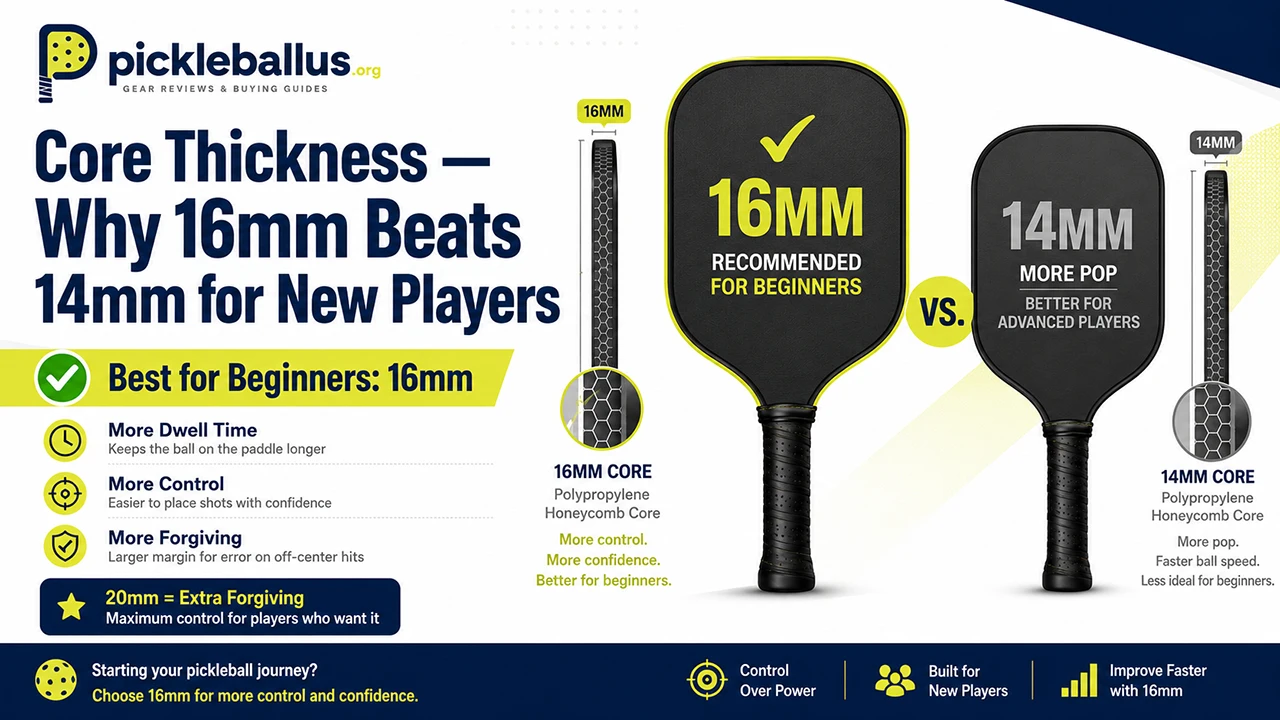
16mm polypropylene honeycomb cores give beginners the single most important thing they need on the court: dwell time. That fraction of a second the ball stays in contact with the paddle face translates directly into more control and a larger margin for error on off-center hits. Thinner 14mm cores are favored by advanced players chasing faster ball speed and pop — attributes that actively work against a beginner still building consistency and shot placement. For a deeper look at how thickness affects performance across skill levels, the pickleball paddle core thickness guide breaks it down in full.
Some newer budget paddles now offer 20mm cores, which are even more forgiving. If your primary goal for the first 6–12 months is consistency, thicker is better.
Face Material — Fiberglass vs. Carbon Fiber for Beginners
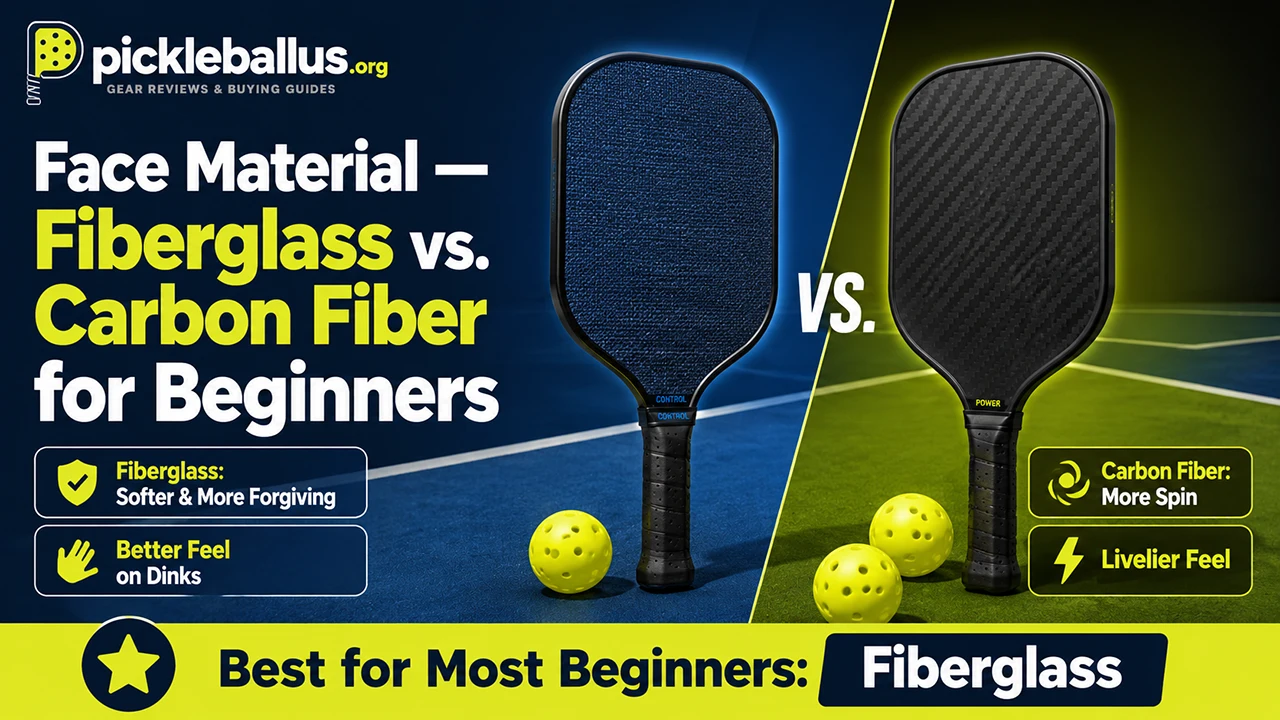
Fiberglass faces are softer and more forgiving than carbon fiber, which is why most beginner-oriented paddles use them. The added flex absorbs some of the ball’s energy, reducing erratic bounce and giving you more feel on softer dink shots near the kitchen line. Carbon fiber faces generate more spin and are popular across all skill levels, but the surface is livelier — meaning errors get amplified rather than dampened.
For most beginners, fiberglass is the safer starting point. That said, raw carbon fiber paddles have dropped significantly in price and are now realistic starter options at mid-range budgets. The tradeoff is a short adjustment period to calibrate the livelier feel.
Weight — Midweight vs. Lightweight Explained
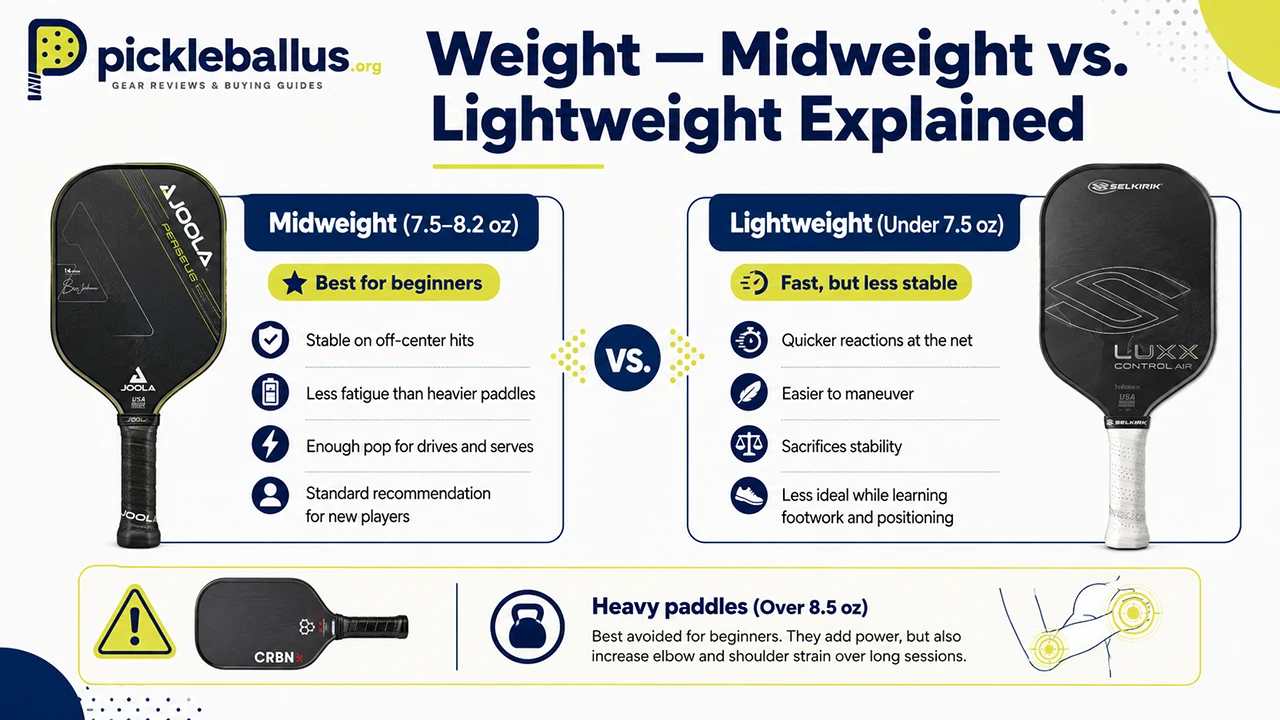
Midweight paddles (7.5–8.2 oz) are the standard recommendation for beginners. The extra mass provides stability on off-center hits, reduces arm fatigue compared to swinging a heavier paddle, and still generates enough pop for drives and serves. Lightweight paddles (under 7.5 oz) favor quick reaction times at the net but sacrifice stability — a mismatch for players still learning footwork and court positioning.
Heavy paddles (over 8.5 oz) are best avoided until you’ve built at least intermediate technique. The added power is real, but so is the increased strain on the elbow and shoulder over longer sessions — a concern especially for players new to the repetitive mechanics of pickleball.
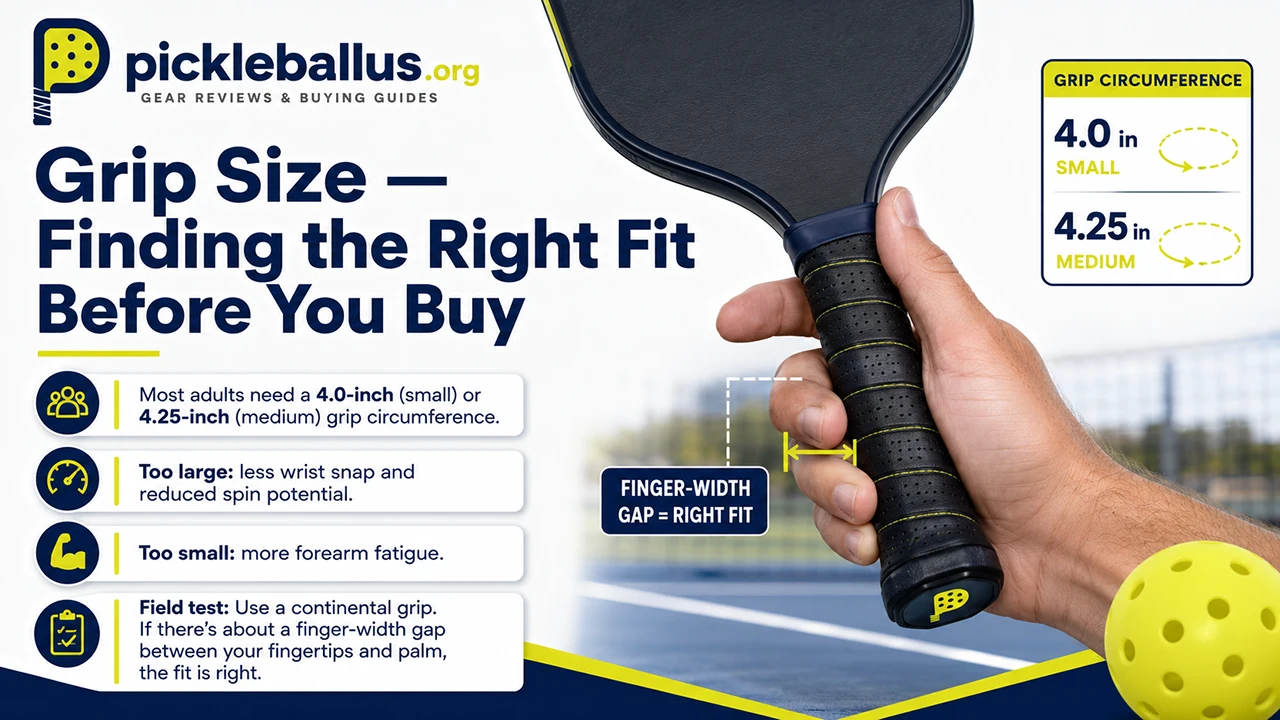
Grip Size — Finding the Right Fit Before You Buy
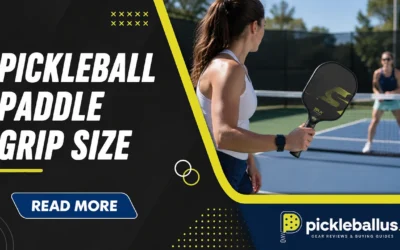
Most adults need a 4.0-inch (small) or 4.25-inch (medium) grip circumference. A grip that’s too large prevents proper wrist snap and reduces spin potential; one that’s too small causes forearm fatigue. A simple field test: hold the paddle in a continental grip (as if shaking hands with the edge facing up). If there’s roughly a finger-width gap between your fingertips and your palm, the size is right. For detailed measuring guidance, the pickleball paddle grip size reference covers every hand measurement scenario.
The 8 Best Pickleball Paddles for Beginners in 2026
The following eight paddles were selected based on Amazon availability, verified review volume, consistent buyer feedback, and on-court performance across different beginner profiles. Every product here is actively sold on Amazon and carries enough review history to give real confidence in its durability and reliability. This isn’t a curated selection of whatever’s trending — it’s a practical, field-tested list built for new players.
#1 JOOLA Ben Johns Hyperion CFS 16 — Best Overall
Calling this a beginner paddle almost feels like a disservice — but hear me out. The Hyperion CFS 16 earned the top spot on this list not because it’s the easiest paddle to pick up on day one, but because it’s the one you won’t outgrow. For beginners who are serious about the sport and plan to be playing at a 3.5+ level within a season, starting here saves you from buying two paddles.
Key Specs
- Core: 16mm Reactive Polymer Honeycomb
- Face: Carbon Friction Surface (CFS) — textured carbon fiber
- Weight: 8.0–8.4 oz
- Grip: 4.25″ circumference, 5.5″ handle length
- Shape: Elongated (16.5″ × 7.5″)
- USAPA Approved: Yes
This review covers the standard Hyperion CFS 16 — the Swift (7.9 oz) variant is also available for players who prefer a lighter feel.
Performance Analysis
The 16mm reactive polymer honeycomb core is the engine here. It absorbs incoming pace better than thinner 13–14mm alternatives, which means mis-hits and off-center returns still land in a useful part of the court — exactly what new players need while their mechanics are still forming. The Carbon Friction Surface adds meaningful topspin even with an imperfect stroke; on third-shot drops I was able to generate enough roll to keep the ball low even when my form wasn’t clean. Where the Hyperion differs from something like the JOOLA Perseus CFS 16mm is forgiveness — the Perseus rewards precision, while the Hyperion rewards commitment. At 8.0–8.4 oz with a head-heavy balance, the paddle does carry more swing weight than ultra-lightweight beginner options, so players coming from zero racket sport experience may feel fatigue earlier in extended sessions. Ben Johns, the world’s top-ranked pro, co-designed this paddle and used it competitively — the construction reflects that pedigree in every aspect of the feel. For players wanting to explore more from this brand, best JOOLA pickleball paddles covers the full lineup with side-by-side comparisons.
Pros
- The 16mm core produces one of the largest effective sweet spots in its class, rewarding consistent dinking even during early skill development
- CFS texture generates reliable topspin without requiring precise technique — useful for beginners still developing stroke mechanics
- The 5.5″ handle comfortably accommodates two-handed backhands, adding a useful shot option as your game develops
- Exceptional stability on volleys: the paddle doesn’t twist or torque on off-center contact, keeping rallies alive
- Built to pro-level tolerances, so you’ll never hit a ceiling on what the paddle can do
Cons
- Head-heavy balance and 8.0–8.4 oz weight can cause arm fatigue for players coming from zero athletic background in the first few weeks
- Elongated shape has a narrower face than widebody paddles, which may feel less forgiving side-to-side for complete beginners
- Premium construction comes at a premium investment — harder to justify if you’re still unsure whether the sport will stick
Best For
Beginners at the DUPR 2.5–3.5 range who are committed to improving quickly and want a paddle that scales with their game rather than requiring a replacement in six months. Particularly well-suited to players with any racket sport background (tennis, ping-pong, racquetball) who can handle the swing weight from session one.
My Verdict
The Hyperion CFS 16 is the best overall beginner paddle on this list because it respects where you’re going, not just where you are. The forgiving 16mm core makes early-stage errors survivable, the CFS face teaches you what spin feels like, and the build quality means you’ll still be reaching for it at a 4.0 rating. If you’re willing to invest in one paddle that lasts, start here.
#2 Selkirk SLK Evo Hybrid Max — Best for Brand Reliability
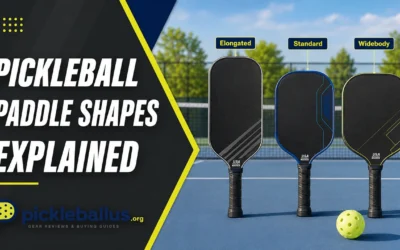
Selkirk’s SLK line was built specifically for newer players, and the SLK Evo Hybrid Max delivers on that brief completely. The “Max” refers to its widebody shape — a wider face that expands the hitting zone and makes life considerably easier when you’re still learning to track and position your body correctly behind the ball.
Key Specs:
- Core: Polymer Honeycomb, 16mm
- Face: Hybrid Fiberglass/Carbon
- Weight: 7.8–8.2 oz
- Grip: 4.25 inches
Performance: The widebody shape is immediately noticeable. Shots that would slide off the edge of a standard paddle stay solidly on the face here. The hybrid face — part fiberglass, part carbon — is a thoughtful middle ground: enough softness for touch shots, enough pop for groundstrokes. Selkirk’s build quality is excellent, and the paddle holds up through the heavy drilling and repetition that defines the early learning phase.
Pros:
- Widebody face provides one of the largest sweet spots in this roundup
- Hybrid face material bridges fiberglass feel with carbon responsiveness
- Excellent build quality backed by one of pickleball’s most trusted brands
- Appropriate grip size for most adult hands without needing an overgrip
Cons:
- Widebody shape is less common; some players prefer standard proportions
- Slightly heavier overall feel compared to pure lightweight alternatives
Best For: Beginners who want a forgiving, large-face paddle backed by a brand with a strong warranty and customer service track record.
My Verdict: If brand trust and build quality matter to you as much as on-court performance, the SLK Evo Hybrid Max earns its place without question.
#3 HEAD Radical Elite — Best for Tennis Players Switching to Pickleball
Tennis players making the transition to pickleball often struggle with the smaller court, softer ball, and completely different touch requirements. The HEAD Radical Elite is designed with that transition in mind — HEAD is a name racquet sports players already trust, and the paddle’s weight profile and dimensions bridge the gap between the two sports effectively.
Key Specs:
- Core: Polymer Honeycomb, 13mm
- Face: Graphite
- Weight: 7.8 oz
- Grip: 4.25 inches
Performance: Lighter and slightly thinner than most on this list, the Radical Elite rewards players who already have racquet-sport wrist mechanics. The graphite face is responsive and provides a familiar feel for anyone coming off a tennis racquet. Control is solid at the kitchen line, and the lighter weight makes it easier to swing through faster volleys without fighting the paddle.
The 13mm core is thinner than ideal for a pure beginner — raw novices with zero racquet sport background will find less forgiveness here. Tennis converts with existing hand-eye coordination will adapt immediately.
Pros:
- Trusted HEAD brand name at a beginner-accessible price
- Lighter weight suits faster swing mechanics from racquet sports backgrounds
- Graphite face delivers clean, responsive feedback on every shot
- Excellent transition paddle for tennis, racquetball, or squash players
Cons:
- 13mm core offers less forgiveness than 16mm alternatives
- Not the right starting point for beginners with no prior racquet sport experience
Best For: Tennis or racquetball players switching sports who want a familiar brand and a paddle that suits their existing mechanics.
My Verdict: The best starter paddle for anyone bringing racquet sport experience to the pickleball court. Pure beginners with no prior racquet background should look to the paddles above first.
#4 Paddletek Bantam EX-L — Best for Control-First Beginners
The Paddletek Bantam EX-L has been a staple in the beginner and recreational category for years. Paddletek’s design philosophy centers on feel, and the Bantam EX-L channels that into a paddle that makes soft shots — dinks, drops, resets — feel intuitive almost from the very start.
Key Specs:
- Core: Smart Response Technology (SRT) Polymer
- Face: Graphite
- Weight: 7.2–7.8 oz
- Grip: 4.25 inches
Performance: The Bantam EX-L plays softer than most paddles at its weight. Dink rallies have a plush, controlled quality that builds real confidence at the kitchen line early on. The lighter weight keeps arm fatigue minimal across longer sessions, and Smart Response Technology dampens vibration noticeably — an underrated benefit for beginners still adjusting their mechanics. Where it trades off is in drive power: this isn’t the paddle for players who want to blast groundstrokes from the baseline.
Pros:
- Exceptional control and touch at the kitchen line from day one
- Lighter weight keeps arm fatigue low during extended sessions
- Smart Response Technology reduces vibration effectively
- Strong track record from a well-established pickleball manufacturer
Cons:
- Less pop for power-oriented beginners
- Graphite face generates less spin than raw carbon fiber alternatives
Best For: Beginners who already gravitate toward finesse play and want to develop their soft game before building power.
My Verdict: If your instinct is to place the ball at your opponent’s feet and win at the net rather than overpower them, the Bantam EX-L is built for your game.
#5 GAMMA Hellbender 16mm — Best Budget Pick
The GAMMA Hellbender 16mm gives budget-conscious beginners a legitimate 16mm paddle from a brand that has been in the racquet sports space for decades. GAMMA is best known for its tennis strings, and that materials expertise shows in how thoughtfully the Hellbender’s core is constructed for its price point.
Key Specs:
- Core: Sensa-Poly Core, 16mm
- Face: Textured Fiberglass
- Weight: 7.8–8.3 oz
- Grip: 4.125 inches
Performance: For its price tier, the Hellbender punches significantly above its category. The 16mm Sensa-Poly core provides the control and forgiveness you’d expect from a paddle at double the cost. The textured fiberglass face generates enough spin for beginners to develop topspin serves and dink variation without overwhelming a new player’s mechanics. This isn’t a flashy paddle, but it’s consistently reliable and won’t let you down when you’re still building fundamentals.
Pros:
- Budget-friendly from a brand with decades of racquet sports manufacturing experience
- 16mm core delivers genuine forgiveness across the hitting surface
- Textured fiberglass face provides solid spin traction for beginners
- Reliable quality from GAMMA’s established production standards
Cons:
- Grip circumference slightly smaller than most alternatives; an overgrip is worth considering
- Less premium feedback feel compared to mid-range options
Best For: New players who want a quality, trust-worthy paddle without committing a significant budget to a sport they’re just exploring. Also one of the best pickleball paddles under $100 in its category.
My Verdict: The Hellbender 16mm is the answer when someone asks “what’s the best beginner paddle under $80?” It doesn’t disappoint at its price point.
#6 Vatic Pro Prism Flash — Best Value All-Rounder
The Vatic Pro Prism Flash made serious noise in the value paddle category and continues to turn heads. At its price point, its thermoformed carbon fiber construction was nearly impossible to find a few years ago. The Flash is built for players who want carbon fiber performance without paying a premium for it.
Key Specs:
- Core: Polypropylene Honeycomb, 16mm
- Face: Raw Carbon Fiber (Thermoformed)
- Weight: 7.8–8.2 oz
- Grip: 4.25 inches
Performance: Thermoformed construction bonds the carbon face to the core more completely than standard manufacturing, producing a livelier and more consistent feel across the entire hitting surface. The raw carbon face generates spin at a level that typically costs significantly more — for beginners ready to start building spin technique early, the Flash is a compelling starting point. The 16mm core provides enough control-oriented dwell time to balance the face’s inherent liveliness.
Pros:
- Raw carbon fiber face at a mid-range price — exceptional value
- Thermoformed construction ensures consistent response across the entire face
- 16mm core provides the dwell and control beginners need
- Strong long-term value as your skill level develops
Cons:
- Raw carbon face is livelier than fiberglass — less immediately forgiving for pure novices
- Better suited to beginners with some athletic or racquet sports background than absolute novices
Best For: Athletic beginners who want to build spin technique from the start and plan to stay with the paddle through intermediate-level play.
My Verdict: The best value paddle on this list, and it’s not a close comparison. If you’re willing to accept a short adjustment period, the Prism Flash pays back that investment quickly.
#7 Franklin Sports Ben Johns Signature — Best True Entry-Level Pick
The Franklin Sports Ben Johns Signature paddle is the clearest example of an entry-level paddle done right. Franklin is one of the most recognized names in pickleball equipment, and the Ben Johns Signature uses the pro’s name to create something genuinely usable for new players — without the technical demands of a professional-grade paddle.
Key Specs:
- Core: Polymer Honeycomb
- Face: Graphite
- Weight: 7.8 oz
- Grip: 4.25 inches
Performance: This paddle keeps things simple and functional. The polymer core delivers solid, predictable control without anything unexpected in the response. The graphite face provides clean, consistent feedback across the hitting surface. For someone picking up a paddle for the very first time, the Franklin Ben Johns Signature removes all the complexity and delivers a manageable, predictable experience that lets you focus entirely on learning the game rather than fighting your equipment.
Pros:
- Genuinely beginner-friendly design with no surprises in feel
- Lightweight build reduces early arm fatigue during long sessions
- Ben Johns brand association provides a quality reference point at entry-level pricing
- Available in bundles — practical for buying alongside a partner starting out together
Cons:
- Performance ceiling is lower than mid-range options; will need upgrading within 12–18 months
- Less spin potential than carbon fiber alternatives at the same price range
Best For: Absolute beginners with no racquet sport background who want the simplest possible introduction to pickleball without overthinking the gear.
My Verdict: The best option if you want to step onto the court and focus entirely on the game, not the equipment. It does exactly what it promises.
#8 Engage Pickleball Pursuit MX 6.0 — Best for Beginners Chasing Spin
The Engage Pickleball Pursuit MX 6.0 rounds out the list as the best option for beginners who’ve already identified spin as a core part of the game they want to develop. Engage has built its reputation around feel and spin generation, and the Pursuit MX 6.0 brings that DNA into a package more accessible than Engage’s professional lines.
Key Specs:
- Core: ControlPro Polymer
- Face: Fiberglass with Skin Technology
- Weight: 7.6–8.1 oz
- Grip: 4.0 or 4.125 inches
Performance: Engage’s Skin Technology creates a naturally grippier surface that gives the ball extended contact time — translating directly into better topspin and slice even at lower swing speeds. Beginners don’t need to swing hard to generate meaningful spin with the Pursuit MX 6.0. The control profile is solid throughout rallies, and the medium weight keeps sessions comfortable. The surface texture feels slightly unusual at first compared to standard fiberglass, but the adjustment period is short.
Pros:
- Skin Technology provides excellent spin generation accessible to beginners
- Solid control profile aids shot placement during the learning phase
- Engage’s well-earned reputation for feel carries through to this model
- Grip size options suit players with smaller hands
Cons:
- Skin Technology surface requires a short break-in period
- Slightly higher price point than some budget-friendly options on this list
Best For: Beginners who have watched pickleball and know from the start that spin is going to be their primary weapon.
My Verdict: If you already know spin is your game, starting with the Engage Pursuit MX 6.0 means you won’t hit a skill ceiling from your equipment anytime soon.
Which Beginner Paddle Type Fits Your Game?
Eight solid options still requires understanding which category actually matches your priorities. The right choice depends on three honest questions: How serious are you about the sport right now? Do you have any prior racquet sport experience? And how long do you want this paddle to last before upgrading?
Budget-Friendly vs. Mid-Range vs. Premium — What You Actually Get
Budget-friendly paddles focus on getting you playing with functional materials. Expect fiberglass or graphite faces, standard polymer cores, and reliable performance without advanced construction techniques. These are appropriate for beginners genuinely unsure whether pickleball will become a regular part of their life.
Mid-range paddles introduce better core construction (consistent 16mm honeycomb), improved face materials (hybrid or raw carbon fiber), and tighter manufacturing tolerances. The performance gap between budget and mid-range is significant and immediately felt. This is where most dedicated beginners should aim from day one — the spend difference typically pays for itself by avoiding a second purchase within the first year.
Premium beginner paddles — like the JOOLA Hyperion CFS — offer performance that remains competitive at intermediate and even early advanced levels. The upfront investment eliminates the need for a replacement paddle within the first 18–24 months.
Fiberglass vs. Carbon Fiber — What Beginners Actually Feel
Fiberglass is softer and more forgiving. Mishits absorb more cleanly. Dinks feel more controlled and readable. The tradeoff is a lower performance ceiling over time — less spin potential and less pop at higher swing speeds. For pure beginners, fiberglass is the lower-risk starting point and remains a viable choice at every level for control-oriented players.
Carbon fiber is livelier and more responsive. When your technique becomes consistent, it rewards precision with better spin generation and faster drive speed. Raw carbon fiber adds additional surface texture that dramatically improves spin traction. The risk is that its liveness amplifies errors — something beginners experience frequently. Athletic beginners or those with racquet sport backgrounds tend to adjust faster.
Can You Use a Beginner Paddle as You Advance?
Most dedicated beginner paddles will limit your game within 12–24 months of regular play as your technique, footwork, and court awareness develop. The good news is that several paddles on this list — particularly the JOOLA Hyperion CFS 16mm and the Vatic Pro Prism Flash — are designed to grow with you, carrying enough performance ceiling to remain competitive well into intermediate play.
Pure entry-level paddles like the Franklin Sports Ben Johns Signature, however, will eventually feel like they’re holding back your placement, spin, and touch once those elements become consistent. The upgrade signal is usually clear: you’re placing shots correctly, your footwork is solid, but the paddle doesn’t reward the precision you’ve built. When that happens, move to our best pickleball paddles for intermediate players to find options built for the next level.
By now, you have a clear picture of which paddles match different beginner profiles — whether you’re prioritizing budget, forgiveness, brand reliability, or long-term value. Choosing the paddle, however, is only the first step. How you hold it, how you care for it between sessions, and when you recognize it’s time to upgrade are the decisions that actually shape how fast you improve on the court. The next section covers those finer details — the smaller choices that separate beginners who plateau at 3.0 from those who steadily keep climbing.
What Else Beginners Should Know Before Their First Purchase
How to Grip a Pickleball Paddle Correctly
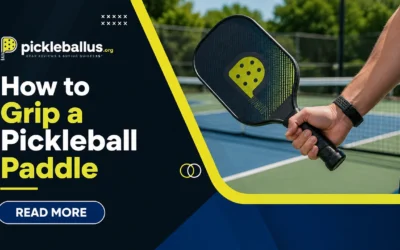
The continental grip — formed by holding the paddle as if shaking hands with the edge facing up — is the standard starting point for beginner players. It allows quick transitions between forehand and backhand without regripping mid-rally, which matters more at the beginner level than any specific spin technique the grip enables.
Grip pressure is equally important and far more often neglected. A death-grip on the handle kills feel and increases forearm fatigue across long sessions. Most coaches recommend a grip pressure of 4–5 on a scale of 1–10 during rallies, tightening slightly at contact and loosening immediately after the shot. Most beginners hold the paddle far too tightly for their first several months — awareness of the problem is the first step toward fixing it. For step-by-step grip and technique basics, the pickleball tips resource covers grip mechanics alongside court positioning and shot fundamentals.
When to Upgrade from a Beginner to an Intermediate Paddle
Upgrade when your paddle becomes the limiting factor, not your technique. The clearest signal is consistent placement — your shots are landing where you intend — but the paddle doesn’t generate the spin, touch, or speed your shots need to be effective against stronger opponents. Most players reach this point somewhere between 12 and 24 months of regular play.
Rushing the upgrade before you’ve built consistent mechanics wastes money. The correct upgrade path leads toward intermediate paddles: typically models with 14mm cores, raw carbon fiber faces, and higher swing weights for more decisive drives. A useful signal: when your dinks feel right but your opponents can predict them, the paddle’s ceiling is the problem, not your execution.
Beginner Paddle Sets vs. Single Paddles — Which Saves More
Starter paddle sets — two paddles, a few balls, and sometimes a bag — are tempting at first glance. For casual backyard play or introducing a partner to the sport, a best starter pickleball paddle set can be a practical, cost-efficient choice.
For anyone serious about improving, buying a single quality paddle outperforms any bundle set at a comparable price. Bundle sets spread their cost across multiple items — paddles, balls, bag, extras — often resulting in paddles made from inferior materials that develop dead spots or delamination within a season. Invest in one proper paddle, buy balls separately, and you’ll spend less in total while playing with meaningfully better equipment from the start.
Write Your Review
No reviews yet. Be the first to share your experience!