

The best pickleball paddles for advanced players in 2026 are the JOOLA Ben Johns Perseus Pro IV (best overall), the Selkirk Boomstik (best for power), the Volair Mach 2 Forza (best for spin), the Six Zero Double Black Diamond (best for control), the Engage Pursuit Pro 6.0 (best for precision all-court play), the Beatnik X Monster (best for 4.0–5.0 DUPR range), the Honolulu J2NF (best value), and the JOOLA Ben Johns Perseus 3S (best pro-used runner-up).
Choosing the right paddle at the advanced level is a different problem than it was when you were learning. You’re no longer asking “will this forgive my off-center hits?” You’re asking which paddle amplifies what you already do well — whether that’s a heavy topspin forehand drive, a surgical reset at the kitchen, or lightning-fast hands in a firefight at the net. Face material, core thickness, and weight all interact differently when your mechanics are already dialed in.
What most listicles skip is that advanced players often need different paddles for different formats. The paddle you trust for a grinding doubles match may feel sluggish in a fast-paced singles game. The one that shines on a cold outdoor court may feel dead indoors in summer heat. Understanding those tradeoffs before you spend on a premium model saves you from cycling through expensive equipment every few months.
Below, you’ll find every paddle reviewed in full — specs, performance analysis, pros and cons, and a clear recommendation for who it suits best. Whether you’re competing at the 4.0, 4.5, or 5.0+ DUPR level, there’s a paddle on this list that will sharpen your competitive edge.
What Makes a Pickleball Paddle “Advanced”?
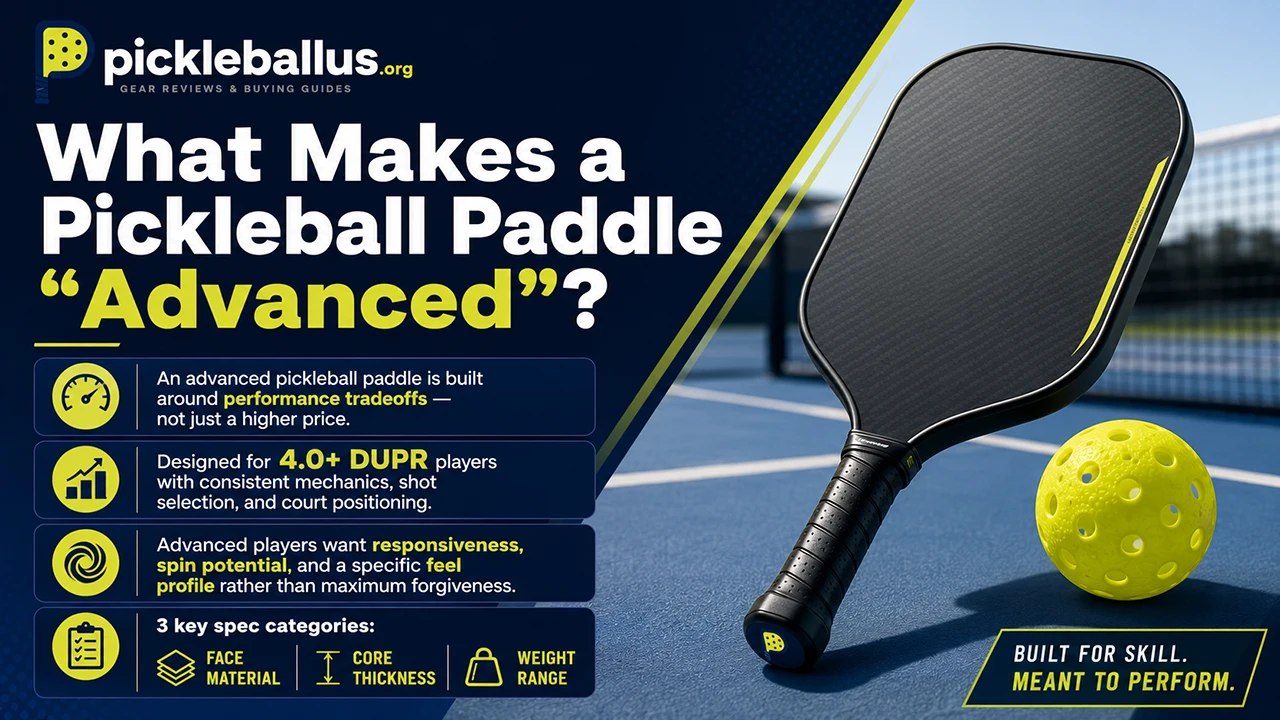
An advanced pickleball paddle is one engineered around performance tradeoffs that only experienced players can exploit — not a paddle that’s simply more expensive. At the 4.0+ DUPR level, players have consistent mechanics, shot selection, and court positioning. What they need from a paddle is responsiveness, spin potential, and a specific feel profile rather than forgiveness and ease of use. Those demands drive every design decision in the paddles reviewed on this list.
Three spec categories define the divide between intermediate and advanced equipment: face material, core thickness, and weight range.
Face Material — Raw Carbon, Fiberglass, or Foam?
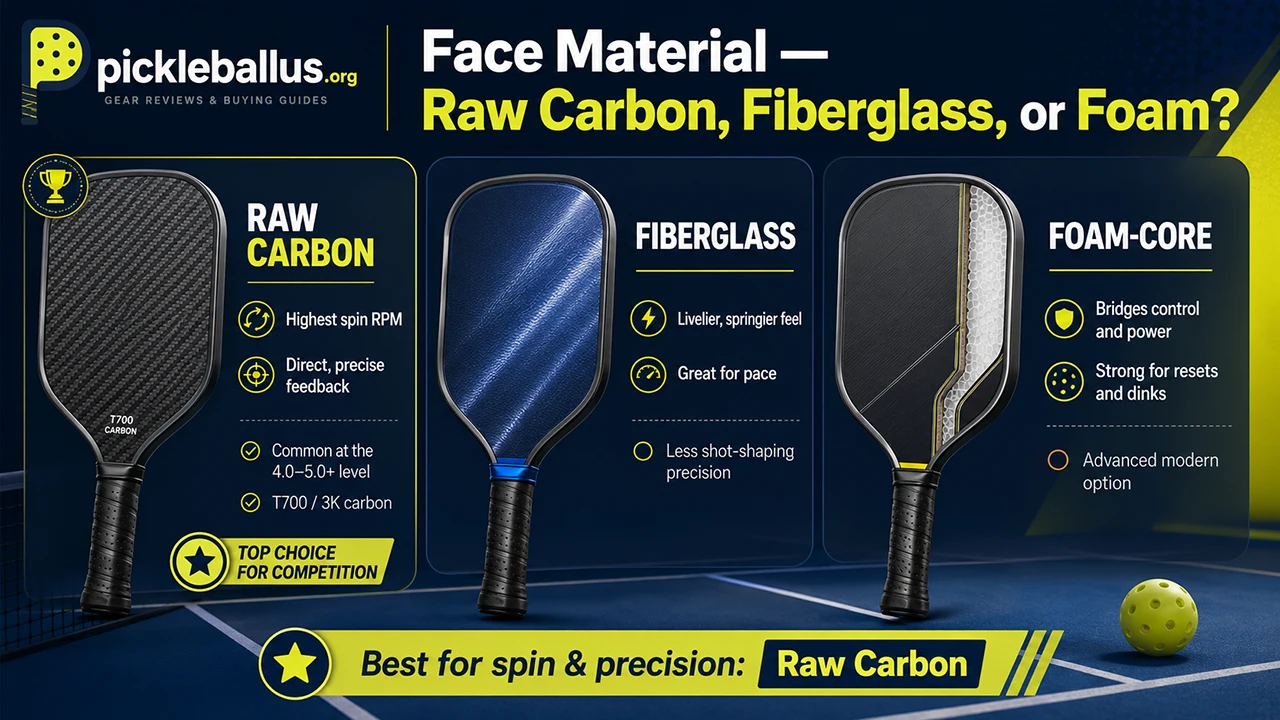
Raw carbon fiber is the face material of choice for most serious competitive players because it generates the highest spin RPM and provides direct, precise feedback on every contact. The exposed carbon weave grips the ball longer than a polished face, letting you shape drives, rolls, and drop shots with more consistency. Most paddles at the 4.0–5.0+ level use T700 raw carbon as their face, with some premium models using 3K carbon for a finer texture and slightly different spin profile.
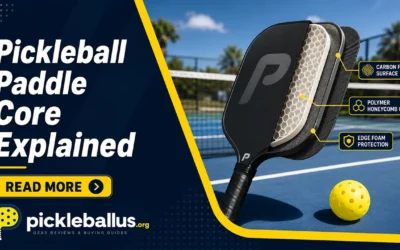
Fiberglass faces — common in mid-range paddles — produce a livelier, springier feel. They’re excellent for players who rely on pace but sacrifice the shot-shaping precision that raw carbon delivers. Foam-core paddles (where the entire paddle construction incorporates injected foam walls rather than just a honeycomb core) are a newer category that bridges control and power, making them a legitimate advanced option — particularly for players who reset and dink a lot. The Selkirk Boomstik and Honolulu J2NF represent this technology.
Core Thickness — 14mm vs 16mm for Advanced Play
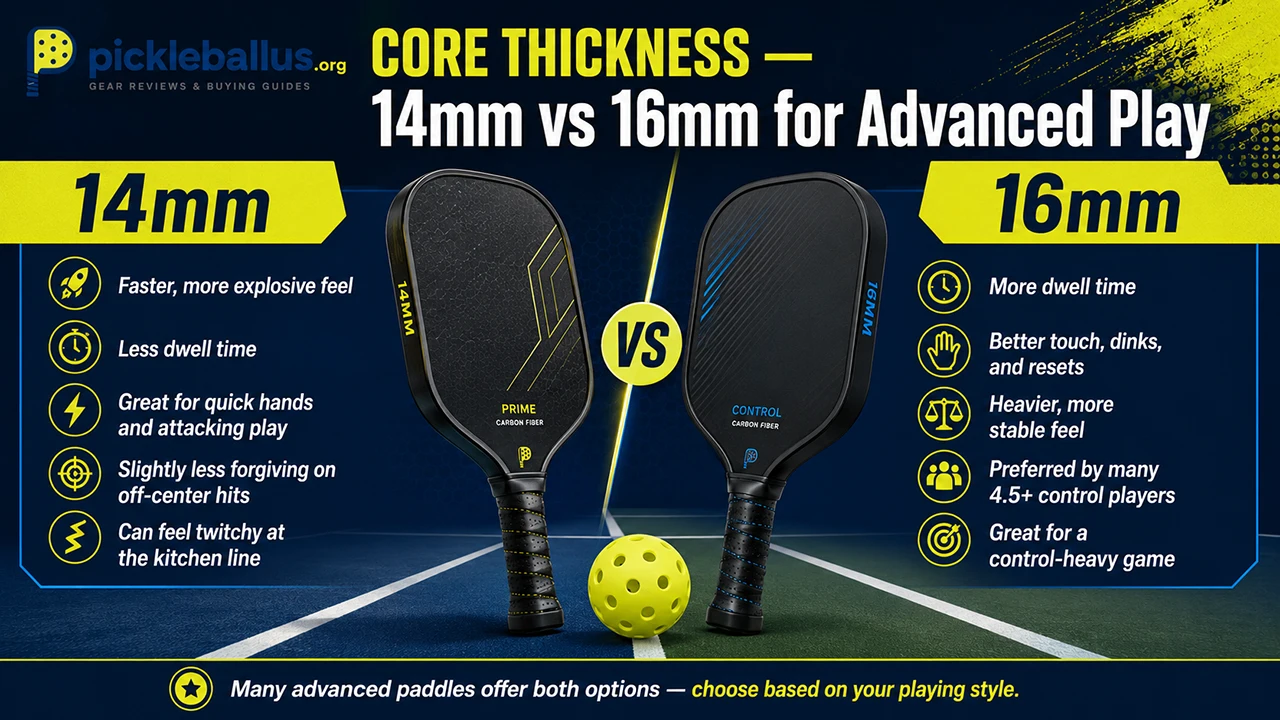
14mm cores produce a faster, more explosive feel. The ball pops off the face with less dwell time, which rewards players with quick hands who want to attack the ball and accelerate it through the court. The tradeoff is that 14mm paddles are slightly less forgiving on off-center contacts and can feel twitchy at the kitchen line.
16mm cores provide more dwell time — the ball stays on the face longer, which translates to better feel for touch shots, dinks, and resets. They’re heavier, which contributes to stability during hard exchanges. Many 4.5+ players who play a control-heavy game strongly prefer 16mm, while attackers and bangers tend to gravitate toward 14mm. Several paddles on this list offer both options, which is worth considering when you decide.
8 Best Pickleball Paddles for Advanced Players in 2026
There are eight top-performing paddles for advanced players: they cover power, spin, control, and all-court play across a range of price points. Each review below covers the full picture — construction, performance, and who the paddle actually suits.
#1 JOOLA Ben Johns Perseus Pro IV — Best Overall
The JOOLA Ben Johns Perseus Pro IV is the best pickleball paddle for advanced players who want elite power without sacrificing the precision to play a complete game. It’s the current paddle used by Ben Johns — one of the highest-ranked players in the world — and the latest evolution of a paddle line that has defined competitive play for the past three seasons.
Key Specs:
- Face: Charged Carbon Surface (raw carbon)
- Core: GEN 3 Propulsion Core — 14mm or 16mm
- Weight: 7.9–8.2 oz
- Shape: Elongated
- Approval: USAP / PBCoR compliant
Performance Analysis: The GEN 3 Propulsion Core delivers an energy return profile that is noticeably different from previous Perseus generations — drives feel more explosive without the paddle feeling stiff on resets. The Charged Carbon Surface creates a grippy contact point that bites into the ball, generating heavy topspin on drives and serves. The 14mm version is particularly well-suited for players who play an aggressive attacking style; the 16mm adds stability and is the better choice for those who mix power with a softer game at the net.
An embedded NFC chip connects the paddle to the JOOLA app — a feature that currently offers exclusive content but hints at future performance tracking capability. It doesn’t affect playability, but it signals where the high-end paddle market is headed.
Pros:
- Elite power with exceptional spin generation
- Available in both 14mm and 16mm configurations
- USAP and PBCoR tournament-approved
- Consistent sweet spot across the paddle face
Cons:
- Premium price point puts it out of reach for some players
- The 14mm version is less forgiving on mishits than 16mm alternatives
Best For: Competitive players at the 4.5–5.0+ DUPR level who play an attacking game and need maximum power while retaining enough control for net exchanges.
My Verdict: The Perseus Pro IV is the most complete advanced paddle available right now. The combination of explosive pop, raw carbon spin, and PBCoR approval makes it a safe long-term investment for anyone competing seriously. It’s the benchmark everything else on this list is measured against.
#2 Selkirk Boomstik — Best for Power
The Selkirk Boomstik is the hardest-hitting paddle on this list and currently one of the most powerful foam-core paddles in pickleball. It’s used by top professionals including Catherine Parenteau and Jack Sock, and it signals a new standard for what foam construction can do at the elite level.
Key Specs:
- Face: Raw carbon fiber
- Core: Full foam core (Selkirk’s proprietary construction)
- Weight: 8.0–8.4 oz
- Shape: Elongated
- Approval: USAP
Performance Analysis: What makes the Boomstik unusual is its construction — it has a completely hollow feel on contact compared to traditional honeycomb core paddles, yet it delivers more raw power than almost anything else you can buy. The full foam core produces a massive sweet spot and a level of forgiveness that makes it more accessible than typical power paddles while still delivering aggressive pace on drives and put-away shots.
The raw carbon face holds its spin potential well. Players who rely on a heavy topspin forehand will feel the benefit immediately. Resets and dinks are manageable despite the power bias, but this paddle rewards an offensive mindset rather than a reset-heavy game.
Pros:
- Unmatched raw power output
- Large sweet spot thanks to foam construction
- Pro-proven durability at the tournament level
- Excellent for players who like to attack from both wings
Cons:
- Touch shots and soft resets require adjustment coming from control paddles
- Premium pricing reflects the cutting-edge foam construction
Best For: Power players at the 4.5–5.0 DUPR range who dominate through pace, aggressive drives, and put-away volleys rather than a finesse-based game.
My Verdict: If your game is built on taking time away from your opponent and ending points quickly, the Boomstik will feel like an unfair advantage. It’s not for every advanced player, but for those who play offense-first, it delivers something other paddles don’t.
#3 Volair Mach 2 Forza — Best for Spin
The Volair Mach 2 Forza is the best paddle on this list for players who shape the ball heavily and build points through spin differential. Co-founded by pro player Julian Arnold (DUPR: 6.7), Volair has built this paddle around a raw carbon face specifically optimized for maximum spin output.
Key Specs:
- Face: Raw TORAY T700 Carbon Fiber with heat-compressed texturing
- Core: Optimized C7 Polymers / High-grade honeycomb
- Construction: Unibody foam-injected walls for expanded sweet spot
- Weight: 7.9–8.2 oz
- Shape: Elongated
Performance Analysis: The heat-compressed texturing on the T700 face is what sets this paddle apart. The surface creates a more aggressive grip on the ball than standard raw carbon, which translates into noticeably heavier spin on topspin drives, slice serves, and roll dinks. Players who rely on creating angles through spin will find the Mach 2 Forza gives them more shape than most alternatives.
The unibody foam-injected wall construction — borrowed from tennis racket engineering — adds to the sweet spot and provides a consistent response across the full face. This paddle rewards a player who takes long, full swings rather than compact punch volleys.
Pros:
- Industry-leading spin generation
- Foam-injected walls for an expanded, consistent sweet spot
- Endorsed and played by a top professional (Julian Arnold)
- Excellent feedback on drives and serve returns
Cons:
- Full swing mechanics are rewarded; players with compact technique may not unlock its full potential
- Not the first choice for a reset-heavy or dink-centric game
Best For: Advanced players who build pressure through heavy topspin — particularly those who dominate on the baseline and want to create angles that opponents can’t neutralize.
My Verdict: If you’ve ever wanted to hit a topspin drive that kicks high and forces a defensive pop-up, the Mach 2 Forza delivers that consistently. It’s niche in the best possible way — and for the right player, it’s a legitimate weapon.
#4 Six Zero Double Black Diamond — Best for Control
The Six Zero Double Black Diamond is the best control paddle for advanced players who win through precision, shot placement, and kitchen management rather than raw power. It has become a trusted choice among players who prioritize feel and consistency over pace.
Key Specs:
- Face: Raw carbon fiber (dual-layer construction)
- Core: 16mm polymer honeycomb
- Weight: 7.8–8.1 oz
- Shape: Elongated
- Approval: USAP
Performance Analysis: The Double Black Diamond’s dual-layer carbon face absorbs pace better than most paddles in this category, which translates directly into easier resets and more controlled dinks. At the kitchen line, it provides the tactile feedback that advanced players need to judge how hard to swing on a third-shot drop — a detail that’s hard to notice until you play with a paddle that gets it right.
The 16mm core supports the control bias, adding dwell time and stability that helps on mid-court resets when opponents are driving hard. It’s not a slow paddle — the carbon face still has enough pop to hit effective drives — but its strength is making advanced touch shots feel repeatable and reliable.
Pros:
- Exceptional dink and reset control at the kitchen
- Dual-layer face provides superior feel and feedback
- 16mm core adds stability for resets under pressure
- Solid USAP approval for all tournament formats
Cons:
- Less pop than power-oriented paddles on this list
- Players who rely on a heavy-hitting game may find it underpowered
Best For: 4.0–5.0 players who play a control-based game built on neutralizing pace, winning dink battles, and constructing points with precision rather than power.
My Verdict: The Double Black Diamond is the kitchen player’s paddle. If you watch how top-ranked doubles teams construct rallies — patient, precise, waiting for the right ball to attack — this is the paddle those players reach for.
#5 Engage Pursuit Pro 6.0 — Best for Precision All-Court
The Engage Pursuit Pro 6.0 is the best all-court option for advanced players who need a paddle that performs reliably at both the kitchen and the baseline. Engage’s proprietary construction delivers a blend of shot-making versatility that suits a complete, well-rounded game.
Key Specs:
- Face: Raw T700 Carbon skin with next-generation inner layers
- Core: Control Pro ‘Black’ polymer core
- Weight: 8.0–8.3 oz
- Shape: Elongated
- Approval: USAP
Performance Analysis: Engage built the Pursuit Pro 6.0 around the idea that the face and core should behave as a single unified system rather than two independent components. The Raw T700 skin bonds directly to the Control Pro polymer core in a way that enhances energy transfer while softening impact — the result is a paddle that can hit a drive with authority and then transition to a soft drop shot without requiring a significant mechanical adjustment.
Players who have tried earlier Engage paddles will notice the updated construction provides more consistent performance across the face. The sweet spot is well-balanced, and the feedback on mishits is informative rather than punishing.
Pros:
- Seamless transition between power and touch shots
- Proprietary bonding construction improves energy consistency
- Reliable across indoor and outdoor conditions
- Excellent for players who mix styles within a single match
Cons:
- Not the top specialist pick for either pure power or pure control
- Some players may prefer a stronger lean in one direction
Best For: Advanced 4.5+ players who don’t want to compromise — those who can drive, dink, reset, and attack equally well and need a paddle that supports the full game.
My Verdict: If you’re a complete player who hates giving up an inch in any phase of the game, the Pursuit Pro 6.0 is built for you. It doesn’t win any single category by a wide margin, but it stays competitive in every one — which is exactly what a well-rounded advanced player needs.
#6 Beatnik X Monster — Best for 4.0–5.0 DUPR Range
The Beatnik X Monster is the most underrated paddle on this list — and possibly the best value among genuinely high-performance options for players in the 4.0–5.0 DUPR bracket. The edgeless construction and distinctive grip make it immediately recognizable, and both features serve a functional purpose.
Key Specs:
- Face: 3K carbon fiber
- Core: High-grade polymer honeycomb
- Design: Edgeless (no edge guard)
- Weight: 7.9–8.2 oz
- Shape: Elongated
- Approval: USAP
Performance Analysis: The 3K carbon fiber face produces a finer, tighter weave than the T700 alternatives on this list — the result is a slightly different spin profile that some players describe as more predictable and consistent on roll dinks and topspin drops. The edgeless design expands the usable sweet spot and eliminates the feedback interference you sometimes feel when hitting near the frame with guarded paddles.
The grip on the Beatnik X Monster is noticeably different from anything else at this level — it’s a full custom grip that provides tactile feedback and wrist mobility that players who rely on rolls and flicks will appreciate. The combination of edge-free sweet spot and a grip designed for wrist-heavy play makes this particularly well-suited for a spin-and-placement game.
Pros:
- Edgeless design maximizes usable face area and sweet spot
- 3K carbon face provides consistent, predictable spin behavior
- Unique grip design supports wrist mobility for rolls and flicks
- Highly competitive price for the performance level
Cons:
- Edgeless construction requires more care to avoid face chipping
- Less name recognition than JOOLA or Selkirk alternatives
Best For: Players in the 4.0–5.0 DUPR range who prioritize sweet spot and spin precision, and who are comfortable with a grip feel that’s different from mainstream options.
My Verdict: This paddle deserves more attention than it gets. The edgeless design alone is worth trying, and the performance backs up the engineering. If you’re in the 4.0–4.5 range and looking to step up without overspending, the Monster should be your first test.
#7 Honolulu J2NF — Best Value for Advanced Players
The Honolulu J2NF is the best value paddle for advanced players who want next-generation foam core technology without the premium pricing of competing flagship models. At roughly half the price of the Selkirk Boomstik, it delivers a level of performance that makes it difficult to justify spending more.
Key Specs:
- Face: Raw carbon fiber
- Core: Next-gen foam core
- Weight: 8.0–8.3 oz
- Shape: Elongated
- Approval: USAP
Performance Analysis: The J2NF uses a foam core construction that was previously only available at higher price points — making it one of the first accessible foam paddles in the mid-range bracket. The foam core dramatically expands the sweet spot compared to standard honeycomb designs, resulting in a level of forgiveness that advanced players rarely find outside flagship paddles.
The raw carbon face contributes solid spin and consistent dwell time. Drives feel powerful, dinks feel controlled, and the paddle handles fast exchanges well thanks to the stability the foam structure adds to the frame. For players competing at the 4.0–4.5 level who don’t want to commit to ultra-premium pricing, this is genuinely the most sensible choice on the list.
Pros:
- Foam core technology at a significantly lower price than rivals
- Massive sweet spot for an advanced paddle
- Consistent performance across power and touch shots
- Strong value for the construction quality
Cons:
- Not quite at the performance ceiling of the Boomstik or Perseus Pro IV
- Less brand cachet than established names at the competitive level
Best For: 4.0–4.5 players making the transition to advanced equipment who want foam-core forgiveness and raw carbon spin without the flagship price tag.
My Verdict: The J2NF is the sleeper hit on this list. If you’re upgrading from an intermediate paddle for the first time, this is where I’d start — it will show you what advanced construction feels like without requiring you to spend at the very top of the market.
#8 JOOLA Ben Johns Perseus 3S — Best Pro-Used Runner-Up
The JOOLA Ben Johns Perseus 3S is the predecessor to the Perseus Pro IV, and it remains one of the most capable competitive paddles available — particularly since Federico Staksrud and Ben Johns were still using it in tournament play into 2025. For players who want proven pro-level performance without paying for the latest generation, this is a compelling option.
Key Specs:
- Face: Charged Carbon Surface (raw carbon)
- Core: GEN 2 Propulsion Core — 14mm or 16mm
- Weight: 7.9–8.2 oz
- Shape: Elongated
- Approval: USAP / PBCoR compliant
Performance Analysis: The Perseus 3S plays similarly to the Pro IV in feel and spin profile, though the Pro IV’s GEN 3 core provides a noticeable upgrade in energy return on hard drives. What the 3S still delivers at a competitive level is the raw carbon Charged Carbon Surface, the familiar elongated JOOLA shape, and the same reliability that made it the paddle of choice for top professionals for multiple seasons.
Players who have extensive time with the Perseus line will feel immediately at home. The 3S is also slightly more widely available than the Pro IV, which can be important when you need to replace a paddle mid-season.
Pros:
- Pro-proven paddle still used at the highest competitive level
- Same Charged Carbon Surface as the current Perseus line
- Available in 14mm and 16mm configurations
- Reliable tournament approval status
Cons:
- GEN 2 core is noticeably less explosive than GEN 3 on hard drives
- The Pro IV outperforms it in most head-to-head comparisons
Best For: 4.5–5.0 players who want a proven tournament paddle in the Perseus family at a slightly lower investment than the current generation flagship.
My Verdict: The 3S is the safe choice for players who know the Perseus feel and don’t want to risk a major adjustment during the competitive season. It’s a step below the Pro IV, but not by enough to hurt your game — and for many players at this level, the difference won’t matter as much as consistency does.
Power vs Control vs All-Court — Which Advanced Paddle Type Fits Your Game?
Power, control, and all-court paddles each suit a different competitive style, and choosing the wrong category is the most common mistake advanced players make when upgrading. The paddle type should match your primary win condition — not just feel good in your hand during warmup.
Here’s a practical breakdown to help you decide:
Choose a Power Paddle If…
You win points by ending rallies, not constructing them. Power paddles — like the Selkirk Boomstik and the Perseus Pro IV in 14mm — reward players who generate their own pace, drive with purpose from mid-court, and attack short balls aggressively. If your first instinct when receiving a third shot is to speed up rather than reset, a power paddle will feel natural.
Power paddles do require precise mechanics. The same stiffness that amplifies a well-struck drive will expose a mishit. They’re best matched with players who have consistent fundamentals and can rely on their mechanics under tournament pressure.
Choose a Control Paddle If…
You win points by outlasting opponents, managing pace, and forcing errors rather than hitting winners. The Six Zero Double Black Diamond and Engage Pursuit Pro 6.0 excel here. If your kitchen game is your strongest weapon, if you prefer to reset speed-up attempts and redirect rather than counter-drive, and if you play a high-percentage game with low unforced errors, a control-oriented paddle will reward your style.
The best pickleball paddles for control — typically 16mm, with softer core constructions — support the dwell time and feel necessary for precision touch shots. For players who rely on best pickleball paddles for spin to create angles and apply placement pressure, a control paddle with a grippy carbon face is often the best combination.
Choose an All-Court Paddle If…
You play a mixed game and don’t want to sacrifice any phase of play for gains elsewhere. The Engage Pursuit Pro 6.0 and Beatnik X Monster both land in this category — enough pop to drive effectively, enough dwell time for reliable dinks, and a sweet spot that forgives the variation that naturally occurs in long, multi-format matches.
All-court paddles are also the safest first choice when upgrading to advanced equipment for the first time, since they let you identify which direction you want to specialize without locking you into a power or control bias immediately.
How to Know You’re Ready to Upgrade to an Advanced Paddle
Yes — there are clear, objective signs that your current paddle is holding your game back, and they’re worth understanding before you spend at the advanced level. Upgrading before you’re ready wastes money; waiting too long limits your development. For full context on how advanced options compare to the broader market, the best pickleball paddles guide covers the complete landscape across all skill levels.
The clearest signal is when your mechanics are consistent but your results aren’t. If you’re hitting the same technical shot with the same swing and getting different ball flights, your paddle’s inconsistent sweet spot or dead face is the culprit. At the 4.0+ level, your mechanics should be reliable enough that paddle inconsistency becomes the variable — and that’s the right time to upgrade.
A second signal is losing to opponents whose shot quality exceeds yours on paper. Advanced paddles unlock precision that intermediate equipment physically cannot deliver — heavier spin, faster hands in firefights, more reliable drops at pace. If you’re a 4.0+ player still using a mid-range paddle, opponents with comparable skill but better equipment will have a systematic edge on spin-heavy drives and fast exchanges at the kitchen.
The third signal is tournament eligibility. If you’re entering USAP-sanctioned events, many intermediate paddles are not PBCoR compliant after the 2024 rule updates. Every paddle on this list meets current tournament standards, which simplifies the compliance question entirely.
When you’ve identified any of these signals, check what your current paddle does when you look specifically at best pickleball paddles for 4.0 players — the skill-matched specifications will help narrow the decision before committing to a purchase.
By now you have a clear map of which paddle suits your playstyle, DUPR level, and competitive goals — whether that’s the explosive power of the Boomstik, the spin-first engineering of the Mach 2 Forza, or the reliable all-court precision of the Pursuit Pro 6.0. Choosing the right model, however, is only part of the picture; how you maintain a premium paddle, when to retire it, and how to protect yourself from fake high-end models are the details that separate players who consistently get value from their gear from those who burn through expensive equipment every few months. The next section covers what most reviews leave out.
Advanced Paddle Ownership — What Most Reviews Don’t Tell You
Advanced paddles are a significant investment, and the questions that come after the purchase are just as important as the ones that inform it. This section addresses the finer points that tend to surface only after you’ve been competing with high-end equipment for a while.
How Long Do Premium Advanced Paddles Last?
Premium advanced paddles typically have a competitive lifespan of 6–18 months with regular tournament and drilling use, and dead paddle syndrome — the gradual loss of pop and feel as the core delaminate from the face — is the primary reason for retirement. The foam-core paddles on this list (Boomstik, J2NF) tend to show wear differently than honeycomb models: instead of a deadening sound, the face may begin to flex in ways that change the dwell time inconsistently.
The best way to track degradation is to test your paddle against a reference — hit a hard drive from the baseline on a ball you know well, and notice how the feel compares to when the paddle was new. If drives that once had authority are falling short, or if your dinks are less predictable than they used to be, it’s likely time to replace rather than adjust your technique.
PBCoR Compliance and Tournament Eligibility After 2024 Rule Changes
Every paddle on this list is PBCoR compliant as of the time of writing, but players competing in USAP-sanctioned events should verify the current approved paddle list before each tournament season. The 2024 rule changes introduced bounce coefficient testing (PBCoR) that disqualified several previously popular paddles — including earlier JOOLA models — that now require replacement for tournament play.
When purchasing any advanced paddle, verify both USAP and PBCoR approval status on the USA Pickleball approved equipment list. Brands like JOOLA and Selkirk update their paddle lines to maintain compliance with rule changes, which is one of the reasons buying from established manufacturers offers an advantage over boutique brands with smaller testing budgets.
How to Spot a Fake High-End Paddle Before You Buy
Counterfeit versions of premium advanced paddles — particularly JOOLA and Selkirk models — are common on third-party resale platforms, and the quality difference is significant enough to affect both performance and safety. Fake carbon fiber faces often use lower-grade textured film rather than genuine woven carbon, which degrades rapidly under competitive use.
Three reliable checks: First, purchase directly from the manufacturer’s website or an authorized dealer rather than third-party resale marketplaces. Second, check the grip end cap — counterfeit paddles often have misaligned branding or inconsistent font weights on the label. Third, weigh the paddle on a kitchen scale; genuine models fall within their stated weight range, while counterfeits are frequently outside spec by half an ounce or more.
For a deeper comparison of materials that separate legitimate advanced construction from lower-grade alternatives, pickleball paddle materials covers the full breakdown of what each face and core type actually delivers in performance terms.
Write Your Review
No reviews yet. Be the first to share your experience!