

The best pickleball paddles for 4.0 players in 2026 are the JOOLA Ben Johns Perseus Pro IV 16mm (best overall), the Six Zero Double Black Diamond Control 16mm (best for control and touch), the Selkirk Labs Project 006 (best for spin and precision), the Gearbox GX2 Power Hybrid 16mm (best for consistency and sweet spot), the 11SIX24 Vapor Power 2 (best budget pick), and the Engage Alpha Pro (best for controllable power).




At the 4.0 level, your paddle needs to do more than just feel solid — it has to support intentional shot construction. You’re dinking with purpose, dropping into the kitchen on demand, and starting to attack from mid-court with real intent. A paddle that served you well at 3.5 can quietly become a ceiling at this stage, because you’re starting to notice misses that aren’t your technique — they’re your equipment failing to hold up its end.
The biggest trap 4.0 players fall into is grabbing the same thermoformed slab a 5.0 pro plays with and wondering why their drops keep flying long. Power-forward paddles feel exciting in warm-ups, but they punish small inconsistencies harshly. The right paddle at 4.0 balances enough pop to close out points with the control needed to keep resets and drops on the table.
Below you’ll find full reviews for all eight paddles on this list, a breakdown of the specs that actually move the needle at this level, and a guide to choosing between power, control, and all-court options based on how you actually play.
What Does a 4.0 Pickleball Rating Actually Mean?
A 4.0 USAPA rating marks the point where pickleball stops feeling like reaction and starts feeling like strategy. At this level, you serve consistently, return with placement rather than just clearing the net, and can execute a third shot drop reliably — not just when the setup is perfect, but under moderate pressure.
The 4.0 player understands kitchen line dynamics. You know when to attack a high ball, when to reset, and how to construct a point through dink exchanges rather than forcing pace. Your backhand has closed most of the gap with your forehand, and you’re beginning to develop reliable put-aways from the transition zone.
What separates a 4.0 from a 3.5 is intentionality. A 3.5 player reacts; a 4.0 player constructs. That distinction matters enormously for paddle selection. You no longer need maximum forgiveness — you need a paddle that rewards deliberate shot-making. You want a surface that generates spin when you brush the ball, a core that gives you feedback on contact, and a weight that lets you whip through volleys without arm fatigue.
If you’re still on your way to a 4.0 rating, the best pickleball paddles for intermediate players guide covers paddles tailored specifically to 3.5–3.9 play. If you’re already pushing into 4.5 territory, you may want to cross-reference the best pickleball paddles for advanced players as your game outgrows this list.
The 6 Best Pickleball Paddles for 4.0 Players in 2026
Here are the full reviews for every paddle. All eight are actively sold on Amazon with strong review counts and proven track records at competitive play.
#1 JOOLA Ben Johns Perseus Pro IV 16mm — Best Overall
The Perseus Pro IV earns the top spot because it covers the widest range of 4.0 play styles without a significant weakness across any area of the game — power, control, dwell time, or spin.
Key Specs
| Spec | Detail |
|---|---|
| Core | GEN 3 Propulsion Core (polymer honeycomb) |
| Face | Charged Carbon Fiber surface |
| Thickness | 16mm |
| Weight Range | ~7.9–8.2 oz |
| Shape | Standard |
Performance
The 16mm core gives you that slower dwell time that 4.0 kitchen play rewards. You feel the ball sitting on the face for just a split second longer than with a stiffer paddle, which makes your drops more consistent and your dinks more reliable under pressure. The carbon fiber face generates solid spin without the twitchy responsiveness that some thermoformed paddles dish out — catches on your rolls and cross-court dinks behave predictably.
On the offensive end, the Perseus Pro IV doesn’t sacrifice pop. Full groundstrokes and overhead puts carry authority, and the sweet spot is large enough that mishits from the transition zone don’t give up the point. The NFC chip connecting to the JOOLA app is a bit of a gimmick for most players, but the underlying paddle construction is genuinely elite.
This is Ben Johns’ own weapon — the man who has dominated pro pickleball for years. The IV model delivers nearly the same performance as its successor at a better price point, which makes it the smartest buy on this list.
Pros
- Large sweet spot with high forgiveness on off-center contact
- Excellent dwell time for kitchen-line control
- Strong spin generation without unpredictability
- Proven at the highest competitive levels
Cons
- May feel slightly heavy for players who prefer lightweight fast-hands paddles
- Not the most budget-friendly option on this list
Best For: 4.0 all-around players who want a paddle that performs in every situation without needing to specialize.
My Verdict: If you’re a 4.0 player who doesn’t want to think too hard about which paddle to buy, the Perseus Pro IV is the answer. It’s balanced, tested at the top tier of the sport, and rewards the intentional shot-making that defines 4.0 play.
#2 Six Zero Double Black Diamond Control 16mm — Best for Control and Touch
The Double Black Diamond Control represents the best entry point into thermoformed paddle tech for 4.0 players who prioritize the kitchen game over raw power.
Key Specs
| Spec | Detail |
|---|---|
| Core | Thermoformed unibody with edge foam |
| Face | Premium Japanese Toray nano-engineered 700K carbon fiber |
| Thickness | 16mm |
| Weight Range | ~7.8–8.0 oz |
| Shape | Standard or Elongated (available) |
Performance
This is the rare thermoformed paddle that was purpose-built as a control option. Most paddles using unibody thermoform construction lean heavily into power — stiff, poppy, and punishing on mishits. Six Zero made a deliberate choice here: the Double Black Diamond Control is tuned for dwell, forgiveness, and touch without sacrificing access to the power the thermoform structure provides.
The 700K carbon fiber surface has exceptional grip on the ball. Topspin dinks, roll volleys, and sliced drops all behave with the precision you’d expect from a higher-end paddle. Edge foam integration means the sweet spot extends further toward the rim than traditional paddles, so off-center volleys at the kitchen line still land where you aimed.
Where this paddle shines is in reset situations. Drop shots from the transition zone and resets from power attacks feel dialed in rather than lucky. For a 4.0 player still cementing the controlled side of their game, this is one of the most forgiving advanced paddles available.
Pros
- Exceptional control and dwell time for a thermoformed paddle
- Extended sweet spot due to edge foam construction
- Superior spin grip on every surface material
- Manageable for players transitioning into advanced paddle tech
Cons
- Some players find the power ceiling lower than they’d like for aggressive baseline play
- Premium pricing puts it in the higher tier
Best For: Kitchen-first 4.0 players who spend most of their time dinking, resetting, and constructing points from soft game.
My Verdict: If your game lives at the kitchen line and you want to upgrade without sacrificing control, the Double Black Diamond Control is one of the best paddles made for how you play. It’s the rare advanced paddle that doesn’t penalize you for prioritizing precision.
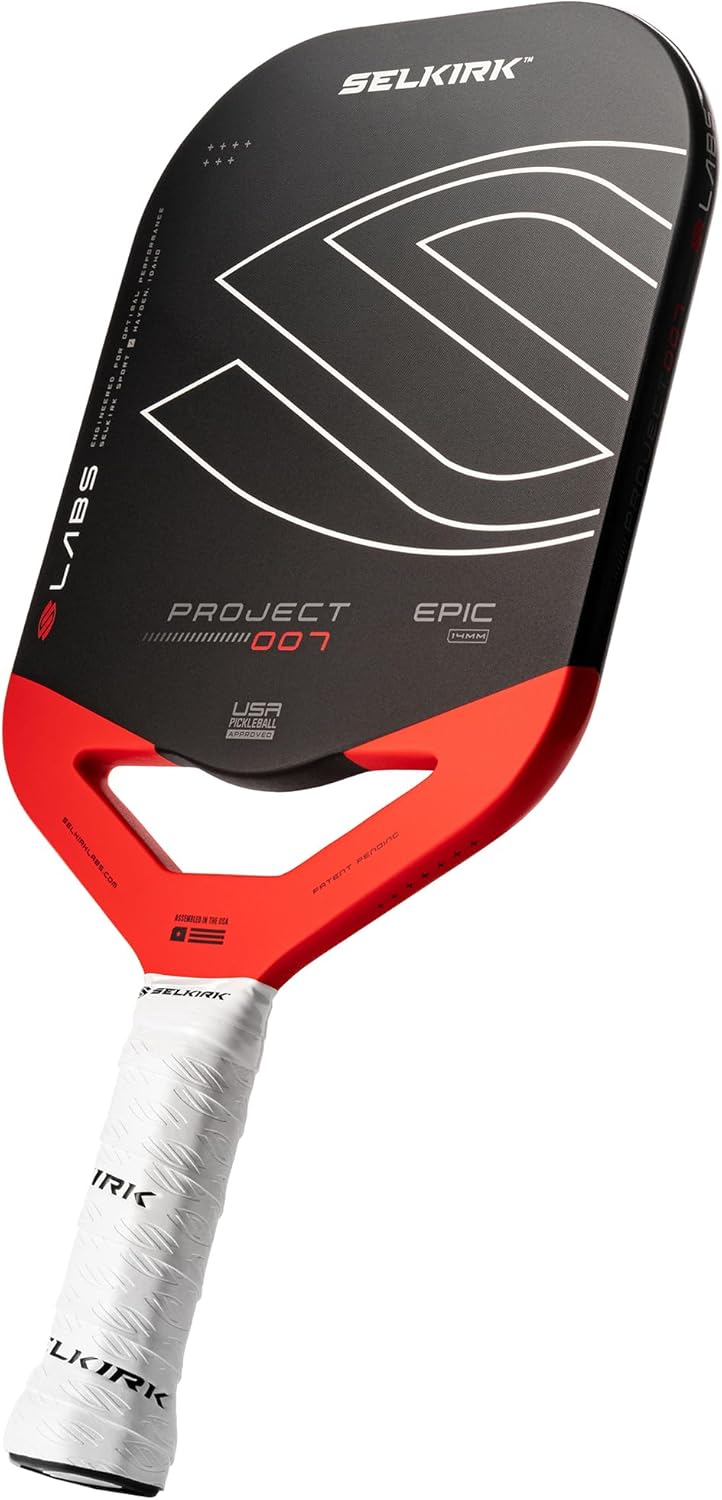
#3 Selkirk Labs Project 007 — Best for Spin and Precision
The Selkirk Project 007 brings tour-level spin capability to competitive players who want to shape the ball and force errors through placement rather than power.
Key Specs
| Spec | Detail |
|---|---|
| Core | Polymer honeycomb |
| Face | T700 raw carbon fiber |
| Thickness | 14mm |
| Weight Range | ~7.7–8.1 oz |
| Shape | Standard |
Performance
Selkirk has built some of the most trusted paddles in competitive play, and the Project 007 represents their approach to the spin-forward all-court game. The T700 raw carbon fiber face produces spin rates that sit above the industry average, which translates directly to better ball flight control on angled dinks, cross-court drops, and roll volleys.
Compared to other Selkirk models, the 007 lands in the sweet spot between aggressive and controlled. It’s not a power paddle — full swings produce solid pace without being explosive — but it rewards players who can brush the ball with spin and place it with intention. Third shot drops with a little topspin tend to land shorter and bounce lower, which is exactly the margin that earns you the kitchen line at 4.0.
The swing weight is well-matched to players with compact, quick strokes. If you play fast hands at the net and win points through precision, the Project 006 will feel like it was built for your game.
Pros
- Among the highest spin rates in its category
- Well-balanced for both kitchen play and transition zone aggression
- Reliable Selkirk build quality and consistent grit retention
- Good swing weight for quick reflex volleys
Cons
- Not the strongest power paddle for players who rely on drive-heavy game plans
- Spin potential is wasted if you don’t use brushing technique regularly
Best For: 4.0 players with technically sound strokes who use spin to control ball flight and outmaneuver opponents with placement.
My Verdict: The Selkirk Project 007 rewards players who have developed real pickleball technique. If you’re hitting brushed shots, shaping your dinks, and varying spin on drops, this paddle will amplify every skill you’ve already built.
#4 Gearbox GX2 Power Hybrid 16mm — Best for Consistency and Sweet Spot
The Gearbox GX2 Power Hybrid is built around one of the largest functional sweet spots in competitive pickleball, making it the top choice for 4.0 players who want to eliminate the variance that comes with off-center contact.
Key Specs
| Spec | Detail |
|---|---|
| Core | SSTCore™ 2.0 Carbon-Rib suspended design |
| Face | 3K Raw Carbon Fiber |
| Thickness | 16mm |
| Weight Range | ~8.0–8.3 oz |
| Shape | Standard |
Performance
Gearbox’s SSTCore technology uses a suspended rib design inside the core, which extends ball contact time beyond what a standard honeycomb core produces. The result is a paddle that delivers consistent power output across a wider hitting zone — even when you catch the ball slightly off-center, the energy transfer remains efficient and the shot doesn’t lose much pace or placement accuracy.
The 3K Raw Carbon Fiber face balances solid spin with reliable dwell time, giving you a surface that works for both soft game construction and baseline driving. Power output on full swings sits at the higher end of the mid-range — enough to finish points without the paddle becoming difficult to manage in control situations.
For a 4.0 player who plays a lot of recreational games with varying opponents and needs a paddle that performs reliably across different pace and spin environments, the GX2 is hard to beat. It doesn’t demand technical perfection on every shot.
Pros
- Largest functional sweet spot on this list
- Suspended core design maintains power on off-center hits
- Good spin capability without an erratic response
- Durable Gearbox construction
Cons
- Slightly heavier than most competitors — may cause fatigue in long sessions for some players
- Power ceiling is lower than the Loco or Perseus Pro for aggressive attackers
Best For: Consistency-focused 4.0 players who want to reduce variance in their game and build confidence through reliable contact.
My Verdict: The Gearbox GX2 is the “steady Eddie” on this list. If your game is built on reliability and you want a paddle that rewards you for getting the ball back in play rather than gambling on pace, this is your pick.
#5 11SIX24 Vapor Power 2 — Best Budget Pick
The 11SIX24 Vapor Power 2 proves that mid-range pricing no longer means settling for mid-tier performance — this paddle matches up against premium options in spin generation and competitive play.
Key Specs
| Spec | Detail |
|---|---|
| Core | Polymer honeycomb |
| Face | HexGrit textured surface (raw carbon fiber) |
| Thickness | 16mm |
| Weight Range | ~7.8–8.1 oz |
| Shape | Standard |
Performance
The most talked-about feature of the Vapor Power 2 is HexGrit — 11SIX24’s proprietary grit technology that delivers high spin output and, critically, maintains that spin longer than standard raw carbon fiber faces. Grit degradation is a real issue with many premium paddles; after months of competitive play, the surface can feel noticeably smoother and less effective. HexGrit’s durability advantage means this paddle earns its value twice: at purchase, and six months later when most competitors have lost their edge.
Performance on the court lives up to the buzz. Spin rates are strong, control is reliable, and power output handles mid-court driving and kitchen finishing without feeling like the paddle is working against you. The sweet spot is appropriately sized for 4.0 play — not as generous as the Gearbox, but more than adequate for consistent, intentional stroke production.
For 4.0 players on a budget, or players who go through paddles quickly through heavy competitive use, the Vapor Power 2 is the most rational choice on this list. You get most of the performance of a premium paddle without the premium price tag, and the grit holds up longer than most.
Pros
- HexGrit surface delivers high spin with better grit durability than raw carbon
- Budget-friendly without major performance compromises
- Good all-court capability for a value paddle
- Lightweight enough for fast hands play
Cons
- Not in the same tier as the Perseus Pro or Loco for elite-level performance gaps
- Less brand recognition than Selkirk, JOOLA, or Bread & Butter in competitive circles
Best For: Budget-conscious 4.0 players who want competitive spin and control without paying premium prices — or heavy users who want a high-performing paddle they can replace without guilt.
My Verdict: The 11SIX24 Vapor Power 2 is the smartest buy for value-driven players on this list. HexGrit is a genuine differentiator, and the performance closes the gap with paddles costing significantly more. This is the paddle to recommend when someone says they “can’t afford a good paddle” — because you can.
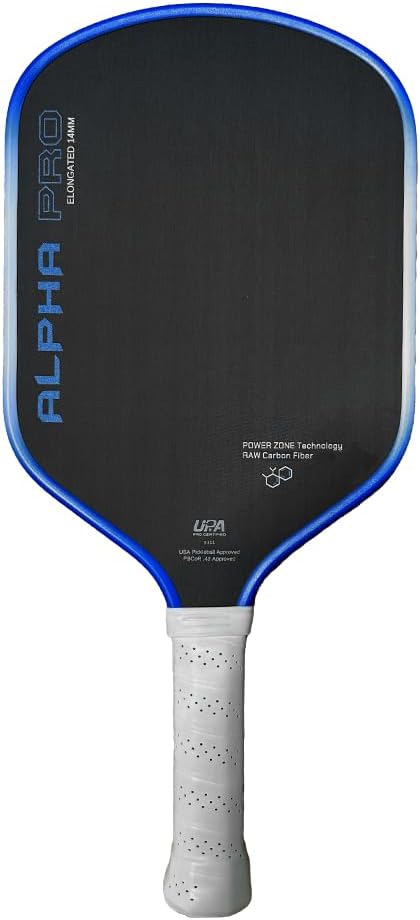
#6 Engage Alpha Pro — Best for Controllable Power
The Engage Alpha Pro delivers premium power output with a control profile that keeps it usable across the full game — not just for driving and finishing.
Key Specs
| Spec | Detail |
|---|---|
| Core | Full foam polymer core |
| Face | Carbon fiber surface |
| Thickness | 16mm |
| Weight Range | ~7.9–8.2 oz |
| Shape | Standard |
Performance
Most power-forward paddles sacrifice softness. The Engage Alpha Pro takes a different approach: its full foam core generates explosive ball speed on drives and overheads while maintaining enough dwell time to keep the soft game playable. The weighting is expertly calibrated — the paddle feels powerful without feeling head-heavy or unwieldy at the kitchen.
In practice, “controllable power” means full swings don’t produce chaos. Your drives land in bounds, your overheads go where you aim them, and your transition zone attacks don’t require you to throttle back on swing speed just to keep the ball in play. That’s a meaningful quality of life improvement over paddles that deliver the same power but with less predictability.
Dinks and drops require some adjustment period if you’re coming from a purely control-focused paddle — the Alpha Pro has more pop than most kitchen specialists — but the learning curve is shorter than with raw thermoformed power paddles. Players who want to attack more frequently without abandoning their soft game will find this paddle opens up that option.
Pros
- High power output with better control feel than comparable power paddles
- Full foam core creates a more stable power profile than stiff thermoformed alternatives
- Well-calibrated swing weight for both offense and kitchen play
- Consistent performance from Engage, a well-established brand
Cons
- Requires adjustment time for players moving from control-focused paddles
- Not the top choice for players whose primary identity is the soft game
Best For: 4.0 players who want to increase their offensive aggression without abandoning the control needed for resets and drops.
My Verdict: The Engage Alpha Pro fills a specific gap in the 4.0 market — it’s the paddle for players who’ve decided to become more aggressive but aren’t ready to sacrifice all controllability. If that describes your next step as a player, this is your paddle.
What Specs Matter Most for 4.0-Level Play?
Four specifications separate paddles that work at 4.0 from those that just feel nice in the store. Understanding each one makes the difference between a good purchase and a paddle you’re second-guessing three weeks later.
Core Thickness — 14mm vs. 16mm
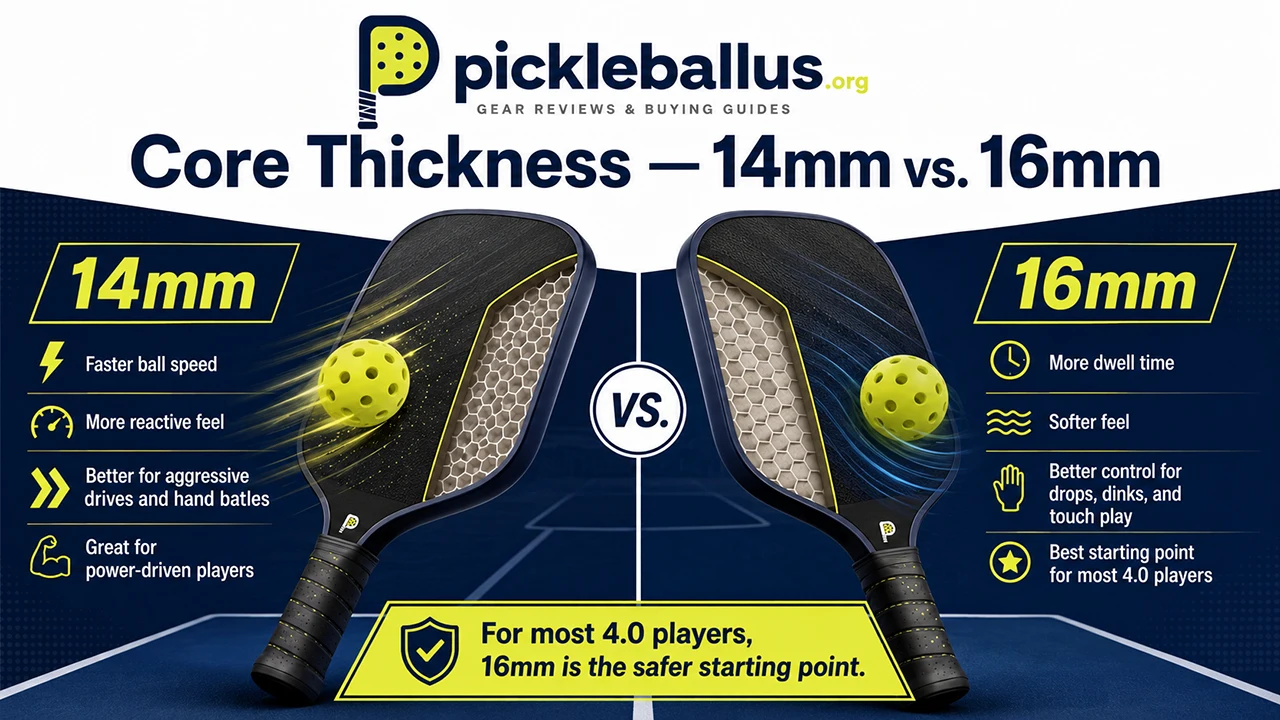
Core thickness is the single most important spec for 4.0 players because it controls how much dwell time you get on every shot. A 16mm core is thicker, which means the ball spends more time on the face — producing a softer, more controllable response that rewards touch play, drops, and dinks. A 14mm core is thinner and stiffer, producing faster ball speed and a more reactive feel that rewards aggressive driving and quick hands battles.
For most 4.0 players whose game includes significant kitchen work, 16mm is the safer starting point. If your game is predominantly power-driven with fast exchanges, 14mm opens up more explosive potential. For a deeper comparison, the best 16mm pickleball paddles and best 14mm pickleball paddles guides compare options within each thickness tier.
Face Material — Carbon Fiber vs. Fiberglass
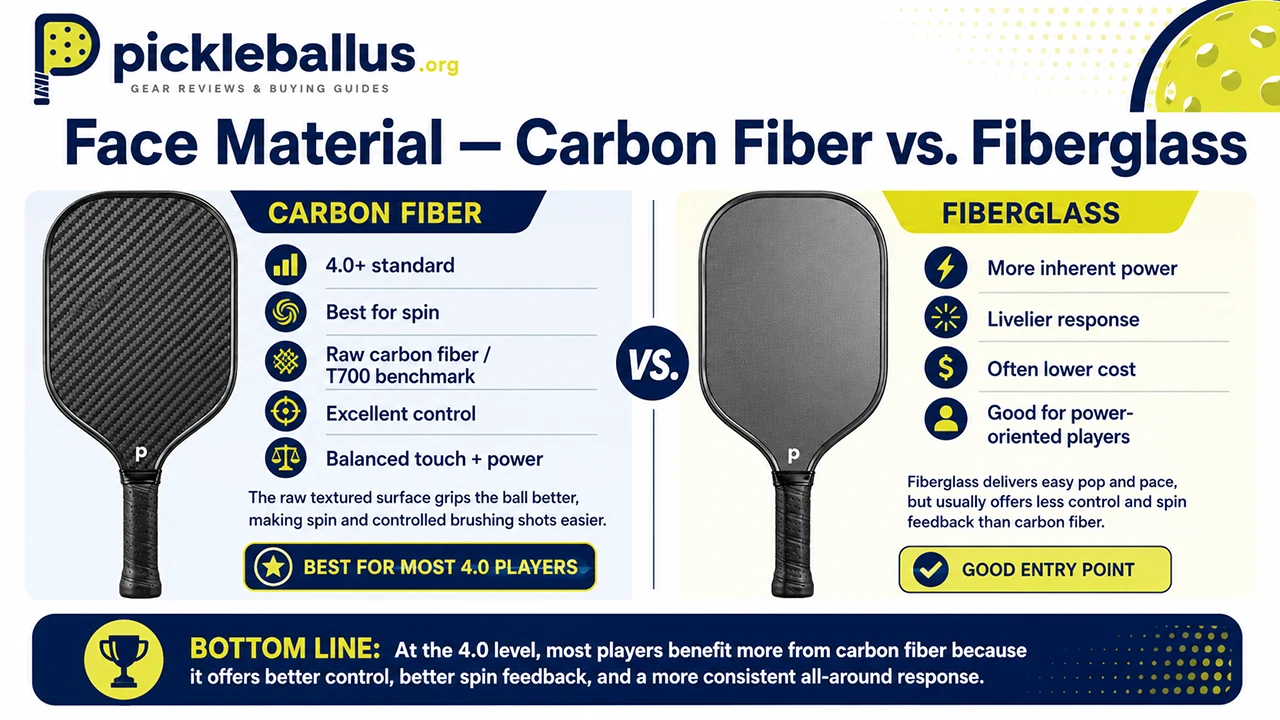
Carbon fiber is now the standard face material at 4.0 and above — particularly raw carbon fiber (T700 being the current benchmark), which provides exceptional spin generation and a consistent touch-to-power balance. The raw surface texture grips the ball and allows you to impart spin with brushing shots more easily than a smooth face.
Fiberglass produces more inherent power with a livelier response, which works well for power-oriented players. It typically costs less than carbon fiber and can be a good entry point, but at 4.0, most players benefit more from carbon fiber’s control and spin feedback. For a full breakdown, the best raw carbon fiber pickleball paddles guide covers the specific models worth considering.
Weight and Swing Weight
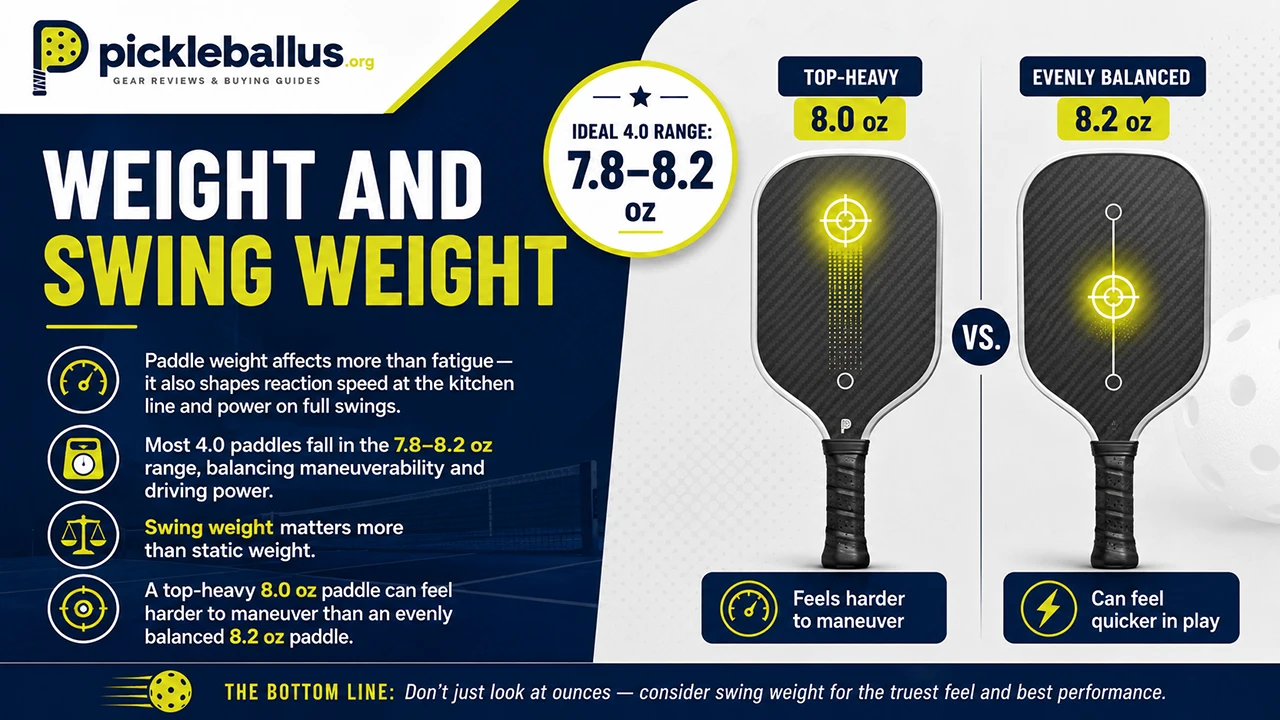
Paddle weight affects more than fatigue — it shapes how quickly you can react at the kitchen line and how much power you generate on full swings. Most 4.0 paddles land in the 7.8–8.2 oz range, which balances maneuverability and driving power. Swing weight (how heavy the paddle feels during the swing) matters more than static weight; a top-heavy paddle that weighs 8.0 oz can feel significantly harder to maneuver than an evenly balanced 8.2 oz option.
Grip Size and Handle Length
Grip size is the most overlooked variable in paddle selection. Too small, and you over-squeeze — creating forearm tension and reduced touch on soft shots. Too large, and your wrist snap is restricted, which limits spin and reduces your ability to redirect volleys quickly. Most adult players land between 4.0″–4.5″ circumference. If you’re unsure, go smaller — you can always add an overgrip to build up the size, but you can’t shrink a grip that’s already too large.
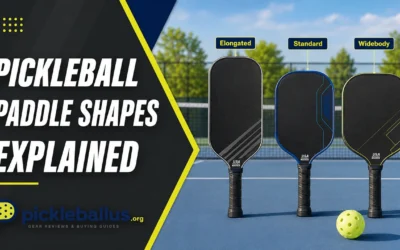
Handle length matters for two-handed backhand players. An elongated handle gives you room to place both hands comfortably without moving up the shaft, while a shorter handle shifts the balance of the paddle toward the head, which can add power to one-handed strokes.
Power, Control, or All-Court — Which Type Is Right for You?
Power paddles deliver maximum ball speed and aggressive response. They reward players who drive frequently from the baseline, finish points with overhead putaways, and accept some reduction in soft game predictability in exchange for offensive ceiling. At 4.0, power paddles work best for players whose game plan involves dictating pace through groundstrokes and transition zone attacks.
Control paddles prioritize dwell time, soft shot consistency, and kitchen-line precision. They’re built for players who win points through placement, spin variation, and error provocation rather than raw speed. At 4.0, control paddles suit players who excel at dinking marathons, consistent drop execution, and defensive play under pressure.
All-court paddles sit in the middle — and that’s where most 4.0 players genuinely belong. At this level, you need to do both well. You can’t afford to be defenseless at the kitchen just because you chose a power paddle, and you can’t afford to be toothless from the baseline just because you chose a control paddle.
For deeper exploration by play style, the best pickleball paddles for control and best pickleball paddles for power guides break down the top specialist options in each category.
Do 4.0 Players Really Need a Premium Paddle?
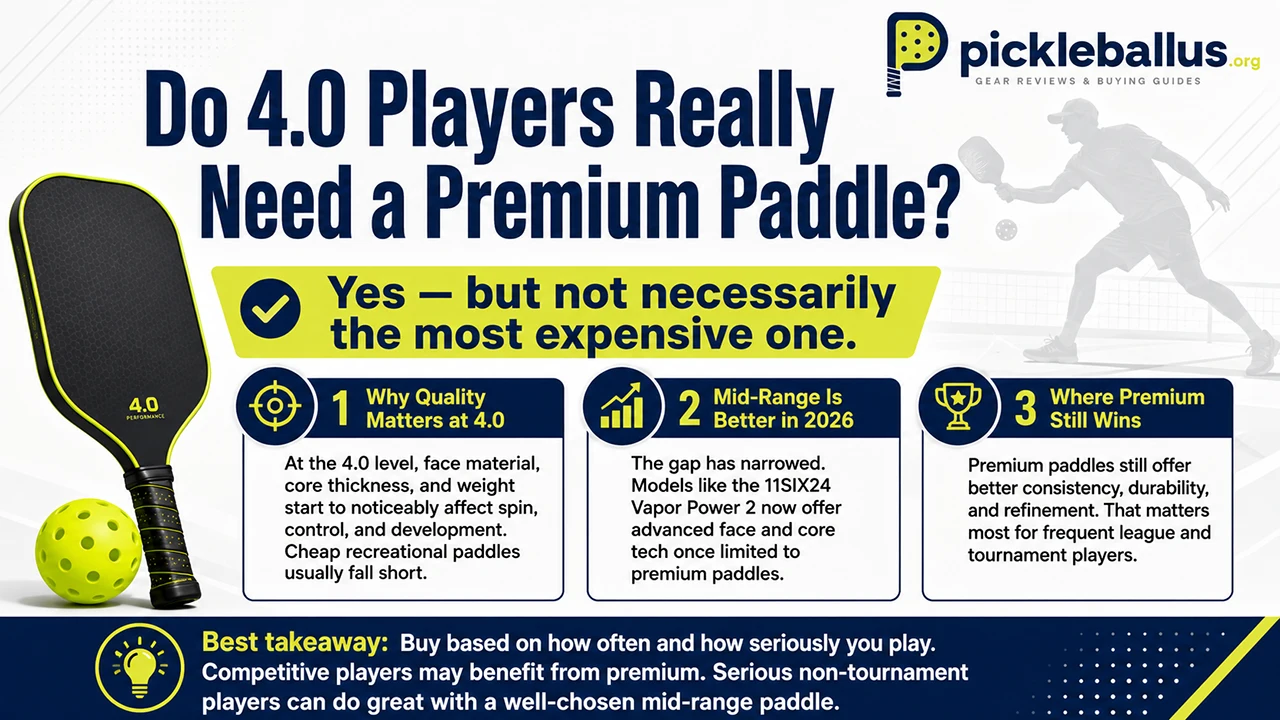
Yes — but not necessarily the most expensive one on the market. At the 4.0 level, your paddle choices start to have a measurable impact on your game in ways they didn’t at 3.5. A quality paddle with a responsive face material, appropriate core thickness, and well-calibrated weight will genuinely support your development. A cheap recreational paddle won’t.
That said, the performance gap between a mid-range paddle and a premium flagship has narrowed significantly in 2026. Brands like 11SIX24 are producing paddles with face technology and core engineering that was exclusive to premium options 18 months ago. The Vapor Power 2 on this list demonstrates that clearly.
Where premium pricing still delivers meaningful advantages is in consistency, durability, and refinement at the edges. A flagship paddle from JOOLA or Selkirk will typically maintain its performance longer, feel more uniform across the face, and handle the demands of frequent competitive play better than a budget option. For a player competing in leagues or tournaments multiple times per week, that consistency is worth the investment.
For players who train intensively but aren’t tournament players, a well-chosen mid-range paddle will serve you at 4.0 without leaving performance on the table. Spend what makes sense for how often and how seriously you play.
By now, you have a complete picture of every paddle on this list and a clear framework for evaluating core thickness, face material, weight, and price tier against your actual play style. Choosing the right paddle is the biggest decision — but what happens after you buy it determines how much of that investment you actually realize. The next section covers the specs, habits, and overlooked variables that 4.0 players routinely underestimate: equipment compliance, upgrade timing, grip customization, and the real value difference between budget and premium at this level.
What Else Should 4.0 Players Know Before Buying?
PEF Compliance — What It Means for Your Paddle Choices
The UPA-A’s Power-to-Efficiency Factor (PEF) standard is now fully enforced at sanctioned play in 2026, which means paddles sold for competitive pickleball must meet defined limits on how much energy they return to the ball. This has changed how manufacturers engineer cores and faces — raw power is no longer unlimited, so the best brands are competing on smarter construction rather than just more pop.
For 4.0 players, the practical effect is straightforward: paddles on approved lists from USAPA/UPA-A are safe for tournament play. If you’re entering sanctioned events, check the current approved paddle list before buying. Most paddles on this list are PEF-compliant, but spec changes happen — confirm before registering.
When You’ve Outgrown Your Current Paddle
Signs you’ve outgrown your paddle at 4.0 are often subtle: your drops are consistently landing longer than intended despite good mechanics, your dinks lack spin, or you’re feeling like your drives require more effort than they should. A new paddle won’t fix bad technique, but if your mechanics are sound and the misses are consistent, your equipment may genuinely be the limiting factor.
Most competitive 4.0 players replace their paddle every 12–18 months under regular play conditions, or sooner if the face grit wears noticeably smooth. A worn face loses spin generation, which cascades into less control and less intentionality on every shot.
Overgrip and Grip Size — The Overlooked Variable
The grip your paddle ships with isn’t necessarily the right grip for your hand. Adding an overgrip costs almost nothing and can transform how the paddle feels in your hand — reducing tension, improving wrist snap, and extending the life of the base grip. Many 4.0 players who struggle with forearm fatigue or inconsistent net volleys haven’t considered whether their grip size is the root issue.
Start with a thinner overgrip and see how it changes your dink game specifically. Soft game touch is the most grip-sensitive part of pickleball — small changes in how tightly you hold the paddle have outsized effects on your soft shot consistency.
Budget vs. Premium — Does the Gap Still Matter at 4.0?
In 2026, the honest answer is: less than it used to, but it’s not gone. A well-designed mid-range paddle like the 11SIX24 Vapor Power 2 delivers competitive performance for most 4.0 recreational players. A premium paddle like the JOOLA Perseus Pro IV or the Bread & Butter Loco delivers refinements in consistency, grit durability, and edge-case performance that matter more as your game and competition level rise.
The clearest signal for when to invest in premium is this: if you’re playing in sanctioned tournaments, competing in leagues where the opposition is strong 4.0 or 4.5 players, or spending serious hours on the court each week, premium construction will pay off. If you’re a recreational 4.0 who plays a few times a week for fun and fitness, a mid-range paddle from a respected brand is plenty.
Write Your Review
No reviews yet. Be the first to share your experience!