

The best pickleball paddles for a two-handed backhand in 2026 are the Honolulu J6CR (best overall), the JOOLA Perseus Pro IV (best for power players), the Six Zero Double Black Diamond Elongated (best for control), the Vatic Pro V7 (best budget pick), the Selkirk VANGUARD Pro Invikta (best for advanced players), the Gearbox GX6 Control (best for soft touch), and the Paddletek Bantam TKO-C (best for singles play).
Two things matter most when shopping for a two-handed backhand paddle: handle length and shape. A handle measuring at least 5.25 inches gives your non-dominant hand enough room to grip without cramping — anything shorter forces both palms together and kills swing stability. Shape matters too. Best elongated pickleball paddles stretch the face to around 16.5 inches and pair it with longer handles as a natural consequence of the geometry. That combination translates directly into leverage, reach, and the kind of follow-through swing that makes a two-handed drive feel natural rather than forced.
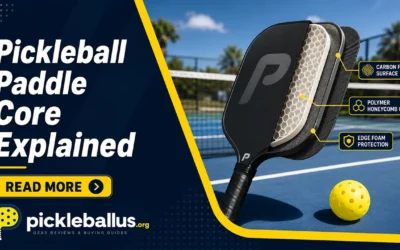
The other variable most players underestimate is core thickness. A 16mm core slows the ball slightly and gives you more dwell time at contact — critical when you’re loading a two-handed backhand roll or keeping a cross-court drive in bounds. A 13mm core generates faster pop, which suits baseline bangers but punishes anyone whose mechanics aren’t locked in. Former tennis players making the switch tend to adapt faster with 16mm builds first.
Below, each paddle is reviewed with its handle length, shape, core thickness, and the player type it suits best. Start at the top if you’re unsure, or jump to the comparison section if you already know what weight and handle length you need.
What Makes a Paddle Good for a Two-Handed Backhand?
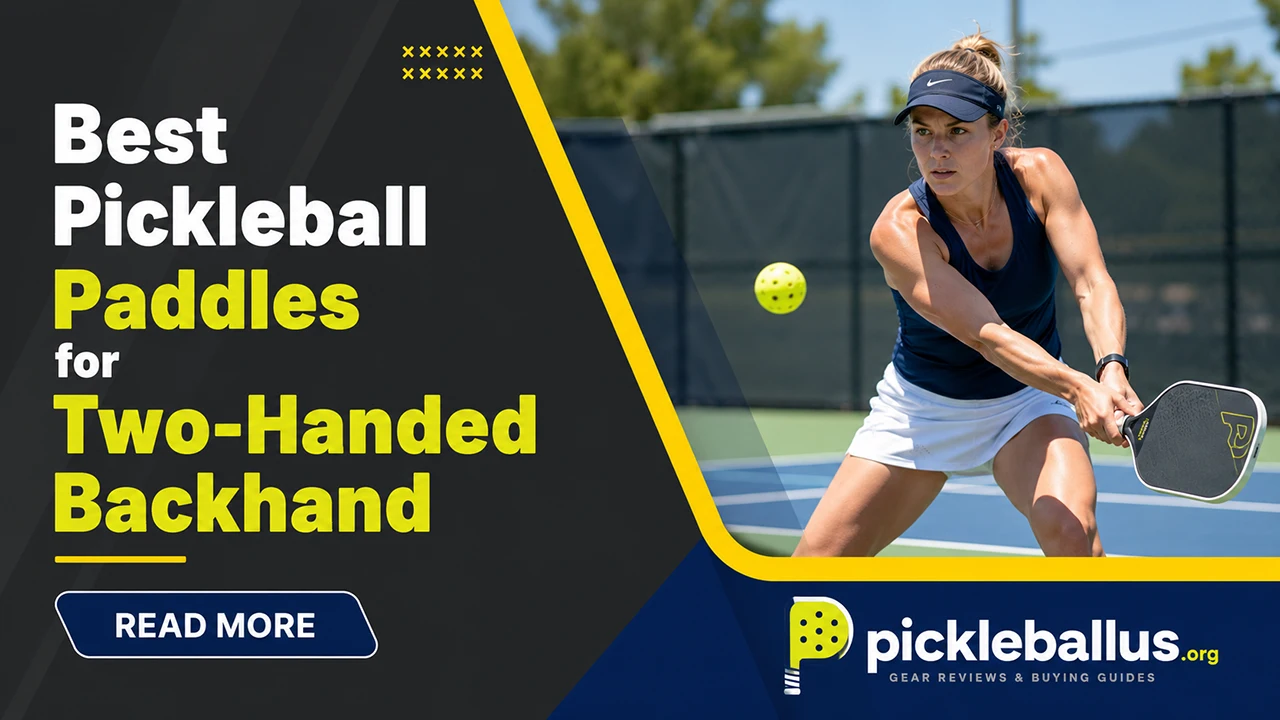
Handle length of at least 5.25 inches and an elongated shape are the two specs that most directly support a two-handed backhand in pickleball.
The handle is the obvious one — your non-dominant hand has to fit somewhere, and anything under 5 inches squeezes both palms together and restricts follow-through. Most modern elongated paddles sit at 5.5 inches or above. Some reach 6 inches, which feels closer to a tennis racket grip and suits players with large hands or an aggressive swing arc.
Shape interacts with handle length in a less obvious way. When a manufacturer stretches a paddle to 16.5 inches, the extra length almost always comes from two places: a taller face and a longer grip. Elongated paddles naturally pair with longer handles because the dimensions are geometrically linked. A widebody paddle, by contrast, maxes out its width and typically sacrifices handle length to stay within the 24-inch combined limit set by USA Pickleball.
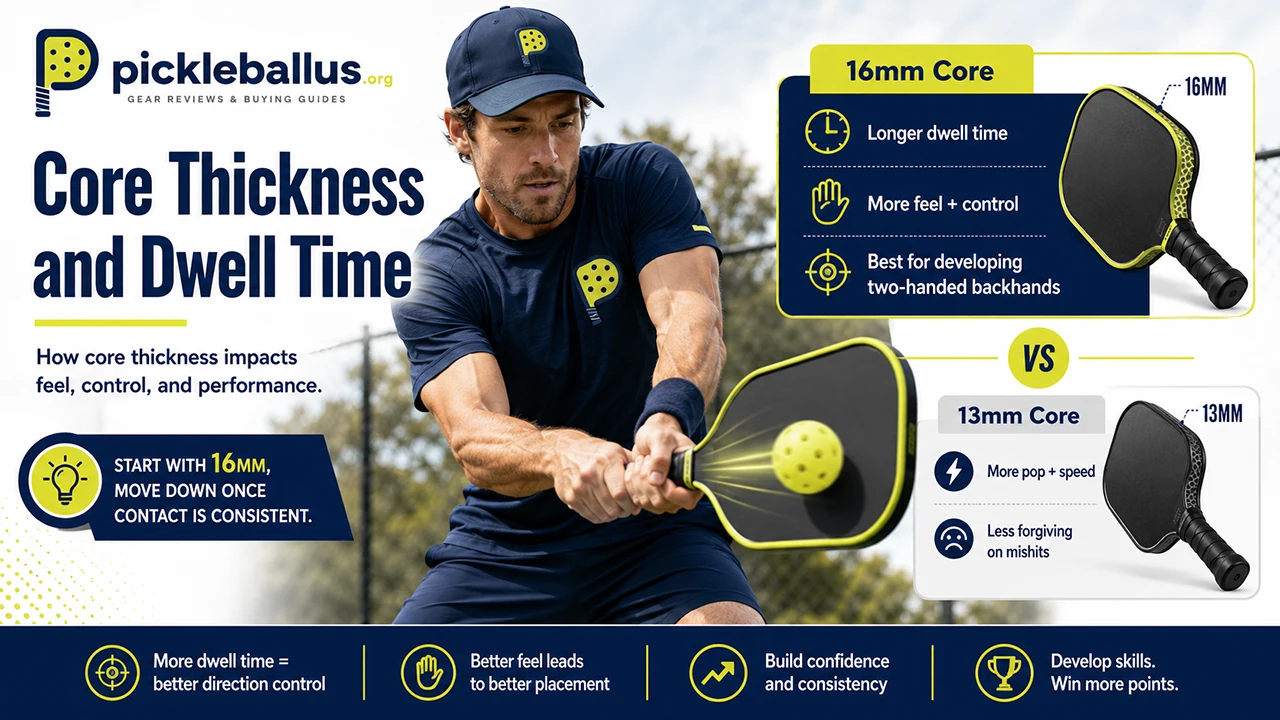
Core Thickness and Dwell Time
16mm cores generally suit two-handed backhand players better because the extra foam or polymer material extends dwell time — the fraction of a second the ball sits against the face. Longer dwell time means more feel and direction control on a loaded backhand drive. A 13mm core hits harder and faster but is less forgiving on mishits. If your two-handed backhand is still developing, start with 16mm and move down once your contact point is consistent.
Surface Material and Spin
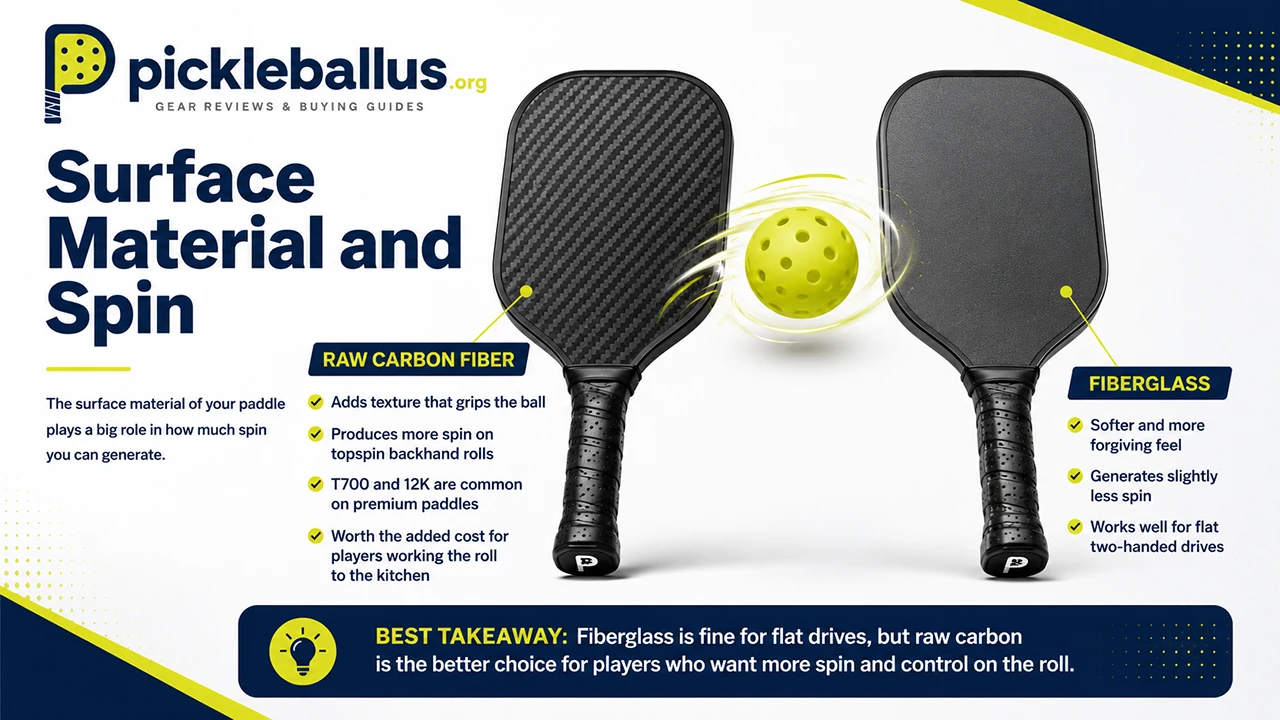
Raw carbon fiber faces add texture that grips the ball and allows more spin on topspin backhand rolls. T700 and 12K raw carbon are the most common specs on premium paddles. Fiberglass faces are softer and more forgiving but generate slightly less spin. For players hitting a flat two-handed drive, fiberglass works fine. For anyone working the roll to the kitchen, raw carbon is worth the added cost.
Weight and Swing Balance
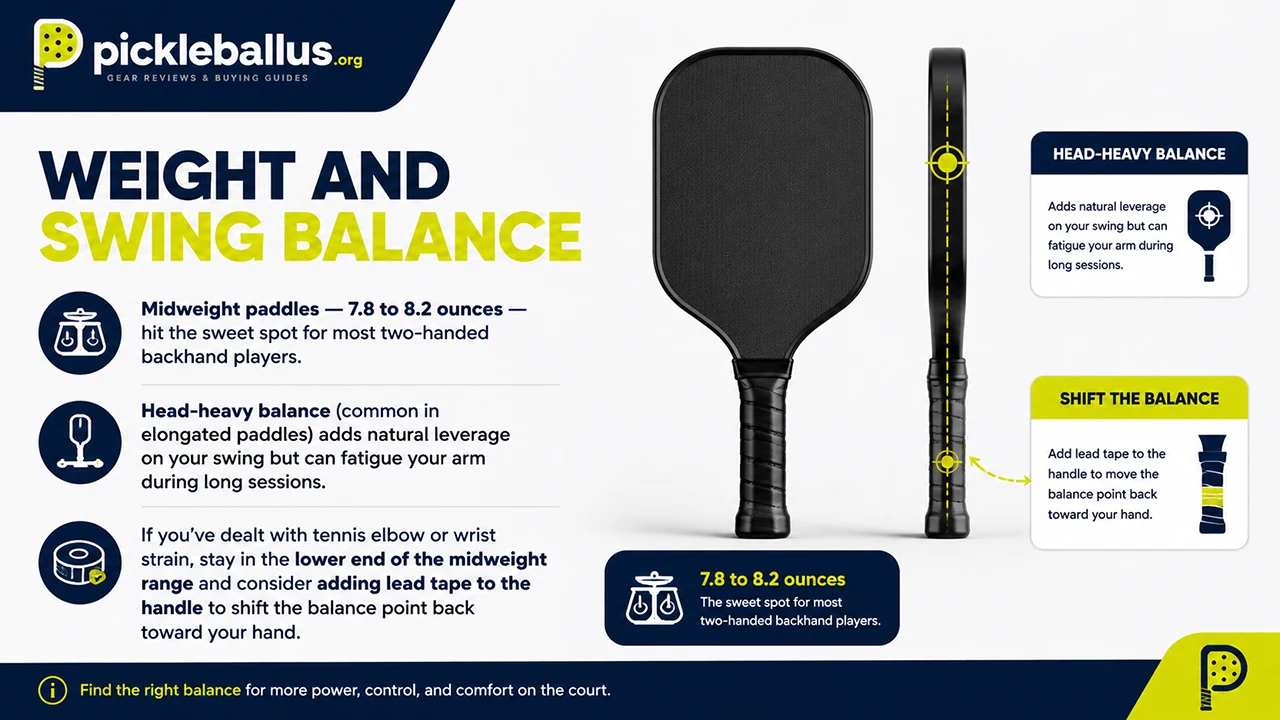
Midweight paddles — 7.8 to 8.2 ounces — hit the sweet spot for most two-handed backhand players. Head-heavy balance (common in elongated paddles) adds natural leverage on your swing but can fatigue your arm during long sessions. If you’ve dealt with tennis elbow or wrist strain, stay in the lower end of the midweight range and consider adding lead tape to the handle to shift the balance point back toward your hand.
7 Best Pickleball Paddles for Two-Handed Backhand
Here are the seven paddles that consistently perform well for two-handed backhand players across every skill level, evaluated on handle length, shape, core construction, and court feel.
#1 Honolulu J6CR — Best Overall
The Honolulu J6CR is the best overall pickleball paddle for two-handed backhand in 2026, combining a 6-inch handle, foam core construction, and a CFC (carbon-fiberglass-carbon) face that performs above its price class.
The 6-inch handle is the headline spec. It gives even players with large hands full comfort on both grips, and the swing arc feels noticeably more like a tennis racket than most elongated paddles. The CFC face delivers solid pop and grip — enough to generate spin on backhand rolls without becoming unruly. What separates the J6CR from other elongated foam paddles is its balance: for an elongated build, it stays maneuverable through hand battles. Mishits go where you aim, which isn’t something you can say about most elongated paddles at this price.
Specs: Elongated | 6-inch handle | Foam core (CFC face) | ~7.8–8.2 oz
Pros:
- Longest handle in class (6 inches) — optimal two-handed grip
- Well-balanced for an elongated paddle; fast through exchanges
- Forgiving on off-center contact
Cons:
- Foam core has less explosive pop than thin-core builds
- Requires some skill to fully manage pace
Best For: All-around players at intermediate to advanced level who hit a two-handed backhand regularly
My Verdict: The J6CR doesn’t ask you to compromise. You get the handle length needed for a proper two-handed grip, the elongated face for reach, and enough control to keep the ball in play under pressure. It’s the first paddle I’d hand to any two-handed backhand player.
#2 JOOLA Perseus Pro IV — Best for Power Players
The JOOLA Perseus Pro IV delivers raw power and premium feel for two-handed backhand players who operate from the baseline and want to end points with their drives.
Ben Johns uses a version of this paddle — that tells you exactly where its strengths lie: aggressive topspin play, decisive drives, and cross-court finishers. TechFlex Power construction with a carbon friction face gives you spin and pop together. The elongated shape adds reach and leverage for a two-handed swing. The Perseus comes with a 5.5-inch handle, long enough for both hands to sit comfortably without crowding.
What the Perseus demands in return is footwork and positioning. This isn’t a forgiving paddle for players whose mechanics are still inconsistent. Off-center contact punishes you more than it would on a 16mm widebody. But if your two-handed backhand technique is sound, the Perseus converts good mechanics into great shots.
Specs: Elongated | 5.5-inch handle | Polymer/foam hybrid core | Carbon friction face | ~8.0–8.3 oz
Pros:
- Strong power-to-control balance for aggressive players
- Carbon friction face delivers consistent spin on backhand rolls
- Premium build quality with pro-level performance
Cons:
- Less forgiving on mishits than 16mm widebody options
- Premium price point
Best For: Competitive players at 4.0+ who use a power-forward two-handed backhand
My Verdict: If your two-handed backhand is a weapon you’re actively building your game around, the Perseus Pro IV gives you the platform to develop it into a consistent point-ender.
#3 Six Zero Double Black Diamond Elongated — Best for Control
The Six Zero Double Black Diamond Elongated earns best for control by combining a raw composite carbon face with a 16mm TruFoam core — a pairing that prioritizes placement over power.
The DBD Elongated measures 16.3 inches long with a 5.5-inch handle and sits in hybrid-elongated territory. That’s slightly wider than a pure elongated build, giving you a more forgiving sweet spot while retaining enough reach for a two-handed swing with room to spare. The low twist weight (around 6.4) means it doesn’t wobble on off-center contact — a real advantage when hitting a two-handed roll to the kitchen where you can’t always guarantee dead-center contact.
For doubles players who rely on placement rather than pace, the DBD Elongated is among the most consistent tools on the market. It won’t blast winners from the baseline the way the Perseus will, but it puts the ball exactly where you’re aiming, almost every time.
Specs: Hybrid-elongated | 5.5-inch handle | TruFoam 16mm core | Raw composite carbon face | 8.0–8.2 oz
Pros:
- Control and placement precision
- Low twist weight — stable on off-center hits
- Works well in both doubles and singles
Cons:
- Lower power ceiling than thinner-core builds
- Hybrid shape sacrifices some reach vs. pure elongated paddles
Best For: Doubles players and control-oriented competitors at 3.5–4.5 who value accuracy above power
My Verdict: The Double Black Diamond Elongated is for players who want to win with their brain instead of their arm. Your two-handed backhand becomes a placement weapon rather than a power shot. Consider comparing it with best pickleball paddles for control if precision is your main priority.
#4 Vatic Pro V7 — Best Budget Pick
The Vatic Pro V7 delivers elite-level specs at a mid-range price — Toray T700 raw carbon, edge-foam injection, thermoformed construction, and a long handle built for two-handed backhands.
Most paddles at this price point make compromises on surface material or core construction. The V7 doesn’t. The T700 raw carbon face generates legitimate spin, and the thermoformed edge-foam construction improves stability and power at the paddle’s perimeter. It plays head-heavy, which helps when loading a baseline drive with both hands. The handle is long enough for a comfortable two-handed grip.
The trade-off is feel. The V7 responds with a stiffer, faster sensation at contact compared to the DBD or J6CR — it suits bangers and baseline drives but feels less nuanced on soft shots in the kitchen. For players developing their all-around game, that’s a minor note. For pure two-handed backhand baseline players, it barely matters.
Specs: Elongated | 5.3–5.5-inch handle | Thermoformed edge-foam core | T700 raw carbon face | 7.8–8.1 oz
Pros:
- Raw carbon face and thermoformed construction at a budget price
- Head-heavy balance amplifies two-handed backhand power
- Strong spin ceiling for the price tier
Cons:
- Stiffer feel — less nuance in the kitchen compared to premium foam paddles
- Limited color/customization options
Best For: Budget-conscious players at 3.0–4.0 who want raw carbon performance without the premium price
My Verdict: The V7 is the smart buy for players who want to feel what raw carbon and thermoformed construction do for their two-handed backhand without committing to a $250 paddle.
#5 Selkirk VANGUARD Pro Invikta — Best for Advanced Players
The Selkirk VANGUARD Pro Invikta brings 12K raw carbon fiber, a 16mm X5+ polymer honeycomb core, and thermoformed foam edge technology into one elongated build aimed at high-level competitive play.
Selkirk built the Invikta for all-court performance — topspin drives, counters, speedups, and two-handed backhand attacks. The 12K raw carbon face is grittier than standard T700, producing more spin on every contact including backhand rolls. The 16mm core balances power with dwell time, keeping shots in play on fast exchanges. At the kitchen line, it stays stable and responsive.
The handle sits at 5.5 inches — adequate for most two-handed grips. Where it earns a spot in the advanced column is the overall demand it places on the player. The Invikta rewards clean mechanics and punishes sloppiness. Your two-handed backhand needs to be a reliable shot, not a work in progress.
Specs: Elongated | 5.5-inch handle | X5+ 16mm polymer honeycomb core | 12K raw carbon face | ~8.0–8.3 oz
Pros:
- 12K raw carbon delivers maximum spin
- Thermoformed foam edge improves stability and vibration absorption
- Premium all-court versatility
Cons:
- Rewards advanced mechanics — not forgiving for developing players
- Premium price
Best For: Tournament players at 4.0+ who want a high-performance all-court paddle with strong two-handed backhand capability
My Verdict: If your two-handed backhand is already a consistent weapon and you play competitive doubles or singles regularly, the VANGUARD Pro Invikta gives you the spin ceiling and control to compete at the highest level.
#6 Gearbox GX6 Control — Best for Soft Touch
The Gearbox GX6 Control takes a completely different construction approach — hand-laid graphite chambers heated into a single-piece unibody instead of a standard honeycomb core — and the result is a paddle with a soft, muted feel that makes two-handed backhand control feel effortless.
The 5 5/8-inch handle comfortably accommodates two hands, and Gearbox offers multiple grip circumferences, making it one of the better options for players with smaller hands who use a two-handed grip. The edgeless design gives you a larger effective sweet spot compared to paddles with traditional edge guards. Mishits don’t twist in your hand the way they do on edged paddles.
The graphite chamber construction produces a noticeably different feel at contact — softer, with less vibration, and a predictable, stable response. Players recovering from arm injuries or managing tennis elbow often gravitate toward the GX6 for this reason. The trade-off is less explosive pop on aggressive drives, but on dinks, resets, and two-handed backhand rolls at the kitchen, it performs well.
Specs: Elongated | 5 5/8-inch handle | SST graphite chamber core | Graphite face | ~7.8–8.2 oz
Pros:
- Unique single-piece graphite construction reduces vibration significantly
- Edgeless frame expands effective sweet spot
- Multiple grip sizes — better fit for smaller hands
- Arm-friendly for players managing elbow or wrist issues
Cons:
- Less explosive pop than polymer or foam core builds
- Less common brand — fewer retail locations
Best For: Control players, arm-conscious players, and anyone from a tennis background who wants soft, precise two-handed backhand feel
My Verdict: The GX6 Control doesn’t play like any other paddle on this list. If you’ve been managing arm fatigue or want a paddle that makes your two-handed backhand feel smooth rather than forceful, this is the one to test.
#7 Paddletek Bantam TKO-C — Best for Singles Play
The Paddletek Bantam TKO-C is an elongated power paddle built around a 12.7mm Bantam polymer core and a PT-700 unidirectional carbon fiber face — designed for players who want reach, raw speed, and spin on their two-handed backhand drives in singles.
The extended handle makes two-handed backhands natural. The thinner 12.7mm core generates faster ball speed than 16mm builds — the trade-off is less dwell time and a more demanding contact window, but for players with consistent mechanics, the payoff is a noticeably faster drive off the backhand side. In singles, where baseline exchanges run longer and the two-handed backhand often creates angles and sets up passing shots, this paddle’s combination of reach and pace is a real advantage. For a broader look at how it stacks up against the best pickleball paddles across all categories, the full comparison is worth reviewing.
Specs: Elongated | Extended handle | 12.7mm Bantam polymer core | PT-700 unidirectional carbon face | ~8.0–8.4 oz
Pros:
- Fast, snappy response ideal for baseline drives
- Extended handle — comfortable two-handed grip
- Carbon face delivers strong spin potential
Cons:
- Thinner core is less forgiving — requires consistent mechanics
- Slightly heavier — can fatigue the arm during long rallies
Best For: Singles players at 3.5+ who use the two-handed backhand as a baseline weapon and want speed over softness
My Verdict: The Bantam TKO-C is a baseline player’s tool. If singles is where you spend most of your time and your two-handed backhand drive is built to punish short balls, this paddle has the reach and pace to do exactly that.
How to Choose the Right Paddle for Your Two-Handed Backhand
Handle length, core thickness, and shape are the three variables that narrow the field from dozens of paddles to the right one for your game.
The table below summarizes the key specs to evaluate before buying.
| Feature | What to Look For | Why It Matters |
|---|---|---|
| Handle length | 5.25 inches minimum; 5.5–6 inches ideal | Second hand needs room to grip without crowding |
| Core thickness | 16mm for control/developing players; 13mm for power/advanced | Dwell time and forgiveness scale with core depth |
| Shape | Elongated (16.5″ length) for reach; hybrid for balance | Elongated adds reach and leverage; hybrid adds forgiveness |
| Surface | Raw carbon for spin; fiberglass for feel | Spin ceiling rises with raw carbon grit |
| Weight | 7.8–8.2 oz midweight | Heavy enough for stable drives; light enough to reset quickly |
If you’re weighing the differences in shape geometry, the comparison of elongated vs standard pickleball paddle shape covers how each dimension affects swing mechanics.
By Skill Level
For 3.0–3.5 players developing their two-handed backhand, the Vatic Pro V7 and the Gearbox GX6 Control are the most forgiving entry points — the V7 for aggressive players who hit hard, the GX6 for anyone who values soft feel and arm comfort.
3.5–4.0 players with consistent mechanics get the most from the Honolulu J6CR or the Six Zero DBD Elongated. Both paddles are forgiving enough to cover imperfect contact but premium enough to reward clean technique.
4.0+ and tournament players should look at the JOOLA Perseus Pro IV, the Selkirk VANGUARD Pro Invikta, or the Paddletek Bantam TKO-C depending on whether they lean toward power (Perseus), spin and all-court control (Invikta), or singles baseline play (TKO-C).
Coming from Tennis?
Former tennis players have a natural advantage with the two-handed backhand in pickleball — the grip, footwork, and swing mechanics transfer directly. The main adjustment is paddle length; a tennis racket handle is significantly longer, so the first few sessions with any pickleball paddle feel cramped. The best pickleball paddles for tennis players covers this transition in more depth, but the core guidance is consistent: start with handles at 5.5 inches or above.
The J6CR at 6 inches is the closest feel to a tennis racket handle available today. Pair it with a 16mm core to compensate for the shorter dwell time you’re used to from a strung racket, and the adaptation happens faster.
By this point you have a clear picture of which paddles deliver the handle length, shape, and core construction you need for a two-handed backhand at every skill level and budget. Selecting the right paddle is only the starting point — how you position your hands on that handle, how you load weight into the shot, and how you practice the motion consistently will determine whether the two-handed backhand becomes a true weapon or stays a defensive reflex. The section below covers the technique and maintenance details that turn a paddle recommendation into a real game improvement.
Making the Most of Your Two-Handed Backhand Paddle
Grip Setup for Two-Handed Backhand
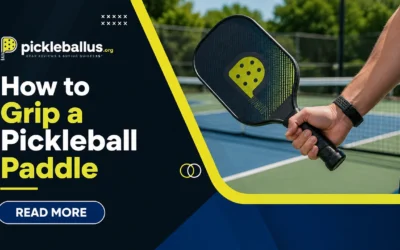
Your dominant hand grips the handle the same way you hold a standard pickleball paddle — a continental or eastern grip works for most players. The non-dominant hand sits above it, adding stability and generating the rotational force that gives the two-handed backhand its power. Key rule: your non-dominant hand should contribute 40–50% of the work. If it’s just resting there, you’re hitting a one-handed backhand with a passenger.
Grip pressure matters too. Tighten your grip at contact, not at the start of your swing. Pre-tensing the forearms kills both speed and feel. For a deeper look at the mechanics of the two-handed backhand in pickleball, including footwork and follow-through, the technique guide is a useful complement to any paddle upgrade.
When to Add Lead Tape to Your Paddle
Lead tape is the fastest way to fine-tune a paddle’s balance for a two-handed backhand. Adding tape to the 3 and 9 o’clock positions on the face increases swing weight, which deepens your two-handed drive. Adding tape to the handle lowers the balance point and reduces head-heaviness — useful if you’re getting fatigued or losing wrist stability during long sessions.
Start with 1–2 grams at a time and test between sessions. Most two-handed backhand players settle on 2–4 grams added to the handle or lower face. If you’re curious about best long handle pickleball paddles that ship with heavier handle specs pre-built, those options skip the tape step entirely.
Signs Your Paddle Is Dead — And Hurting Your Backhand
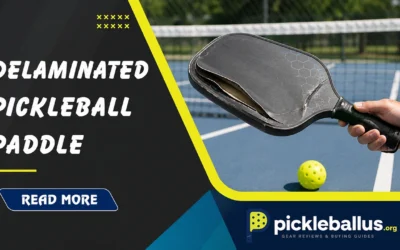
A dead or delaminated paddle feels hollow at contact and loses spin grip on the face. For two-handed backhand players, the first sign is usually loss of direction control — shots that used to land cross-court start missing wide. Test by tapping the paddle face firmly with your knuckle. A live face gives a consistent tone. A dead spot sounds noticeably duller.
Most raw carbon paddles lose significant grit within 6–12 months of heavy play. Once the texture wears down, it doesn’t come back. That’s the natural lifespan, not a manufacturing defect.
One-Handed vs. Two-Handed Backhand in Pickleball
The one-handed backhand gives you more reach on wide balls and resets faster from a neutral position. The two-handed backhand generates more power and is harder for opponents to read. Neither is objectively superior — the right choice depends on your athletic background, arm strength, and how you build points.
Players from tennis almost always prefer the two-handed backhand at first. Players who started in pickleball often develop a one-handed backhand because the compact exchanges in pickleball reward speed over power. If you’re investing in a long-handle paddle for the two-handed backhand, commit to it — switching mid-development slows both strokes down.
Write Your Review
No reviews yet. Be the first to share your experience!