

The best 16mm pickleball paddles in 2026 are the JOOLA Ben Johns Perseus Pro IV 16mm (best overall), the RPM Friction Pro V2 16mm (best for spin), the Selkirk VANGUARD Pro Invikta 16mm (best for control), the Six Zero Coral 16mm (best all-court alternative), the CRBN TruFoam Genesis 3 Elongated (best foam paddle), the Gearbox GX2 Power Hybrid 16mm (best for power), the Engage Pursuit Pro MX 6.0 16mm (best mid-range value), and the Franklin C45 Dynasty 16mm (best for competitive players).
Choosing between these eight models comes down to three variables that matter on the court: face material (raw carbon vs. textured carbon vs. fiberglass), core construction (honeycomb polypropylene vs. full foam), and weight distribution (swing weight and balance point). Get one of those wrong for your style and even a premium paddle will fight you on soft resets.
Most players gravitating toward 16mm paddles share a common concern — they want to stop popping the ball long on resets and dinks, reduce arm fatigue during long sessions, and build a more reliable kitchen game. That’s exactly where a thicker core earns its place in the bag.
Below, every paddle on this list is available on Amazon, carries strong review history, and has been vetted against 2026 court performance standards. Each entry covers the specs that matter, a real analysis of feel and performance, and a clear “best for” recommendation so you can match the paddle to your game rather than just buying the most expensive option.
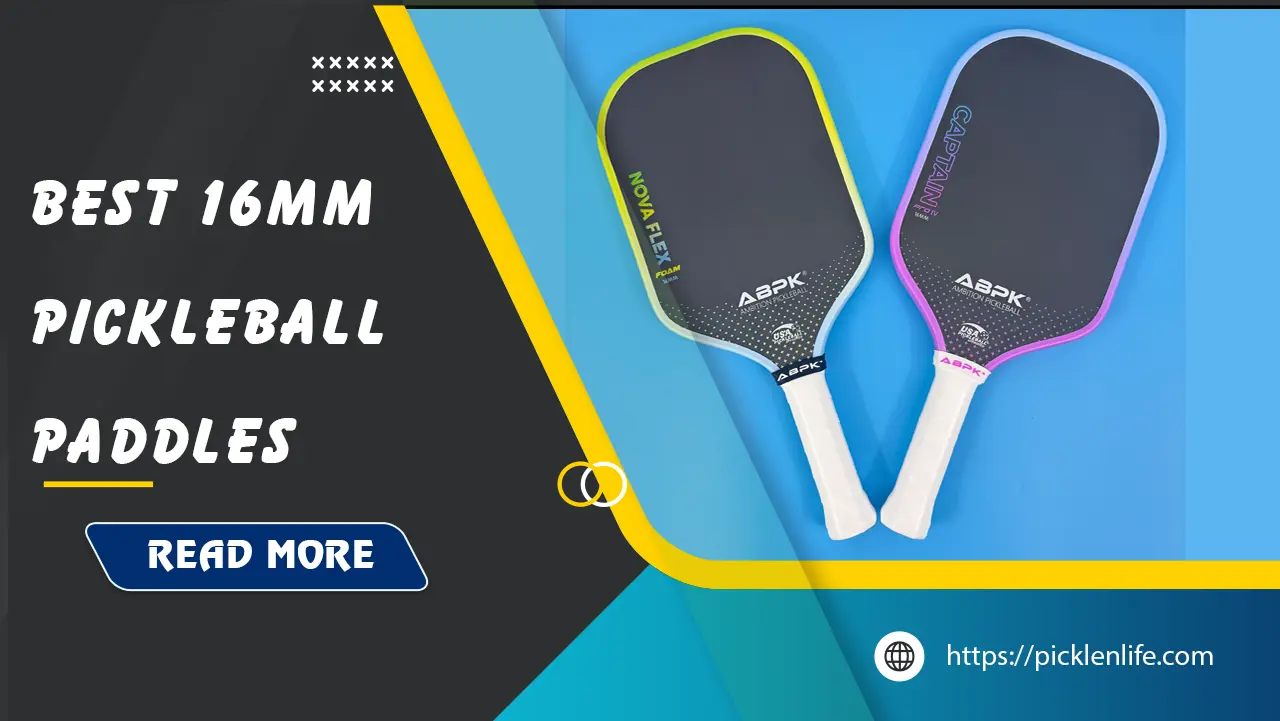
What Is a 16mm Pickleball Paddle?
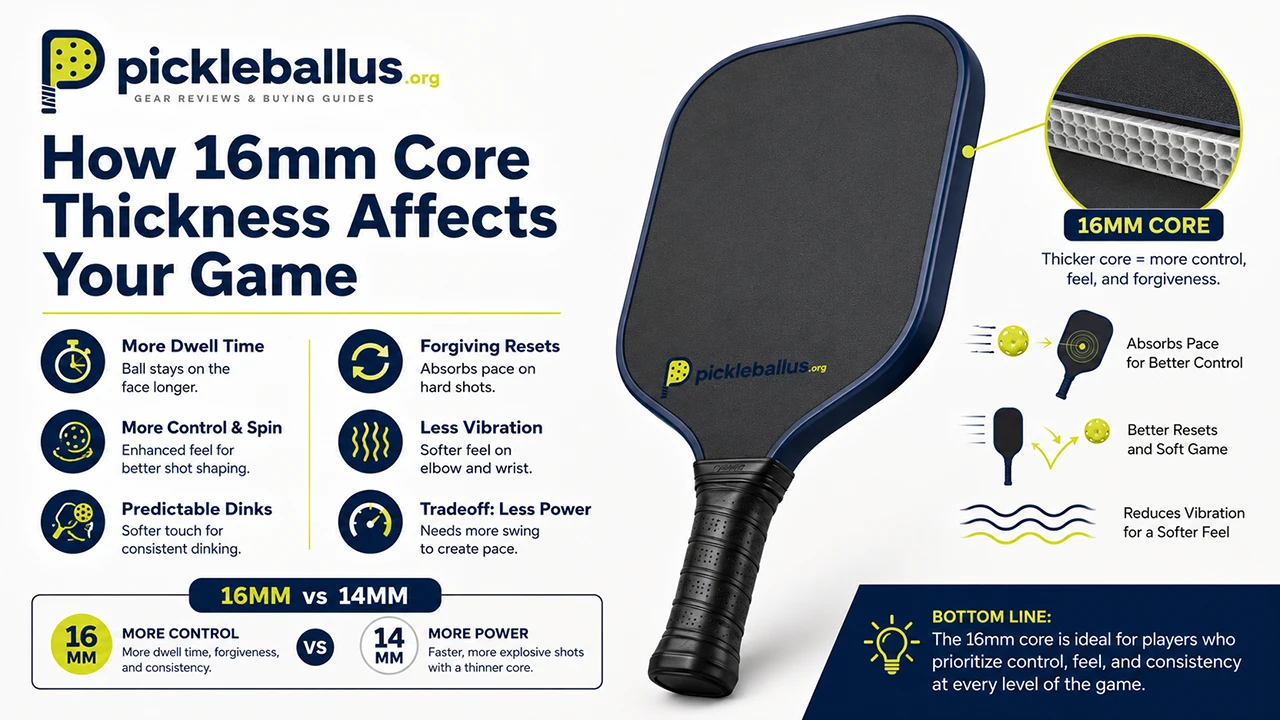
A 16mm pickleball paddle uses a core — the material sandwiched between the two face surfaces — that measures 16 millimeters thick. That extra material changes how the ball interacts with the paddle in three specific ways: it increases dwell time (how long the ball stays on the face), absorbs vibration before it reaches your arm, and produces a noticeably softer feel on contact.
Most paddles sit in a range from 11mm at the thinnest to 16mm on the thicker end. You’ll occasionally see brands label anything at 16mm or above as a “thick core” or “control paddle” — and while that’s a reasonable shorthand, it’s worth understanding what’s actually happening inside the paddle before you commit.
How 16mm Core Thickness Affects Your Game
The defining characteristic of a 16mm core is increased dwell time — the fraction of a second the ball compresses against the face and stays in contact before launching off. More dwell time gives your hand more influence over ball direction and spin, which is why most control-oriented paddles run 16mm.
Three on-court differences stand out:
- Dink rallies become more predictable. The ball doesn’t pop off unexpectedly. You feel it on the face, and your hand guides it where you intend.
- Resets are more forgiving. On a hard-driven ball coming at you, the 16mm core absorbs energy and deflects with less pop-back than a thinner option.
- Vibration drops. If you’ve dealt with arm soreness after long sessions, the thicker core reduces the harsh feedback that travels into your elbow and wrist.
The tradeoff is power. The same energy absorption that makes resets easier also means you need more swing intention to generate pace on drives. Players who rely on a short, punchy swing for put-away shots sometimes find 16mm paddles feel slightly “dead” compared to a 14mm alternative. For context, check out our full guide to pickleball paddle weight to see how core thickness interacts with swing weight in your selection process.
Who Should Use a 16mm Paddle?
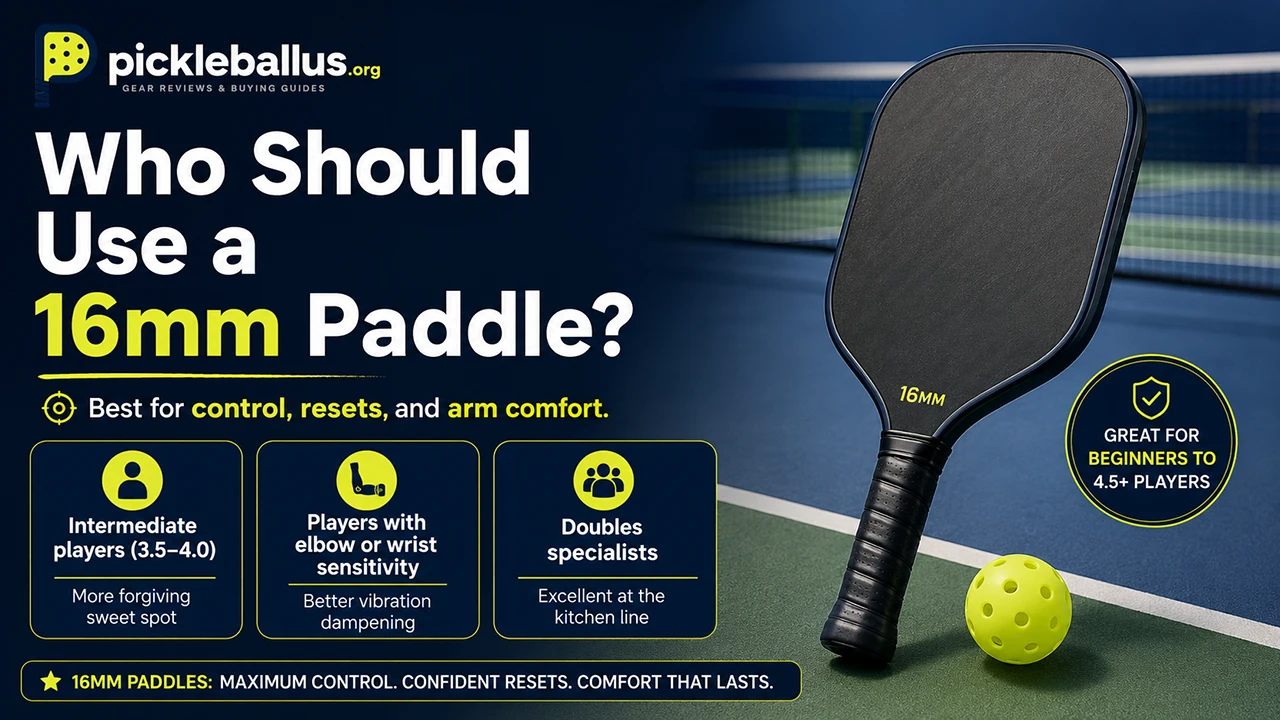
Players who prioritize kitchen-line consistency, reset accuracy, and arm comfort should choose a 16mm paddle over thinner alternatives. That covers a wide range of skill levels — from beginners still building contact consistency to 4.5+ players who have already decided that controlling the soft game is how they win matches.
Three specific groups gain the most from 16mm:
- Intermediate players (3.5–4.0) building a dink game and needing a more forgiving sweet spot.
- Players with elbow or wrist sensitivity who benefit from the vibration dampening a thicker core provides.
- Doubles specialists who spend more time at the kitchen line than driving from the baseline.
If your game is built around driving hard from the baseline and you rarely rally in the kitchen, a best 14mm pickleball paddles list might be a better starting point — the thinner core delivers more pop on offensive swings.
The 8 Best 16mm Pickleball Paddles in 2026
The following eight paddles represent the current market across all price tiers, playing styles, and face materials. Every one of them is sold on Amazon, carries a verified review history, and belongs to a brand with an active 2026 production line.
#1 JOOLA Ben Johns Perseus Pro IV 16mm — Best Overall
The Perseus Pro IV is the benchmark 16mm paddle for competitive all-court players in 2026. Ben Johns — arguably the best player in the world — games this model for a reason: it delivers tour-level performance across every shot category without asking you to specialize.
Key Specs:
- Face: Textured carbon fiber
- Core: 16mm polypropylene honeycomb with high-density foam throat insert
- Weight: ~8.1 oz average
- Shape: Elongated (16.5″ length, 7.5″ width)
- Handle: 5.5″
Performance Analysis:
The Perseus Pro IV’s foam-in-the-throat construction is the detail that separates it from most 16mm paddles. JOOLA fills the throat area — the part of the paddle that tends to go dead on mishits — with high-density foam, which increases flexibility and extends the sweet spot deeper into the face. On-court, this means off-center hits still respond predictably instead of dying on contact.
The textured carbon fiber surface generates serious spin. Topspin drives and kick serves respond well, and the surface texture holds up over hundreds of games better than some raw carbon alternatives that wear smooth quickly. Power output is strong for a 16mm — the Pro IV doesn’t feel sluggish, but players coming from a 14mm will notice slightly more intention required on full drives.
At the kitchen line, dinks and cross-court rolls feel planted. There’s enough dwell time to shape the ball, and the paddle doesn’t reward over-hitting — which, for most players, is a feature.
Pros:
- Exceptional all-court versatility
- Foam throat insert extends sweet spot
- Durable textured carbon holds spin texture over time
- Pro-level performance, especially strong for two-handed backhands
Cons:
- Premium price tier
- Head-heavy elongated feel may not suit players who prefer a neutral balance
Best For: Competitive 4.0+ players who want one paddle that handles drives, counters, soft game, and put-aways without compromise.
My Verdict: If budget isn’t a constraint and you want the most versatile 16mm paddle in the 2026 market, the Perseus Pro IV is the benchmark. Everything else on this list is measured against it.
#2 RPM Friction Pro V2 16mm — Best for Spin
The RPM Friction Pro V2 is the highest-spin 16mm paddle you can buy right now, and it’s the choice for players who want to weaponize topspin on every stroke. Designed by pro James Ignatowich — who moved to China specifically to oversee production quality — the V2 is a meaningful upgrade over the original, with more pop while preserving the plush Gen3 feel that made the first version popular.
Key Specs:
- Face: Gen3 raw carbon fiber
- Core: 16mm elongated
- Weight: ~8.0–8.2 oz
- Shape: Elongated and Widebody options (16mm available in both)
- Handle: Standard
Performance Analysis:
The Gen3 carbon surface on the RPM is distinctly grittier than most carbon fiber paddles on the market. On first contact, you feel the ball grab the face — it doesn’t slide off. This translates directly into spin RPMs that are noticeably higher than standard textured carbon paddles, particularly on backhand rolls, kick serves, and cross-court dinks with heavy topspin.
The V2’s core upgrade adds pop without sacrificing the soft feel that makes 16mm paddles attractive. Hard drives off the baseline have more pace than the original, and the improvement feels more like a refinement than a redesign — Ignatowich compared it to a 5–10% iPhone update rather than a new phone, and that’s accurate.
The tradeoff for the spin-heavy surface is control precision on resets. New players may find the surface’s grip causes the ball to move unexpectedly on defensive blocks until they calibrate to it.
Pros:
- Best-in-class spin generation for a 16mm paddle
- V2 upgrade adds measurable power increase
- Gen3 surface texture maintains grit over heavy use
- Available in elongated and widebody shapes at 16mm
Cons:
- High spin surface requires calibration period
- Premium price
Best For: Advanced players (4.0+) who build their game around spin placement, topspin drives, and heavy dinks.
My Verdict: For spin-first players, nothing in the 16mm category beats the Friction Pro V2. It’s a specialist tool that rewards players who understand how to use spin as a weapon.
#3 Selkirk VANGUARD Pro Invikta 16mm — Best for Control
The VANGUARD Pro Invikta is Selkirk’s premium control paddle for players who prioritize touch, placement, and soft-game dominance over raw power. The elongated Invikta shape gives extra reach without sacrificing the forgiving feel that defines the VANGUARD line.
Key Specs:
- Face: Raw carbon fiber
- Core: 16mm polypropylene honeycomb
- Weight: ~7.9–8.2 oz
- Shape: Elongated Invikta
- Handle: 5.25″
Performance Analysis:
The VANGUARD Pro Invikta’s raw carbon face produces a slightly softer contact feel than textured carbon alternatives like the Perseus Pro IV. This shows up most on dinks and third-shot drops, where the ball comes off the face with a smooth, predictable arc rather than a sharp departure. Players focused on best pickleball paddles for control consistently mention the Invikta as the softest-feeling elongated paddle in its price tier.
Spin generation is strong — raw carbon produces good grab — but the VANGUARD prioritizes feel over spin-maximization. On kitchen rallies and resets, it’s among the most reliable paddles in this entire list. Drives have enough pace for competitive play, though players wanting to batter the ball from the baseline will find the V2 RPM or the Gearbox GX2 a better fit.
Pros:
- Softest, most touch-oriented feel of any elongated 16mm paddle
- Premium Selkirk build quality and consistent specs
- Raw carbon face generates reliable spin without over-gripping
- Excellent for third-shot drops and kitchen resets
Cons:
- Less pop on offensive drives compared to power-oriented options
- Premium price tier
Best For: Control-focused players (3.5–5.0) who win through placement, soft game, and rally consistency rather than power.
My Verdict: If your game plan involves winning the soft game and making opponents uncomfortable with placement rather than pace, the VANGUARD Pro Invikta is the clearest choice in this list.
#4 Six Zero Coral 16mm — Best All-Court Alternative
The Six Zero Coral is one of the freshest 16mm entries in 2026, earning its place through a convincing touch-and-power blend that competes with established names at a lower price point. Six Zero built the Coral around a Tectonic Core with ProPulsion Foam and a Diamond Tough raw carbon surface — a combination that delivers more dwell time than standard honeycomb without going full-foam.
Key Specs:
- Face: Diamond Tough raw carbon fiber
- Core: 16mm Tectonic Core with ProPulsion Foam
- Weight: ~8.0–8.3 oz average
- Shape: Elongated (16.5″ × 5.75″ handle)
- Swing weight: 117
Performance Analysis:
The Coral’s hybrid core design positions it between a pure honeycomb control paddle and a full-foam power paddle. ProPulsion Foam layers inside the core extend ball contact time on drives, producing more pace than a standard polypropylene honeycomb at the same 16mm thickness. At the same time, the 16mm depth keeps dink feel manageable — it doesn’t have the harsh, explosive pop of thinner foam paddles.
At swing weight 117, the Coral moves quickly at the kitchen line — lighter-feeling in fast exchanges than the Perseus Pro IV despite similar weight specs. Players who need to defend fast hands battles will appreciate that response speed.
The lower twist weight on an elongated shape gives it a quicker, livelier response than a widebody, which suits baseline players who want reach without sacrificing hand speed at the net.
Pros:
- Hybrid core delivers more power than standard honeycomb 16mm
- Diamond Tough surface holds spin texture well
- Quick response at the kitchen line for its weight
- Strong value relative to competing paddles at similar performance
Cons:
- Slightly less dwell-time softness than pure control paddles like the VANGUARD Invikta
- Smaller sweet spot than widebody alternatives
Best For: All-court players (3.5–4.5) who want baseline power and kitchen touch without buying two paddles.
My Verdict: The Coral is the best 16mm option for players who don’t want to specialize. It handles both sides of the court better than most paddles at its price point, and it’s a genuine 2026 newcomer worth taking seriously.
#5 CRBN TruFoam Genesis 3 Elongated — Best Foam Paddle
The CRBN TruFoam Genesis 3 is the best full-foam 16mm paddle for players who want a distinctly plush, advanced feel with high put-away power. CRBN’s foam core design produces a playing experience that’s noticeably different from honeycomb paddles — softer on touch shots, more explosive on drives — and the Genesis 3 refines that formula with tighter construction tolerances.
Key Specs:
- Face: Raw carbon fiber
- Core: Full foam, 16mm elongated
- Weight: ~8.0–8.2 oz
- Shape: Elongated
- Handle: 5.5″
Performance Analysis:
Full-foam cores are one of 2025–2026’s most significant paddle technology shifts. Unlike polypropylene honeycomb, which absorbs energy consistently across the face, foam cores redirect and release energy with a distinct “pocketing” feel — the ball sinks into the face slightly more on contact, then launches with higher dwell time and more put-away power on aggressive swings.
The Genesis 3’s 16mm thickness keeps this power somewhat tamed compared to thinner foam paddles, making it more accessible for players who aren’t yet at the highest competitive levels. Dinks and resets feel plush and predictable. Drives have genuine pace. The raw carbon face adds spin RPMs that complement the foam core’s natural ball-shaping ability.
Where foam paddles ask more of the player is in consistency — a paddle that amplifies intention on aggressive shots also amplifies intention errors on defensive blocks until your calibration adjusts.
Pros:
- Full-foam core delivers premium plush feel not found in honeycomb paddles
- High put-away power on drives and overheads
- Raw carbon face adds meaningful spin
- Well-suited for advanced doubles and kitchen-line specialists
Cons:
- Requires calibration period vs. honeycomb paddles
- Less forgiving on inconsistent defensive technique
Best For: Skilled players (4.0–5.0) who want the most premium-feeling 16mm paddle and can handle the transition period from honeycomb.
My Verdict: For players who’ve used standard honeycomb paddles for years and want to understand what the foam-core hype is about, the Genesis 3 is the cleanest entry point that doesn’t sacrifice touch for power.
#6 Gearbox GX2 Power Hybrid 16mm — Best for Power
The Gearbox GX2 Power Hybrid is the 16mm paddle built for players who refuse to sacrifice pop for a thicker core. Its SST 2.0 CarbonRibCore uses a suspended construction that extends ball contact time without flattening the pop typical of standard 16mm paddles — a combination that makes it the most power-oriented option on this list.
Key Specs:
- Face: 3K raw carbon fiber
- Core: SST 2.0 CarbonRibCore, 16mm
- Weight: ~8.0–8.3 oz
- Shape: Standard/widebody option
- Sweet spot: Large
Performance Analysis:
Gearbox’s SST 2.0 CarbonRibCore is a structural engineering approach that suspends the core inside the frame rather than pressing it flush against the face material. This suspension design extends how long the ball stays in contact during impact, improving control over energy release — you get more consistent drives because the core has more time to transfer energy uniformly across the face.
The 3K raw carbon fiber surface provides a solid foundation for spin generation. On drives and volleys, the GX2 delivers force that competes with 14mm paddles, which is uncommon for a 16mm option. The large sweet spot means mishits stay in play more than on elongated alternatives with smaller hitting zones.
For players who drive hard from the baseline but still need the kitchen softness a 16mm core provides, the GX2 splits the difference more effectively than almost any other paddle in this category. It’s the best choice if best carbon fiber pickleball paddle performance is your top priority alongside thickness.
Pros:
- Most power output of any 16mm honeycomb paddle on this list
- SST 2.0 suspension extends ball contact for consistent energy transfer
- Large sweet spot reduces punishment on mishits
- 3K raw carbon surface generates reliable spin
Cons:
- Less dwell-time softness than pure control options like the VANGUARD Invikta
- May feel aggressive for players transitioning from recreational paddles
Best For: Aggressive 3.5–4.5 players who want the control benefits of 16mm without accepting a significant power reduction versus thinner cores.
My Verdict: The GX2 Power Hybrid redefines what “power from a 16mm” means. If you’ve avoided 16mm because you thought you’d give up too much pop, this is the paddle that changes that assumption.
#7 Engage Pursuit Pro MX 6.0 16mm — Best Mid-Range Value
The Engage Pursuit Pro MX 6.0 is the best 16mm paddle for players who want legitimate competitive performance without paying premium prices. Engage has a long history of building paddles used by serious tournament players, and the Pursuit Pro MX 6.0 delivers that pedigree at a mid-range price point.
Key Specs:
- Face: Carbon fiber
- Core: 16mm polymer honeycomb
- Weight: ~7.9–8.2 oz
- Shape: Elongated
- Made in USA
Performance Analysis:
The Pursuit Pro MX 6.0’s core construction emphasizes consistency over flashiness. The polymer honeycomb delivers a neutral, predictable feel that experienced players will recognize immediately — no unexpected pop variation, no dead zones, no dramatic performance drop-off at the edges. It’s the kind of reliability that serious players appreciate when playing under pressure.
The carbon fiber face produces good spin, and the elongated shape gives reach on cross-court shots and two-handed backhands. At the kitchen line, the paddle performs exactly as a 16mm should — dinks sit softly, resets absorb pace well, and the ball launches predictably off touch shots.
The MX 6.0’s advantage over budget options is build quality. Engage manufactures in the USA with tighter tolerances than offshore alternatives, which means the paddle performs consistently from the first session through several hundred hours of play.
Pros:
- Strong mid-range value with genuine tournament-level construction
- Consistent, neutral feel across the entire face
- USA-manufactured with quality control advantage over budget imports
- Elongated shape for reach without sacrificing kitchen feel
Cons:
- Less surface spin texture than RPM or JOOLA carbon options
- Not as powerful as the Gearbox GX2 for drive-focused players
Best For: Intermediate-to-competitive players (3.0–4.0) who want a reliable, well-made 16mm paddle at a mid-range investment.
My Verdict: The Pursuit Pro MX 6.0 is the smartest mid-range buy on this list. It won’t dazzle you with flashy specs, but it will perform reliably every session — and at its price point, that consistency is worth more than features you won’t use.
#8 Franklin C45 Dynasty 16mm — Best for Competitive Players
The Franklin C45 Dynasty 16mm is the paddle of choice for multiple PPA Tour pros in 2026 and the best option for competitive players who want tour-validated performance in the C45 line. Hayden Patriquin uses the 16mm C45 Dynasty as his main gamer, and Anna Leigh Waters (who signed with Franklin in early 2026) has been working across the C45 shape options — a meaningful endorsement from the two top-ranked players in their respective categories.
Key Specs:
- Face: C45 carbon fiber
- Core: 16mm honeycomb
- Weight: Standard competitive range
- Shape: Multiple C45 shape options available
- Discount available: code “KITCHEN” at checkout for 15% off
Performance Analysis:
The C45 line earns its reputation through consistency across a full session. Pros and high-level amateurs who’ve tested the Dynasty note that its feel doesn’t drift significantly from the first rally of a match to the last — which matters when match situations require precise execution under fatigue.
The C45 carbon face delivers strong spin on serves and topspin drives, and the 16mm core keeps the soft game manageable in extended dink rallies. Power output is competitive but not aggressive — the Dynasty is not a banger’s paddle. It rewards players who use precision and placement to construct points rather than trying to end them with pace.
The Dynasty also holds up well over time. Surface texture durability is a known weakness in several high-performance carbon paddles, and the C45 construction has been praised for maintaining its grip texture through heavy use.
Pros:
- Pro-validated at the highest competitive level (PPA Tour)
- Consistent performance across full match duration
- Durable C45 carbon surface maintains texture longer than many competitors
- Multiple shape options allow players to find their best fit within the C45 line
Cons:
- Less aggressive power output than the GX2 or Perseus Pro IV
- Premium price tier
Best For: Competitive players (4.0–5.0) who want a tour-validated paddle with proven durability and consistent all-court performance.
My Verdict: The C45 Dynasty is the paddle for players who want to know what the pros are gaming. Its performance ceiling is legitimate, and its durability record makes it a better long-term investment than some flashier alternatives.
16mm vs 14mm Pickleball Paddles: Which Is Right For You?
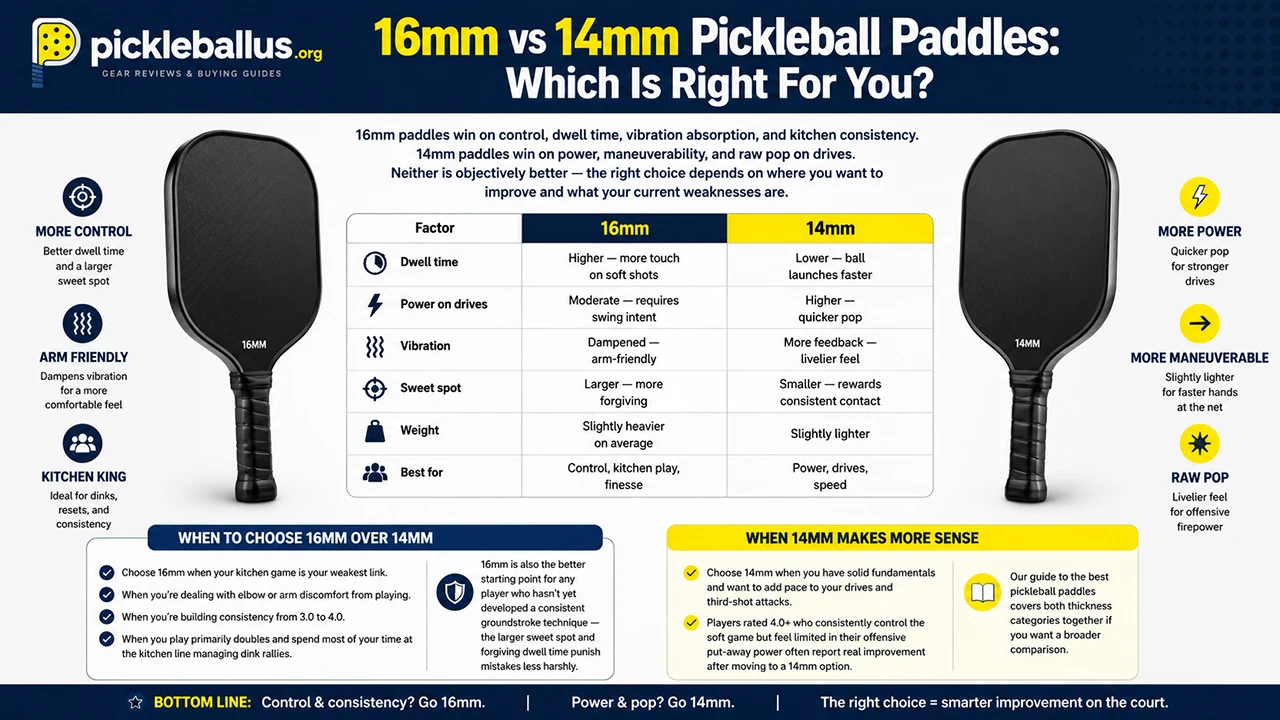
16mm paddles win on control, dwell time, vibration absorption, and kitchen consistency. 14mm paddles win on power, maneuverability, and raw pop on drives. Neither is objectively better — the right choice depends on where you want to improve and what your current weaknesses are.
The table below shows the key differences across the factors that matter most:
| Factor | 16mm | 14mm |
|---|---|---|
| Dwell time | Higher — more touch on soft shots | Lower — ball launches faster |
| Power on drives | Moderate — requires swing intent | Higher — quicker pop |
| Vibration | Dampened — arm-friendly | More feedback — livelier feel |
| Sweet spot | Larger — more forgiving | Smaller — rewards consistent contact |
| Weight | Slightly heavier on average | Slightly lighter |
| Best for | Control, kitchen play, finesse | Power, drives, speed |
When to Choose 16mm Over 14mm
Choose 16mm when your kitchen game is your weakest link, when you’re dealing with elbow or arm discomfort from playing, when you’re building consistency from 3.0 to 4.0, or when you play primarily doubles and spend most of your time at the kitchen line managing dink rallies.
16mm is also the better starting point for any player who hasn’t yet developed a consistent groundstroke technique — the larger sweet spot and forgiving dwell time punish mistakes less harshly.
When 14mm Makes More Sense
Choose 14mm when you have solid fundamentals and want to add pace to your drives and third-shot attacks. Players rated 4.0+ who consistently control the soft game but feel limited in their offensive put-away power often report real improvement after moving to a 14mm option. Our guide to the best pickleball paddles covers both thickness categories together if you want a broader comparison.
What to Look for in a 16mm Paddle
Narrowing down a 16mm paddle comes down to four variables beyond core thickness: face material, weight, shape, and core construction type.
Face Material: Carbon Fiber vs Fiberglass
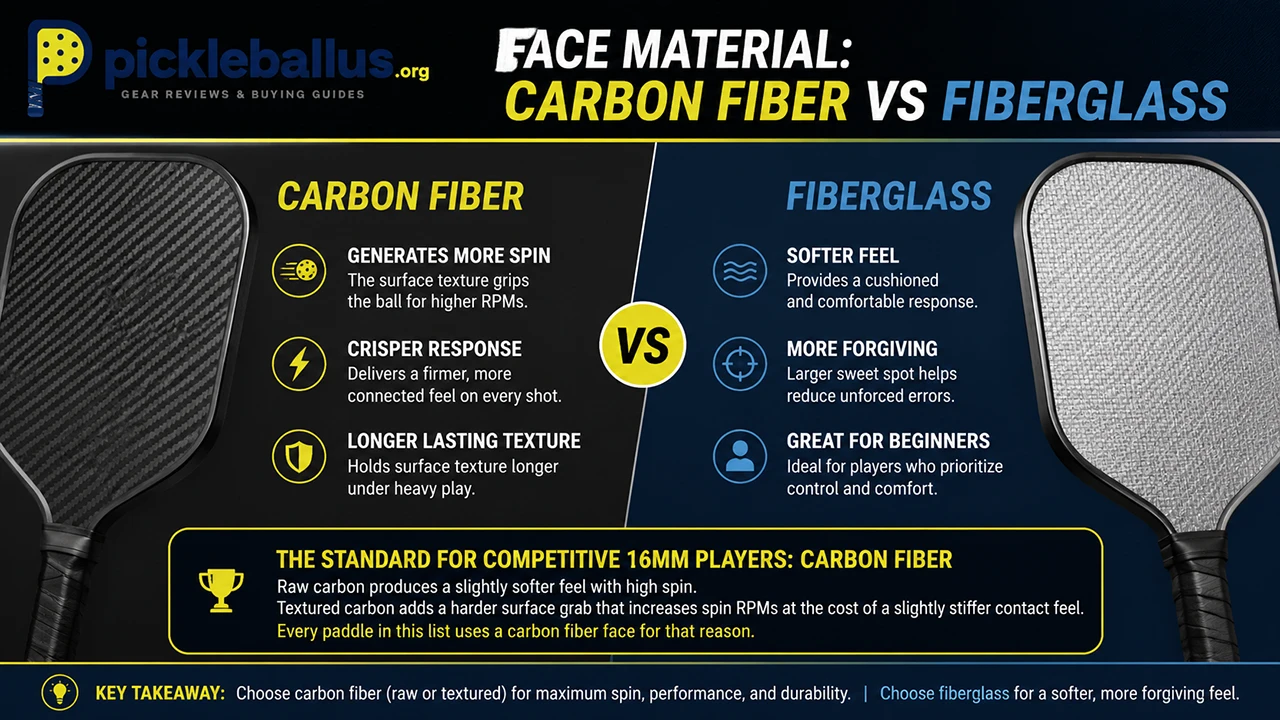
Carbon fiber face paddles generate more spin, produce a crisper response, and hold surface texture longer under heavy play. Fiberglass faces are softer and more forgiving — they suit beginners and players who prioritize a cushioned feel over spin-maximization.
For competitive 16mm players, carbon fiber (raw or textured) is the standard choice. Raw carbon produces a slightly softer feel with high spin; textured carbon adds a harder surface grab that increases spin RPMs at the cost of a slightly stiffer contact feel. Every paddle in this list uses a carbon fiber face for that reason.
Weight Range and Shape Considerations
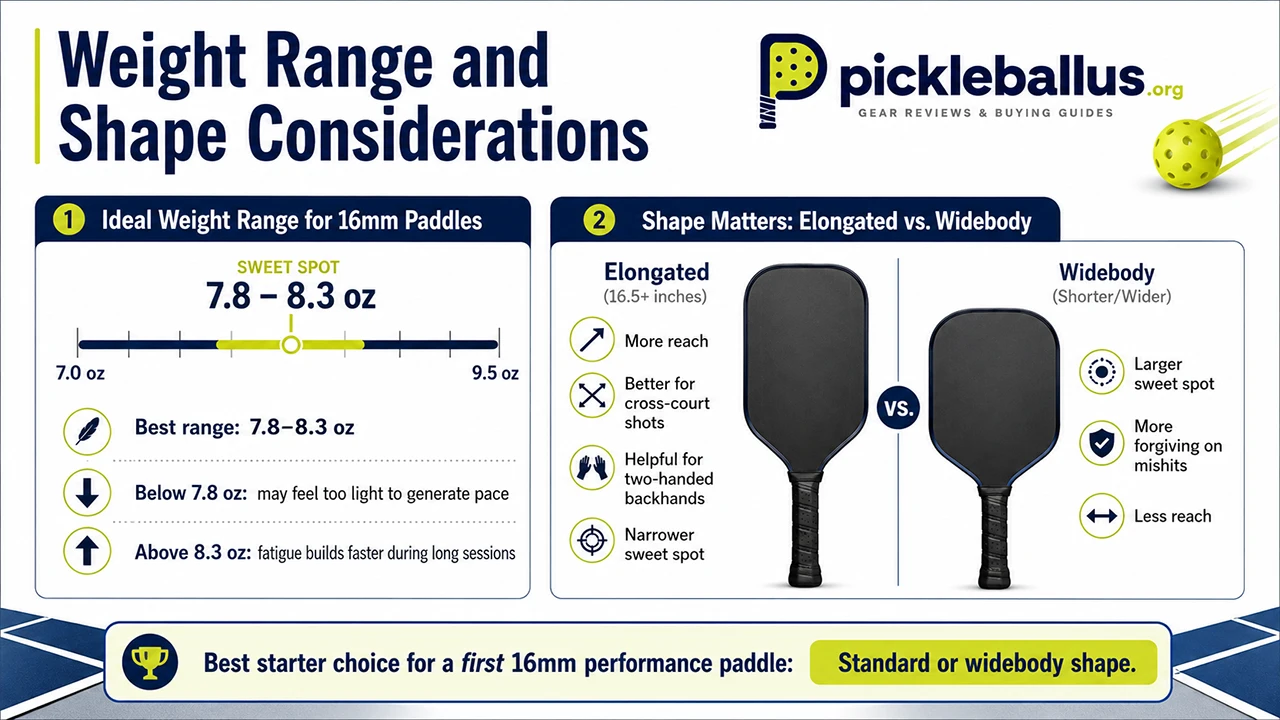
For 16mm paddles, the most useful weight range is 7.8–8.3 oz. Below 7.8 oz, the paddle may feel too light to generate pace even with swing intent. Above 8.3 oz, fatigue sets in faster during long sessions.
Shape choice — elongated vs. widebody — affects reach and sweet spot size more than most players account for. Elongated shapes (16.5″+ length) give more reach on cross-court shots and two-handed backhands but have a narrower hitting zone. Widebody shapes offer a larger sweet spot and more forgiveness on mishits at the cost of some reach. If you’re choosing your first 16mm performance paddle, a standard or widebody shape is the safer starting point until you’re confident in your contact consistency.
By this point, you have everything you need to pick the right 16mm paddle — a clear breakdown of what thick-core construction actually does, eight reviewed models across every budget tier and play style, and a direct 16mm vs. 14mm comparison to confirm you’re in the right category. Owning the right paddle is only the starting point, though; what happens after you buy it — how long it will last, whether it protects your arm on high-volume play, and whether it meets tournament standards — determines the long-term value of that investment. The next section covers the details that experienced players research but rarely find answered in a standard buying guide.
Beyond the Purchase: What 16mm Paddle Owners Need to Know
How Long Does a 16mm Pickleball Paddle Last?
A quality 16mm pickleball paddle lasts between 1 and 3 years for regular players, with the primary failure mode being surface texture degradation on the carbon fiber face rather than structural damage to the core. The carbon surface gradually loses its grit over hundreds of hours of play, reducing spin generation — you’ll notice this when your topspin drives start landing longer and your kick serves lose their bite.
Foam-core paddles show a different wear pattern: the core itself can develop dead spots after heavy use, where the foam compresses and doesn’t recover fully. Foam paddles may play consistently for the first year then drop off in feel more noticeably than honeycomb options.
To extend paddle life, avoid leaving paddles in extreme heat (car trunks in summer), clean the face with a damp cloth after sessions, and use an edge guard if your paddle doesn’t include one. Surface degradation is partly manageable with a light sandpaper rub on some carbon faces — though check the manufacturer’s guidance before trying this.
Are 16mm Paddles Good for Tennis Elbow?
Yes — 16mm paddles reduce the vibration that aggravates tennis elbow, making them the recommended thickness for players dealing with arm or elbow discomfort. The thicker core acts as a buffer between ball impact and your grip hand, dispersing force more gradually than a thin 14mm paddle would.
For players actively managing elbow issues, a 16mm paddle is a meaningful improvement — but it works best in combination with proper swing mechanics (leading with the shoulder rather than flicking the wrist) and a grip size that doesn’t require over-gripping. Our full guide to best pickleball paddles for tennis elbow covers additional equipment and technique factors for players managing arm injuries.
A heavier grip (4.25″ circumference or larger) also reduces the squeezing force needed to hold the paddle, which directly reduces forearm strain during extended play.
16mm Paddles and USAPA Approval — What to Check
All eight paddles on this list are USAPA/USA Pickleball approved for sanctioned tournament play, but this is worth verifying before you register for a tournament if you’re using a newer paddle model. USA Pickleball maintains an approved equipment list that updates regularly as new models are submitted and tested.
The most common reason a paddle gets removed from the approved list is surface texture — specifically, paddles with surfaces that exceed the allowed spin-generation threshold. Raw carbon paddles are periodically retested, and surface texture can degrade or change in ways that affect compliance status over time.
Before registering for a sanctioned tournament, check the current USAPA approved equipment list directly on the USA Pickleball website and confirm your paddle’s model number matches the listed approved variant. Some paddles sell in multiple configurations, and only specific variants may be approved.
Write Your Review
No reviews yet. Be the first to share your experience!