

The best pickleball paddles for 3.0 players in 2026 are the Selkirk SLK Evo Control XL (best overall), the JOOLA Ben Johns Hyperion CFS 16mm (best all-court), the Paddletek Bantam EX-L Pro (most forgiving sweet spot), the Onix Z5 Graphite (best widebody shape), the Prince Response Pro (best for transitioning to 3.5), the Vatic Pro V7 16mm (best budget pick), and the Engage Pursuit MX 6.0 (best elongated option for players who want extra reach).


At the 3.0 rating, your fundamentals are in place — you understand the kitchen, you can sustain rallies, and your third-shot drop is starting to take shape. What you do not yet own is consistency. You still mishit more than you’d like, your dinks occasionally float, and your drives sometimes end up out. The right paddle does not fix those problems by itself, but a forgiving core and a surface material matched to your developing technique can shorten the learning curve considerably.
Three things matter most at this level: sweet spot size, core thickness, and weight balance. A paddle that punishes off-center contact will cost you points your game does not yet have the consistency to recover. A paddle engineered for forgiveness gives you room to build habits without fighting your equipment every session.
Below you will find seven paddles reviewed in detail — each tested against the specific demands of 3.0 play. After the reviews, a comparison of control and power paddle types explains which direction fits your current skill, and a quick section addresses whether spending more actually buys you anything at this stage.
What Does a 3.0 Player Actually Need From a Paddle?
A 3.0 pickleball player sits at the early-intermediate stage: you know every shot that exists, you just cannot hit them reliably under pressure yet. That gap between awareness and execution is exactly where paddle choice makes a measurable difference. At this level, you benefit from a paddle that trades some raw performance ceiling for forgiveness and feedback — a setup that rewards developing swings rather than demanding perfect contact on every hit.
Why 16mm Core Thickness Is the Right Starting Point
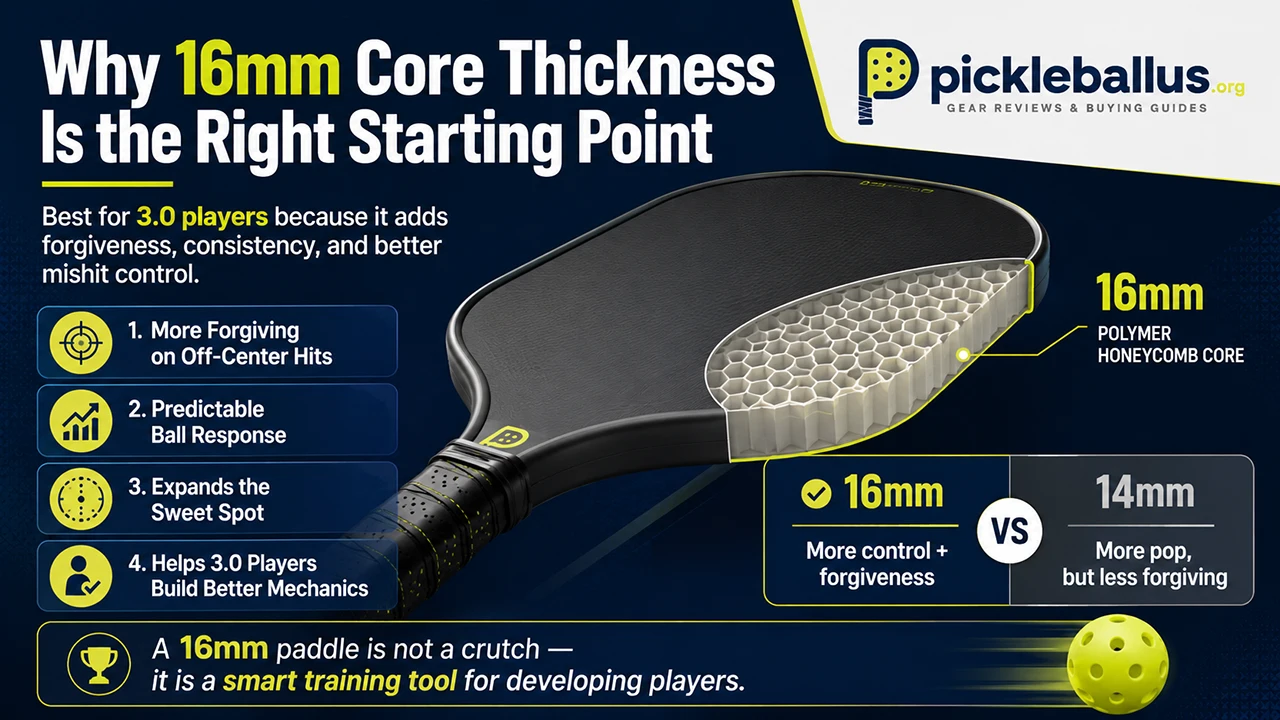
16mm core thickness is the most consistent feature across all top paddle recommendations for 3.0 players because it directly addresses the biggest weakness at this skill level: off-center hits. A thicker polymer honeycomb core distributes impact energy more evenly across the paddle face, which means a ball struck two inches from the sweet spot still behaves predictably. In practical terms, your mishits land closer to where you were aiming.
Thinner paddles — typically 13mm or 14mm — generate more pop and a harder response from the face. That extra pop rewards players who find the sweet spot consistently, but it also amplifies errors. A 14mm paddle at 3.0 teaches you a harsh lesson every time your footwork is one step off. The 16mm build is not a crutch; it is a training tool that gives you enough feedback to identify your mistakes without punishing every minor imperfection in your swing mechanics.
For comparison, a 14mm paddle trades that forgiveness for more speed on speedup shots and drives — attributes you will want later, but are secondary right now. Most 3.0 players who upgrade to a 14mm paddle early find themselves fighting the equipment instead of developing their game. The best 16mm pickleball paddles are specifically built around the sweet spot expansion that thicker cores provide, and for developing players, that engineering decision pays dividends in every practice session.
Face Material — Fiberglass Gives Feel, Carbon Gives Spin
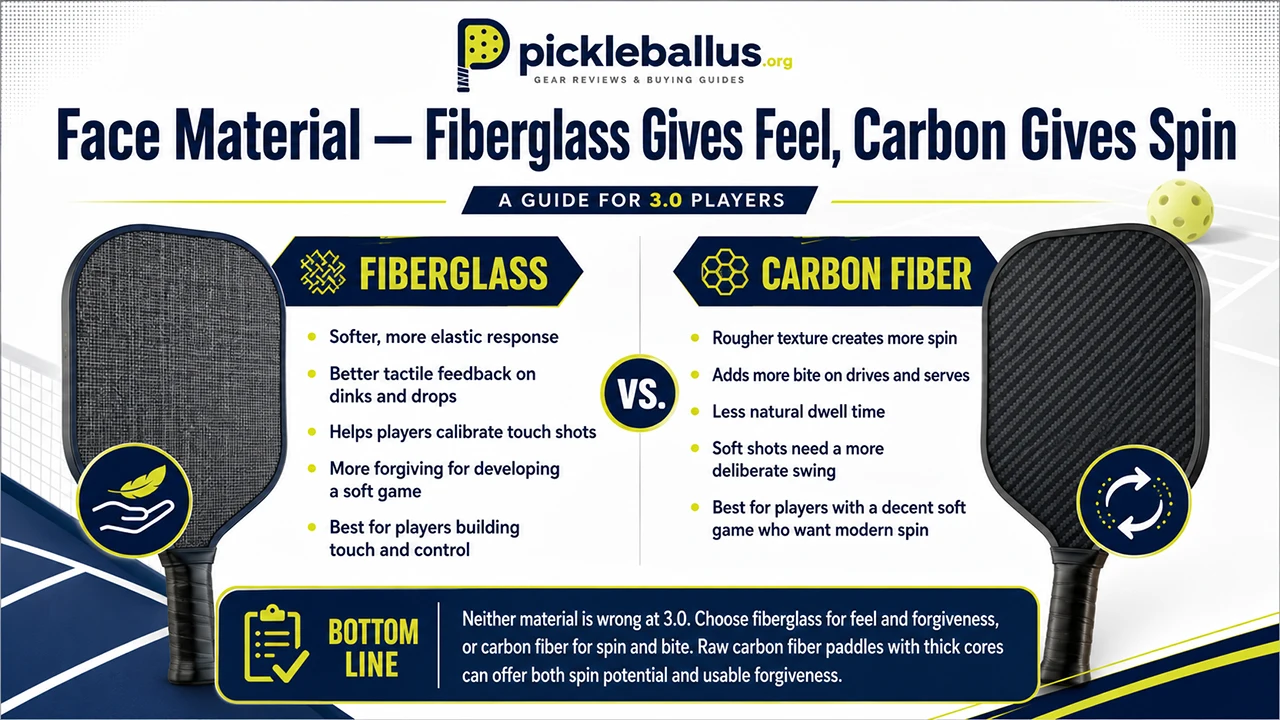
Fiberglass paddle faces have a softer, more elastic response that gives players tactile feedback on dinks and drops — you can feel how much energy is transferring to the ball, which helps you calibrate touch shots over time. That sensory connection to the ball is valuable for a player who is still learning how much swing speed their soft game needs.
Carbon fiber faces generate significantly more spin because the rougher texture grabs the ball longer during contact. At 3.0, that spin potential is partially available to you — if you brush the ball correctly, you will get more rotation than fiberglass delivers. However, carbon fiber faces also have less natural dwell time, which means your dinks require a more deliberate soft swing to avoid floating the ball. Players who are still developing their kitchen game often find fiberglass more forgiving on touch shots early on.
Neither material is wrong at 3.0. Fiberglass suits players focused on building their dink game and drops. Carbon fiber suits players who already have a decent soft game and want more bite on their drives and serves. Several paddles on this list offer raw carbon fiber surfaces with enough core thickness to compensate for the reduced dwell time — those models work well for 3.0 players who want modern spin potential without completely sacrificing forgiveness.
Weight Range: Why 7.5–8.0 oz Works Best at This Level
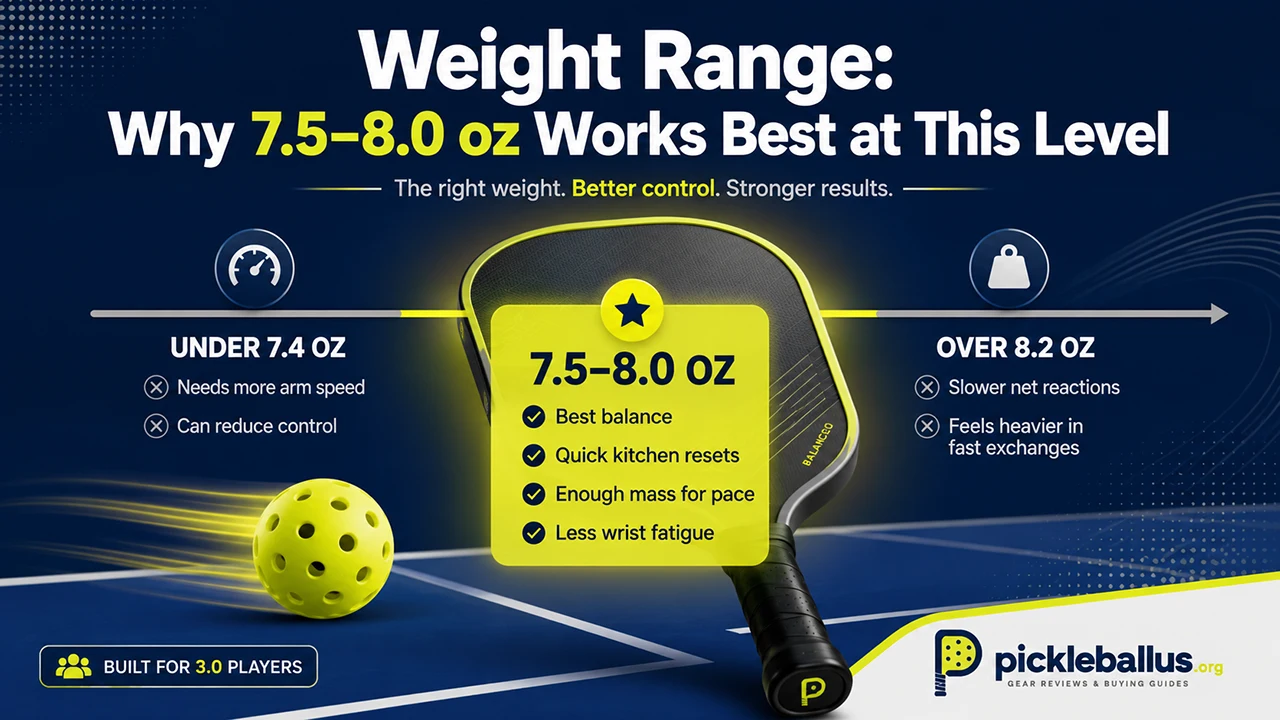
7.5 to 8.0 oz is the weight window where maneuverability and stability reach their best balance for 3.0 players. At this range, you can reset quickly at the kitchen without wrist fatigue in long sessions, while still having enough mass behind drives to generate pace without overswinging.
Paddles under 7.4 oz require more arm speed to generate the same pace, which can lead to overcompensating and losing control of your placement. Paddles over 8.2 oz slow your reaction time at the net, where 3.0-level exchanges are becoming faster and more consequential. The sweet spot for developing players sits comfortably in the midweight tier, and every paddle on this list lands within or close to that range.
The 7 Best Pickleball Paddles for 3.0 Players
Seven pickleball paddles for 3.0 players cover a range of playstyles, budgets, and build philosophies. Every paddle below is actively sold on Amazon, carries consistent positive reviews from players in the 3.0–3.5 range, and has been evaluated against the specific demands of this skill level.
#1 Selkirk SLK Evo Control XL — Best Overall for 3.0
At the 3.0 level, the single biggest separator between a paddle that helps you improve and one that holds you back is how much the equipment manages your mistakes. The Selkirk SLK Evo Control XL was engineered with exactly that problem in mind — a thermoformed, carbon fiber paddle designed to absorb off-center hits without punishing you for them. For a 3.0 player still developing shot placement and kitchen consistency, this paddle builds confidence faster than almost anything else in its class.
Key Specs & Features
- Core: 16mm Rev-Control Polymer Honeycomb
- Face: G8-Flex Carbon Fiber (thermoformed)
- Weight: 7.6–8.1 oz
- Grip: 4.25″ circumference
- Handle Length: 5.75″
- Shape: Elongated (16.4″ x 7.4″)
- USAPA Approved: Yes
Performance Analysis
The 16mm Rev-Control Core is the real story here — it’s tuned specifically to kill pace on resets and third-shot drops, which are exactly the shots where 3.0 players tend to lose points. The G8-Flex Carbon Fiber face adds enough texture for reliable topspin without the gritty, grabby feel of raw carbon that punishes timing errors. When I’m working on dink exchanges from the kitchen line, the Evo Control XL makes it almost annoyingly easy to keep the ball low — you’re not fighting the paddle on soft shots. Compared to a stiffer option like the JOOLA Hyperion CFS 16mm, the SLK absorbs more pace and provides a more predictable touch for players still calibrating their stroke. The elongated shape also extends reach on wide balls without demanding the precise mechanics an elongated paddle usually requires. For 3.0 players focused on building control-based fundamentals, this paddle is the right tool at the right time.
Pros
- 16mm core produces excellent feel and dampening on dinks and resets, making soft-game development far more achievable
- Thermoformed construction gives the Evo Control XL a sweet spot that punches well above its price point
- Elongated shape adds reach without the high swing weight that makes other elongated paddles feel sluggish
- G8-Flex Carbon Fiber provides consistent spin without the surface grit that wears out fast
- Lightweight range (7.6–8.1 oz) keeps it maneuverable during fast kitchen exchanges
Cons
- Players who generate most of their own power may find the 16mm core a little too muted for drives
- The elongated shape has a slightly tighter feel than a widebody — takes a session or two to dial in
- Mid-range carbon fiber face texture won’t satisfy players chasing elite spin metrics
Best For
Players rated DUPR 2.5–3.5 who are actively working on their soft game and want a paddle that teaches good touch habits rather than masking poor ones. Especially strong for players who net a lot of third-shot drops or struggle to keep dinks out of the danger zone.
My Verdict
The Selkirk SLK Evo Control XL earns the top spot for 3.0 players because it’s genuinely skill-building, not just forgiving. The combination of a 16mm control core, thermoformed carbon face, and balanced elongated shape addresses every weakness common at this stage of development. If you’re serious about pushing to 3.5, start here.
#2 JOOLA Ben Johns Hyperion CFS 16mm — Best All-Court
Ben Johns is the most decorated player in pickleball history, and the paddle bearing his name was built to perform at every position on the court — not just in one dimension. For a 3.0 player ready to stop thinking of their paddle as beginner gear and start treating it as a long-term investment, the JOOLA Hyperion CFS 16mm is the most complete all-court paddle at this level. It’s a paddle you genuinely won’t outgrow.
Key Specs & Features
- Core: 16mm Polymer Honeycomb with Hyperfoam Edge Wall
- Face: Carbon Friction Surface (CFS)
- Weight: 8.2–8.6 oz
- Grip: 4.125″ circumference
- Handle Length: 5.5″
- Shape: Elongated (Aero-Curve)
- USAPA Approved: Yes
Performance Analysis
The Hyperfoam Edge Wall is what separates this paddle from the field at its price tier — foam injected into the perimeter expands the effective sweet spot significantly, so even when contact is slightly off-center, the ball behaves as expected. The Carbon Friction Surface generates elite spin for a 16mm paddle, which at the 3.0 level means topspin drives suddenly become a real weapon rather than a liability. I noticed the most benefit against bangers — the combination of foam edge stability and 16mm dampening made blocking hard drives predictable in a way that cheaper paddles simply don’t deliver. The 8.2–8.6 oz weight range does skew heavier than most paddles at this level, which means quick-hands exchanges can feel slightly labored until you’ve adjusted, particularly on one-handed backhand volleys. Compared to the Selkirk SLK Evo Control XL, the Hyperion leans more toward power and spin while still maintaining excellent kitchen-line touch. For intermediate players ready to add a new dimension to their game, this paddle delivers growth runway few others can match.
Pros
- Hyperfoam Edge Wall creates one of the largest and most stable sweet spots in the elongated paddle category
- Carbon Friction Surface produces top-tier spin that rewards developing topspin mechanics
- CX Forged Handle adds flex at the throat, generating surprising pop on drives without sacrificing dink touch
- Well-suited for two-handed backhand players due to the 5.5″ handle length
- Ben Johns’ signature model has been proven across thousands of competitive matches at every level
Cons
- Head-heavy balance (8.2–8.6 oz range) can slow down reaction speed at the kitchen line for smaller or lighter players
- One of the higher-priced options in this round-up
- Raw surface texture is prone to wearing faster than non-textured CFS options if played heavily outdoors
Best For
3.0–3.5 players who want a single paddle to carry them through multiple rating milestones, with enough performance ceiling to remain competitive at 4.0. Ideal for athletic, power-oriented players comfortable managing a slightly heavier swing weight.
My Verdict
The JOOLA Ben Johns Hyperion CFS 16mm is overkill for some 3.0 players and exactly right for others. If you’re 3.0 but competing with 3.5 tendencies — aggressive groundstrokes, two-handed backhand, comfort with heavier gear — buy this paddle now and stop upgrading for years.
#3 Paddletek Bantam EX-L Pro — Most Forgiving Sweet Spot
Some paddles reward precision. The Paddletek Bantam EX-L Pro rewards effort. Its extra-wide 7-7/8″ face and Smart Response Technology core make it one of the most forgiving full-sized paddles on the market — and that forgiveness translates directly to confidence for 3.0 players still learning where to make contact on the face. The Bantam series has been a tournament court staple since 2012 for good reason.
Key Specs & Features
- Core: Advanced High Grade Polymer Composite Honeycomb (Smart Response Technology)
- Face: Velvet Textured Polycarbonate
- Weight: 8.2–8.8 oz
- Grip: 4.125″ or 4.375″ circumference
- Handle Length: 4.75″
- Shape: Standard (16″ x 7-7/8″)
- USAPA Approved: Yes
- Made in: USA
Performance Analysis
Smart Response Technology is Paddletek’s proprietary core engineering that optimizes the energy transfer at contact — the result is a paddle that consistently returns the ball with similar pace and placement regardless of where on the face contact is made. At 7-7/8″ wide, the Bantam EX-L Pro’s hitting surface is notably broader than most paddles in this list, which is precisely why mishits feel so manageable. The velvet-textured polycarbonate face provides respectable spin for a polycarbonate surface and produces a softer, more muted sound at contact than carbon fiber alternatives, making it a good choice for noise-restricted courts. On the downside, players approaching 3.5 who are developing big topspin mechanics will eventually notice the polycarbonate face can’t generate the RPMs that raw or textured carbon surfaces produce. The Bantam EX-L Pro is heavier than the Onix Z5 Graphite in the same widebody category, offering more pop on drives at the cost of some kitchen-line quickness. For players wanting the largest sweet spot in a trusted tournament-ready design, this is the benchmark.
Pros
- 7-7/8″ wide face creates one of the most forgiving target areas in the entire paddle market
- Smart Response Technology core delivers consistent energy transfer even on off-center contact
- Made in the USA — a build quality differentiator many players notice immediately
- Velvet polycarbonate surface is USAPA legal for all tournament levels and holds up better in outdoor play than softer textured surfaces
- Two grip size options allow players to dial in hand comfort without modification
Cons
- Polycarbonate face has lower spin potential than carbon fiber alternatives, which limits ceiling for players developing heavy topspin games
- At 8.2–8.8 oz, it runs heavy — smaller players or those with arm fatigue concerns may find the weight accumulates over long sessions
- Shorter handle (4.75″) limits two-handed backhand range and reach on wide groundstrokes
Best For
DUPR 2.75–3.25 players who mishit frequently and need maximum forgiveness to develop ball-striking consistency. Also strong for recreational players who prioritize comfort and reliability over advanced spin metrics.
My Verdict
The Bantam EX-L Pro is the right paddle for 3.0 players who are honest about where they are in their development. The enormous sweet spot and consistent response take one variable out of the equation — now you can focus on footwork and placement instead of where the ball hits the face. Made in the USA and battle-tested on tournament courts for over a decade, this is a paddle that delivers on its promises.
#4 Onix Z5 Graphite — Best Widebody Shape
There are paddles, and then there are icons. The Onix Z5 Graphite has been one of the most recognizable paddles on public courts across the country for years, and its staying power isn’t nostalgia — it’s performance. The widebody design delivers a hitting surface that newer 3.0 players instinctively pick up and immediately understand, and the Nomex honeycomb core gives it a pop that surprises players moving up from entry-level gear.
Key Specs & Features
- Core: Nomex Honeycomb
- Face: Graphite
- Weight: 7.5–8.2 oz
- Grip: 4.25″ circumference
- Handle Length: 5″ (tennis style)
- Shape: Widebody (15.5″ x 8.125″)
- USAPA Approved: Yes
Performance Analysis
Nomex is the original pickleball core material — a cardboard-like structure dipped in resin that produces one of the crispest, most responsive feels in the game. The tradeoff is that it’s the loudest core type, which matters on noise-restricted courts. The graphite face adds a smooth, reactive pop on contact without the grit of raw carbon, making it predictable and easy to control for developing players. At 8.125″ wide, the Z5’s face is genuinely wide — wider than most paddles in this batch — and that extra surface area is felt immediately on groundstrokes where you’d normally clip the edge. Endorsed by Team Onix pro Tyler Loong, who used the Z5 as his foundational paddle, the design has legitimate competitive credentials. Compared to the Paddletek Bantam EX-L Pro, the Z5 is lighter and quicker at the net, though its Nomex core produces more vibration than polymer alternatives. For players exploring the benefits of graphite face paddles, the Z5 is the most field-tested entry point available.
Pros
- Widebody 8.125″ face creates a massive hitting zone — one of the most forgiving shapes in the entire paddle market
- Nomex honeycomb delivers excellent pop without requiring heavy swing mechanics, a real advantage for 3.0 players developing power
- Tennis-style 5″ handle makes the transition from tennis to pickleball remarkably intuitive
- Lightweight end of the range (7.5 oz) provides outstanding kitchen-line maneuverability
- One of the most widely stocked paddles in the country — easy to find, try, and replace
Cons
- Nomex core is the loudest core material available — a real limitation on noise-restricted courts
- Graphite face produces less spin than textured carbon fiber options, limiting topspin development ceiling
- Widebody shape is shorter (15.5″) than elongated options, reducing reach on wide groundstrokes
Best For
DUPR 2.5–3.25 players who value a large, forgiving face and crisp pop, especially those coming from a tennis background who want a familiar handle feel. Also strong for recreational players who prioritize simplicity and don’t need advanced spin mechanics.
My Verdict
The Onix Z5 Graphite is the classic for a reason — no gimmicks, no learning curve, just a wide, responsive face that does exactly what you ask of it. For any 3.0 player who wants a battle-tested widebody paddle they can immediately play well with, the Z5 earns every rec it gets.
#5 Prince Response Pro — Best for Transitioning to 3.5
When Simone Jardim used the Prince Response Pro to win four gold medals at the 2018 US Open — including the women’s singles, doubles, and mixed doubles Triple Crown — she settled the debate about whether this paddle can compete at the highest level. For a 3.0 player eyeing a push to 3.5, the Response Pro’s wide, rounded face and polymer core make the mechanics of winning points at the kitchen line dramatically cleaner, which is exactly where the gap between 3.0 and 3.5 lives.
Key Specs & Features
- Core: Thick Polymer Honeycomb
- Face: Fiberglass
- Weight: 7.7–8.3 oz (standard) / 7.2–7.6 oz (light)
- Grip: 4.125″ or 4.375″ circumference
- Handle Length: 5.5″
- Shape: Rounded Widebody (15.75″ x 8.25″)
- USAPA Approved: Yes
Performance Analysis
The Response Pro’s defining characteristic is its rounded shape — an 8.25″-wide face that creates exceptional side-to-side consistency, meaning a ball struck toward the outer edge of the paddle feels nearly identical to a ball struck in the center. That kind of consistency is what gives developing players the courage to go for difficult dink angles rather than playing safe. The thick polymer core absorbs pace well, making third-shot drops and resets feel soft and predictable even when you’re scrambling. I’ve found that the headlight balance — more weight in the handle than the head — makes net exchanges noticeably quicker compared to the heavier Hyperion, particularly on backhand punches and flick volleys. Against the Paddletek Bantam EX-L Pro, the Response Pro is lighter, more maneuverable, and better suited for kitchen-focused play. Players targeting the 3.5 skill level will find the Response Pro teaches the shot-making discipline that separates the two rating brackets.
Pros
- 8.25″ rounded face creates the largest and most consistent sweet spot in the standard-shaped category
- Headlight balance produces outstanding quickness at the net — flicks, punch volleys, and reset blocks all feel athletic
- Thick polymer core generates excellent control on drops and dinks without requiring advanced touch mechanics
- Available in both standard and light weight — rare flexibility that lets players choose what suits their arm and swing style
- Simone Jardim Triple Crown performance history gives it undeniable competitive credibility
Cons
- Fiberglass face produces lower spin output than carbon fiber options — players developing heavy topspin drives will notice the ceiling
- Rounded shape is visually unfamiliar at first and takes a short adjustment period compared to traditional teardrop profiles
- Standard weight range (7.7–8.3 oz) varies enough between units that ordering without knowing the exact weight can be a gamble
Best For
DUPR 3.0–3.5 players who are actively working on kitchen-line play, dink consistency, and tactical shot placement. Excellent for former tennis players who want a wide, comfortable face that bridges the two sports’ mechanics.
My Verdict
The Prince Response Pro is a purpose-built paddle for the exact transition most 3.0 players are attempting — developing the controlled, placement-based game that 3.5 competition demands. The rounded face, headlight balance, and soft polymer core give you all the tools. Simone Jardim proved it wins at the top level. You just have to use it.
#6 Vatic Pro V7 16mm — Best Budget Pick
Vatic Pro entered the pickleball paddle market in 2022 and immediately made a lot of established brands uncomfortable. The V7 16mm delivers thermoformed construction, T700 raw carbon fiber, and foam edge walls at a price point that paddles with those specifications had no business being. For 3.0 players who want premium-tier performance without the premium-tier invoice, this is the paddle the market has been waiting for.
Key Specs & Features
- Core: 16mm Polymer Honeycomb
- Face: T700 Raw Carbon Fiber (thermoformed)
- Weight: 8.0–8.4 oz
- Grip: 4.125″ circumference
- Handle Length: 5.75″
- Shape: Elongated (16.5″ x 7.5″)
- USAPA Approved: Yes
Performance Analysis
Thermoforming is the construction process that welds the carbon fiber facing layers directly to the core edges rather than gluing them together — the result is a stiffer, more stable paddle that transfers energy more efficiently at contact. At the V7’s price tier, thermoformed construction is almost unheard of, which is what makes the performance-per-dollar equation so dramatic here. The raw carbon fiber surface generates spin rates that stack up against paddles costing $80–$100 more, a fact that’s been independently noted by testing reviewers who compared it directly to the CRBN 1X 16mm. On drives, the V7 produces noticeably more pop than softer paddles in the 3.0 category — you don’t have to swing out to generate pace, which helps 3.0 players develop cleaner, more compact strokes. The elongated shape and 5.75″ handle are a strong fit for players working on two-handed backhands. For players hunting affordable carbon fiber options, the V7 resets what “budget” means in this sport.
Pros
- Thermoformed construction at a budget-friendly price — a genuine technological anomaly in this price bracket
- T700 raw carbon fiber face produces elite-tier spin rates that develop topspin mechanics effectively
- Foam edge walls stabilize off-center hits and contribute to a noticeably larger effective sweet spot
- 5.75″ handle accommodates two-handed backhands with comfort
- Consistently rated among the best value paddles by independent reviewers who test across every price tier
Cons
- Elongated shape and heavier swing weight (8.0–8.4 oz) demand more developed mechanics than a widebody option — not ideal for raw beginners
- Raw carbon fiber texture can feel grabby during dinks until players calibrate their touch to the surface
- Brand recognition is still growing — not as widely stocked in physical retail locations as Selkirk or JOOLA
Best For
DUPR 2.75–3.5 players who want access to legitimate carbon fiber performance without stretching their budget to the $200+ tier. Particularly suited for players committed to developing topspin mechanics and elongated paddle feel early in their improvement arc.
My Verdict
The Vatic Pro V7 16mm is a disruptor. Players who buy it expecting a budget compromise will instead find a paddle that performs alongside equipment costing significantly more. For any 3.0 player who wants to play with elite materials while their budget is still developing, the V7 is the most honest recommendation on this list.
#7 Engage Pursuit MX 6.0 — Best Elongated Option
Engage paddles occupy a distinct space in the market — they’re made in the United States, built around a proprietary polymer core technology that no other manufacturer replicates, and backed by a lifetime warranty that signals serious confidence in build quality. The Pursuit MX 6.0 is the elongated, thick-core option in the Pursuit lineup, and it delivers the kind of arm-friendly, high-touch performance that 3.0 players with an eye toward longevity and long sessions will immediately appreciate.
Key Specs & Features
- Core: 16mm Proprietary Control Pro Black Polymer
- Face: Raw T700 Carbon Fiber
- Weight: 8.0–8.4 oz (Standard) / 7.6–7.9 oz (Lite)
- Grip: 4.125″ circumference
- Handle Length: 5.5″
- Shape: Elongated (16.5″ x 7.5″)
- USAPA Approved: Yes
- Made in: USA
- Warranty: Lifetime
Performance Analysis
Engage’s Black Polymer core is the defining characteristic of the Pursuit MX 6.0 — it’s one of the softest, most vibration-damping cores in the market, and the Vortex Barrier technology that bonds it to the carbon fiber face reduces shock transmission significantly. For 3.0 players who have had elbow or wrist discomfort from harder paddles, this design makes long sessions dramatically more sustainable. The Raw T700 Carbon Fiber face generates excellent spin, particularly on topspin drives where the grit catches the ball long enough to impart real RPMs. I noticed the most advantage at the kitchen line, where the soft core and elongated shape together allowed me to stab wide dinks and re-direct with touch rather than brute force. Compared to the Vatic Pro V7 16mm, the MX 6.0 has a softer, more cushioned feel and a slightly smaller sweet spot — it’s a more targeted performance paddle for players who know how to use it. For 3.0 players specifically developing their reach game off the elongated paddle shape, the MX 6.0 is the most arm-friendly option in the format.
Pros
- Proprietary Black Polymer core with Vortex Barrier technology reduces vibration better than almost any paddle at this level — excellent for joint-sensitive players
- Raw T700 Carbon Fiber face produces high spin rates that reward developing topspin mechanics
- Lifetime warranty from Engage — one of the most comprehensive coverage policies in the industry
- Made in the USA with build quality that’s immediately noticeable compared to overseas-manufactured alternatives
- Available in two weight options (Lite and Standard) — rare flexibility that lets players match the paddle to their arm strength
Cons
- Sweet spot is medium-sized for an elongated paddle — off-center mishits are less forgiving than the Bantam EX-L Pro or Response Pro
- Softest-core feel won’t appeal to players who prefer the crisp, snappy feedback of a stiffer thermoformed paddle
- Higher price than most paddles in this batch — a real investment at the 3.0 level
Best For
DUPR 3.0–3.75 players who prioritize arm health, long-session comfort, and developing a spin-heavy game from an elongated platform. Especially strong for players with existing elbow or wrist sensitivity who don’t want to compromise on performance to protect their joints.
My Verdict
The Engage Pursuit MX 6.0 is the most technically sophisticated paddle on this list and the best choice for 3.0 players who are serious about playing well into their improvement arc without compromising their body in the process. The lifetime warranty, US manufacturing, and joint-protective core design make this a long-term investment as much as a performance tool.
Control Paddle vs Power Paddle — What Actually Works at 3.0?
Control paddles win more points for 3.0 players because consistency beats aggression at this skill level — most 3.0 matches are decided by unforced errors, not by who hits harder. A control-forward paddle absorbs pace, provides a larger dwell time window on soft shots, and teaches your hands to develop touch. Power paddles generate more offensive potential from compact swings, but they amplify every error proportionally — a mis-hit with a power paddle travels further out of bounds than the same mis-hit with a control model.
The table below summarizes where each type performs strongest for developing players:
| Attribute | Control Paddle | Power Paddle |
|---|---|---|
| Dink consistency | High — absorbs pace naturally | Medium — requires deliberate soft swing |
| Third-shot drop | High — longer dwell gives touch feedback | Medium — requires more swing calibration |
| Drive pace | Medium — enough pop for rallies | High — generates more pace from compact swing |
| Forgiveness on mishits | High | Low to medium |
| Best for 3.0 when… | You are building soft game and consistency | You already have decent consistency and want offense |
Why Control Paddles Build Better Habits at This Skill Level
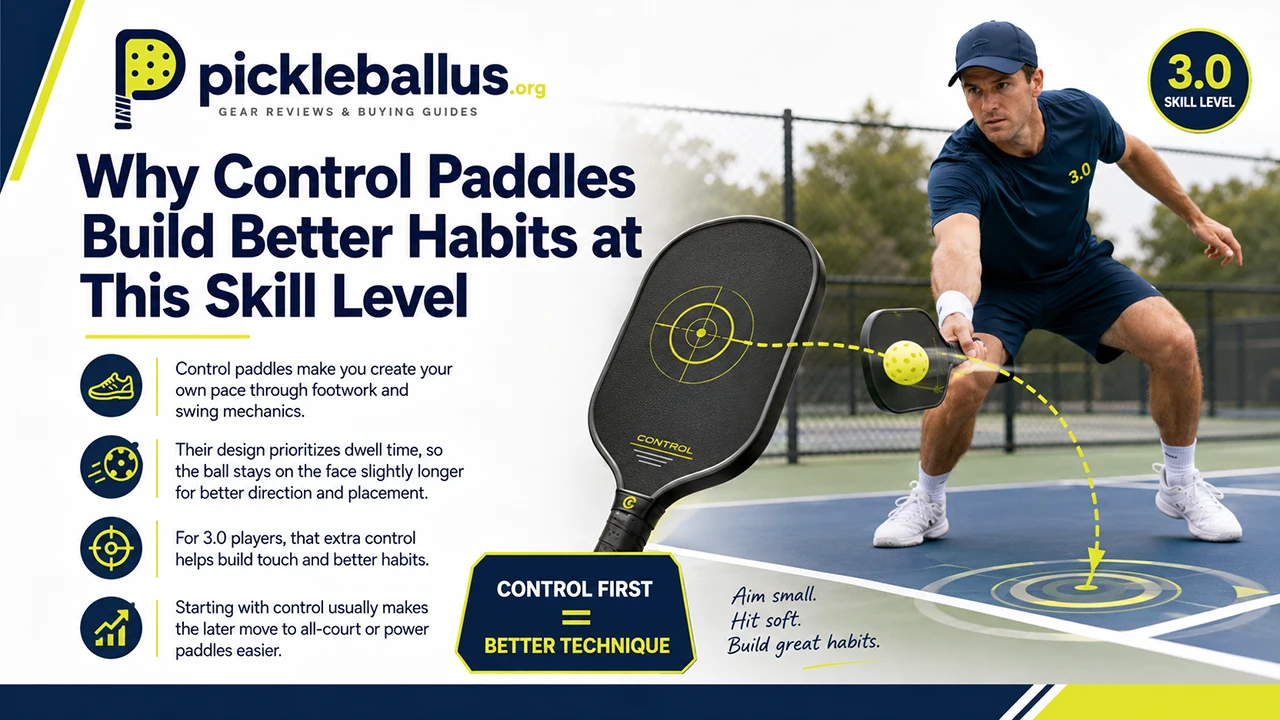
Control paddles force you to generate your own pace through footwork and swing mechanics rather than relying on the paddle’s elasticity to do it for you. That constraint builds better technique. The best pickleball paddles for control are specifically engineered with core and surface configurations that prioritize dwell time — meaning the ball stays on the paddle face slightly longer on contact, giving you more influence over its direction. For a 3.0 player learning to place the ball rather than just return it, that extra fraction of contact time is a real training advantage.
Players who start with control paddles and move to all-court or power models later in their development almost universally report that their touch game transfers cleanly. The reverse — starting with power and trying to develop touch — is a harder adjustment. The control foundation is generally the more efficient developmental path.
When a Power-Leaning Paddle Makes Sense for a 3.0 Player
Power paddles are appropriate for 3.0 players when you are coming from a racquet sport background — tennis, badminton, or racquetball — and you already own a functional soft game from that experience. In that case, your kitchen consistency is ahead of your pickleball-specific offense, and a power-leaning paddle like the JOOLA Hyperion CFS helps you close that gap faster.
They also make sense if your primary game context is doubles with a more advanced partner who handles the soft game while you play a more aggressive role at the baseline or during speed-up exchanges. In that team dynamic, power generation is more immediately useful than maximum control.
Should a 3.0 Player Spend Big on a Paddle?
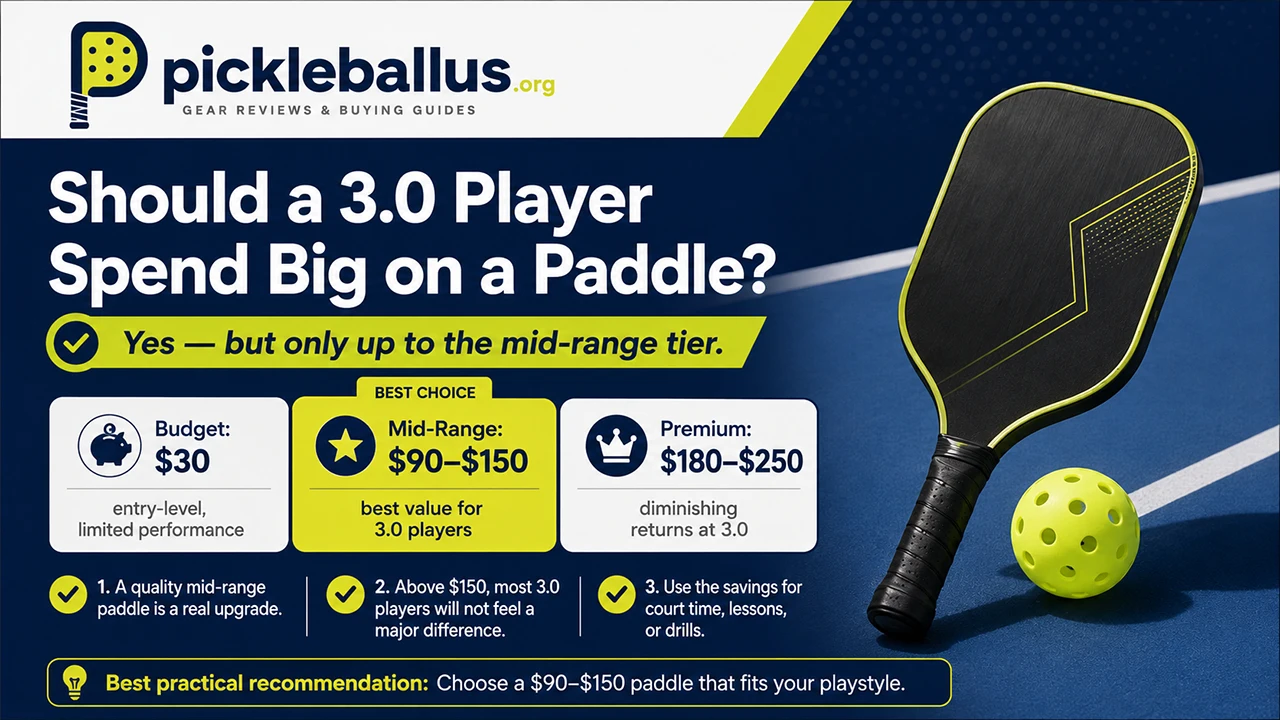
Yes — but with a ceiling around the mid-range tier. Spending on a quality paddle at 3.0 is worthwhile because the difference between a cheap recreational paddle and a well-engineered 16mm polymer core with a real carbon or fiberglass face is substantial and immediately felt. Moving from a $30 budget set to a mid-range paddle in the $90–$150 range represents a genuine performance upgrade that a developing player can directly experience.
Spending above that mid-range, however, returns diminishing value at 3.0. Premium paddles in the $180–$250 range are optimized for players with consistent, repeatable technique — they offer tighter construction tolerances, better grit retention on carbon faces, and more precisely tuned swing weights. Those properties matter when your mechanics are consistent enough to notice the difference. At 3.0, variable technique means variable contact, which means the difference between a $100 paddle and a $200 paddle will often be invisible in actual play.
The practical recommendation: set a budget of $90–$150, choose a paddle from this list that fits your playstyle, and use the savings to invest in court time, lessons, or drills. You will improve faster through deliberate practice with a mid-range quality paddle than through owning an elite paddle you do not yet have the consistency to exploit. When your game reaches the point where you regularly feel constrained by your equipment — when your touch shots are consistently landing where you aim them and your drives need more precision at the upper end — that is the right time to step up to a premium build.
For reference, if you are still in the earlier part of your pickleball journey, the best pickleball paddles for beginners guide covers a different set of priorities before this stage, and the best pickleball paddles overview covers the full spectrum across all skill levels.
By now you have a clear picture of which paddles give 3.0 players the best combination of forgiveness, touch, and room to improve — and whether a control or power build fits your current game. Choosing the right paddle is the bigger half of the equipment decision, but understanding what comes next is what turns a smart purchase into real skill gains. The section below covers the subtler details that help 3.0 players stay ahead of the development curve rather than simply catching up to it.
Moving Beyond 3.0 — What Your Paddle Choice Tells You About Your Game
Signs You Are Ready to Try a More Demanding Paddle
You are ready for a more demanding paddle when your current equipment starts to feel like it is hiding your mistakes rather than teaching you from them — the moment you realize you have stopped mishitting not because your technique improved, but because your paddle is covering for inconsistency you have not actually resolved.
Concrete signals include: your dinks are landing consistently in the kitchen rather than occasionally catching the tape, your third-shot drops are executed with intent rather than just getting the ball over, and your drives stay in bounds reliably because you are controlling your swing rather than relying on a thick core to dampen overhit shots. When those skills are present, a 14mm or more responsive paddle will reward you rather than expose you. Moving to the best pickleball paddles for 3.5 players typically coincides with this shift — the paddle options at that tier are calibrated for more advanced consistency and offensive capability.
How Core Thickness Preference Shifts as You Improve
16mm remains valid at 3.5 and even 4.0 for control-style players, but many intermediate players who progress past 3.0 find themselves drawn toward 14mm cores for their increased pop and faster response on speedup exchanges. The shift is gradual rather than sudden — you do not wake up one day and need a thinner paddle. What happens is that your soft game develops to a point where you no longer need the extra forgiveness of a thicker core, and you start to feel that 16mm is absorbing pace you could be using offensively.
The best 16mm pickleball paddles guide covers why many experienced players stay with that thickness intentionally — for doubles players with a defensive or reset role, 16mm stays competitive well past the intermediate stage. There is no rule requiring you to move to a thinner core as you improve, but it is useful to understand what the trade-off involves when you start to feel the difference.
Playing With a Supportive Paddle vs. One That Challenges You
A supportive paddle — forgiving sweet spot, thick core, wide face — is the right tool while you are building baseline consistency. It makes your good shots feel great and your average shots feel acceptable, which keeps your confidence up during the development phase. A challenging paddle demands more precise contact, responds more aggressively to technique errors, and exposes weaknesses in your mechanics that a forgiving build would mask.
Neither approach is permanently correct. At 3.0, the supportive paddle wins because it builds confidence and keeps you playing more, which generates more court hours and faster improvement. As your consistency rises and you start entering recreational tournaments or playing against more competitive partners, a paddle that challenges your technique begins to sharpen skills that a supportive model can no longer develop. The transition is personal — some players stay with a forgiving 16mm setup deep into 4.0 play and win consistently, while others benefit from switching earlier. The best pickleball paddles for control and best pickleball paddles for intermediate players sections cover that transition in more detail when you are ready for it.
Write Your Review
No reviews yet. Be the first to share your experience!