

The best pickleball paddles for singles are the JOOLA Ben Johns Perseus Pro IV 14mm (best overall), the JOOLA Pro V Agassi Elongated (best for tennis converts), the Paddletek Bantam TKO-CX (best for power-first players), the Exo Venator 14mm (best for court coverage and spin), the RPM Friction Pro 14mm Elongated (best for advanced spin-heavy game), the Proton Project Peacock 15mm Elongated (best versatile singles pick), and the Bread & Butter Shogun 16mm (best premium elongated paddle). Every one of these earned its spot through court performance, not marketing.
Singles pickleball rewards a different skill set than doubles. There is no partner to cover the wide-angle pass. No teammate to poach at the kitchen. Every baseline drive, every serve, and every passing shot lands on your shoulders alone. The paddle you carry into that kind of match needs more reach, more pop off the baseline, and enough spin potential to create dipping forehands that force errors from a retreating opponent. A standard doubles paddle — built for soft hands and dinking precision — often leaves singles players feeling underpowered when they need to cover the court and go on offense.
That gap between what doubles demands and what singles requires is why many competitive players carry two paddles to the court. The single biggest physical difference comes down to shape: elongated paddles — typically 16.5″ or longer — give you extra reach to run down wide balls and extra leverage to generate pace on your serve. Paddle weight and swing weight also play a larger role than in doubles, where quick hand battles at the kitchen dominate. In singles, you need a paddle that moves fast through the air but still delivers mass behind a drive.
The seven picks in this guide cover every skill level and budget tier. Whether you’re a tournament-level 4.5 player looking for a proven singles weapon or an intermediate 3.5 building your open-court game, there’s a right option in this list. Below, you’ll find full reviews of each paddle, what makes it specifically suited to singles, and exactly who should — and shouldn’t — buy it.
What Makes Singles Pickleball Different From Doubles?
Singles pickleball eliminates the partner advantage, changing the entire calculus of shot selection, footwork, and equipment needs. Understanding these differences is the first step toward choosing a paddle that actually helps you win.
Court Coverage and the Movement Penalty
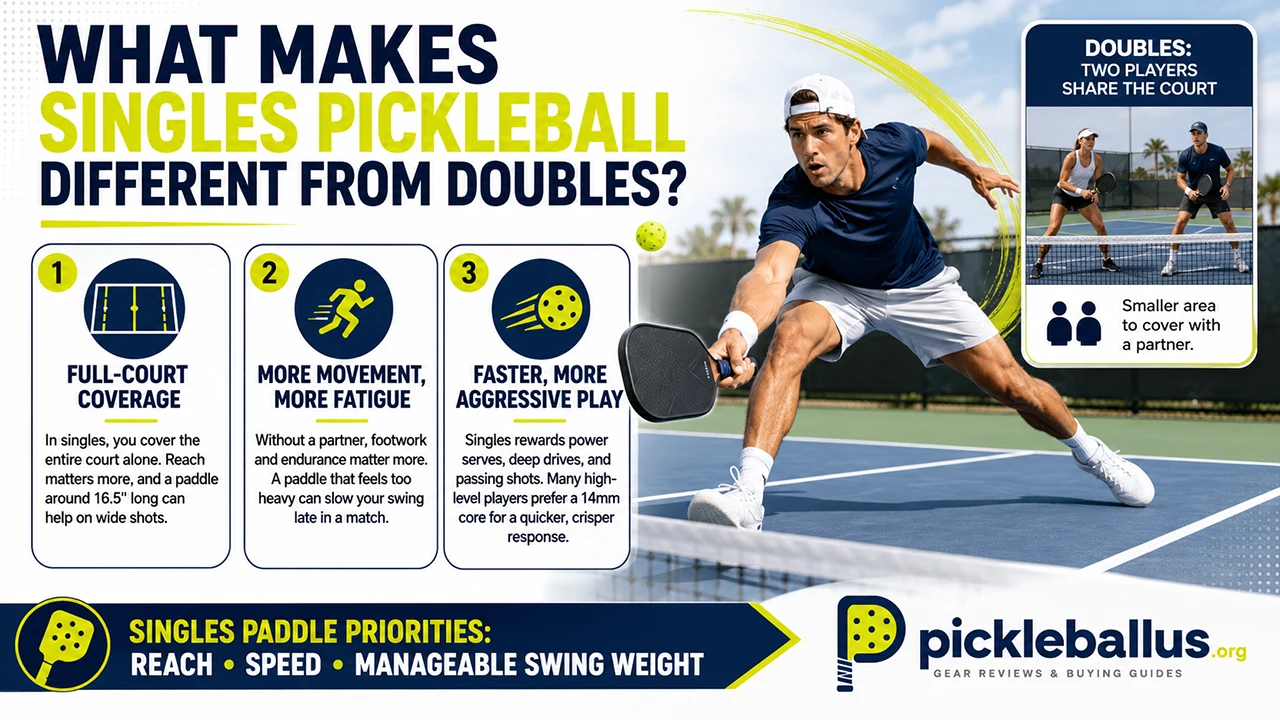
In doubles, two players split a 44-foot-wide court. In singles, you cover that same width alone. That physical reality shifts paddle priorities in two clear ways. First, reach matters more: a paddle that’s 16.5″ long gives you several extra inches on outstretched shots that would otherwise sail past your frame. Second, arm fatigue becomes a real factor over long singles matches. A paddle too heavy for your fitness level will slow your swing speed by the third game, which is why matching swing weight to your physical output matters as much as picking the right shape.
Power Serves, Passing Shots, and the Role of Reach
Modern singles pickleball at the competitive level revolves around big serves and penetrating passing shots. There’s little of the patient dinking and third-shot-drop strategy that dominates doubles. Drives need depth and pace. Serves need topspin or body placement to create short returns. For this game style, the 14mm core has become the default among high-level singles players because it produces a faster, crisper response off the face compared to the softer feel of a 16mm core. The trade-off is less dwell time for touch shots — but if you’re playing aggressive singles from the baseline, that trade is usually worth making.
What to Look for in a Singles Pickleball Paddle
Four specs determine whether a paddle fits your singles game: shape, core thickness, surface material, and weight. Each affects a different part of your performance, and the best singles paddles optimize for at least three of the four.
Elongated vs. Standard Shape
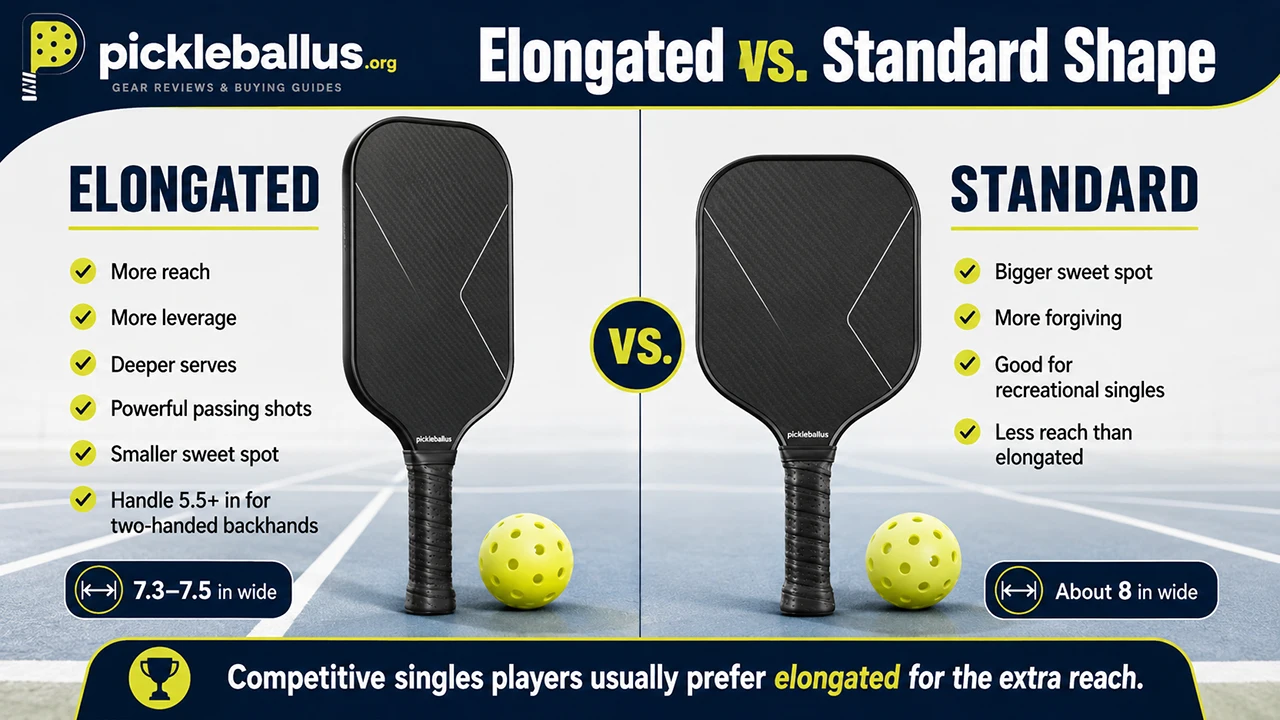
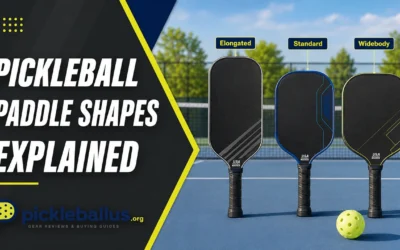
Elongated paddles give you more reach and more leverage on groundstrokes, which translates directly to deeper serves and more powerful passing shots. The trade-off is a smaller sweet spot — elongated paddle faces are narrower (around 7.3–7.5″ wide versus 8″ for widebody), which punishes off-center contact more than a forgiving widebody. For the best elongated pickleball paddles suited to single-format play, look for elongated options with a handle long enough for a two-handed backhand (at least 5.5″).
Standard or hybrid shapes still work for singles at the recreational level, but competitive players almost universally prefer elongated. The extra reach when scrambling back for a lob or stretching for a wide groundstroke makes the sweet-spot trade-off worth it.
Core Thickness — 13mm, 14mm, or 16mm?
This is where singles and doubles preferences diverge most sharply. Most elite best pickleball paddles for power choices for singles use a 14mm core, which produces a snappier, more responsive feel at contact. The ball launches off the face with more pop, helping with pace on serves and drives. Some players prefer a 13mm core for even more power — the thinner the core, the firmer and faster the feel.
A 16mm core offers more cushioning and dwell time, which helps with drops and resets — great for doubles, less necessary for singles. That said, if you’re an intermediate singles player who still dinks occasionally or plays a control-based game, a 16mm paddle gives you more forgiveness and a larger effective sweet spot.
Surface Material and Spin Potential
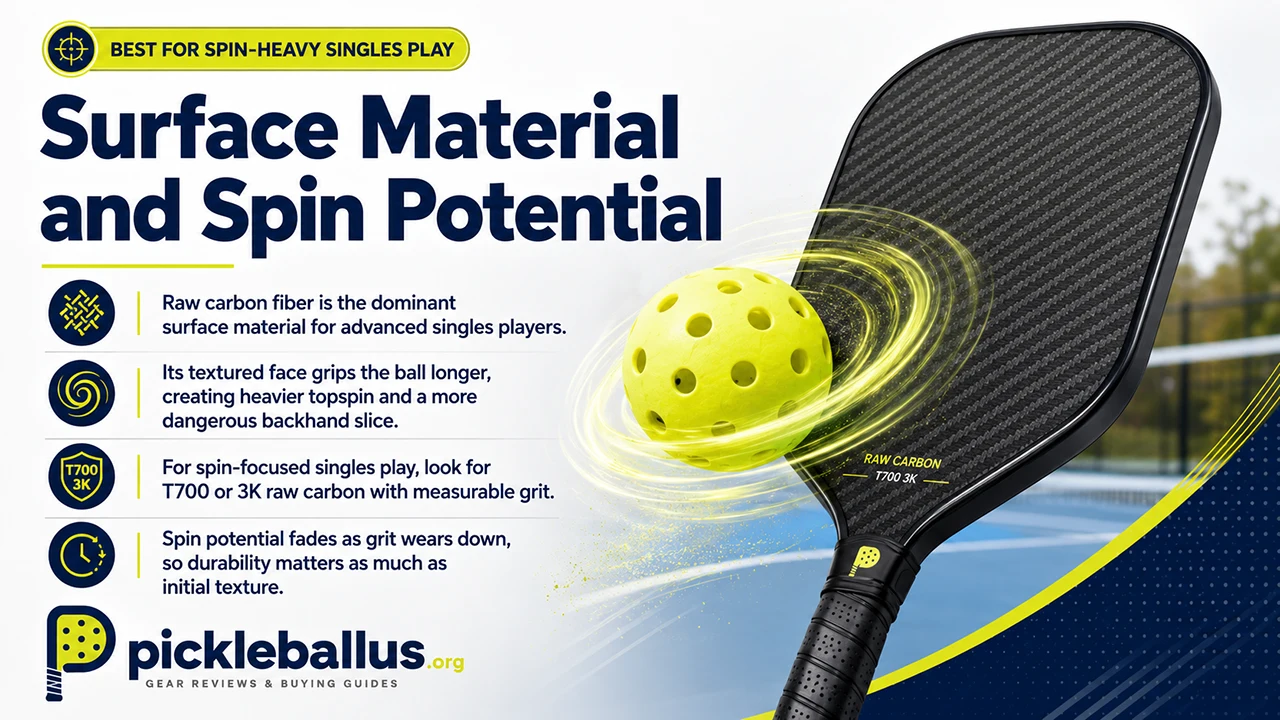
Raw carbon fiber is the dominant surface material among advanced singles players. The texture grabs the ball longer than standard carbon or fiberglass, generating heavy topspin off the baseline and heavy slice on backhands — two shots that create real problems for a retreating singles opponent. For best pickleball paddles for spin that benefit a singles game, look for T700 or 3K raw carbon with measurable grit. Spin potential degrades over time as grit wears, so surface durability matters as much as initial texture.
Weight, Swing Weight, and Maneuverability
Most singles paddles fall in the 7.6–8.3 oz range. Heavier paddles drive the ball more efficiently on baseline exchanges; lighter paddles let you recover and reposition faster. Raw weight tells only part of the story — swing weight (the rotational resistance of the paddle as you swing) affects how heavy the paddle feels in motion more than static weight alone. A paddle with high swing weight hits with more punch but is harder to flick at net. For most singles players, a mid-level swing weight (roughly 115–125 on a calibrated scale) balances these needs.
7 Best Pickleball Paddles for Singles in 2026
The following paddles earned their spots based on actual court performance in singles formats, supported by feedback from PPA Tour pro players and high-level amateur testers. Every paddle listed below is actively sold and reviewed on Amazon.
#1 JOOLA Ben Johns Perseus Pro IV 14mm — Best Overall for Singles
The JOOLA Ben Johns Perseus Pro IV 14mm is the most well-rounded singles paddle on the market. Ben Johns — widely considered the best player in pickleball — famously continued using an older JOOLA model for singles even after the Pro IV launched, which tells you something about how seriously top players take their singles gear. The Pro IV 14mm delivers the fast, responsive pop that singles play demands while maintaining enough dwell time on the face to shape passes and serves with precision.
Key Specs & Features:
- Core: 14mm Reactive Honeycomb Polymer
- Face: Carbon Friction 3K
- Shape: Elongated
- Handle: 5.5″
- Weight: ~7.9 oz
Performance Analysis:
The Pro IV’s added section of high-density foam in the paddle’s lower corners gives it a forgiving bounce even on off-center hits. That forgiveness pays dividends in singles, where you’re routinely reaching on stretched groundstrokes. The Carbon Friction 3K face generates heavy topspin, and the 14mm core responds fast enough that drives don’t feel sluggish. At the kitchen — which comes into play more in singles than most people expect — the Pro IV holds resets cleanly without feeling unpredictable.
Pros:
- Fast, responsive 14mm feel built for baseline power
- High spin potential from Carbon Friction 3K surface
- Corner foam adds forgiveness on stretched contact
- Elongated shape increases reach on wide balls
- Trusted by pro-level singles players
Cons:
- Premium price tier
- Slightly demanding on players who rely on touch at net
Best For: Intermediate to advanced singles players (3.5–5.0+) who drive the ball and want a paddle used at the highest competitive levels.
My Verdict: The Perseus Pro IV 14mm is the safest choice for anyone serious about singles. It handles power, spin, and baseline driving better than almost any other paddle tested this year. If you play singles competitively and want one paddle that does it all, start here.
#2 JOOLA Pro V Agassi Elongated — Best for Tennis Converts
The JOOLA Pro V Agassi brings a sweet-spot geometry that immediately feels familiar to players coming from tennis. Kate Fahey (ranked No. 2), Brooke Buckner (ranked No. 4), and Lea Jansen (ranked No. 5) on the women’s PPA Tour all chose this paddle for their singles matches in 2026 — three top-five players on one paddle is a clear signal.
Key Specs & Features:
- Core: 14mm (KineticFrame construction)
- Face: Carbon Friction
- Shape: Elongated (Agassi profile — sweet spot shifted toward paddle top)
- Handle: 5.5″ with two-handed backhand clearance
- Weight: ~8.0 oz
Performance Analysis:
The Agassi’s top-loaded sweet spot geometry mimics the feel of a tennis racket more than most pickleball paddles. Players transitioning from tennis instinctively put weight behind shots at the top of the paddle, and the Agassi rewards that natural tendency. The KineticFrame — JOOLA’s new flex-point architecture inspired by hockey stick and golf club engineering — lets the paddle head flex and recover during impact, reducing angle deviation on drives and adding satisfying pop to overhead finishes. The pocketing effect at contact also helps players shape passing shots from the baseline with more feel.
Pros:
- Sweet spot positioned where tennis players naturally strike
- KineticFrame architecture adds flex and power on full swings
- Three top-five women’s singles players chose it in 2026
- Long handle suits two-handed backhand converts
- Strong baseline ball shaping compared to most foam paddles
Cons:
- Learning curve for players without tennis backgrounds
- Higher price point
Best For: Former tennis players converting to pickleball who play singles, and intermediate-to-advanced players who hit with a top-loaded swing pattern.
My Verdict: If you came from tennis and find most pickleball paddles feel off, the Agassi Pro V solves that problem immediately. The sweet spot placement and flex behavior match tennis muscle memory in a way no other paddle does this well.
#3 Paddletek Bantam TKO-CX — Best for Power-First Singles Players
The Paddletek Bantam TKO-CX was designed in collaboration with PPA pro Christian Alshon, and in 2025 it was used by Alshon, Hunter Johnson, and Chris Haworth — who combined for nine PPA Tour singles titles. Two of those three players were unsponsored by Paddletek, meaning they chose it voluntarily. That detail matters more than any spec sheet.
Key Specs & Features:
- Core: 14mm Polymer
- Face: PT-700 Unidirectional Raw Carbon Fiber
- Shape: Elongated
- Handle: 5.75″ (extra-long)
- Weight: ~8.0 oz
Performance Analysis:
The 5.75″ handle sets the TKO-CX apart from most paddles in this list. That extra length enables a comfortable two-handed backhand, which is a major advantage in singles — two-handed backhands generate more pace and stability on return of serve and passing shots. The PT-700 unidirectional raw carbon surface delivers high-level spin potential, and the aggressive feel from the baseline fits a style built around dictating points rather than reacting to them. Drives come off with genuine pop. Serves carry enough topspin to create short returns.
Pros:
- 5.75″ handle — best in class for two-handed backhand players
- Proven at PPA Tour level in singles formats
- High spin from PT-700 raw carbon surface
- Elongated reach for court coverage
- Chosen by unsponsored pros — the strongest endorsement possible
Cons:
- Long handle reduces paddle face surface area
- Aggressive feel can punish over-hitting
Best For: Singles players who hit a two-handed backhand or are building one, and aggressive baseliners who want pro-proven singles performance.
My Verdict: The TKO-CX earns the “power-first” badge because everything about its design — the long handle, unidirectional raw carbon, 14mm core — points at generating pace and spin. If you play a physically dominant singles game, this is a top-three choice.
#4 Exo Venator 14mm — Best for Court Coverage & Spin
The Exo Venator 14mm was built with one purpose: help singles players win by covering more court and generating more spin. At 16.55″ long by 7.45″ wide, it pushes close to the USA Pickleball size limit — and that extra length translates directly into extra reach on scrambling shots.
Key Specs & Features:
- Core: 14mm
- Face: T700 Raw Carbon Fiber
- Shape: Extended elongated (16.55″ x 7.45″)
- Handle: 5.6″
- Weight: ~7.8 oz average
Performance Analysis:
The Venator’s T700 raw carbon face produces a noticeable grab at contact — the ball stays on the face a fraction longer than standard carbon, loading more topspin onto forehands and more slice onto backhands. For singles players who want to hit aggressive, dipping passing shots that push opponents back, this texture is a genuine advantage. The 16.55″ length means less frame weight up top (the face is narrower), so the paddle moves faster through the air than its length suggests. At 7.8 oz average, it avoids the arm-fatigue problems of heavier elongated paddles.
Pros:
- Maximum reach from an extended elongated shape
- T700 raw carbon generates heavy topspin and slice
- Lighter than most power paddles at comparable specs
- USA Pickleball Approved
- Balanced feel despite extra length
Cons:
- Narrower face means tighter tolerance on sweet spot
- Less forgiving than widebody or standard shapes
Best For: Court-coverage focused singles players who want max reach and spin from the baseline, and players who hit with topspin-heavy forehands.
My Verdict: The Venator is purpose-built for singles. If you cover the court by reading angles and redirecting pace — rather than overpowering opponents — this paddle gives you the tools to do it consistently.
#5 RPM Friction Pro 14mm Elongated — Best for Advanced Players
The RPM Friction Pro emerged as a collaboration with PPA pro James Ignatowich and established itself as one of the highest-performing paddles for advanced players in 2026. The surface grit on the 14mm elongated version ranks among the highest measured on any tested paddle.
Key Specs & Features:
- Core: 14mm Polymer
- Face: Unidirectional Raw Carbon (measured high grit level)
- Shape: Elongated
- Handle: 5.5″
- Weight: ~7.9 oz
Performance Analysis:
The Friction Pro’s most striking feature is its surface. Players who switch to it from a standard carbon paddle immediately notice heavier spin output on serves and groundstrokes. Topspin dips land steeper, kicking high on the opponent’s backhand side. Slice stays low and skids. For a singles player who uses spin as a tactical weapon — not just a power supplement — the Friction Pro delivers performance that costs significantly more on competing paddles. In hands battles at the kitchen, the 14mm core responds quickly. Overheads and full drives carry the kind of pace needed to finish points against baseline defenders.
Pros:
- Industry-leading surface grit for spin output
- Fast, responsive 14mm feel for singles drives
- Pro-developed and pro-used at PPA level
- Consistent performance from baseline to kitchen
- Available in both elongated and widebody shapes
Cons:
- Surface texture degrades faster under heavy play than some alternatives
- Small sweet spot demands precision on stretched shots
- Higher price than many competitors
Best For: Advanced singles players (4.0+) who use spin strategically and want the most aggressive surface texture available.
My Verdict: The RPM Friction Pro 14mm Elongated is a weapon for players who’ve already built their singles game and want a paddle that amplifies their strengths. It’s unforgiving of poor mechanics but extraordinary when used right.
#6 Proton Project Peacock 15mm Elongated — Best Versatile Singles Pick
The Proton Project Peacock stands out because it plays well across skill levels and game styles — rare in a category where most paddles are tuned for one type of player. The 15mm elongated version specifically targets singles play, while the widebody version targets doubles. That design intentionality shows in how it performs.
Key Specs & Features:
- Core: 15mm (mid-range between 14mm and 16mm)
- Face: Raw Carbon Fiber
- Shape: Elongated
- Handle: 5.5″
- Weight: ~7.9–8.1 oz
Performance Analysis:
The 15mm core finds a genuine middle ground between the snap of 14mm paddles and the cushioned feel of 16mm designs. You get enough pop for baseline drives and serves without sacrificing the control needed on drops or kitchen exchanges when the rally slows down. The raw carbon face generates strong spin, and the elongated shape provides the reach singles players need. What sets the Peacock apart is consistency — it performs predictably across every shot type, which matters when you’re covering the full court alone and can’t afford to second-guess your paddle’s behavior under pressure.
Pros:
- 15mm core balances power and control for mixed game styles
- Raw carbon face provides strong spin
- Elongated shape designed specifically for singles
- Consistent, predictable feel across all shot types
- Versatile for players who split time between singles and doubles
Cons:
- Less maximum power than 13mm or 14mm choices
- Less maximum dwell time than 16mm alternatives
Best For: Intermediate to advanced singles players who want one paddle that works across different game situations without committing to one extreme.
My Verdict: If you play singles regularly but haven’t settled on a pure power or pure control style yet, the Peacock 15mm elongated is the most versatile choice in this list. It handles whatever singles throws at it.
#7 Bread & Butter Shogun 16mm — Best Premium Elongated Paddle
The Bread & Butter Shogun earns recognition as the best elongated paddle across multiple independent reviewers in 2026, and its 16mm core makes it the outlier in a list dominated by 14mm and 15mm designs. The Shogun proves that the right 16mm paddle doesn’t mean sacrificing power — it means gaining control without giving up pace.
Key Specs & Features:
- Core: 16mm Polymer
- Face: Carbon Fiber
- Shape: Elongated
- Handle: 5.5″
- Weight: ~7.8–8.2 oz
Performance Analysis:
Most players assume a 16mm core means a slow, soft paddle suited for doubles. The Shogun challenges that assumption. Its elongated shape generates more leverage on full swings, compensating for the softer core feel. Drives carry real pop. Serves land deep. Crucially for singles, the 16mm core’s extra dwell time lets you shape passing shots with more precision — a forehand drive that dips at the baseline is more useful than one that sails long. Independent testers found the Shogun delivered more power at 16mm than expected, and its balance between spin, control, and pace held up from first game to last.
Pros:
- 16mm core provides better touch on drops and resets
- Elongated shape compensates with leverage on drives
- Premium cover and unboxing included
- More forgiving sweet spot than typical 14mm elongated
- Performs consistently late in long singles matches
Cons:
- Less outright power than 14mm alternatives
- Premium price tier
- Not available on Amazon directly
Best For: Singles players who want a premium elongated option with more control and touch than standard power paddles, and players transitioning from doubles who prefer a softer, more controlled feel.
My Verdict: The Shogun 16mm is the right choice for singles players who trust their mechanics and want to win with placement over raw power. It performs above its core thickness in ways that still surprise players expecting a typical soft doubles paddle.
Should You Use Different Paddles for Singles and Doubles?
Yes — at the competitive level, using two different paddles for singles and doubles is the correct decision, and most serious tournament players do exactly that. The demands of each format pull paddle specs in opposite directions.
The best pickleball paddles for doubles favor thicker cores (16mm), softer dwell time for kitchen exchanges, and widebody shapes that maximize forgiveness on fast hands battles at the net. Singles paddles — as covered throughout this guide — favor elongated shapes, thinner cores (14–15mm), and higher spin grit for baseline aggression.
Carrying two paddles has a cost: financial and physical (different swing weights mean different muscle memory). If you play singles occasionally but doubles primarily, a quality 16mm hybrid paddle serves both formats at a slight performance cost for your singles game. If singles is your primary format or you compete in both, a dedicated singles paddle is worth the investment.
The following table summarizes how to decide:
| Player Type | Recommended Approach |
|---|---|
| Primarily doubles, singles occasionally | One quality hybrid paddle covers both |
| Split between singles and doubles | Two paddles — one per format |
| Singles specialist | Elongated, 14mm power paddle |
| Beginner exploring both formats | Start with one all-court paddle, upgrade later |
Can Beginners Use a Singles-Specific Paddle?
Beginners can use a singles-specific paddle, but most shouldn’t start with one. Elongated paddles with thin 14mm cores and textured raw carbon surfaces reward precise mechanics — they amplify good shots but also amplify mistakes. A beginner whose technique is still developing will produce more errors with a tight-sweet-spot power paddle than with a forgiving all-court design.
The exception: if you’re coming from tennis with established stroke mechanics, an elongated paddle may feel natural from day one. Former tennis players often adapt faster to the mechanics elongated singles paddles demand.
For beginners exploring the full range of best pickleball paddles options, a 16mm widebody or hybrid paddle builds fundamentals better. Once you develop consistent contact and understand your game style, upgrading to a singles-specific elongated model makes sense.
By now you have a clear picture of which paddles deliver the power, reach, and spin that singles pickleball demands — and why the format calls for gear that plays differently than a doubles setup. Choosing the right paddle, however, is only the starting point. How you train, serve, and move across the full court determines whether that paddle becomes an advantage or just a spec sheet. The next section goes deeper into the habits and gear decisions that separate casual singles players from the ones who consistently apply pressure and win tight matches.
Beyond the Paddle — What Shapes Your Singles Game?
Even the best singles paddle underperforms if the rest of your game isn’t calibrated for the format. Three factors beyond equipment matter most.
Serve Strategy and How Paddle Choice Amplifies It
A high-grit raw carbon surface changes what’s possible on your serve. A standard singles serve lands deep and waits for the opponent’s return. A spin serve — topspin, slice, or body placement — creates a short or awkward return that sets you up for a third-ball attack. The paddles in this guide with raw carbon surfaces (Venator, Bantam TKO-CX, RPM Friction Pro) generate enough friction to put real kick on a topspin serve. Learning to use that grit strategically, rather than just hitting flat and hard, turns your serve into an offensive weapon rather than a formality.
Footwear and Court Speed
Court coverage in singles is partly a footwear problem. Dedicated pickleball shoes with herringbone court outsoles provide lateral grip and quick-stop traction that running shoes don’t match. A player wearing proper court footwear covers the same wide angle in fewer steps than one in cross-trainers — arriving at the ball with more time to set up a clean shot. The best singles paddle in the world doesn’t compensate for arriving late to the ball.
What Pro Singles Players Actually Use
The clearest signal of which paddles work for singles comes from unsponsored pro usage. Sponsored players carry contractual obligations to use their brand’s gear. Unsponsored players use what actually helps them win. In 2025, the Bantam TKO-CX was used by two unsponsored PPA Tour players who combined for six singles titles alongside their sponsored teammate. On the women’s side, the JOOLA Pro V Agassi held three of the top five women’s singles rankings in 2026. These unsponsored choices represent the purest available data on what works in competitive singles — and they consistently point toward elongated shapes, 14–15mm cores, and raw carbon surfaces.
Write Your Review
No reviews yet. Be the first to share your experience!