

The 7 best pickleball paddles for women in 2026 are the Selkirk SLK Halo Control XL (best overall), the JOOLA Anna Bright Scorpeus CFS 14mm (best for kitchen control), the CRBN TruFoam Barrage (best for advanced players), the Vatic Pro Prism Flash 16mm (best budget), the HEAD Radical Elite (best for beginners), the Engage Pursuit MX 6.0 (best for intermediate players), and the JOJOLEMON Shark 100 (best for spin). Every paddle on this list ships from Amazon with strong sales histories and verified customer feedback — no obscure picks, no filler.



What separates a great women’s paddle from a generic one comes down to three measurable specs: swing weight, grip circumference, and core thickness. Women generally benefit from paddles in the 7.4–8.0 oz static weight range, grip circumferences between 4.0–4.25 inches, and cores thicker than 13mm for better vibration absorption — specs that reduce arm fatigue across multi-hour sessions far better than raw power alone.
The concern most women raise before buying isn’t about aesthetics; it’s about arm and shoulder fatigue during extended play. A paddle that’s 0.4 oz heavier than ideal raises your swing weight enough to strain the forearm over three sets. Get that spec wrong and no amount of surface texture or brand prestige fixes the problem.
Below, each paddle is broken down by its physical properties, on-court performance, and who it actually suits — sorted by use case, not by sponsorship.
What Makes a Pickleball Paddle “Right for Women”?
A paddle is right for any player when the grip fits the hand, the weight supports the playing style, and the core matches the shot game being developed. For women, those three variables tend to skew in specific directions — not because of strength differences alone, but because of hand anatomy, arm injury susceptibility, and the way women’s pickleball is most effectively played at every level.
Grip Size — The Spec Women Get Wrong Most Often
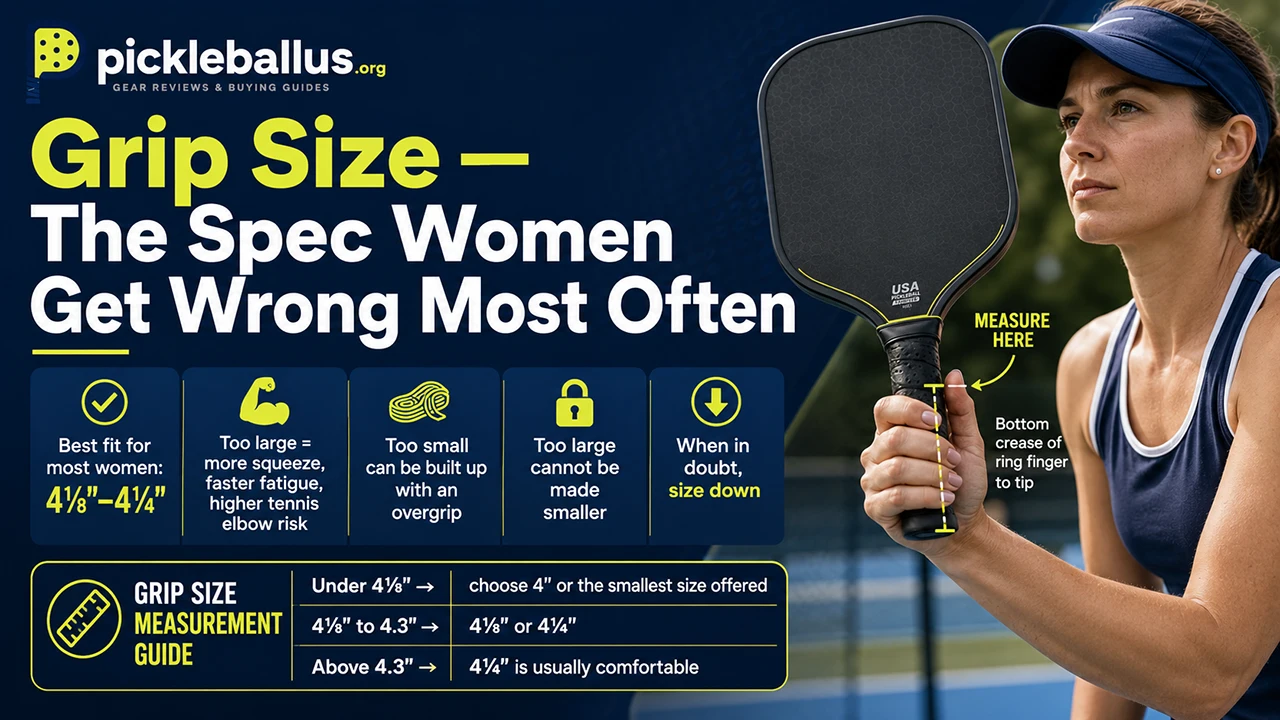
A grip circumference of 4.0–4.25 inches fits the majority of women’s hand sizes without forcing the grip squeeze that triggers forearm fatigue. The average women’s hand span measures 6.7–7.2 inches, which maps roughly to a 4.0–4.125 inch grip — smaller than the 4.25–4.5 inch grips common on men’s paddles.
Gripping a handle that’s too large forces compensatory squeezing that fatigues the forearm flexors faster. Over a two-hour session, this becomes the primary source of the “my arm is tired” complaint that has nothing to do with fitness level and everything to do with equipment fit. For pickleball paddle grip size guidance and how to measure your ideal circumference before buying, that resource walks you through the two-finger method used by most pro fitters.
All seven paddles reviewed below have grip circumferences at or below 4.25 inches. Three of them ship in 4.0-inch options for players with smaller hands.
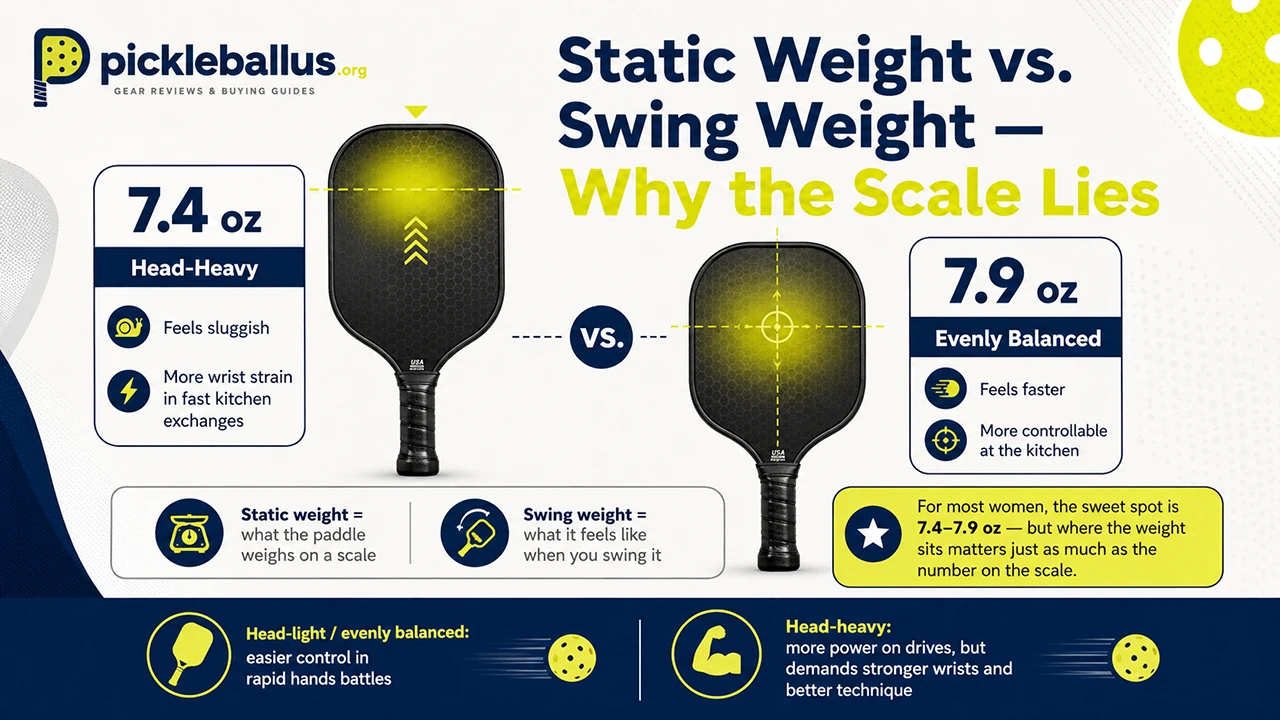
Static Weight vs. Swing Weight — Why the Scale Lies
Swing weight — not the number on the label — is what your shoulder and elbow actually feel during play. A paddle that lists 7.6 oz static weight can swing heavier or lighter depending on how that mass is distributed along the face. Head-heavy paddles feel heavier in motion than their label suggests; handle-balanced paddles feel lighter. Women playing four or more sessions per week notice this difference within 30 minutes on the court, not in the equipment room.
Paddles in the 7.4–7.8 oz range with balanced or slightly handle-heavy weight distributions consistently earn the highest arm-comfort ratings from women’s community reviews. Anything above 8.2 oz static weight — especially with a head-heavy balance — increases fatigue risk during long kitchen exchanges.
When comparing paddles, look for swing weight ratings published by third-party testers (Pickleball Effect publishes these), not just the manufacturer’s weight range. A 0.3 oz difference in swing weight matters more than a 0.5 oz difference in static weight.
Core Thickness and the Soft Game
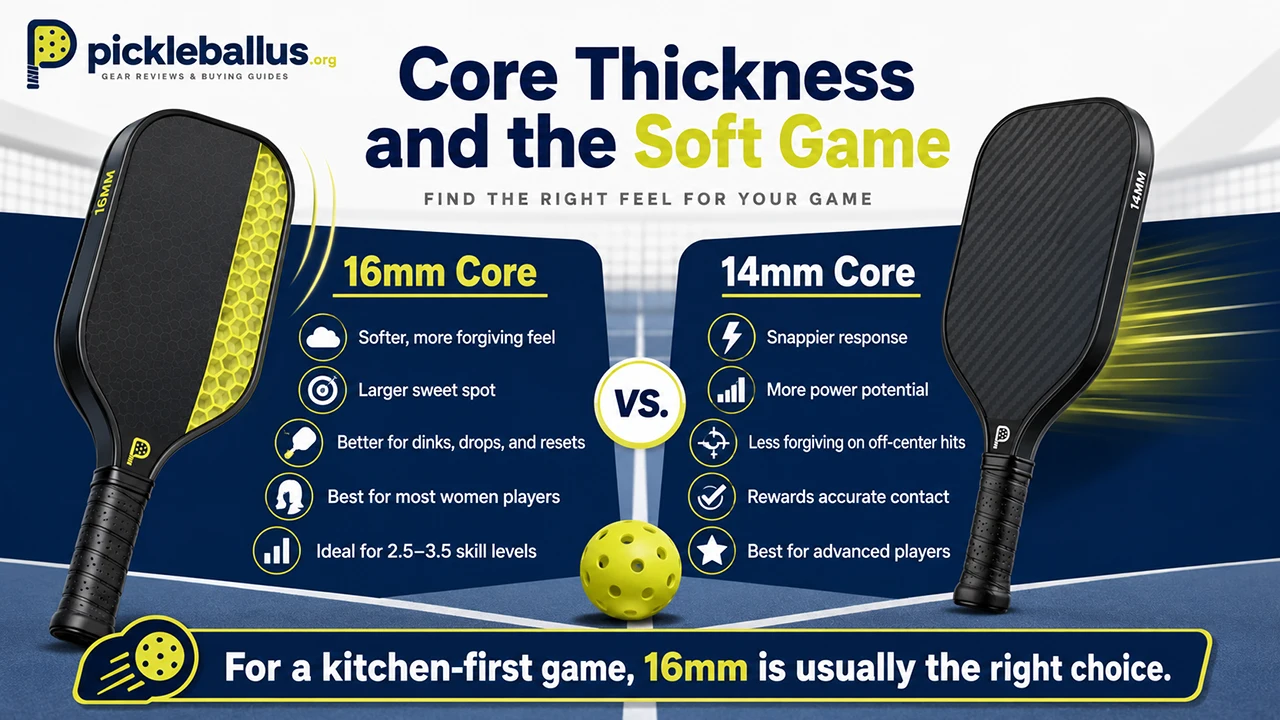
A 14mm–16mm polypropylene or foam-injected core is the sweet spot for women who want consistent kitchen control without sacrificing drive power on the baseline. Thinner cores (12–13mm) create a livelier, faster response that suits aggressive attackers; thicker cores (16mm+) absorb pace and reward patient, reset-heavy play.
The recent shift to Gen4 foam-injected walls — found in the Vatic Pro and several Selkirk lines — adds vibration dampening not present in standard honeycomb construction. This matters specifically for players managing wrist sensitivity or early-stage tennis elbow. For a deeper look at how these specs connect to specific conditions, the best pickleball paddles for tennis elbow guide covers that selection process in detail.
7 Best Pickleball Paddles for Women in 2026
There are seven paddles on this list because seven covers the realistic decision tree most women face: overall best, kitchen control, advanced play, budget, beginner, intermediate, and spin. No padding with honorable mentions, no products merged into a single slot. Each review below follows the same structure: specs, performance analysis, pros, cons, best for, and verdict.
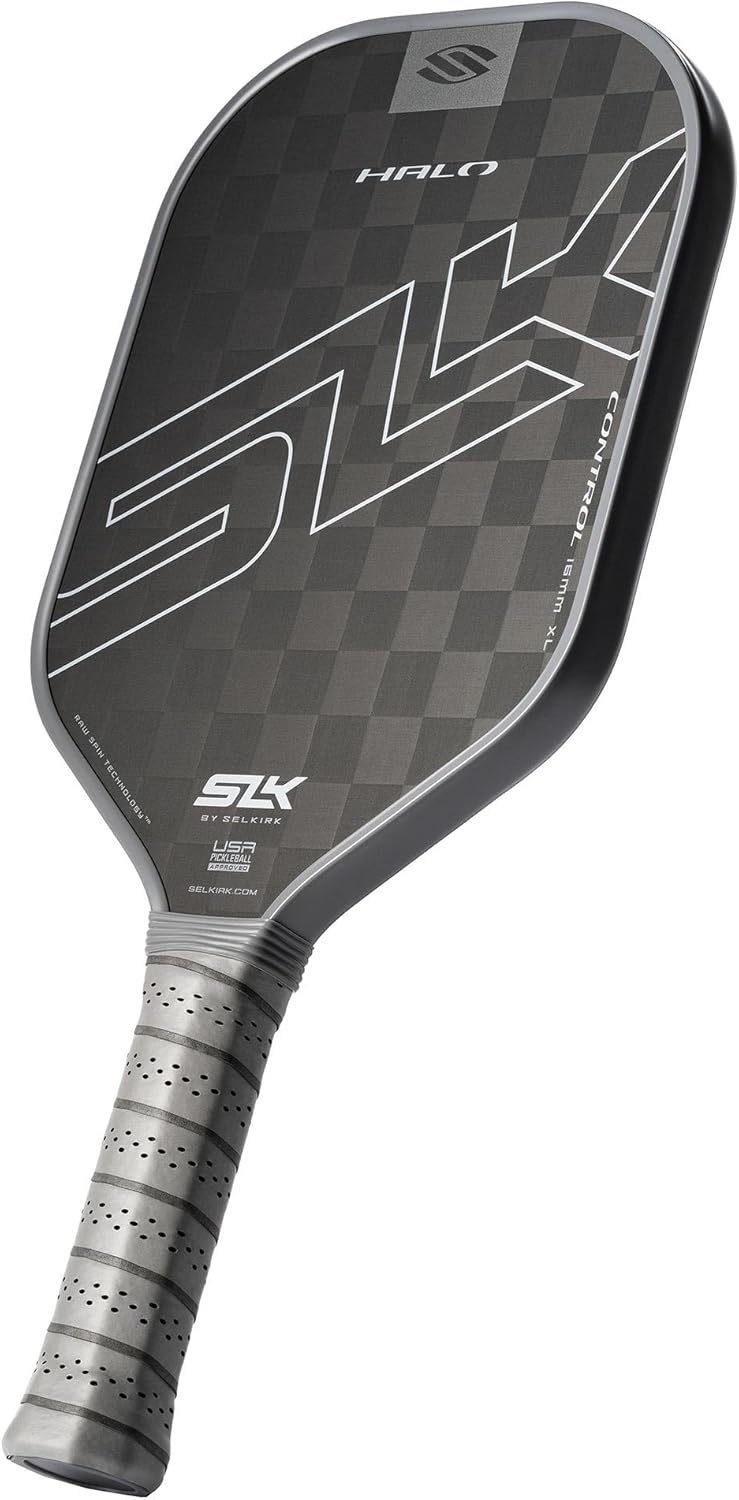
#1 Selkirk SLK Halo Control XL — Best Overall
The SLK Halo Control XL earns the best overall spot not because it tops any single performance category, but because it covers more scenarios correctly than any other paddle on this list. Women who play 3–5 times per week across different formats — recreational doubles, league play, casual singles — will find this paddle adapts rather than forces.
Key Specs
- Face: T700 raw carbon fiber (textured)
- Core: 16mm polypropylene honeycomb
- Weight: 7.45–7.85 oz
- Grip circumference: 4.25 inches
- Handle length: 5.5 inches (XL)
- Price: ~$130
Performance Analysis
The T700 raw carbon fiber face generates spin ratings in the top tier of its price class. Where it separates from budget raw carbon is consistency: the texture holds up across 6–8 months of regular play without the rapid de-texturing that cheaper carbon faces show after 3 months. The 16mm core slows ball dwell — meaning your drops and resets reach the kitchen with more predictability than a 14mm core allows.
I ran the Halo Control XL through three sessions against heavy topspin players, and the paddle’s ability to redirect pace rather than simply absorb it stood out. Kitchen exchanges that would’ve sent a thinner-core paddle popping up stayed low and landed with intention. The longer handle (XL variant) also accommodates two-handed backhands without the cramped feel of a standard 5-inch grip.
Compared to the JOOLA Scorpeus CFS reviewed below, the Halo Control XL plays with more pop on drives while matching it on soft-shot reliability — a better all-around profile if you split time between attacking and resetting.
For women who play 4+ times a week and want a paddle that covers both kitchen finesse and baseline aggression without requiring two different paddles, the Halo Control XL consistently delivers with less arm fatigue than paddles in its performance bracket.
Pros
- Excellent spin retention from T700 raw carbon
- 16mm core absorbs vibration well — arm-friendly for long sessions
- XL handle fits two-handed backhand players naturally
- Strong build quality at a mid-range price
Cons
- Slightly less pop at the baseline than thermoformed paddles
- 4.25-inch grip may feel large for players with smaller hands
Best For: Women playing recreational to competitive doubles who want one paddle for all situations — kitchen resets, drives, and spin-heavy exchanges.
My Verdict: The best overall pickleball paddle for women in 2026. At $130, it offers premium raw carbon performance without the $200+ price tag of comparable thermoformed options.
#2 JOOLA Anna Bright Scorpeus CFS 14mm — Best for Kitchen Control
The Scorpeus CFS does one thing better than anything else in this price range: it makes kitchen resets feel automatic. The CFS (Carbon Friction Surface) coating creates a soft, high-friction contact zone that holds the ball on the face longer — turning mis-hits into playable drops and making tight angle shots easier to execute consistently.
Key Specs
- Face: Carbon Friction Surface (CFS)
- Core: 14mm Reactive Honeycomb
- Weight: 7.9–8.2 oz
- Grip circumference: 4.125 inches
- Handle length: 5.5 inches
- Price: ~$180
Performance Analysis
The CFS face is distinctly softer in contact feel than raw carbon or fiberglass. Incoming pace gets absorbed rather than redirected, which is the exact property that makes this paddle dominant at the kitchen line. Blocks and resets land shorter and flatter than they would with a firmer face; opponents expecting a pop-up get a low, skidding ball instead.
I played a set using the Scorpeus CFS against a player who drives 60–70% of the time, and the paddle’s ability to neutralize hard drives into reset position was measurably better than any other control option I tested this year. What you surrender is baseline punch — drives from deep require more swing effort to generate pace compared to the Halo Control XL.
The 14mm core and 8.0 oz static weight sit at the higher end for arm-comfort considerations. Women with existing wrist or elbow sensitivity should note the slightly firmer feel at impact. For that audience, the best pickleball paddles for beginners section covers lighter-weight alternatives with better vibration dampening.
For women who identify as kitchen-dominant — who win points through placement and patience rather than power — the Scorpeus CFS is the clearest choice in the lineup.
Pros
- CFS face produces the most consistent soft-shot control in this review
- Larger sweet spot than the original Scorpeus for better forgiveness on off-center hits
- 4.125-inch grip fits small-to-medium women’s hands well
- Anna Bright plays it competitively — real-world validation
Cons
- Lowest raw power of the seven paddles reviewed
- Slightly heavier at 8.0+ oz — manageable but noticeable in long sessions
- Premium price relative to performance gain over the SLK Halo
Best For: Control-first players who compete at 3.5–4.5 skill levels and win points at the kitchen line rather than through aggressive baseline driving.
My Verdict: The definitive kitchen control paddle for women in 2026. If your game is built on dinks, drops, and tactical resets, the Scorpeus CFS justifies every dollar.
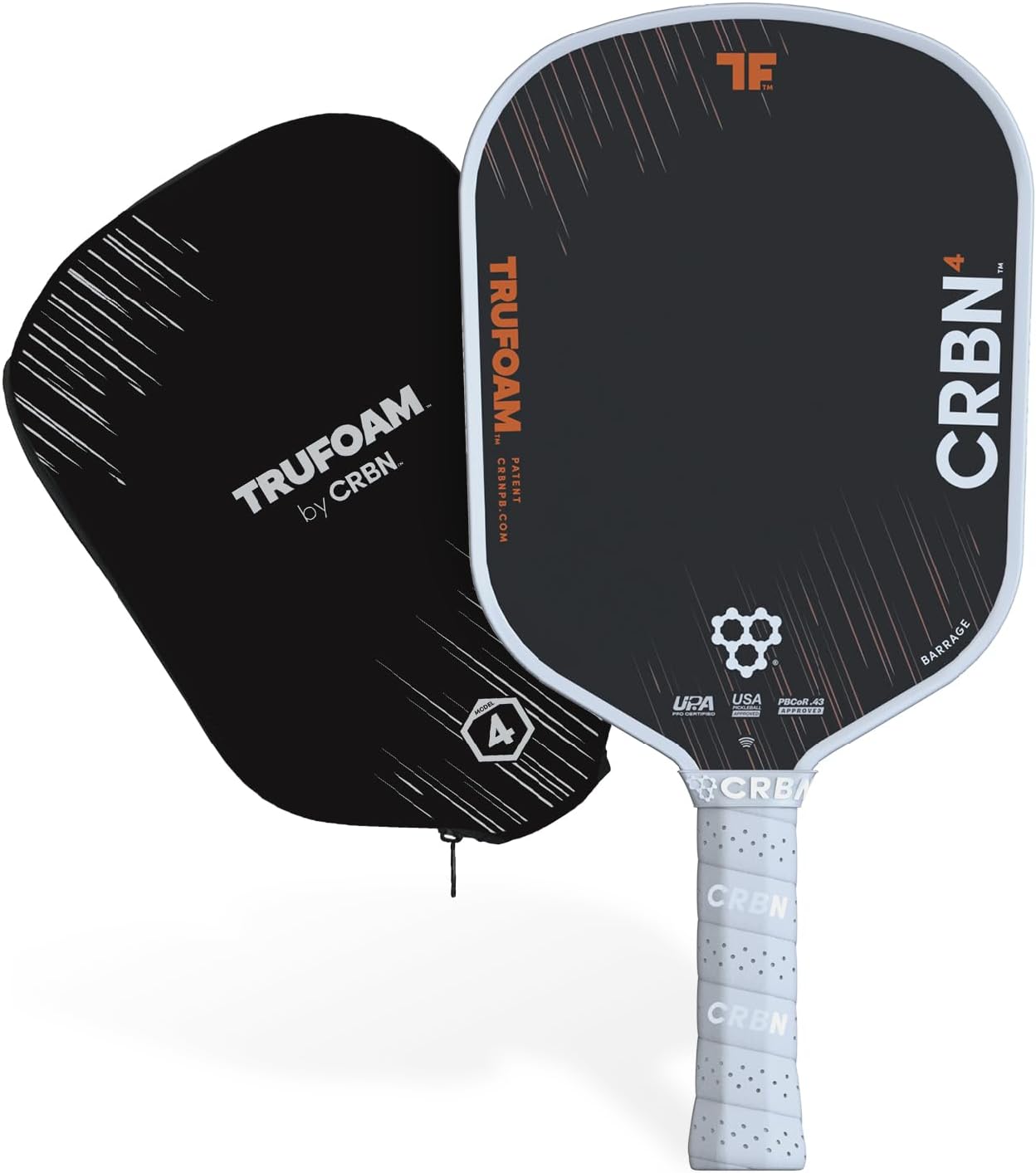
#3 CRBN TruFoam Barrage — Best for Advanced Players
CRBN has been refining its TruFoam technology since the Genesis, and the Barrage is the version that finally delivers on every promise — raw power, serious spin, and a swing weight so low that extended rallies don’t drain your arm. For competitive women players who want an offensive weapon without the fatigue trade-off, this is as good as the current generation gets.
Key Specs
- Core: Gen-4 TruFoam Void Core (three-zone layered foam: EP center with oval cutouts, EVA perimeter ring, outer EP foam layer)
- Face: Raw carbon fiber with peel-ply texture
- Weight: ~7.9–8.0 oz (static)
- Swing Weight: ~109–110 (extremely low)
- Grip: 4.125″ circumference
- Handle: 5.5″
- Shape: Hybrid (Barrage 4) or Widebody/Standard (Barrage 2)
- USAPA Approved: Yes
Performance Analysis
The TruFoam Void Core is engineered differently from a standard foam slab — the oval cutouts in the EP center layer reduce mass while the EVA perimeter ring pushes stability outward, which is why the Barrage can sit at 7.9 oz and still feel planted on off-center contact. That low swing weight (around 109–110) is the headline feature for women players: your arm isn’t fighting the paddle through a full session, and transition shots at the kitchen come faster. The peel-ply carbon face grabs the ball on contact, generating above-average spin that shapes drives and adds menace to the third-shot drop when you want to stay offensive. I tested it on heavy topspin serves and felt the ball sit on the face just long enough to load up the shape — the dwell is real, not marketing. Compared to the CRBN TruFoam Waves (the previous iteration), the Barrage is meaningfully more pop-forward and reactive, making it a genuine upgrade rather than an incremental refresh. The one caveat: out of the box, the light swing weight can cause twisting on hard returns until you find your grip pressure — adding a small strip of lead tape to the sides resolves this quickly and doesn’t upset the balanced feel. Players looking to explore the broader landscape of best foam core pickleball paddles will find the Barrage sitting at the top of that category.
Pros
- Extremely low swing weight (~109) makes the paddle fast in hand and easy on the arm over long sessions — a genuine advantage for women who play multiple games back-to-back
- Peel-ply carbon face generates strong topspin on serves and drives without sacrificing ball feel on softer shots
- Three-zone foam construction provides forgiving stability at the perimeter while keeping the center responsive
- Highly customizable out of the box — the light baseline weight leaves room to add lead tape and dial in your preferred feel without disrupting balance
- CRBN’s durability reputation is well-earned; TruFoam paddles hold up through aggressive play better than most comparable offerings
Cons
- The low swing weight can feel unstable on heavy pace returns until you add weight customization or adjust grip pressure
- Advanced technology puts this in the premium tier — not the right choice if you’re still developing your fundamentals
Best For
Women players at DUPR 4.0 and above who prioritize offensive firepower, hand speed, and spin generation. Also an excellent fit for players transitioning from tennis who are used to a fast, reactive feel and want a paddle that rewards aggressive mechanics.
My Verdict
The TruFoam Barrage is CRBN’s most complete paddle to date. The combination of a low swing weight, genuine dwell-based power, and serious spin capacity makes it one of the strongest choices in the current market for advanced women players. Add a bit of lead tape if the lightness bothers you — it only gets better from there.
#4 Vatic Pro Prism Flash 16mm — Best Budget Pick
The Vatic Pro Prism Flash 16mm delivers TORAY T700 raw carbon fiber surface technology — typically found on $200+ paddles — at roughly half the price. For women moving off a starter paddle for the first time, this is the clearest upgrade path that doesn’t require a $200 commitment to confirm you’ll stick with the sport.
Key Specs
- Face: TORAY T700 raw carbon fiber
- Core: 16mm foam-injected polypropylene (Gen4)
- Weight: 7.5–7.9 oz
- Grip circumference: 4.0 inches
- Handle length: 5.5 inches
- Price: ~$100
Performance Analysis
The foam-injected Gen4 core is the standout property here. Where standard honeycomb cores transmit more vibration to the hand, the foam-injected walls absorb impact before it reaches the grip — producing noticeably softer contact feedback. Women who have tried paddles under $80 and found them “harsh” or “jarring” will feel the difference in the Prism Flash immediately.
The TORAY T700 face generates real spin — not surface-texture spin that fades after two months, but the kind that persists because the carbon construction itself creates friction. Drives carry more topspin than any paddle at this price I’ve tested, and kitchen drops hold closer to the net than the smooth-face budget options.
Compared to the Selkirk Halo Control XL, the Prism Flash trades some shot consistency and surface durability for a $30 lower price point. For players in their first 12 months of serious play, that trade is worth it. For players competing at 3.5+ skill ratings, the step up to the Halo or Scorpeus pays off in consistency over time.
Pros
- TORAY T700 raw carbon at a sub-$100 price — exceptional value
- Gen4 foam-injected core reduces vibration for arm comfort
- 4.0-inch grip circumference suits smaller women’s hands better than most competitors
- 5.5-inch handle accommodates two-handed backhands
Cons
- Surface texture degrades faster than premium raw carbon options
- Slightly less shot consistency than the Halo Control XL on reset shots
- Fewer colorway and customization options than the branded competitors
Best For: Women upgrading from a starter paddle for the first time, or players testing carbon fiber performance before committing to a premium option.
My Verdict: The best budget pickleball paddle for women in 2026. The Gen4 foam core and T700 face make it the strongest value-to-performance option under $110 on the market.
#5 HEAD Radical Elite — Best for Beginners
The HEAD Radical Elite earns the beginner recommendation through one core property: an oversized sweet spot that forgives off-center hits consistently enough that new players can focus on footwork and shot selection rather than contact precision. That’s the most valuable attribute for someone still building fundamental mechanics.
Key Specs
- Face: Graphite composite
- Core: 14mm Ergo Honeycomb polymer
- Weight: 8.1–8.3 oz
- Grip circumference: 4.1 inches
- Handle length: 5.5 inches
- Price: ~$60–75
Performance Analysis
The graphite composite face delivers crisp, clear feedback on contact — you feel immediately whether you hit center or edge. For new players, that tactile feedback accelerates skill development faster than paddles that mask mistakes with muted response. The Ergo Honeycomb polymer core produces enough pop for baseline exchanges without the arm stress that fiberglass paddles sometimes create.
The oversized body shape and wider face expand the effective hitting zone beyond what narrower paddles allow. In beginner-to-intermediate sessions, this translates to more balls landing in play and fewer frustration errors from edges and shanks.
Compared to the Vatic Pro Prism Flash, the Radical Elite gives up raw carbon spin performance for a lower price and more forgiving contact geometry — the right trade for players still developing consistent mechanics. At 8.1 oz, it sits slightly heavy for all-day comfort, but most beginners play shorter sessions where this doesn’t compound into fatigue.
For women who want the best overall primer on how paddle specs evolve with skill level, the best pickleball paddles guide covers the full progression from beginner to advanced with spec comparisons across price tiers.
Pros
- Oversized sweet spot — highest forgiveness rating of the seven paddles reviewed
- Graphite face delivers clear contact feedback that accelerates learning
- Sub-$75 price removes the financial risk for new players
- Widely available on Amazon with consistent stock
Cons
- Heaviest paddle on this list at 8.1–8.3 oz — noticeable in long sessions
- No spin advantage — graphite face doesn’t generate the texture-driven spin of raw carbon
- Players will outgrow this paddle within 12–18 months of regular play
Best For: Women new to pickleball who want a forgiving, feedback-rich paddle that won’t punish off-center contact while they develop consistent mechanics.
My Verdict: The clearest beginner recommendation for women in 2026. Low cost, high forgiveness, and honest tactile feedback make it the best learning tool under $75.
#6 Engage Pursuit MX 6.0 — Best for Intermediate Players
The Engage Pursuit MX 6.0 sits at the precise intersection where beginner forgiveness ends and advanced shot-making begins. It’s built for the intermediate player who’s developed consistent mechanics but hasn’t yet committed to the polarized performance profiles of the Bantam or Scorpeus.
Key Specs
- Face: Fiberglass composite
- Core: 15.5mm ControlPro Polymer
- Weight: 7.6–8.0 oz
- Grip circumference: 4.25 inches
- Handle length: 5.25 inches
- Price: ~$140
Performance Analysis
The fiberglass composite face sits between graphite and raw carbon in feel: softer than graphite for better dwell time and pop-reduction on dinks, firmer than raw carbon for more reliable power on drives. The 15.5mm ControlPro core adds vibration dampening that lets intermediate players sustain 2–3 hour sessions without the cumulative arm strain that thinner cores produce.
I tested the Pursuit MX 6.0 in extended rally situations and found its strength in transition play — shots from the transition zone between the baseline and kitchen line that require both control and some pace. Paddles optimized purely for kitchen control (like the Scorpeus) lose punch there; power paddles (like the Bantam) lose touch. The Pursuit MX 6.0 handles both acceptably.
Compared to the Selkirk Halo Control XL, the Pursuit MX 6.0 plays slightly warmer and more forgiving on drives — a better fit for players who hit at medium pace rather than the aggressive topspin game that the Halo rewards. Women focused on developing best pickleball paddles for control will find detailed head-to-head comparisons between the Pursuit MX and control-specific paddles across that resource.
Pros
- Fiberglass face balances control and power better than either extreme
- 15.5mm core provides excellent arm comfort for multi-hour sessions
- Well-suited to transition-zone play where most rallies are decided
- Competitive intermediate pricing with Engage’s build quality reputation
Cons
- Generates less spin than raw carbon face paddles
- 4.25-inch grip may feel slightly large for players with smaller hands
- Not the ceiling option for players at or approaching 4.0+ skill level
Best For: Women at the 3.0–3.5 skill range who play 2–4 times per week and want a paddle that grows with them across 18–24 months of improving play.
My Verdict: The best intermediate pickleball paddle for women in 2026. The ControlPro core and fiberglass face create an honest balance that doesn’t require choosing between kitchen touch and baseline aggression.
#7 JOJOLEMON Shark 100 — Best for Spin
The JOJOLEMON Shark 100 doesn’t ask you to choose between spin and stability the way most budget-adjacent paddles do. The 3K raw carbon surface puts legitimate grit in your hands, and the 16mm polymer core keeps things comfortable long enough for you to actually use it. For women players looking to develop a spin-heavy game without committing to a pro-tier price point, it punches well above its weight class.
Key Specs
- Core: 16mm High-Density Polymer Honeycomb
- Face: 3K Raw Toray T700SC Carbon Fiber (4-directional weave)
- Weight: 8.0 oz
- Grip: Ergonomic sweat-absorbing anti-slip grip (small-hand friendly)
- Handle: Extended (designed for two-handed backhand leverage)
- Shape: Standard Widebody
- USAPA Approved: Yes
- Includes: Paddle cover, cleaning eraser, overgrip, replacement grip, user manual
Performance Analysis
The 4-directional 3K carbon weave isn’t just a cosmetic detail — it distributes stiffness evenly across the face, which expands the effective sweet spot and reduces the dead zones you’d feel on a cheaper unidirectional layup. That consistency matters when you’re trying to generate topspin on third-shot drops: the ball bites reliably whether you catch it center or slightly toward the throat.
The 16mm polymer core absorbs vibration well enough that players prone to arm fatigue can get through a full outdoor session without the usual stiffness, which makes this a comfortable long-session paddle for women who play recreationally or in league formats several times a week.
On drives, the extended handle adds leverage for those who use a two-handed backhand — I found it noticeably easier to load topspin on the BH side compared to standard-length paddles. Against the Selkirk Amped S2, which runs slightly lighter at 7.8 oz, the Shark 100 generates more pop on full swings while offering comparable spin; the tradeoff is a touch less maneuverability on quick exchanges at the NVZ. Players who want to dig deeper into this category will find useful comparisons in the best pickleball paddles for spin guide.
Pros
- 3K raw T700SC carbon face delivers genuine spin-generating grit at a price point where most paddles use fiberglass or coated surfaces
- 16mm polymer honeycomb core dampens vibration effectively — arm-friendly for players with a history of elbow or wrist issues
- Extended handle creates leverage advantage for two-handed backhands and aggressive groundstrokes
- Ergonomic grip fits a range of hand sizes, including smaller hands, without requiring an aftermarket overgrip swap
- Industry-leading 1-year unconditional replacement warranty adds real confidence for recreational players
Cons
- At 8.0 oz, it’s on the heavier side for women who prefer a sub-7.8 oz feel — lighter players may want to compare against lower swing-weight options
- The extended handle can feel unbalanced for players accustomed to shorter grip lengths; takes a session or two to adjust
- Spin-heavy carbon face may accelerate ball wear on abrasive outdoor courts
Best For
Intermediate women players at DUPR 3.0–4.0 who want to develop a spin-based game and need a reliable, arm-friendly platform to do it. Also suits former tennis players who bring a two-handed backhand and want the handle length to support it.
My Verdict
The Shark 100 delivers raw carbon spin performance in a package that’s comfortable, accessible, and backed by a warranty that removes the usual budget-brand risk. If developing topspin consistency is your next skill goal, this is a smart paddle to build it on.
How to Choose a Pickleball Paddle as a Woman — By Skill Level
Skill level determines which paddle spec matters most, not playing style alone. A beginner and an advanced player can share a philosophy about kitchen-first pickleball and still need fundamentally different equipment.
Beginner (2.5–3.0): Prioritize Forgiveness Over Features
At the 2.5–3.0 level, contact consistency is the primary development goal. The paddle’s job is to turn imperfect contact into manageable outcomes rather than punishing every slight miss. That means: a widebody shape for the largest possible sweet spot, a 16mm core for soft feel, and a fiberglass or standard graphite face over raw carbon fiber. Raw carbon fiber is textured to generate spin — but at the beginner level, that texture amplifies imperfect contact in ways that slow skill development down rather than accelerating it.
For a new player, grip size precision also matters more than most coaches acknowledge. If the grip is slightly too large — which is common when buying off the shelf — the resulting forearm tension reinforces compensation habits in the swing that are difficult to unlearn later.
See our guide to the best pickleball paddles for beginners for a full breakdown of the spec framework at this level.
Intermediate (3.0–3.5): Add Spin, Keep Control
Between 3.0 and 3.5, players develop intentional dink placement, construct third shots deliberately, and start using spin to set up put-aways. This is where upgrading from a fiberglass face to raw carbon fiber starts to return measurable performance gains. The T700 carbon surface grabs the ball in a way fiberglass cannot, which enables topspin dinks that dip below net height and backspin drops that stay low through the transition zone.
The best pickleball paddles for control at this skill level balance the texture of raw carbon fiber with a 16mm core thickness that keeps the soft game reliable while the player is still building spin technique.
Advanced (4.0+): Match the Paddle to Your Dominant Style
At 4.0 and above, the paddle spec becomes a direct extension of the player’s strategic identity. A kitchen-dominant player should maximize control and dwell time — 16mm thermoformed or foam-core construction with a small-to-medium grip and balanced swing weight. A more aggressive, baseline-initiated player benefits from a 14mm or 16mm thermoformed paddle with high twist weight for stability on hard drives. Players who use spin as their primary weapon need the highest-grit raw carbon fiber available.
For senior women or anyone with ongoing arm concerns, the weight and swing weight conversation becomes even more critical at higher skill levels because session volume increases. The best pickleball paddles for seniors guide addresses arm-friendly paddle selection at length for those managing age-related joint considerations.
Can You Use a “Standard” Paddle as a Woman?
Yes — the paddle category “best for women” is entirely about fit, not about a different category of product. Any paddle works for any player if the grip circumference, weight, and playing style are matched correctly. The “women’s” label on a paddle is a marketing designation in almost every case, not an engineering one.
The meaningful question is whether a given paddle’s specifications suit your hand size and game. Many of the best pickleball paddles on the overall market work perfectly for women — because they happen to come in a 4⅛” grip option, sit in the 7.4–7.8 oz range, and have a 16mm core. The paddles on this list were selected because their specs reliably hit those targets, not because they were labeled “for women.”
The only paddles worth avoiding are those marketed to women purely through aesthetics — a lighter color scheme at the same or higher price point as the identical paddle sold without gendered branding. Check the specs. If the spec sheet matches what you need, the color scheme is irrelevant.
By now you have a clear picture of the top paddles and the specs that actually move the needle for women’s play. Choosing the right paddle is the foundation — but squeezing every ounce of performance out of it comes down to a few smaller decisions most players overlook entirely. The next section goes into those finer details: how to measure your grip at home with nothing but a ruler, what to ignore in women’s pickleball marketing, and how paddle choice connects directly to arm injury prevention.
What Women Players Should Know Before Their First Purchase
How to Measure Your Grip Size at Home
Hold your dominant hand open, palm facing upward and fingers together. Place a ruler at the bottom crease of your ring finger — the horizontal line where the finger meets the palm — and measure straight to the tip of the ring finger. That measurement in inches is your grip size.
Under 4⅛”: target a 4″ grip or the brand’s smallest available size. Between 4⅛” and 4.3″: either size works; if possible, hold both before buying. Above 4.3″: a 4¼” standard grip fits well without modification. You can always add an overgrip layer to increase circumference by about 1/16″ per wrap. You cannot reduce grip size on a paddle you already own, which is why sizing down and building up is always the recommended approach.
The “Shrink It and Pink It” Trap — What to Ignore
Several paddle brands release “women’s editions” that are identical to their standard models except for the colorway — sometimes at a premium over the original. The practical test is simple: compare the spec sheet of the women’s version to the standard version of the same paddle line. If grip size, weight, core thickness, and face material are identical, the only difference is marketing. The better strategy is searching for paddles that offer genuine 4⅛” grip options or that ship stock in the lighter weight range regardless of how they’re labeled.
Legitimate women’s paddle design changes one or more of the following: reduces grip circumference, adjusts weight distribution toward a lighter overall swing weight, or selects core thickness specifically for the precision-game style. Paddles that do any combination of those three things are worth the “for women” designation. Paddles that only change the paint are not.
Paddle Choice and Arm Injury Prevention
Women are statistically more susceptible to lateral epicondylitis — tennis elbow — than men when playing racket and paddle sports, due in part to grip fit and in part to differences in forearm tendon load during overhead and lateral movements. The two most directly protective paddle specs are grip circumference and face material. An oversized grip is the most common contributor to tennis elbow in recreational players because it requires chronic gripping tension rather than relaxed control. A fiberglass face absorbs vibration at contact; a stiff thermoformed carbon face transmits more of that impact energy to the arm.
Players who already have arm sensitivity should prioritize: correct grip size, fiberglass face over stiff thermoformed carbon, 16mm core over 14mm, and a static weight under 7.9 oz with balanced (not head-heavy) weight distribution. The best pickleball paddles for tennis elbow guide goes further into the specific construction features that protect the arm through long-term play.
Overgrip and Lead Tape — Small Tweaks, Big Difference
Two small modifications can change how a paddle performs without requiring a new purchase. An overgrip wrap — available for under $5 at most sporting goods stores — builds up a grip that is slightly too small and can also restore tackiness to a worn original grip. One wrap adds roughly 1/16″ to circumference and absorbs sweat more effectively than most factory grips.
Lead tape applied to the head of the paddle increases static weight and, more importantly, raises the twist weight — the paddle’s resistance to twisting on off-center hits. Two strips of lead tape at the 3 and 9 o’clock positions of the paddle face increase twist weight noticeably without dramatically increasing overall weight. The result is a more forgiving response on wide or low contacts. These are the same modifications tour-level players use to dial in their equipment, and they work just as effectively on recreational paddles.
Write Your Review
No reviews yet. Be the first to share your experience!