

The best foam core pickleball paddles in 2026 are the CRBN TruFoam Genesis 4 (best overall), the Selkirk LABS Boomstik (best for power), the Honolulu J2NF (best for control), the Diadem Warrior BluCore V3 Pro (best all-court), the Body Helix Flik F1 (best mid-range value), the Adidas Metalbone LP S 16mm (best budget premium pick), and the Ronbus Quanta (best for beginners). Each uses structural foam as the primary core component, replacing the polypropylene honeycomb that has defined paddle construction for decades.
Choosing the right foam paddle comes down to three factors: how much of the core is actually foam (full foam vs foam-enhanced), the face material layered over it (raw carbon, carbon fiber, or fiberglass), and the foam density profile — which determines whether the paddle leans toward touch and control or explosive power off the face. Getting this wrong means paying a premium for technology that doesn’t match how you play.
The problem most players are trying to solve with a foam paddle is real: core crush. That slow degradation of honeycomb polymer cells creates dead spots, inconsistent response across the face, and eventually a paddle that doesn’t play the way it did when new. Foam doesn’t compress the same way honeycomb does — and the best full-foam builds eliminate this issue entirely.
Below, you’ll find every paddle reviewed in full, a side-by-side comparison of full foam and foam-enhanced designs, and a skill-level breakdown to help you narrow the field without overspending on features your game doesn’t need yet.
What Is a Foam Core Pickleball Paddle?
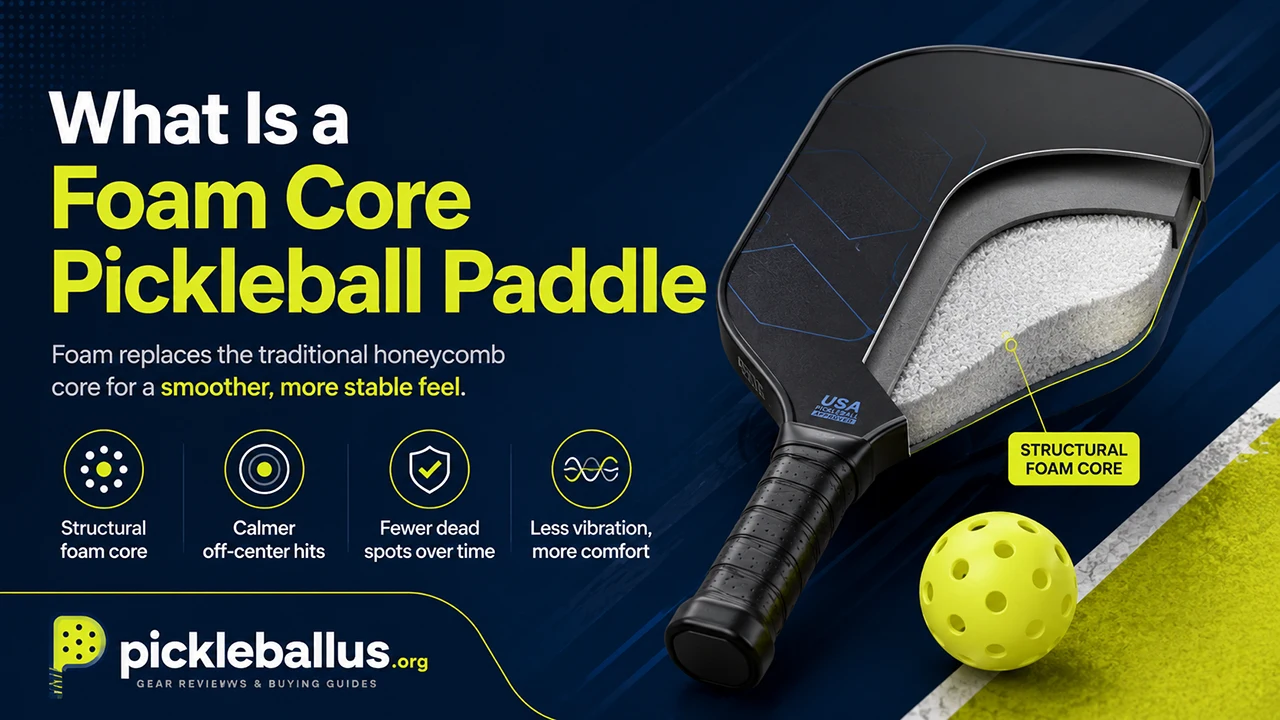
A foam core pickleball paddle uses structural foam — rather than a traditional polypropylene honeycomb grid — as the primary material inside the paddle body. This changes how the paddle flexes on contact, how vibration travels through the handle, and how consistently the ball leaves the face across different strike zones.
The result is a paddle that tends to feel calmer on off-center hits, produce fewer dead spots over time, and damp more vibration than a comparable honeycomb paddle. For players managing elbow or wrist fatigue, these qualities matter — and they’re a big reason foam has attracted serious attention at every level of the game. Players who have already explored best pickleball paddles for tennis elbow will notice foam appearing near the top of every ranked list in that category.
Full Foam vs Foam-Enhanced: The Key Difference
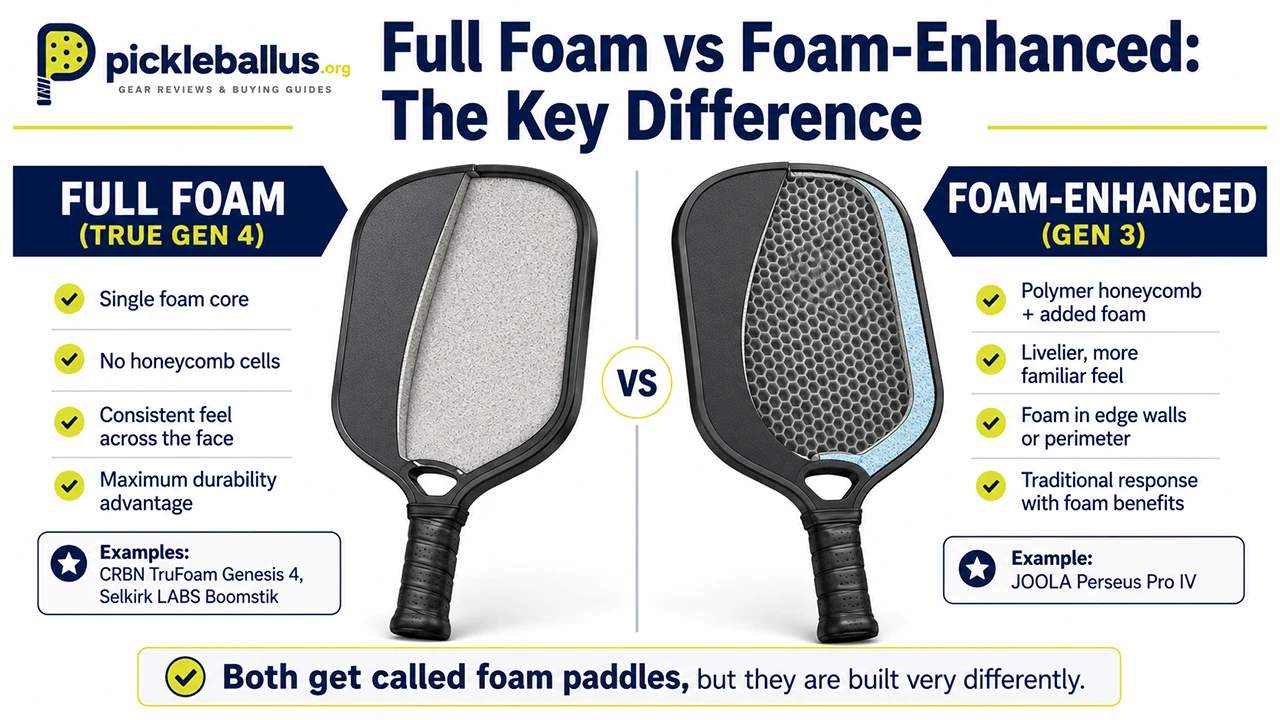
Full foam means the core spans the entire hitting area in a single foam structure — no honeycomb cells, no hybrid arrangement. These are the true Gen 4 builds. Foam-enhanced paddles (sometimes called Gen 3) retain a polymer honeycomb core but add foam strategically: in the edge walls, around the perimeter, or in a suspended layer between the core and face. Both types get marketed as “foam paddles,” but they play very differently.
Full-foam paddles like the CRBN TruFoam Genesis 4 and Selkirk LABS Boomstik offer the maximum durability advantage and a more consistent feel across the face. Foam-enhanced paddles like the JOOLA Perseus Pro IV trade some of that long-term durability benefit for a livelier, more familiar feel closer to what traditional honeycomb players already know. Neither is objectively better — it depends on what you’re optimizing for.
Understanding this distinction is part of navigating the broader landscape of pickleball paddle materials, where core technology, face material, and thickness all interact to shape how a paddle actually performs on court.
Gen 4 Technology Explained
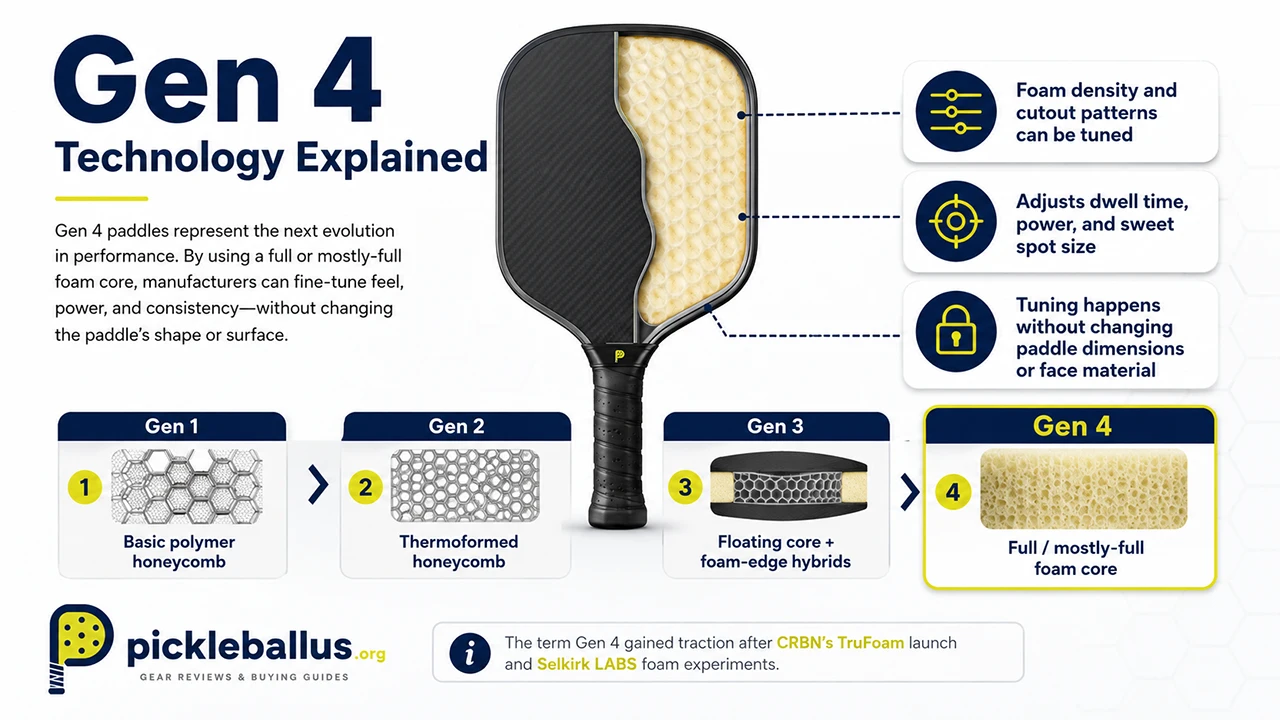
Gen 4 is the industry label for paddles built around full or mostly-full foam cores, distinguishing them from Gen 3 (floating core and foam-edge hybrids), Gen 2 (thermoformed honeycomb), and Gen 1 (basic polymer honeycomb). The framework became widely adopted after CRBN released the first TruFoam paddle, followed closely by Selkirk’s foam experiments through their LABS division.
What earns Gen 4 its own category: the core density and cutout patterns within the foam can be tuned to adjust dwell time, power output, and sweet spot size — without changing paddle dimensions or face material. That tunability is difficult to achieve with fixed-cell honeycomb structures, and it has opened a new dimension of paddle engineering that competing brands are moving toward quickly.
The 7 Best Foam Core Pickleball Paddles in 2026
Seven paddles stand out across this category — ranging from elite Gen 4 builds to accessible options that still deliver real foam core benefits. Here is the full breakdown.
#1 CRBN TruFoam Genesis 4 — Best Overall
The CRBN TruFoam Genesis 4 is the most complete foam core paddle currently available, combining elite spin generation, consistent dwell time, and a sweet spot that extends further toward the edges than most raw carbon options. It builds on earlier TruFoam models with meaningful improvements in swing speed and power output — areas where the original Genesis fell short of top-tier honeycomb paddles.
Key Specs and Features:
- Full TruFoam core (100% foam, no honeycomb)
- Raw carbon fiber face for high-RPM spin
- Fiberglass sweet spot layer in the center for added pop
- Available in standard elongated shape
Performance Analysis: On soft resets and dinks, the Genesis 4 produces a noticeably calmer response than a raw carbon paddle on a standard honeycomb. The foam absorbs the twitchy energy that causes unforced errors at the kitchen line. At the same time, drive shots carry well, and the raw carbon face consistently puts 2,100+ RPM on serve. The sweet spot is generous for a non-widebody shape, and off-center hits don’t punish you the way some Gen 3 paddles do. Players who have tested the Genesis 4 alongside Gen 3 power paddles generally report sacrificing very little pace while gaining noticeably more touch control in soft exchanges.
Pros:
- Consistently high spin numbers
- Full foam eliminates core crush concerns
- Calmer, more stable feel on touch shots
Cons:
- Premium price — not the right entry into foam for casual players
- Slightly less raw pop than the hardest-hitting Gen 3 paddles
Best For: All-court 4.0+ players who want elite spin, dwell time, and long-term durability in one paddle.
My Verdict: The TruFoam Genesis 4 is the benchmark in this category. Few paddles — foam or otherwise — match this combination of touch and spin. If you’re building a serious paddle rotation and want the most advanced foam build on the market, start here.
#2 Selkirk LABS Boomstik — Best for Power
Selkirk’s Boomstik is the paddle that changed the conversation about whether full-foam cores can compete on raw power. Earlier Selkirk foam experiments (notably the Project 008) leaned soft and felt underpowered at pace. The Boomstik corrects that — an elongated, power-biased foam paddle with strong forgiveness and a swing speed that aggressive baseliners can trust.
Key Specs and Features:
- Full structural foam core with Selkirk’s proprietary density tuning
- Carbon fiber face with raw texture for spin
- Elongated body shape for extended reach
- Limited-edition colorway variants available
Performance Analysis: Testing the Boomstik reveals something earlier foam paddles didn’t have: genuine explosiveness at pace. Hard drives carry authority, the elongated shape adds leverage on groundstrokes, and the paddle’s perimeter support minimizes face twist on stretch volleys. The power profile skews offensive, but there’s enough touch available to play the short game competently. Players who relied on Gen 3 power paddles and worried foam meant a step backward in aggression now have their answer. A mini-tournament win by an independent tester using a pre-release version illustrates how competitive this paddle is at a high level.
Pros:
- Best power output of any full-foam paddle tested
- Extended sweet spot from elongated body
- Less twitchy on messy contacts than thin raw carbon paddles
Cons:
- Elongated shape requires an adjustment period for players coming from widebody
- Premium pricing reflects Selkirk’s LABS positioning
Best For: Aggressive 4.0–5.0 players, singles-focused players, and anyone who wants foam durability without sacrificing offensive punch.
My Verdict: The Boomstik fills a real gap — a foam paddle power players can actually trust. Selkirk’s R&D is visible in how differently this plays from the Project 008.
#3 Honolulu J2NF — Best for Control
The Honolulu J2NF is built for players whose games live and die by their reset game and soft hands at the kitchen. This paddle prioritizes feel over firepower, using full-foam construction to produce one of the calmer, more forgiving touch experiences in the Gen 4 category.
Key Specs and Features:
- Full foam core with fiberglass-dominant face
- Lower exit velocity design — control-biased by construction
- Standard widebody shape for maximum face area
Performance Analysis: Dinking and resetting from defense is where the J2NF shines. The foam damps vibration noticeably, volleys feel planted rather than reactive, and the widebody shape provides margin when footwork isn’t quite right. Control players who pair this paddle with placement-based strategy will find it a strong match. Power hitters trying to use it offensively will find it limiting — by design. It’s not built for pace; it’s built for precision. Players focused on best pickleball paddles for control consistently find the J2NF near the top of ranked lists in this category, particularly for kitchen-dominant styles.
Pros:
- Best-in-class vibration dampening for wrist and elbow comfort
- Widebody face adds forgiveness on off-center contact
- Consistent feel across the entire face
Cons:
- Not suitable for power-oriented players
- Less spin capability compared to raw carbon options
Best For: Control-first players, 3.5–4.5 players focused on kitchen domination, and anyone managing arm injuries.
My Verdict: There isn’t a better foam paddle for a soft-game specialist. If your strategy centers on placement and patience rather than pace, the J2NF is worth its mid-premium asking range.
#4 Diadem Warrior BluCore V3 Pro — Best All-Court
Diadem’s BluCore line was one of the earliest serious efforts to bring full-foam construction to a broader audience. The Warrior BluCore V3 Pro is the most refined version yet — a balanced all-court paddle that handles power, touch, and spin without overcommitting to any one quality.
Key Specs and Features:
- Diadem BluCore full-foam core with Carbon + Kevlar face
- 16mm thickness for added stability
- Available in standard and elongated shapes
Performance Analysis: The Carbon + Kevlar face separates the V3 Pro from earlier BluCore builds. Kevlar adds stiffness and texture that improves ball bite on topspin shots without making the paddle harsh in soft touch sequences. Combined with the foam core’s natural vibration management, the V3 Pro handles transitions between fast exchanges and kitchen play better than most paddles at this price tier. The 16mm thickness keeps the feel stable without adding noticeable weight penalty. It won’t lead rankings for pure spin or pure power — but as an all-court daily driver, it over-delivers on consistency.
Pros:
- Carbon + Kevlar face provides strong ball bite and durability
- Balanced performance suits all-court play
- 16mm thickness adds stability without weight penalty
Cons:
- Not the best specialist choice for pure power or pure touch
- Less well-known brand requires hands-on testing to build trust
Best For: All-court 3.5–4.5 players who want one paddle that handles every situation competently.
My Verdict: The V3 Pro is the best all-around value in the foam core category. Players who don’t want to compromise on any single aspect of their game should put it near the top of their shortlist.
#5 Body Helix Flik F1 — Best Mid-Range Value
The Body Helix Flik F1 is the paddle that first made testers take foam seriously as a high-performance option. Before this release, most affordable foam paddles traded too much power for feel. The Flik F1 breaks that pattern — a mid-range paddle with genuine pop and spin output that punches above its price positioning.
Key Specs and Features:
- Structural foam core (full foam construction)
- Carbon fiber face for spin and durability
- Standard shape with a mid-weight profile
Performance Analysis: What stands out with the Flik F1 is how hard it hits for a foam paddle at this price. Drive shots carry, serve spin bites on bounce, and the paddle doesn’t feel sluggish in fast hands exchanges at the net. The foam core’s vibration dampening is present but less prominent than in the Honolulu J2NF — the F1 leans slightly more toward performance than pure comfort. Players coming from a mid-range honeycomb paddle will notice the more consistent sweet spot immediately. The handle ergonomics are basic, but for players who want to experience foam technology without paying Gen 4 elite-tier prices, this is the right entry point.
Pros:
- Strong power and spin for a mid-range foam paddle
- Full foam core at an accessible price
- Consistent face response across contact zones
Cons:
- Handle ergonomics aren’t as refined as premium options
- Less dwell time than CRBN or Selkirk builds
Best For: 3.0–4.0 players ready to upgrade from a budget honeycomb paddle and curious about foam technology.
My Verdict: The Flik F1 is the most compelling entry into Gen 4 foam paddles. It doesn’t feel compromised — it feels like a legitimate performance paddle at a price that makes the jump accessible.
#6 Adidas Metalbone LP S 16mm — Best Budget Premium Foam Option
Adidas entered the pickleball market aggressively, and the Metalbone LP S 16mm is its most refined foam offering. It sits at the crossroads between Gen 3 foam-enhanced design and full Gen 4 construction — delivering a live, powerful feel backed by a foam-dominant core that handles extended play sessions better than comparable honeycomb paddles.
Key Specs and Features:
- Foam-dominant core with carbon fiber face
- 16mm thickness for stability and control
- UPA-A approved for tournament play
- Elongated paddle profile (LP = Long Profile)
Performance Analysis: The LP S punches harder than its foam core would suggest. Adidas’s construction approach — layering carbon fiber over a foam core tuned for responsiveness — produces a paddle that feels fast and explosive without the twitchy edge-hit behavior common in thinner raw carbon paddles. At 16mm, volleys are stable, and the longer profile gives reach on wide balls. The price tag (frequently available at a strong discount from retail on Amazon) makes this one of the most compelling propositions for players who want premium materials without full CRBN or Selkirk pricing.
Pros:
- Strong power profile for a foam-dominant build
- UPA-A tournament approval
- Good value at sale pricing
Cons:
- Not a true full-foam design — some honeycomb influence in the construction
- Elongated shape (LP) isn’t suited to every play style
Best For: Competitive 3.5–4.5 players wanting tournament-legal foam performance at a mid-tier price.
My Verdict: The Metalbone LP S 16mm is the smart buy for players who don’t need the top shelf but still want foam technology in a tested construction.
#7 Ronbus Quanta — Best for Beginners
The Ronbus Quanta brings foam core technology to players new to the sport or upgrading from a starter wooden or budget plastic paddle. It doesn’t compete at the elite level — it focuses on delivering foam’s core benefits (reduced vibration, consistent feel, generous sweet spot) in a format that’s forgiving and easy to control.
Key Specs and Features:
- Structural foam core
- Fiberglass face for softer, forgiving response
- Standard widebody shape
- Lighter weight for easier swing speed generation
Performance Analysis: Beginners picking up the Quanta notice immediately that it doesn’t punish off-center hits. The fiberglass face over foam produces a softer, rounder response that helps new players develop feel for the ball without battling a twitchy paddle. It won’t spin the ball like a raw carbon face and won’t produce the power an advanced player needs — but those qualities are irrelevant for a player still building fundamental technique. The lightweight profile reduces arm fatigue during longer sessions, which matters more than most beginners realize in their first few months. For anyone exploring the best pickleball paddles at the beginner level, the Quanta is a safe, smart starting point.
Pros:
- Forgiving on off-center contact
- Lightweight — reduces arm fatigue for new players
- Full foam core brings durability benefits even at entry level
Cons:
- Limited power for advanced play
- Fiberglass face trades spin potential for comfort
Best For: Beginners, recreational players, and younger players building fundamental skills.
My Verdict: The Quanta does exactly what a beginner paddle should — it gets out of your way and lets you focus on learning the game. The foam core means it will hold up longer than comparable honeycomb starter paddles.
Full Foam vs Foam-Enhanced: Which Should You Choose?
Full foam paddles outperform foam-enhanced designs on durability and face consistency, but cost more and require adjustment for players coming from traditional honeycomb. Foam-enhanced paddles feel more familiar out of the box and often produce higher power, at the cost of some long-term durability benefit.
The table below covers the key decision points across both types:
| Factor | Full Foam (Gen 4) | Foam-Enhanced (Gen 3) |
|---|---|---|
| Core crush resistance | Eliminates the issue | Reduces, but doesn’t eliminate |
| Face consistency | More consistent across full face | May vary near edges |
| Power output | Improving rapidly; some now match Gen 3 | Generally higher out of the box |
| Durability | Superior long-term | Good — better than pure honeycomb |
| Adjustment from honeycomb | Requires some adjustment | Minimal adjustment needed |
| Price tier | Premium ($200–$350+) | Mid to premium ($150–$280) |
Players comparing foam to other surface technologies should also look at best raw carbon fiber pickleball paddles and best carbon fiber pickleball paddle to understand the face-material tradeoffs that interact with core design.
Is a Foam Core Paddle Right for Your Skill Level?
Foam core paddles are worth considering at every skill level, but what to prioritize differs significantly depending on where your game currently sits.
Beginners and Casual Players
Beginners benefit from foam’s vibration dampening and wider, more forgiving sweet spots — qualities that reduce mishit punishment during the learning phase. The catch: full Gen 4 foam paddles are priced for serious players. A better entry path is a mid-range foam paddle like the Body Helix Flik F1 or Ronbus Quanta, which deliver the durability and consistency benefits without the elite-tier cost.
Arm fatigue is a real issue for new players who practice several times per week. Foam’s shock absorption gives it a genuine edge over budget honeycomb paddles here — something worth weighing even before skill-based performance matters.
Intermediate and Advanced Competitive Players
Intermediate players in the 3.5–4.0 range will notice the most meaningful performance difference when switching to foam — mainly in how consistently the paddle behaves across different shot types and through extended play sessions. Advanced 4.5–5.0 players have historically been foam skeptics because of early Gen 4 power limitations. The CRBN TruFoam Genesis 4 and Selkirk Boomstik now answer that objection directly, delivering power profiles that compete with the strongest Gen 3 paddles.
Tournament players should verify the approval status of their specific model and year before competing, as governing body lists update regularly.
By now you have a clear map of the best foam core paddles on the market and a framework for choosing by play style and skill level. Selecting the right paddle is only part of the equation — understanding how foam paddles age through months of heavy play, what early warning signs to watch for, and how the long-term economics compare to replacing honeycomb paddles more frequently will determine whether your investment holds up for years or sends you back to the store next season. The next section covers the finer details that separate a confident purchase from a hopeful one.
What Else Should You Know Before Buying a Foam Paddle?
Three questions follow most foam paddle purchases once players move past the initial excitement of the technology: whether the paddle is legal in their tournaments, whether disbonding is a real risk, and whether full-foam paddles actually save money over time compared to replacing honeycomb paddles on a faster cycle.
Are Foam Core Paddles Tournament-Approved?
Most current full-foam paddles from established brands carry tournament approval from USA Pickleball (USAP) and/or the UPA. The CRBN TruFoam Genesis 4, Selkirk Boomstik, Diadem BluCore V3 Pro, and Adidas Metalbone LP S 16mm all hold current approval at time of publication. Approval status changes — governing bodies update their paddle lists regularly — so always verify the specific model and year against the official USAP approved paddle list before entering sanctioned play. Don’t rely on older approval stickers on used paddles.
Disbonding Risk: What to Watch For
Disbonding occurs when the paddle face separates from the core material, usually starting at the edges. It’s a known failure point in foam construction and was notably problematic in early budget foam builds — the Vatic Pro V-Core had to be pulled from sale after widespread disbonding reports. Current premium foam paddles from CRBN and Selkirk have significantly improved bonding methods, and no major disbonding pattern has been reported on Gen 4 releases. That said, foam is a younger technology than honeycomb, and long-term field data is still accumulating. Watch the perimeter edges of your paddle every few months, particularly after hard play sessions or exposure to temperature extremes.
Long-Term Cost: Foam vs Honeycomb
Full-foam paddles carry a higher upfront cost but a better long-term durability profile. If core crush was causing you to replace honeycomb paddles every 6–12 months, a full-foam paddle that lasts 2+ years without performance degradation represents real savings. Players who are careful with their gear and don’t experience rapid core crush on honeycomb may find the long-term math less compelling. As foam pricing becomes more competitive with mainstream honeycomb models — which is already beginning to happen at the mid-range tier — this equation will continue to shift in foam’s favor.
Write Your Review
No reviews yet. Be the first to share your experience!