

The best Nomex pickleball paddles in 2026 are the Onix Graphite Z5 (best overall), the Onix Z5 Widebody (best for beginners and rec players), the Gamma Voltage 5.0 (best for power hitters), the Gamma Micron 5.0 (best budget pick), the Engage Encore Pro (best for touch and control), and the Head Radical Pro (best for intermediate players). All six use a Nomex honeycomb core — the hard, resin-dipped aramid material that defined the first generation of composite pickleball paddles and still earns a place in the bags of players who want a faster, more powerful game.
Choosing the right Nomex paddle means understanding how the core interacts with your face material choice, your weight preference, and your play style. A graphite face over a Nomex core plays very differently from a fiberglass face over the same core — and neither option behaves like a standard pickleball paddle materials guide would suggest if you’ve only tested polymer before.
Most players searching for a Nomex paddle are dealing with a real problem: they’ve tried a polymer core, found it too soft and slow-feeling, and want that crisp, snappy response back. Or they play aggressive singles, value raw exit velocity over soft touch, and need a paddle that rewards power without rewarding slop. Nomex delivers exactly that — with trade-offs you need to understand before buying.
Below is a complete breakdown of every paddle on this list, followed by a buying guide covering face material, weight, and the Nomex-vs-polymer decision in plain terms.
What Is a Nomex Core Pickleball Paddle?
Nomex is the original composite core material used in pickleball paddles — a hard, rigid honeycomb structure made from aramid paper that has been dipped in resin and formed into hexagonal cells. It was used in the first generation of non-wooden paddles and remains the hardest, most power-forward core option available today.
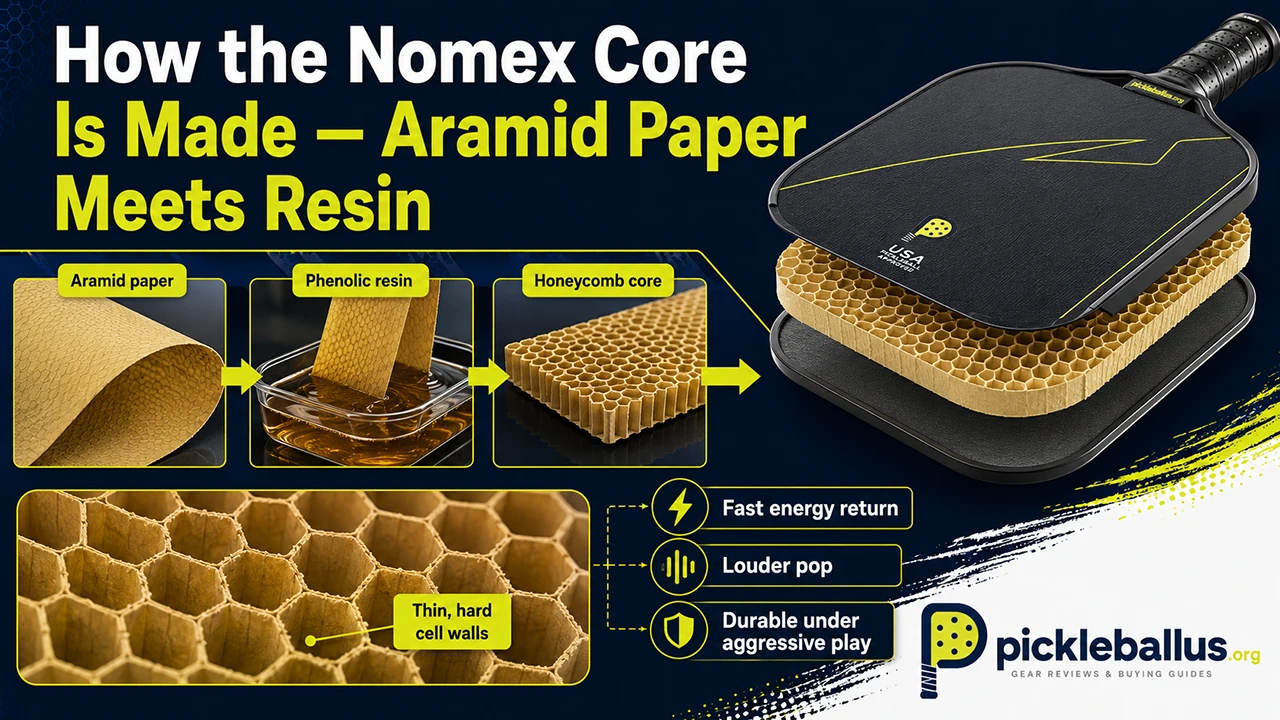
How the Nomex Core Is Made — Aramid Paper Meets Resin
Nomex begins as an aramid-based paper — the same fiber family used in aerospace insulation, military gear, and high-performance industrial applications. The paper is dipped in a phenolic resin, which hardens and stiffens it significantly. That treated material is then cut and formed into a honeycomb grid, creating a matrix of small hexagonal cells that sit between the two face layers of the paddle.
The cell walls in a Nomex core are thinner and harder than those in a polymer core. This is what makes Nomex behave so differently on impact. When the ball strikes the face, the stiff cell walls transfer energy back into the ball quickly rather than absorbing it. The result is a louder, sharper “pop” at contact and a noticeably faster ball exit velocity compared to polymer.
That hardness also contributes to durability. Nomex cores resist compression over time better than softer materials, which is why many experienced players report their Nomex paddles holding up longer before losing their liveness. The honeycomb structure is dense enough to resist deformation under aggressive play.
Nomex vs. Polymer vs. Aluminum — The Core Comparison
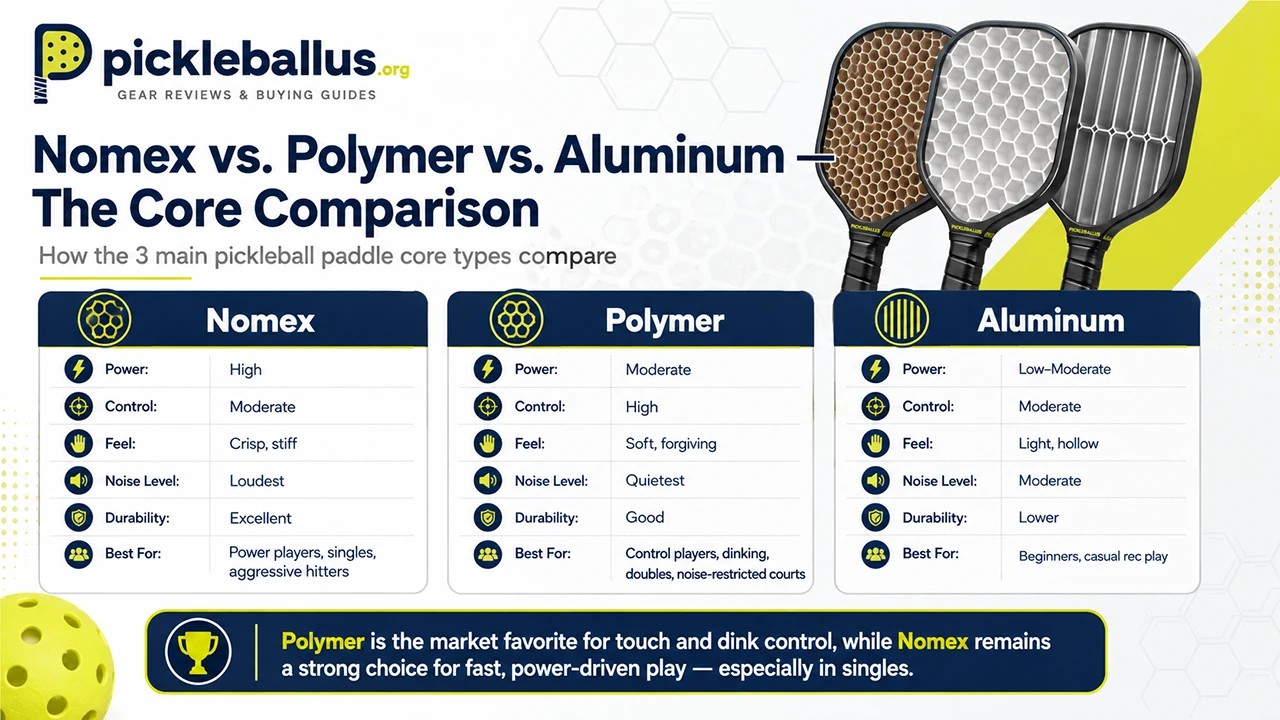
The table below covers the three primary core types across the attributes that matter most to players making a buying decision.
There are meaningful performance differences between all three cores, and no single option wins across every category.
| Core Type | Power | Control | Feel | Noise Level | Durability | Best For |
|---|---|---|---|---|---|---|
| Nomex | High | Moderate | Crisp, stiff | Loudest | Excellent | Power players, singles, aggressive hitters |
| Polymer | Moderate | High | Soft, forgiving | Quietest | Good | Control players, dinking, doubles, noise-restricted courts |
| Aluminum | Low–Moderate | Moderate | Light, hollow | Moderate | Lower | Beginners, casual rec play |
Polymer cores currently dominate the best pickleball paddles market because most top-level players prioritize soft touch and dink control. But Nomex holds its own for any player who values a fast, responsive game where power drives the point structure — particularly in singles, where you’re generating your own pace rather than redirecting a hard-hit ball.
6 Best Nomex Pickleball Paddles in 2026
There are six Nomex paddles on this list, selected for their consistent Amazon availability, verified customer satisfaction, and representative coverage of different face materials, weight classes, and player profiles. Every paddle here uses a genuine Nomex honeycomb core — not a hybrid or polymer alternative marketed with similar terminology.
#1 Onix Graphite Z5 — Best Overall Nomex Paddle
The Onix Graphite Z5 is the benchmark Nomex pickleball paddle — the product most players think of first when someone mentions a honeycomb core, and for good reason. It has been one of the best-selling paddles on Amazon for years, and its reputation holds up under scrutiny.
Key Specs and Features
- Core: Nomex honeycomb
- Face: Graphite
- Shape: Standard widebody
- Weight range: Mid-weight (7.5–8.2 oz depending on variant)
- Grip size options: Small (4 inches) and medium (4¼ inches)
- USAPA approved: Yes
- Edge guard: Yes, full perimeter
Performance Analysis
The graphite face over the Nomex core creates a particularly snappy, fast-feeling combination. Graphite is thin and stiff, so it doesn’t absorb ball energy — it redirects it almost immediately. Combined with the hard Nomex cells beneath, the Z5 produces a paddle that rewards flat, aggressive hitting with impressive exit velocity.
The sweet spot on the Z5 is larger than you’d expect for a Nomex paddle. The widebody shape adds surface area, which pushes the sweet spot closer to the edges compared to an elongated paddle design. Players who tend to hit slightly off-center will notice more forgiveness here than on narrower profiles.
Control on the Z5 is workable at the net — not exceptional, but not a liability either. The graphite face does provide some texture for spin generation, and the hard core gives you enough feedback to develop good dink placement with practice. This is not a soft-touch, dink-first paddle, but it won’t embarrass you in a kitchen exchange.
Pros
- One of the largest sweet spots among Nomex paddles
- Crisp, fast response rewards power-forward play
- Strong durability — holds its liveness well over time
- Widely available on Amazon with consistent stock and return policy
- Trusted brand with deep community familiarity
Cons
- Loud — not suitable for noise-restricted courts or HOA communities
- Less spin texture than modern carbon fiber faces
- Not the best option for players prioritizing soft touch at the kitchen line
Best For: Intermediate to advanced players who want raw power and a proven platform; players transitioning from soft tennis balls who want a livelier, faster court feel.
My Verdict: The Z5 is the Nomex paddle that earns its reputation every time you swing it. If you’re trying Nomex for the first time or coming back to it after a polymer stint, start here. The combination of graphite face, Nomex core, and widebody shape makes this the most balanced option on the list — not the most powerful, not the most controlled, but the most complete overall package.
#2 Onix Z5 Widebody — Best Nomex Paddle for Beginners and Rec Players
The Onix Z5 Widebody delivers the Nomex core experience in the most forgiving shape available — a broad face designed to maximize the hitting area and reduce the penalty for off-center contact.
Key Specs and Features
- Core: Nomex honeycomb
- Face: Composite (fiberglass-blend)
- Shape: Widebody — extra width compared to the standard Z5
- Weight range: Mid-weight
- USAPA approved: Yes
Performance Analysis
Where the standard Z5 pairs graphite with Nomex for maximum crispness, the Z5 Widebody uses a composite face that softens the response slightly. The result is a paddle that still produces the fast, lively feel of a Nomex core, but with a fraction more forgiveness and a slightly more muted impact sound.
The wider face shape is the key feature here. Players who are still developing their mechanics — or recreational players who don’t need elite-level precision — will notice that mishits on the Z5 Widebody stay in play more often than on a narrower paddle. The sweet spot extends further toward the edges, giving you more room for error on volleys and third-shot drives.
That said, the Nomex core still makes itself felt. This is not a soft paddle. It rewards decisive swings and punishes tentative jabs, so it’s better suited to beginners who play with confidence than to beginners who are still searching for their swing.
Pros
- Maximum sweet spot coverage among Nomex options
- Composite face softens the core’s harshness slightly
- Great entry point into the Nomex category
- Durable and consistently available on Amazon
Cons
- Less precise feedback than graphite face for experienced players
- Still loud — the Nomex core is the dominant noise driver
- The wide shape reduces reach compared to elongated designs
Best For: Recreational players and beginners who want to experience Nomex power without the unforgiving feedback of a narrower, graphite-face paddle.
My Verdict: The Z5 Widebody occupies a smart niche — it lets newer players access Nomex performance without demanding the consistency that a more precise paddle would require. If you’re buying your first Nomex paddle and aren’t sure about your mechanics yet, this is the safest entry point on the list.
#3 Gamma Voltage 5.0 — Best Nomex Paddle for Pure Power Hitters
The Gamma Voltage 5.0 is the paddle you choose when power is the only metric that matters. Gamma’s Voltage line has been built around Nomex-core construction, and the 5.0 represents the refined version of that power-focused philosophy.
Key Specs and Features
- Core: Nomex honeycomb
- Face: Graphite
- Shape: Standard
- Weight range: Mid-weight
- USAPA approved: Yes
- Textured graphite face for spin generation
Performance Analysis
The Gamma Voltage 5.0 leans into the hardest, fastest aspect of the Nomex core and pairs it with a textured graphite face that adds spin to the power equation. Compared to the Z5, the Voltage feels slightly more head-heavy, which amplifies the sensation of power on flat drives and punch volleys.
The textured graphite face gives the Voltage a meaningful spin advantage over the smooth-face Z5. Players who like to drive the ball with topspin rather than just pace will find the Voltage rewards that style more consistently. At the baseline, the combination of Nomex snap and graphite texture produces a ball that kicks low and fast — exactly what you want when you’re trying to end the point.
At the kitchen, the Voltage is usable but demanding. The stiff feedback makes soft resets harder to feel and harder to time consistently. Players who rely on a game built around resets and dinks will likely find this paddle frustrating; players who avoid the kitchen and look to win exchanges from the baseline or transition zone will feel right at home.
Pros
- Maximum power output among Nomex paddles tested
- Textured graphite face adds spin to the power foundation
- Slightly head-heavy balance amplifies drive effectiveness
- Solid build quality — Gamma’s durability reputation holds
Cons
- Demanding to use at the kitchen — not forgiving on soft shots
- Loud (Nomex + graphite combination is particularly sharp)
- Less suitable for control-based games or doubles-heavy schedules
Best For: Aggressive singles players and baseline-dominant doubles players who want to put pace on every ball and own the transition zone.
My Verdict: The Voltage 5.0 is the most power-forward paddle on this list. If that’s what you’re shopping for — pure exit velocity, hard drives, a paddle that punishes weak returns — this is your pick. Just know going in that you’re trading kitchen feel for firepower.
#4 Gamma Micron 5.0 — Best Budget-Friendly Nomex Paddle
The Gamma Micron 5.0 makes Nomex core performance available at a mid-range price point without cutting corners on the core material that matters most. It’s the best answer to the question: “Can I get a real Nomex paddle without spending premium money?”
Key Specs and Features
- Core: Nomex honeycomb
- Face: Composite (fiberglass-blend)
- Shape: Standard
- Weight range: Mid-weight
- USAPA approved: Yes
Performance Analysis
The composite face on the Micron 5.0 creates a noticeably different character than the graphite-face Gamma paddles above it. The Nomex core still drives the power profile, but the fiberglass composite face absorbs marginally more energy at impact, giving the Micron a slightly softer feel and a fractionally larger effective sweet spot compared to the Voltage.
That softer face also makes the Micron more forgiving on off-speed shots. You won’t have as much raw pop on drives as you would with the Voltage or the Z5, but you’ll find it easier to execute a consistent dink or drop shot when needed. For players who want to use Nomex primarily for power but don’t want to give up all kitchen functionality, the Micron sits at a workable middle ground.
At its price tier, the Micron competes directly with polymer paddles that cost similar amounts. The argument for choosing the Micron comes down to core preference — if you’ve tried polymer and it feels too dead, the Micron will feel significantly livelier without asking you to spend significantly more.
Pros
- Nomex core performance at a mid-range budget
- Composite face softens some of the Nomex harshness
- More kitchen-friendly than graphite-face Nomex options
- Good entry point for players curious about Nomex
Cons
- Less raw power than the Voltage 5.0 or Graphite Z5
- Composite face wears faster than graphite over heavy use
- Still audibly louder than polymer core alternatives
Best For: Budget-conscious players who want to experience Nomex power without paying full premium; players who want Nomex feel with slightly more touch at the net.
My Verdict: The Micron 5.0 earns its spot as the budget pick by not sacrificing the actual Nomex core — the thing that defines the category. You get the lively, fast feel at a lower cost of entry, with a composite face that makes it slightly more versatile than a pure graphite-face option.
#5 Engage Encore Pro — Best Nomex Paddle for Touch and Control
The Engage Encore Pro is the most nuanced Nomex paddle on this list — a paddle designed to show that a Nomex core doesn’t have to mean brutal, uncontrollable power. Engage engineering prioritizes touch and spin alongside the core’s natural speed.
Key Specs and Features
- Core: Nomex honeycomb
- Face: Proprietary composite (Engage ControlPro texture)
- Shape: Standard
- Weight range: Mid-weight
- USAPA approved: Yes
- Specialized textured face for grip and spin
Performance Analysis
Engage paddles are built around the idea that surface texture and core stiffness can be tuned together rather than trading one off against the other. The Encore Pro’s proprietary face texture creates noticeably more ball friction than a standard graphite or composite face, and that friction translates into a meaningful spin advantage — particularly on third-shot drops and cross-court dinks where trajectory control matters.
The Nomex core underneath still delivers the fast, crisp ball response the material is known for. But the Engage face engineering takes the edge off the hardest impacts, making the transition from a power shot to a soft shot feel less abrupt. Experienced players will appreciate the wider dynamic range — you can still drive with authority, but you can also place a drop shot in the kitchen with more precision than a standard Nomex setup allows.
This is not a beginner paddle. The Encore Pro rewards players who already understand how to generate spin, how to vary pace deliberately, and how to read the paddle’s feedback during an exchange. Newcomers to Nomex will likely find it harder to read than the Z5.
Pros
- Best spin generation among Nomex paddles on this list
- More control at the kitchen than typical Nomex options
- Wide dynamic range — effective for both power and touch
- Premium build quality consistent with Engage’s reputation
Cons
- Requires experience to unlock full potential
- Premium price point
- Still loud compared to polymer options
Best For: Intermediate-to-advanced players who want Nomex speed but won’t sacrifice the ability to execute soft shots and spin-heavy plays at the kitchen.
My Verdict: The Encore Pro is the paddle for players who have dismissed Nomex as “too blunt” and want proof that the core can support a more complete game. It delivers. If you’re a skilled player who values touch alongside power, this is the best Nomex option on the list.
#6 Head Radical Pro — Best Nomex Paddle for Intermediate Players
The Head Radical Pro bridges the gap between the raw Nomex experience and a more polished, modern paddle feel, making it the easiest recommendation for intermediate players stepping into the Nomex category for the first time.
Key Specs and Features
- Core: Nomex honeycomb
- Face: Graphite
- Shape: Standard
- Weight range: Mid-weight
- USAPA approved: Yes
- Ergo-Grip handle for extended play comfort
Performance Analysis
Head brings its racket-sport expertise to the Radical Pro, and it shows. The paddle’s balance point is carefully engineered to feel neither head-heavy nor head-light — a neutrality that gives intermediate players more forgiveness while they develop the consistency to take full advantage of the Nomex core’s speed.
The graphite face delivers crisp feedback without the brutally stiff response of the most power-focused options above. Intermediate players often struggle to tell the difference between good contact and bad contact on very stiff paddles; the Radical Pro is stiff enough to deliver the Nomex snap, but calibrated enough that off-center hits still give you usable information about your swing mechanics.
The Ergo-Grip handle is a genuine differentiator for players who experience hand fatigue during long sessions. The ergonomic contouring distributes grip pressure more evenly, reducing the strain that a stiff Nomex paddle can impose over multiple games.
Pros
- Balanced feel that’s accessible for intermediate players
- Ergo-Grip reduces hand fatigue during extended play
- Crisp graphite face with manageable stiffness
- Head’s tennis-derived engineering brings build quality advantages
Cons
- Less raw power than the Gamma Voltage or Onix Z5
- Graphite face still produces significant noise
- Less spin texture than the Engage Encore Pro
Best For: Intermediate players transitioning from softer paddles who want to explore Nomex core performance without being overwhelmed by the hardest, fastest options.
My Verdict: The Radical Pro is the thoughtful intermediate choice — not the most powerful Nomex paddle, not the most refined, but the most approachable stepping stone into the category. Head’s build quality and ergonomic grip design make this the easiest Nomex paddle to spend a full day with.
How to Choose the Right Nomex Pickleball Paddle
There are three variables that determine whether a Nomex paddle will fit your game: face material, weight, and whether Nomex is actually the right core for your playing style in the first place. Getting all three right before you buy will save you the cost of a return.
Face Material — Graphite vs. Fiberglass vs. Composite on a Nomex Core
The face material you pair with a Nomex core changes the paddle’s character significantly. The core provides the power foundation; the face determines how that power is expressed and how much touch you retain.
The table below summarizes the key trade-offs. Each face type reflects different priorities, and there’s no universally correct choice — the right answer depends on how you play.
| Face Material | Feel | Power | Spin | Control | Best Paired With Nomex For |
|---|---|---|---|---|---|
| Graphite | Crisp, stiff | Highest | Low–Moderate | Moderate | Pure power players, singles, fast exchanges |
| Fiberglass (composite) | Softer, more give | Moderate | Moderate–High | Better | Players who want Nomex speed with more kitchen versatility |
| Textured proprietary | Variable | High | Highest | Better | Advanced players managing both power and spin deliberately |
For your first Nomex paddle, graphite is the most common and most representative choice — it gives you the clearest signal of what Nomex actually feels like. If you’ve used a best graphite pickleball paddles guide before and found graphite appealing, a graphite-face Nomex option is the logical next step.
If you want the Nomex speed but want to keep more touch at the kitchen, a composite face on a Nomex core — as reviewed in the best composite pickleball paddles options — is the pragmatic middle ground.
Weight — How Paddle Weight Changes Your Game
Most Nomex paddles cluster in the mid-weight range (7.5–8.5 oz), which is intentional — the Nomex core itself is lightweight, and manufacturers typically pair it with face materials that keep the total weight manageable.
Lighter options (under 7.5 oz) give you faster swing speed and more maneuverability at the kitchen, but reduce the mass-driven power on drives. Heavier options (over 8.5 oz) amplify power but accelerate arm fatigue, especially given that Nomex’s stiff feedback already transmits more vibration than a polymer core would.
For most players, mid-weight (7.5–8.3 oz) is the right target when choosing a Nomex paddle. It balances the core’s natural speed advantage with enough mass to generate power without requiring perfect swing mechanics every time.
Nomex vs. Polymer — Which Core Actually Fits Your Style?
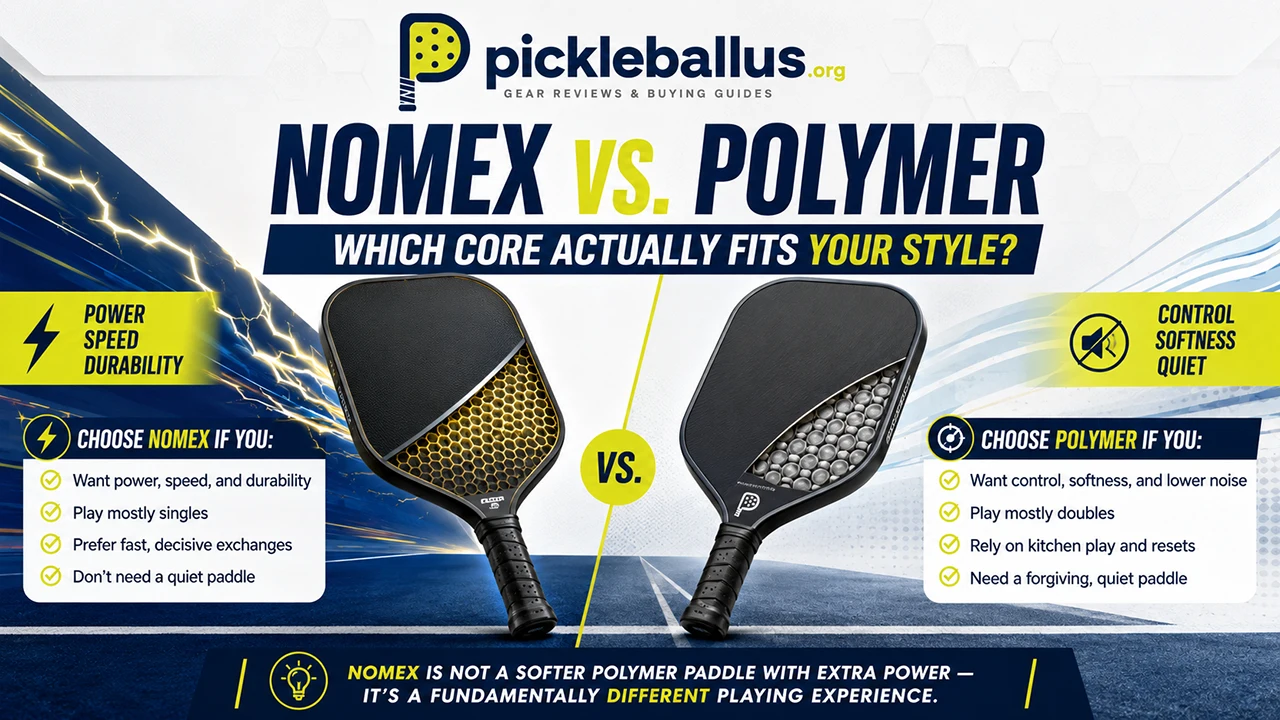
Nomex wins on power, speed, and durability. Polymer wins on control, softness, and noise management. The honest comparison is straightforward — the question is which trade-offs you’re willing to accept.
Choose Nomex if you: play primarily singles, rely on a power-first game, prefer fast, decisive exchanges over soft resets, and play on courts where noise isn’t an issue. The best carbon fiber pickleball paddle options also use hard, responsive constructions, but with modern thermoforming and different face physics — Nomex delivers its speed through core stiffness where carbon relies more on face flex engineering.
Choose polymer if you: play primarily doubles, rely on a kitchen-heavy game, need a quiet paddle for noise-restricted courts, or are earlier in your pickleball development and benefit from the forgiveness of a softer core.
There’s no wrong answer. But players who buy a Nomex paddle expecting it to feel like a soft polymer paddle with extra power will be disappointed — Nomex is a fundamentally different playing experience, not an upgrade applied on top of polymer’s characteristics.
By now you have a clear picture of the six best Nomex paddles on the market, how the core material works, and what to look for when matching a paddle to your play style. Choosing the right paddle is the starting point — but understanding how the Nomex core behaves under real-world conditions, including noise regulations and long-term durability, will determine whether it becomes your go-to paddle or causes unexpected friction on and off the court. The next section covers the practical details that experienced Nomex players deal with, and that first-time buyers rarely think to ask about before purchasing.
What Nomex Players Need to Know Beyond the Basics
Most paddle reviews stop at performance specs. The details below reflect how Nomex paddles actually behave over months of play, across different court environments, and across different game formats — information that changes how you’ll use and maintain your paddle once it arrives.
Noise Restrictions — Will a Nomex Paddle Get You Kicked Off the Court?
Nomex is the loudest core material in pickleball — a reality that matters more than most first-time buyers expect. Many residential communities, HOAs, parks, and indoor facilities have noise level ordinances or informal policies that effectively prohibit Nomex use.
The hard cell walls of the Nomex honeycomb produce a sharp, high-pitched pop at contact that carries significantly further than the muffled thud of a polymer paddle. If you play at a community recreation center, near residential housing, or at any facility that has already dealt with noise complaints, check the facility’s paddle policy before purchasing a Nomex paddle. Some locations specifically ban paddles with Nomex or aluminum cores.
Players who need a quiet paddle — those playing in best quiet pickleball paddles territory — should choose polymer. Nomex and quiet are not compatible.
How Long Does a Nomex Core Last Compared to Polymer?
Nomex cores generally outlast polymer cores in terms of maintaining their original feel. The rigid aramid structure resists compression and cell wall deformation more effectively than the softer polypropylene cells in a polymer core. Many players report their Nomex paddles retaining their liveness and snap for years of regular play.
Polymer cores can develop “dead spots” — areas where repeated impact has deformed the cell structure and reduced energy return — over heavy play schedules. Nomex is more resistant to this type of degradation, though it is not immune. The face-to-core bonding layer and edge guard integrity are more common failure points on Nomex paddles than core degradation itself.
For players who want a paddle that holds its performance characteristics over a long period without frequent replacement, Nomex’s durability advantage is a genuine consideration.
Nomex for Singles vs. Doubles — Where It Wins and Where It Struggles
Nomex performs best in singles — a game format defined by baseline power, transition zone aggression, and the ability to generate your own pace rather than redirect incoming pace. The hard core’s fast energy return and crisp feedback reward the attacking style that singles demands.
In doubles, the game dynamics shift. Kitchen exchanges, soft resets, cross-court dinks, and third-shot drops become central to winning points. These are exactly the scenarios where Nomex’s stiffness becomes a liability — soft shots require feel, and Nomex gives you speed where you want touch. Most top doubles players favor polymer cores for this reason, even those who keep a Nomex paddle for singles use.
If your schedule includes both formats, the best fiberglass pickleball paddles or composite-face Nomex options (like the Gamma Micron or Engage Encore Pro) offer the best compromise — enough power for singles exchanges, enough touch to stay functional in doubles kitchen play.
Is Nomex a Good Choice for Beginners?
Nomex is workable for beginners, but not the ideal starting point. The core’s stiff feedback is honest — every mishit is felt clearly, and the paddle doesn’t compensate for loose mechanics the way a soft polymer core does. For players still building fundamental stroke patterns, that brutal honesty can be frustrating before it becomes instructive.
That said, a forgiving Nomex option like the Onix Z5 Widebody can work well for beginners who are confident in their swing and simply want to experience the livelier, faster court feel that Nomex provides. The wider face shape and mid-weight construction add enough margin for error that developing players won’t be punished on every off-center contact.
Beginners who are unsure of their mechanical consistency, or who play primarily recreational doubles, are better served starting with polymer and moving to Nomex once they’ve developed the stroke mechanics to benefit from the harder core’s feedback.
Write Your Review
No reviews yet. Be the first to share your experience!