

Carbon fiber pickleball paddles are the go-to choice for players who want more spin, tighter control, and a durable surface that holds up through a full season. The best carbon fiber pickleball paddles in 2026 are the Six Zero Double Black Diamond Control (best overall), the JOOLA Ben Johns Hyperion CFS 16mm (best for advanced players), the Vatic Pro V-Sol (best value), the Selkirk LUXX Control Air Invikta (best for control), the CRBN 3X Power (best for spin), the Franklin C45 Dynasty (best for power), the Paddletek Bantam TKO-C (best for offensive players), and the Engage Pursuit Pro1 (best for versatility).
These eight paddles stand out because of their carbon fiber face quality, core construction, and real-world performance across different skill levels. Whether you’re a 3.5 player ready to step up your game or an advanced competitor looking for more spin on dinks and drives, there’s a carbon fiber paddle on this list that fits your style.
One thing every player asks before committing: is carbon fiber actually better than graphite or fiberglass? The short answer is — it depends on what you prioritize. Carbon fiber paddles excel at spin and durability. They also tend to feel stiffer, which translates to faster ball exit and more precise shot placement. If you’ve been playing on a fiberglass or graphite surface and you’re curious about making the switch, this guide will show you exactly what you’re trading in and what you’ll gain.
Below is a full breakdown of every paddle, followed by a buying guide to help you match the right carbon fiber surface to your playing style.
What Is a Carbon Fiber Pickleball Paddle?
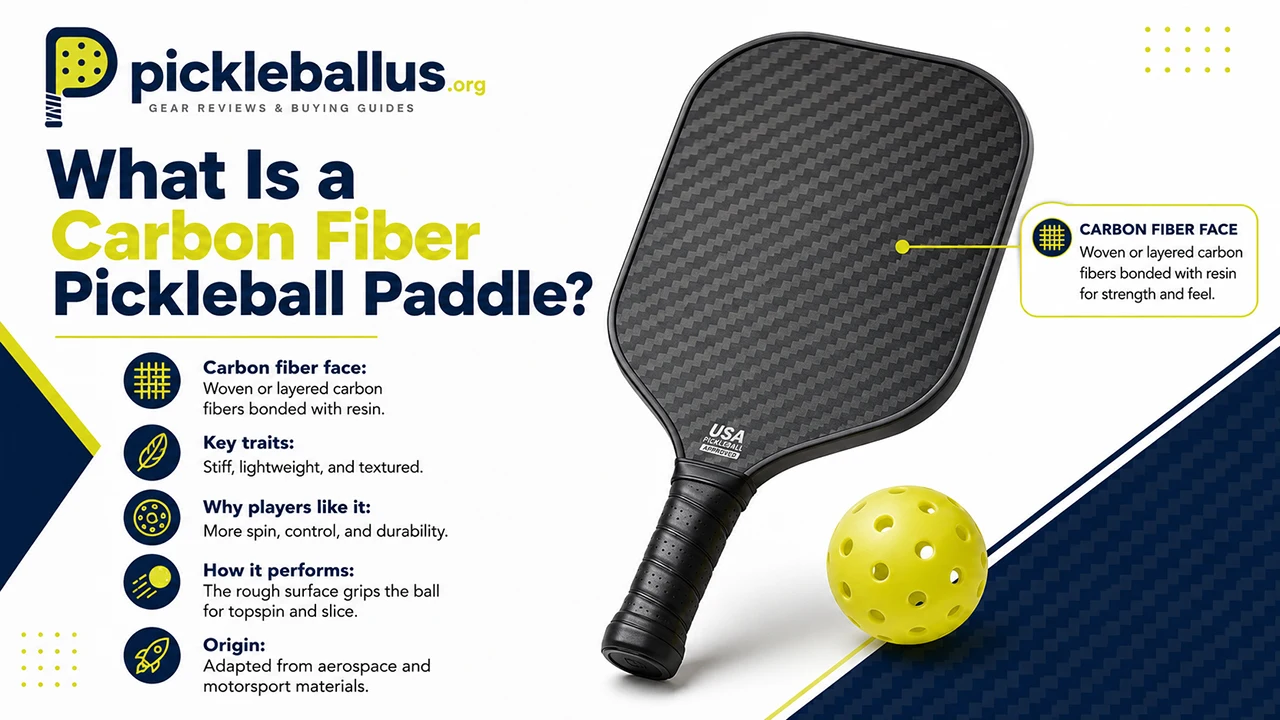
A carbon fiber pickleball paddle is a paddle with a face made from woven or layered carbon fibers bonded with resin. The material creates a surface that is stiff, lightweight, and texturally rough — three properties that deliver spin and control softer materials like fiberglass can’t match at the same weight class.
Carbon fiber originally came from aerospace and motorsport engineering, where its strength-to-weight ratio made it the ideal structural material. In pickleball, manufacturers adapted those same properties to create paddle faces that grip the ball on contact, allow players to generate topspin and slice, and resist wear better than older graphite surfaces.
If you want to understand how carbon fiber compares to every other face material, the guide to pickleball paddle materials breaks down the trade-offs across graphite, fiberglass, kevlar, and composite options.
Carbon Fiber vs Graphite vs Fiberglass Face
Carbon fiber offers more grit and stiffness than graphite, while providing better durability and spin than fiberglass. Here’s how the three most common face materials compare:
| Feature | Carbon Fiber | Graphite | Fiberglass |
|---|---|---|---|
| Spin potential | High | Moderate | Low–Moderate |
| Power / pop | Moderate–High | Moderate | High |
| Durability | High | Moderate | Moderate |
| Weight | Lightweight | Very lightweight | Moderate |
| Feel | Stiff, crisp | Soft, touch-sensitive | Flexible, poppy |
| Best for | Control + spin | Touch players | Power hitters |
Graphite paddles were the dominant choice a few years ago, but carbon fiber has largely replaced them at the intermediate-to-advanced level because the gritty surface texture generates significantly more spin. Players who enjoy a touch-sensitive feel sometimes prefer graphite, which is why the best graphite pickleball paddles still earn strong reviews for certain playing styles.
Fiberglass delivers excellent pop and energy return, making it a solid choice for players who prioritize power over spin. For a focused comparison, the best fiberglass pickleball paddles guide covers the top options in that category.
Raw Carbon Fiber vs Regular Carbon Fiber — What’s the Difference?
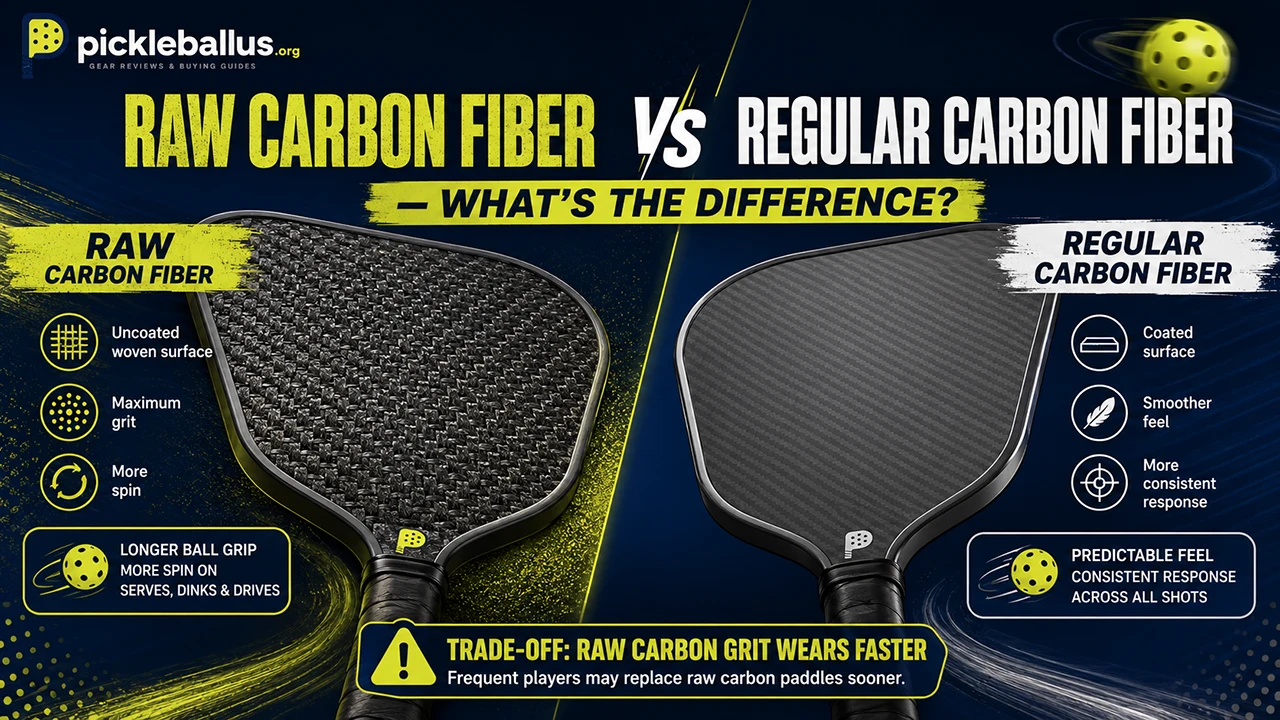
Raw carbon fiber leaves the woven surface uncoated, exposing the fiber texture directly to the ball. This creates maximum grit — the ball grips longer on contact, which translates to more spin on serves, dinks, and drives. Regular carbon fiber faces receive a smooth coating or paint layer over the fibers, which reduces surface texture and produces a slightly harder, more consistent feel.
The trade-off: raw carbon grit degrades faster than a coated surface, especially at higher ball speeds. If you play five or more days a week, expect to replace a raw carbon paddle sooner. For players who want raw carbon specifically, the best raw carbon fiber pickleball paddles guide covers paddles built around that surface in detail.
The 8 Best Carbon Fiber Pickleball Paddles of 2026
The following paddles were selected based on construction quality, verified player feedback, core technology, and availability on Amazon. Every product listed is actively sold and has a strong review history.
#1 Six Zero Double Black Diamond Control — Best Overall
The Six Zero Double Black Diamond Control earns its place at the top of this list because it delivers a rare balance of spin, control, and power that works for players at multiple skill levels. The paddle’s TruFoam construction pairs a polypropylene honeycomb core with a Toray raw carbon fiber surface — the raw texture grabs the ball hard on contact, giving you aggressive topspin without requiring you to swing harder.
Key specs:
- Face: Toray raw carbon fiber
- Core: Polypropylene honeycomb with TruFoam
- Technology: Fusion Edge Technology (extended sweet spot to the edges)
- Shape: Standard / Elongated (available in both)
Performance analysis: The Fusion Edge design is the biggest differentiator here. Most paddles lose stability and feel on off-center hits, but the Six Zero’s extended TruFoam perimeter keeps shots consistent even when you make contact near the edge. At the kitchen line, dinks feel soft and placed — the raw carbon grips without sending the ball long. On drives, the stiffness in the carbon face converts swing speed into exit velocity efficiently.
Pros:
- Raw carbon grit produces top-tier spin
- TruFoam + Fusion Edge expands the effective sweet spot
- Handles both soft game and power shots well
- Available in standard and elongated shapes
Cons:
- Raw carbon surface degrades faster under heavy use
- Premium price tier
Best For: Intermediate to advanced players who want one paddle that doesn’t compromise between the kitchen and the baseline.
My Verdict: The Six Zero Double Black Diamond is the most well-rounded carbon fiber paddle in this roundup. If you can invest in a top-shelf option, this is where the money is well-spent.
#2 JOOLA Ben Johns Hyperion CFS 16mm — Best for Advanced Players
Few paddles carry as much competitive pedigree as the JOOLA Ben Johns Hyperion CFS 16mm. Developed in partnership with the world’s top-ranked pickleball player, this paddle uses JOOLA’s Carbon Flex Surface (CFS) technology — a carbon fiber face designed to flex slightly on ball contact, softening the feel while preserving spin.
Key specs:
- Face: JOOLA Carbon Flex Surface (carbon fiber)
- Core: 16mm polypropylene honeycomb
- Shape: Standard
- Technology: Hyperfoam Edge Wall
Performance analysis: The 16mm core is the thickest in the Hyperion lineup, and it shows in the feel. Dinks are exceptionally forgiving — the deeper core absorbs impact and gives you a wider margin for error on touch shots. The Hyperfoam Edge Wall extends playable surface to the paddle’s perimeter, which matters during fast exchanges at the net. On power shots, the carbon flex surface channels energy into the ball without feeling trampoline-like.
Pros:
- 16mm core = maximum forgiveness and soft feel at the kitchen
- Carbon Flex Surface balances spin and touch better than pure raw carbon
- Hyperfoam Edge Wall reduces dead spots near the frame
- Backed by the most tested playing style in professional pickleball
Cons:
- Heavier than 14mm alternatives; not ideal for players who prefer a lighter swing
- Not the best choice if raw carbon grit is a priority
Best For: Advanced players who play a control-first game and want a paddle that rewards patience and precise placement.
My Verdict: The Hyperion CFS 16mm is the paddle of choice for players whose game is built around the kitchen line. The soft flex and wide sweet spot make it extremely difficult to play against when you’re operating at full control.
#3 Vatic Pro V-Sol — Best Value Carbon Fiber
The Vatic Pro V-Sol is the strongest case for carbon fiber at a mid-range budget. It uses a foam-injected polymer core — a construction method typically found in paddles costing significantly more — paired with a carbon fiber face that delivers legitimate spin and control without the premium price tag.
Key specs:
- Face: Carbon fiber (textured)
- Core: Foam-injected polymer (16mm)
- Shape: Standard
- Weight: ~7.8–8.1 oz
Performance analysis: The foam-injected core is what makes the V-Sol punch above its weight class. Foam-filled walls reduce vibration and give the sweet spot a much larger, more forgiving feel than a hollow-core paddle at this price point. The carbon face texture generates solid spin — not raw-carbon-level grit, but more than enough to curve dink shots and add spin on serves. For a budget-to-mid-range carbon paddle, this is where the performance curve hits its peak value.
Pros:
- Foam-injected core found in paddles at much higher price points
- Consistent performance across the entire face
- Strong spin generation for its price class
- Great option for players making their first carbon fiber purchase
Cons:
- Face texture not as aggressive as raw carbon
- Not suited for advanced tournament players looking for maximum spin potential
Best For: Intermediate players looking for a serious upgrade from graphite or fiberglass without paying premium prices.
My Verdict: The Vatic Pro V-Sol is the smartest money you can spend on a carbon fiber paddle if you’re not ready to commit to the top tier. It plays better than its price suggests.
#4 Selkirk LUXX Control Air Invikta — Best for Control
The Selkirk LUXX Control Air Invikta is built specifically for players whose game depends on precision — accurate drops, controlled dinks, and consistent placement on third-shot rolls. Selkirk’s carbon fiber face pairs with an Air Dynamic Throat design that reduces air resistance during swings, giving you faster paddle movement without changing the swing weight.
Key specs:
- Face: Carbon fiber
- Core: Polymer honeycomb
- Shape: Elongated (Invikta)
- Technology: Air Dynamic Throat
Performance analysis: Control paddles live and die by how forgiving the sweet spot is and how predictable the response feels. The LUXX Control Air Invikta scores well on both. The elongated Invikta shape adds reach without making the paddle feel unwieldy — ideal for players who want to cover more court with less movement. At the kitchen, the carbon face provides just enough grit to add spin without producing the aggressive, sometimes hard-to-control ball flight of a raw carbon surface. For players on the best pickleball paddles for control spectrum, this is the carbon fiber option most worth trying.
Pros:
- Carbon face optimized for control-first play rather than spin-first
- Elongated shape adds reach for singles and baseline coverage
- Air Dynamic Throat improves swing speed
- Consistent response across the face
Cons:
- Reduced power compared to thinner paddles
- Not the best fit for players who prioritize a power baseline game
Best For: Control-oriented players — 3.5 to 4.5 level — who want a carbon surface that supports finesse over force.
My Verdict: If your strategy centers around placement and making opponents run, the LUXX Control Air Invikta is the carbon fiber paddle that rewards your style most directly.
#5 CRBN 3X Power — Best for Spin
The CRBN 3X Power is designed from the ground up for spin. CRBN (pronounced “carbon”) focused their engineering on maximizing surface texture — the result is one of the grittiest carbon fiber faces on the market, producing aggressive topspin on drives and heavy slice on resets.
Key specs:
- Face: Raw carbon fiber (high-grit texture)
- Core: Polypropylene honeycomb
- Shape: Standard
- Weight: ~8.0–8.3 oz
Performance analysis: The high-grit raw carbon surface is what separates the CRBN 3X from paddles with a smoother carbon finish. On topspin drives, the texture grabs the ball noticeably longer than a coated face, producing heavier spin that dips quickly and sits lower in opponents’ strike zones. Dinks with slice stay low and skid through the kitchen — difficult to attack cleanly. The paddle does demand a bit more technique to use well; if you spray shots when trying to generate power, the raw face amplifies those tendencies. For players building a spin-heavy game, this is worth the adjustment period. If spin is your priority across all surfaces, see also the best pickleball paddles for spin for a full cross-material comparison.
Pros:
- Among the highest spin potential of any carbon fiber paddle
- Raw surface creates heavy, dipping ball flight on drives
- Consistent performance after break-in period
Cons:
- High grit requires clean technique; not forgiving for inconsistent swings
- Raw carbon surface will wear faster under frequent hard use
Best For: Intermediate to advanced players with consistent mechanics who want to add a spin weapon to their game.
My Verdict: The CRBN 3X is a spin-first tool that rewards players who already have solid fundamentals. If you can use the grit intentionally rather than accidentally, this paddle gives you a significant edge.
#6 Franklin C45 Dynasty — Best for Power
The Franklin C45 Dynasty brings an engineering detail that makes it stand out from the rest of this list: a T700 carbon fiber face laid at a 45° angle. That layup angle increases the surface texture’s interaction with the ball on contact, generating more spin and a more explosive feel on power shots than paddles using conventional horizontal or vertical fiber alignment.
Key specs:
- Face: T700 raw carbon fiber (45° layup angle)
- Core: PowerFlex polymer with foam channels
- Shape: Elongated
- Weight: ~8.0–8.2 oz
Performance analysis: The angled carbon fiber face is the defining feature. On hard drives, the textured grit bites into the ball aggressively, producing spin-loaded power shots that arc down steeply and challenge opponents at the baseline. The foam channels in the PowerFlex core add vibration dampening that keeps the paddle manageable even on hard contacts. The elongated shape extends reach, making it effective for aggressive baseline play and transitional shots from mid-court.
Pros:
- 45° carbon fiber layup creates superior grit for power-spin combination shots
- PowerFlex foam channels reduce hand fatigue on hard drives
- Elongated shape increases court coverage
- T700 carbon provides good durability compared to cheaper carbon grades
Cons:
- Elongated shape takes adjustment if you’re coming from a standard-width paddle
- Not as forgiving as a 16mm core paddle at the kitchen
Best For: Power players at the 4.0+ level who want to end points with heavy-spin drives from mid-court and the baseline.
My Verdict: The C45 Dynasty is the paddle for players who build their game around aggressive shot-making. The 45° fiber angle is a genuine performance differentiator, not just a marketing claim.
#7 Paddletek Bantam TKO-C — Best for Offensive Players
The Paddletek Bantam TKO-C was developed with pro player Christian Alshon and engineered for players who dominate with offensive pressure. Its PT-700 unidirectional carbon fiber face pairs with a thinner 12.7mm Bantam polymer core — a combination that trades some soft-game forgiveness for faster swing speed and more pop on drives and speed-ups.
Key specs:
- Face: PT-700 unidirectional carbon fiber
- Core: 12.7mm Bantam polymer
- Shape: Elongated
- Handle: Extended (ideal for two-handed backhands)
Performance analysis: Unidirectional carbon fiber runs all fibers in one direction, creating a face that responds with a consistent, stiff feel across the full surface — there’s less variability in how the ball comes off at different contact points. The thinner 12.7mm core adds a livelier response on speed-ups and power volleys. The extended handle makes this paddle a standout option for players who use a two-handed backhand, a technique that increasingly appears at the advanced level.
Pros:
- Unidirectional carbon fiber face = consistent ball response across the paddle face
- Thinner core generates faster exit velocity on drives
- Extended handle serves two-handed backhand players
- Elongated shape + thin core creates excellent swing speed
Cons:
- Thin core reduces forgiveness at the kitchen; requires precise dinking technique
- Not suited for players who prioritize a soft, touch-first game
Best For: Offensive 4.0–5.0 players who play a fast-hands game and want a paddle that rewards pressure and aggression.
My Verdict: The Bantam TKO-C is a specialist tool for players who play forward and attack. If your winning points come from speed-ups and transition bangers rather than resets and drops, this paddle fits that game plan well.
#8 Engage Pursuit Pro1 — Best for Versatility
The Engage Pursuit Pro1 is the most adaptable paddle on this list. Its Variable Release 2.0 technology adjusts how the face responds based on swing speed — softer and more precise on touch shots, more explosive when you accelerate through a drive. The raw Toray T700 carbon surface delivers consistent spin in both modes.
Key specs:
- Face: Raw Toray T700 carbon fiber
- Core: MachPro polymer with Variable Release 2.0
- Shape: Standard
- Weight: ~8.0–8.3 oz
Performance analysis: Variable Release 2.0 is what makes the Pursuit Pro1 versatile — not just marketing copy. On slow dinks, the core compresses and absorbs, giving you the kind of soft response that prevents kitchen errors. When you load up on a drive, the core stiffens and returns energy aggressively. The raw T700 surface generates heavy spin in both scenarios. This paddle suits players whose game shifts between a patient reset game and occasional offensive bursts — the construction handles both styles without asking you to compensate.
Pros:
- Variable Release tech adapts to swing speed (soft for dinks, explosive for drives)
- Raw Toray T700 surface delivers high-grade spin
- Excellent for players who can’t commit to a single playing style
- Solid durability from the T700 grade carbon fiber
Cons:
- Premium price point
- The adaptive feel takes a session or two to calibrate to
Best For: All-court players at the 3.5–5.0 level who need a single paddle that performs across every phase of the game.
My Verdict: If you play doubles and need to be good from the baseline, in transition, and at the kitchen on the same paddle, the Engage Pursuit Pro1 handles that range better than anything else in this roundup.
How to Choose the Right Carbon Fiber Paddle
The right carbon fiber paddle depends on three variables: core thickness, paddle shape, and where your skill level sits on the control-vs-power spectrum. Getting these three right narrows your choice from eight paddles to two or three that match your game.
Core Thickness — 13mm, 14mm, or 16mm?
Core thickness is the single most important spec when choosing a pickleball paddle at any level. Here’s what each range delivers:
- 12–13mm cores (Bantam TKO-C): Thinner, livelier response. More pop and ball speed. Less forgiving on mishits. Best for offensive players with consistent mechanics.
- 14mm cores (Hyperion CFS 14mm, many competition paddles): A middle ground — faster than 16mm, more forgiving than 13mm. Popular at the 4.0–4.5 level where players balance offense and defense.
- 16mm cores (Hyperion CFS 16mm, Vatic Pro V-Sol): The most forgiving option. Dinks are softer, sweet spot is wider, and hand battles at the net are easier to manage. Ideal for control-oriented players and those protecting against arm fatigue.
A thicker core almost always means softer feel and wider margin for error. If you’re developing your soft game, 16mm is the smarter starting point.
Shape — Standard, Elongated, or Widebody?
- Standard shape (Six Zero, CRBN 3X, Engage Pursuit Pro1): Balanced between reach and maneuverability. The most forgiving shape for doubles at the kitchen.
- Elongated (Bantam TKO-C, Franklin C45 Dynasty, Selkirk LUXX Invikta): Extra length adds reach for singles coverage and two-handed backhands, but narrows the face width, shrinking the horizontal sweet spot.
- Widebody (less common in carbon fiber): Wider face increases the sweet spot horizontally; typically heavier and less popular at advanced levels.
For most doubles players, standard shape is the right starting point. Elongated paddles make more sense if you play singles regularly or you specifically use a two-handed backhand.
Who Should Choose Carbon Fiber Over Fiberglass or Graphite?
Carbon fiber is the right choice for players who prioritize spin, durability, and a crisp, controlled feel. If you rely on topspin dinks, slice serves, or spin-heavy drives to win points, a carbon fiber face will amplify those abilities more than graphite or fiberglass.
Fiberglass is worth keeping if raw power and ball speed are your main weapons and you don’t rely on spin. Graphite makes sense for touch-first players who want a softer, more sensitive response at the kitchen. The best pickleball paddles guide compares the top options across all materials and skill levels if you want a broader comparison before committing.
By now you have a clear picture of every major carbon fiber paddle available in 2026 and a framework for matching one to your game. Choosing the right surface, core, and shape is only part of the equation — understanding how carbon fiber behaves over time and what separates raw carbon from coated faces will determine whether your paddle holds up through a full competitive season. The next section covers the finer technical details that intermediate and advanced players often overlook on their first carbon fiber purchase.
What Serious Players Should Know Before Buying
How Long Does Carbon Fiber Grit Last?
Raw carbon fiber grit degrades faster than coated carbon surfaces, especially for players who hit hard and play frequently. Under regular recreational use (two to four sessions per week), a raw carbon face holds its texture for roughly six to twelve months before spin generation noticeably drops. Competitive players who practice daily can expect that window to shrink to three to six months.
The grade of carbon fiber matters here. T700 carbon — used in the Franklin C45 Dynasty, Engage Pursuit Pro1, and Paddletek Bantam TKO-C — maintains texture longer than lower-grade carbon because the fiber density is higher. If longevity is a priority, look for T700 specifically in the paddle specs.
Is Carbon Fiber Approved for Tournament Play?
Yes — carbon fiber paddle faces are approved by USA Pickleball for tournament play, as long as the paddle meets the organization’s surface roughness and size standards. Most reputable carbon fiber paddles from established brands are pre-approved. Before entering a sanctioned tournament, confirm the specific model number appears on USA Pickleball’s current approved equipment list, as new models occasionally go through a review window before receiving approval.
One construction combination to avoid: carbon fiber faces bonded over aluminum cores. Carbon fiber reacts with aluminum over time, degrading the core material and weakening the paddle’s structure. Stick to polypropylene or polymer honeycomb cores with your carbon fiber face.
Thermoformed Carbon vs Cold-Pressed Carbon — Does It Matter?
Thermoforming uses heat and pressure to bond the carbon fiber face directly into the core, creating a unified structure rather than a layered one. The result is a paddle with fewer air gaps, more consistent ball response across the entire face, and slightly higher durability. Cold-pressed paddles use adhesives at room temperature — a faster and cheaper manufacturing process, but one that can create small inconsistencies in how different areas of the face respond.
At the recreational level, cold-pressed paddles play fine and cost less. At the 4.0+ level, thermoformed construction becomes meaningful — the consistency shows up in fast hand exchanges at the net, where small variances in ball response cause errors under pressure.
Should Beginners Buy a Carbon Fiber Paddle?
Beginners can use carbon fiber paddles, but most coaches recommend starting on graphite or a mid-range composite until you’ve developed basic consistency. The reason is straightforward: carbon fiber’s grit amplifies both good and bad mechanics. A well-struck topspin dink comes off beautifully; an inconsistent stroke telegraphs its flaws more obviously than it would on a softer fiberglass surface.
If you’re new to pickleball and want to start on carbon fiber anyway, choose a 16mm core option with a standard shape — the thick core forgives mishits, and the standard shape keeps the sweet spot wide enough to support a developing technique. The Vatic Pro V-Sol at #3 on this list is the most forgiving carbon fiber entry point in 2026 for players building their game from scratch.
Write Your Review
No reviews yet. Be the first to share your experience!